


California Cannabis License Renewal 2026: A Strategic Legal Guide
- jzanglaw
- Jul 18
- 12 min read
Updated: 7 days ago
In 2026, your california cannabis license renewal is no longer a routine administrative filing; it represents a high-stakes audit of your corporate integrity and tax strategy. With the total elimination of provisional licenses as of January 1, the Department of Cannabis Control has shifted toward a rigorous annual standard that leaves zero margin for error. You've likely felt the mounting pressure of these stricter requirements, fearing that a single oversight in gross revenue reporting could trigger a 50% late fee penalty or an invasive regulatory inquiry that jeopardizes your entire operation.
We understand that maintaining a compliant operation while managing ownership changes and shifting federal classifications is an exhausting balancing act. This guide provides the professional legal clarity you need to secure your standing, optimize your reporting to minimize tax liability, and ensure your business remains attractive for future M&A activity or a potential IPO. We'll examine the critical 60-day renewal window, the strategic implications of recent federal rescheduling, and the precise documentation required to maintain a clean regulatory record that protects your long-term interests. By approaching this process with a proactive, defensive mindset, you can transform a mandatory filing into a strategic advantage for your company's growth.
Table of Contents
Navigating the 2026 DCC License Renewal Timeline
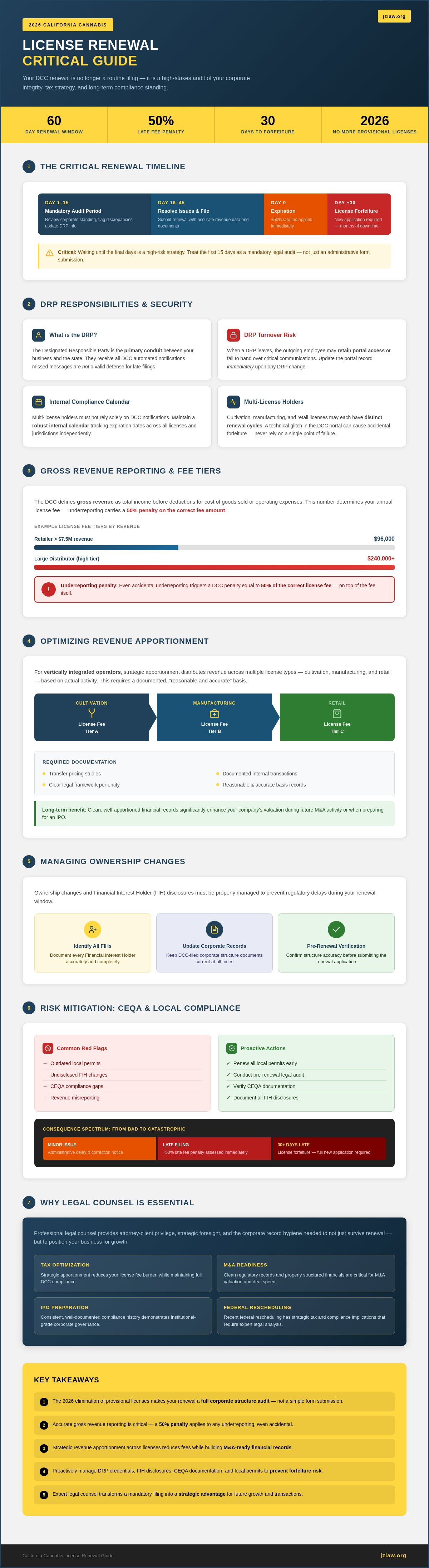
The Department of Cannabis Control (DCC) opens the portal for your california cannabis license renewal exactly 60 days before your current permit expires. While this timeline seems generous, waiting until the final days is a high-risk strategy that often leads to catastrophic administrative delays. The history of cannabis regulation in California demonstrates a clear shift toward increasing complexity; the 2026 landscape is no exception. If you fail to submit by the expiration date, the DCC assesses a 50% late fee penalty immediately. If the renewal remains unfiled 30 days past the deadline, the license is forfeited entirely, requiring a brand new application process that could halt your operations for months.
The Critical 60-Day Countdown
We advise our clients to treat the first 15 days of this window as a mandatory audit period. This isn't just about clicking "renew"; it's about conducting a comprehensive legal review of your current standing. We coordinate with your team to identify "red flag" discrepancies, such as outdated local permits or shifts in financial interest holders, before the DCC automated systems flag them. Early detection allows us to resolve issues through the proper channels without the pressure of a looming expiration date. This proactive stance is the only way to ensure your corporate record remains pristine for future transactions.
DRP Responsibilities and Security
The Designated Responsible Party (DRP) serves as the primary conduit between your business and the state. In the 2026 regulatory environment, the security of the DRP email account is paramount. Missed notifications are not a valid defense for late filings. We've seen businesses face significant turmoil due to DRP turnover where the outgoing employee retains access to the portal or fails to hand over critical communications. Updating the record mid-cycle is essential to maintain your license standing. If your DRP changes, you must update the portal immediately to prevent a communication breakdown that could lead to an accidental license expiration.
While the DCC sends automated notifications, multi-license holders shouldn't rely on these alone. A robust internal compliance calendar is necessary to track various expiration dates across different jurisdictions. Relying solely on the state's portal creates a single point of failure that your corporate structure cannot afford. If you hold cultivation, manufacturing, and retail licenses, each may have a distinct renewal cycle. For cultivators aiming for both regulatory and agricultural success, you can discover GrowQanz and their microbial solutions for soil health. Managing these manually ensures that a technical glitch in the DCC system doesn't lead to an accidental forfeiture. Successful california cannabis license renewal requires a methodical approach that prioritizes precision over speed, ensuring your business maintains its clean regulatory standing for future growth.
Gross Revenue Reporting and Tax Structuring Strategy
Accurate financial disclosure is the most scrutinized component of a successful california cannabis license renewal. The Department of Cannabis Control (DCC) defines gross revenue as the total income received before any deductions for cost of goods sold or operating expenses. This figure determines your annual license fee, which can escalate significantly based on your revenue tier. For instance, a retailer with over $7.5 million in revenue faces a $96,000 fee, while a large distributor might see fees exceeding $240,000. Underreporting this figure, even accidentally, carries a heavy price; the DCC can assess a penalty equal to 50% of the correct license fee.
Optimizing Revenue Apportionment
For vertically integrated operators, the challenge lies in distributing revenue across multiple license types. You shouldn't simply aggregate all income under a single entity without a clear legal framework. Strategic apportionment allows you to reasonably distribute revenue between cultivation, manufacturing, and retail based on the actual activity of each license. This requires a "reasonable and accurate" basis, such as transfer pricing studies or documented internal transactions. Beyond immediate fee savings, this level of precision is vital for your long-term corporate health. Clean, well-apportioned financial records significantly enhance your company's valuation during future M&A or when preparing for an IPO. If your current structure feels fragmented, consulting with an expert in cannabis tax structuring can help align your reporting with your growth objectives.
Audit-Proofing Your Financial Submissions
The DCC frequently cross-references renewal data with state tax returns to ensure consistency. Discrepancies between your reported gross revenue and your filings with the California Department of Tax and Fee Administration (CDTFA) are immediate red flags. We often see accounting pitfalls where businesses fail to reconcile these figures, leading to invasive inquiries or disciplinary actions. Providing documentation beyond a simple profit and loss statement, such as audited financial statements or detailed sales ledgers, demonstrates a commitment to transparency. Professional legal oversight in certifying these submissions adds a layer of protection, ensuring that every figure is defensible under the DCC license renewal process standards. This methodical approach doesn't just satisfy a regulatory requirement; it safeguards your business against the financial and reputational damage of an audit.
Managing Ownership Changes and Corporate Restructuring
Ownership transparency has become a cornerstone of the DCC's enforcement strategy for 2026. During your california cannabis license renewal, the state meticulously audits your cap table to ensure every individual or entity meeting the "Financial Interest Holder" definition is properly disclosed. A frequent strategic error involves waiting for the renewal window to report significant equity shifts. While you can update certain details during the renewal process, major changes in ownership typically require filing Form DCC-LIC-027 within 14 calendar days of the change. Attempting to "catch up" on months of unreported corporate restructuring during renewal can lead to administrative holds that stall your operations indefinitely.
Disclosure Requirements for 2026
The 2026 regulatory environment is notably less forgiving of "silent partners" or undisclosed investors. Any individual holding a 10% or greater interest, or any entity receiving a share of the profits, must be vetted. If your business is navigating M&A activity, these transactions complicate the renewal narrative significantly. You must ensure your operational reality matches your administrative record with surgical precision. This transparency extends to environmental obligations; for instance, if an ownership change coincides with facility expansions, you must verify that your CEQA compliance for cannabis businesses remains valid and updated to reflect the new corporate scale.
Securities Law and Ownership Transparency
For operators with ambitions of taking companies public, ownership disclosure isn't just a regulatory hurdle; it's a fundamental requirement for investor due diligence. Your cap table must serve as a perfect mirror of your regulatory filings. Investors, underwriters, and secondary market regulators will scrutinize any discrepancies between your DCC record and your corporate books. We specialize in managing these high-stakes disclosures, particularly when dealing with complex trust structures or multi-layered holding companies. Ensuring these vehicles are structured to meet both securities law and cannabis regulations is essential for maintaining a clean record.
Shifts in equity can also have immediate financial consequences regarding your social equity status or eligibility for fee deferrals. A minor change in the percentage of ownership held by a qualified equity applicant can result in the sudden loss of significant fee waivers. We recommend a comprehensive cap table audit at least 90 days before your california cannabis license renewal date. This proactive review allows us to identify and disclose any interest holders that might otherwise trigger a "red flag" during the DCC's automated audit. By maintaining a transparent and current record, you protect your business from the reputational and financial risks associated with undisclosed ownership.
Mitigating Risk: Penalties, CEQA, and Local Compliance
The transition from provisional to annual licensing has fundamentally altered the risk profile of a california cannabis license renewal. In previous years, the state allowed for a degree of administrative flexibility; however, the 2026 regulatory climate is defined by strict adherence to deadlines and environmental mandates. Beyond the immediate financial sting of penalties, a botched renewal creates a "regulatory stain" that can complicate future license expansions or trigger increased scrutiny from the Department of Cannabis Control (DCC). Protecting your business requires a holistic view that aligns your state standing with local authorizations and environmental certifications.
The 50% Late Fee Trap
Financial penalties for late filings are calculated with clinical precision. If your renewal application is submitted even one day after the expiration date, the DCC assesses a penalty equal to 50% of the correct licensing fee. For a high-revenue distributor or a large-scale cultivator, this can represent a loss of tens of thousands of dollars in non-deductible expenses. We've seen businesses attempt to argue "good faith" efforts or technical glitches, but in 2026, the DCC has largely eliminated these defenses. Accurate gross revenue reporting is equally critical; if an audit discovers under-reported income, the 50% penalty is applied to the difference in the fee tiers. Appealing these administrative errors requires a rigorous legal strategy that identifies procedural failures on the part of the regulator.
Environmental and Local Mandates
Your state license rests on the foundation of local compliance. If your city or county permit lapses, your state renewal is effectively void. This jurisdictional alignment is where many operators stumble, particularly when local ordinances change mid-cycle. Furthermore, annual licenses in 2026 require absolute CEQA compliance for cannabis businesses. This environmental certification isn't a "one and done" filing. Any modifications to your facility or operational footprint since your last renewal must be reflected in your CEQA documentation. This intersection of land use and licensing is where our expertise in real estate law becomes a strategic asset, ensuring your property rights and permits are fully synchronized.
For operators facing external challenges, the 2026 criteria for disaster relief and social equity fee waivers provide a necessary but complex safety net. Eligibility for these programs is strictly vetted during the california cannabis license renewal process. You must provide documented proof of impact or maintain specific ownership percentages to retain fee relief. We help our clients navigate these requirements to ensure they don't lose vital financial support due to a paperwork technicality. Don't leave your operational future to chance; secure your regulatory standing by engaging with our cannabis licensing specialists before your renewal window closes. A proactive audit today prevents the reputational and financial contagion of a failed renewal tomorrow.
Why JZ Law is Your Strategic Partner for Cannabis Compliance
In the high-stakes environment of a california cannabis license renewal, the distinction between a general consultant and professional legal counsel is fundamental. This level of expertise is built on the rigorous training standards of the California legal system, which Jackson-Wagner LLC helps legal professionals master to ensure they can navigate such complex regulatory landscapes. While consultants often provide a "check-the-box" service, JZ Law offers the protection of attorney-client privilege. This shield is vital when identifying and rectifying sensitive discrepancies in gross revenue reporting or ownership structures. If a regulatory inquiry arises, your communications with a consultant are discoverable; your communications with us are protected. We provide that shield. We don't just manage forms; we integrate your cannabis licensing requirements into a comprehensive corporate growth strategy that prioritizes your business's long-term health and valuation.
Our expertise extends beyond the borders of California. We navigate multi-jurisdictional compliance across Colorado, Alberta, and Ontario, providing our clients with a sophisticated, global perspective on regulatory trends. This breadth of experience allows us to anticipate shifts in the 2026 landscape before they impact your operations. We understand that a successful california cannabis license renewal is merely one component of a larger business lifecycle. By maintaining a clean, defensible regulatory record today, you're securing the foundation for your next stage of growth, whether that involves scaling operations or preparing for an exit.
Strategic Regulatory Oversight
John Zang's deep background in securities regulation provides our clients with an advantage that general compliance firms cannot replicate. We view every regulatory filing through the lens of future investor due diligence. For founders, this means ensuring that your cap table, tax positioning, and operational permits are perfectly aligned with the standards required for a public listing. We provide tailored solutions for the most complex challenges of 2026, from navigating the intersection of state and federal rescheduling to managing intricate holding company disclosures. This level of strategic oversight ensures that your compliance efforts are an investment in your company's future rather than a mere administrative expense.
Next Steps: Securing Your Business Future
The most effective way to mitigate risk is through a pre-renewal legal audit. We identify hidden liabilities in your current records, from lapsed local authorizations to inconsistencies in revenue apportionment, well before the 60-day DCC window opens. This proactive approach allows us to resolve issues quietly and methodically. We invite you to contact JZ Law for a comprehensive compliance and tax structuring review to ensure your entity is fully prepared for future corporate transactions. By engaging with a strategic partner who understands the nuances of the law and the dynamics of the market, you can navigate the renewal process with confidence and focus on your core business objectives.
Securing Your Operational Legacy in 2026
Mastering the california cannabis license renewal process requires more than just meeting a deadline; it demands a comprehensive audit of your corporate structure and financial reporting. By prioritizing early filing and precise revenue apportionment, you protect your business from aggressive 50% penalty tiers while positioning your entity for future M&A or public market entry. Ownership transparency and CEQA alignment are no longer optional administrative tasks; they're the pillars of a defensible, scalable operation that withstands rigorous regulatory scrutiny.
JZ Law brings a unique blend of regulatory depth and business foresight to your compliance strategy. Principal lawyer John Zang leverages extensive experience in complex corporate frameworks to safeguard founders' interests across global hubs, including Denver and Vancouver. It's time to move beyond reactive filings and embrace a proactive regulatory stance that protects your long-term valuation. We invite you to Schedule a Strategic Compliance Consultation with JZ Law to transform your regulatory obligations into a competitive advantage. With the right legal partner, you'll navigate the complexities of 2026 with absolute certainty and focus on the continued growth of your enterprise.
Frequently Asked Questions
When exactly does the California cannabis license renewal window open in 2026?
The Department of Cannabis Control opens the renewal window exactly 60 days before your current license is set to expire. You'll receive a notification through the DCC portal, but we advise operators to maintain an independent compliance calendar to ensure they don't miss this critical period. Initiating the process during the first 15 days allows sufficient time to resolve any unforeseen administrative or financial discrepancies.
What happens if I miss my license renewal deadline by one day?
Missing your expiration date by even a single day results in an immediate 50% late fee penalty calculated against your total licensing fee. If the renewal isn't submitted within 30 days of the expiration date, the license is forfeited entirely. At that point, you're required to cease all commercial activity and begin the application process from the beginning, which can lead to months of operational downtime.
Can I change my license type during renewal?
You can request a change in license designation, such as moving from medicinal to adult-use, during the renewal process if your local jurisdiction permits the new activity. This change requires you to upload updated local authorization documents that reflect the new license type. It's essential that your state and local permits remain perfectly synchronized to avoid a summary denial of your request.
What documents are required to prove gross revenue for a 2026 renewal?
You must provide detailed financial records that support your reported gross revenue, including Profit and Loss statements, sales ledgers, and state tax returns. The DCC utilizes these documents to place your business in the correct fee tier. For complex california cannabis license renewal filings, we recommend including audited financials to provide a transparent and defensible record of your income.
How do I report a change in ownership that occurred during the licensing year?
Ownership changes should ideally be reported within 14 calendar days of the event using Form DCC-LIC-027. If you didn't report a shift in equity mid-year, you must disclose the new Financial Interest Holders during the renewal window. Failing to align your current cap table with your DCC record can trigger an audit or result in a disciplinary hold on your renewal application.
Is CEQA review required every year for license renewal?
Annual licenses require you to certify that your environmental compliance remains current each year. While a full new study isn't always necessary, you must provide an updated CEQA certification or a new review if your facility's operational footprint or environmental impact has changed. Maintaining these records is a fundamental requirement for a successful california cannabis license renewal in the 2026 regulatory environment.
Are there fee waivers available for social equity applicants in 2026?
Fee waivers and deferrals are available for qualified social equity applicants who meet the state's specific ownership and income criteria. You must apply for these waivers during the renewal process and provide documented evidence that you still maintain the required equity ownership percentage. These programs are strictly vetted to ensure that the financial benefits only reach eligible operators.
What is the penalty for under-reporting gross revenue to the DCC?
The DCC assesses a penalty equal to 50% of the correct licensing fee if it's determined that you under-reported your gross revenue. This penalty is applied to the difference between the fee you paid and the fee required by your actual revenue tier. Ensuring your financial reporting is accurate and consistent with your tax filings is the only way to avoid these significant administrative fines.


Comments