


Cannabis farm-gate sales in Ontario: legal steps to open a storefront
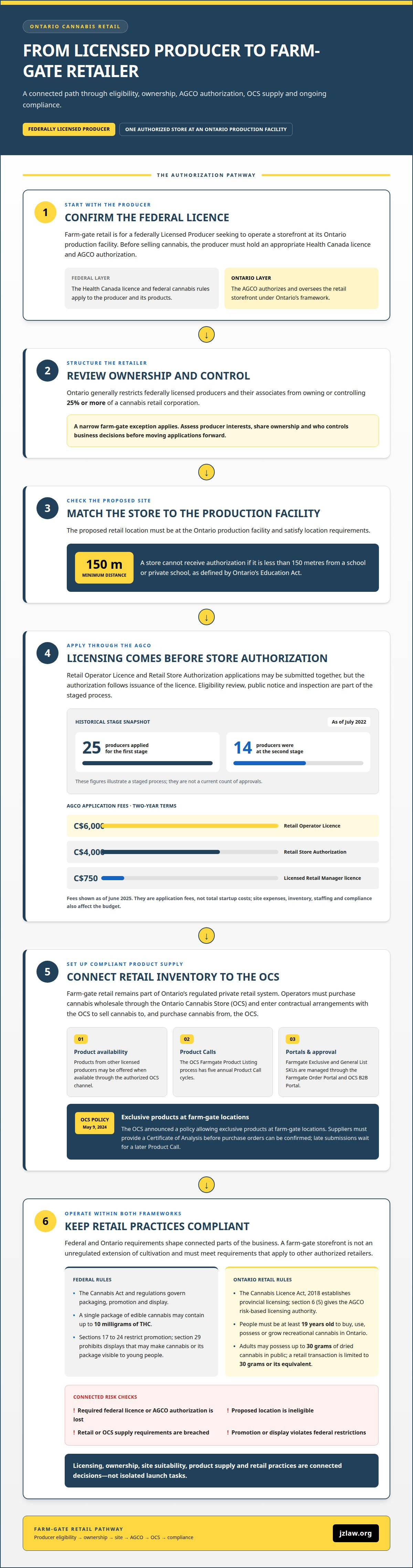
A farm-gate storefront is not a shortcut around Ontario’s cannabis retail rules: a federally Licensed Producer may apply to the AGCO to operate one authorized retail store at an Ontario production facility. Legal advice for cannabis farm-gate sales in Ontario can help clarify how federal licensing, provincial authorization and the producer’s business structure fit together before the project moves forward.
Selling cannabis at the production site can be appealing, but the storefront must meet the requirements that apply to other authorized Ontario retailers, including purchasing wholesale through the OCS. Understanding the regulatory steps early can help you assess eligibility, prepare for the application process and spot issues affecting the proposed location or ownership structure.
This article explains what farm-gate retail means, the steps to become a retailer, and how Ontario and federal rules shape the process. It also explains when legal counsel can help you address regulatory complexity and make informed decisions as requirements evolve.
Table of Contents
Farmgate retailers as cannabis producers with retail storefronts at production facilities
Ontario’s farm-gate model places a producer’s retail storefront at its production facility. A federally Licensed Producer may apply to the Alcohol and Gaming Commission of Ontario (AGCO) to operate one authorized retail store at an Ontario production facility. Before selling cannabis, the producer must hold an appropriate Health Canada licence and AGCO authorization. The storefront is part of Ontario’s regulated private recreational retail system, not an unregulated extension of cultivation.
Federal and provincial rules apply together. The federal Cannabis Act and its regulations govern cannabis, while Ontario’s Cannabis Licence Act and AGCO requirements govern retail licensing and oversight. Farm-gate operators must meet the same requirements as other authorized retailers, including purchasing cannabis wholesale through the Ontario Cannabis Store (OCS). They must also enter into contractual arrangements with the OCS to sell cannabis to, and purchase cannabis from, the OCS.
Farm-gate sales are subject to restrictions on how cannabis may be supplied. Ontario retailers may sell cannabis to another Retail Store Authorization holder under the rules for sales between authorization holders. That limited route does not replace the OCS wholesale requirement for farm-gate retail. Location also matters: a proposed store cannot receive authorization if it is less than 150 metres from a school or private school, as defined by Ontario’s Education Act.
Products remain subject to federal packaging and promotion controls. For example, a single package of edible cannabis may contain up to 10 milligrams of THC; sections 17 to 24 of the Cannabis Act restrict cannabis promotion, and section 29 prohibits displays that may make cannabis or its package visible to young people.
Key legal and business risks include losing the required federal licence or AGCO authorization, selecting an ineligible location, and breaching retail or OCS supply requirements. Promotion or display that violates federal restrictions can create a separate compliance issue. Licensing, site suitability, product supply and retail practices are therefore connected decisions, not isolated launch tasks.
What are the stages of becoming a cannabis farmgate retailer?
The process connects producer eligibility, ownership review, AGCO applications and OCS product supply. Each stage affects whether the proposed storefront can operate as authorized retail.
Producer Ownership and the Farmgate Exception
Ontario generally restricts federally licensed producers and their associates from owning or controlling 25% or more of a cannabis retail corporation, subject to a narrow farmgate exception. This ownership rule matters when structuring the retailer and deciding who will hold shares or control business decisions. A proposed farmgate arrangement should be assessed against both producer interests and the corporation’s ownership before applications move forward.
Farmgate Locations and Applications
A farmgate location pairs a producer’s production facility with its proposed retail store. As of July 2022, 25 producers had applied for the first licensing stage, while 14 were at the second stage. Those figures illustrate a staged process, not a current count of approvals. Location, eligibility review, public notice and inspection all affect the path to authorization.
Retail Operator Licence and Retail Store Authorization applications may be submitted together, but the authorization follows issuance of the licence. As of June 2025, the two-year Retail Operator Licence fee was C$6,000, and the two-year Retail Store Authorization fee was C$4,000. A Licensed Retail Manager licence fee was C$750 for a two-year term. These are application fees, not total startup costs; site expenses, inventory, staffing and compliance also affect the budget. Taxes and operating costs affect margins, so there is no single typical margin for every store.
Farm-gate retail differs from supplying the OCS: the producer operates a storefront, while wholesale purchasing and retail supply remain connected to the OCS. A farm-gate store can offer products from other licensed producers when those products are available through the authorized OCS channel. The OCS Farmgate Product Listing process has five annual Product Call cycles. Its Farmgate Exclusive and General List SKUs are managed through the Farmgate Order Portal and OCS B2B Portal. On May 9, 2024, the OCS announced a policy allowing exclusive products at farm-gate locations. Suppliers must provide a Certificate of Analysis before purchase orders can be confirmed; late submissions wait for a later Product Call.
Ontario and federal cannabis legislation
Farm-gate operators in Canada must account for federal cannabis rules and Ontario’s retail framework. The Cannabis Act and its regulations govern areas such as promotion, packaging and display. Ontario’s Cannabis Licence Act, 2018 establishes provincial licensing, with section 6 (5) giving the AGCO authority to use risk-based licensing. The two levels of government regulate connected parts of the same business.
Ontario’s rules also shape who may buy and how a retail transaction proceeds. A person must be at least 19 years old to buy, use, possess or grow recreational cannabis in Ontario. Adults may possess up to 30 grams of dried cannabis in public, and a retail transaction is limited to 30 grams or its equivalent. These limits affect sales procedures and how staff handle transactions.
Promotion and display require separate attention. Sections 17 to 24 of the federal Cannabis Act restrict promotion; subsection 24(1) prohibits inducements unless authorized under the Act. Section 29 addresses displaying cannabis, its package or label where young people may see it. The Cannabis Regulations also address promotions involving alcohol, tobacco and vaping products under sections 104.15 and 104.16. A retail store’s signage or marketing therefore needs review against more than one federal provision.
Ontario’s local rules can affect the proposed location. Municipalities had a one-time opportunity to opt out of permitting cannabis retail, so local eligibility can shape whether a retail store authorization is possible. Owners should also account for location restrictions, including the 150-metre school separation rule discussed for proposed stores. For personal cultivation, Ontario adults may grow up to four plants per residence, subject to stated conditions, including lease restrictions. These provisions concern personal use, not commercial production, which requires its own federal licensing framework.
For farm-gate businesses, the practical challenge is aligning licensing, store operations and marketing with both federal and provincial rules. A change to ownership, location or promotional materials can engage different requirements, so a regulatory review before acting can help identify issues early.
Seeking legal counsel on evolving cannabis regulations
Legal advice for cannabis farm-gate sales in Ontario can help connect federal licensing, provincial authorization and the commercial structure of a proposed operation. A Licensed Producer’s Health Canada licence, ownership arrangements, retail premises and Ontario Cannabis Store supply relationship may raise related legal questions. Reviewing them together helps identify how a decision in one area could affect the others.
Timing matters when an application reaches public notice or a regulatory issue requires a response. For a Retail Store Authorization, Ontario provides 15 days for public submissions, followed by five calendar days for the business to respond to the Registrar. Counsel can help organize the response around the application record and address the issues raised, such as concerns about the location or proposed retail operation.
Regulatory review also reaches operational details. Ontario retailers must retain video surveillance recordings for at least 30 days and make them available to the AGCO upon request. Employees must complete required training within 60 days of its approval and availability. These obligations affect recordkeeping and staff planning, so they belong in an operating program as well as the opening plan.
Rules can change the premises or marketing analysis. Effective May 23, 2025, the AGCO removed the requirement for cannabis stores to cover their stores to prevent cannabis or accessories from being visible outside. That change does not displace federal promotion restrictions. Counsel can distinguish which rule governs a proposed sign, display, store procedure or ownership change, then identify the action needed to align operations.
Legal advice for cannabis farm-gate sales in Ontario is particularly relevant before committing to a location, finalizing corporate arrangements or submitting an application. It can also help a regulated business assess how a new requirement affects its existing program or respond to an AGCO concern. To discuss the regulatory issues affecting your proposed operation, arrange a legal discussion.
JZ Law: Cannabis Licensing
JZ Law provides cannabis licensing advice to businesses assessing an Ontario farm-gate storefront. Legal support can connect the producer’s federal licence, provincial retail authorization, ownership structure and supply arrangements in a coordinated regulatory plan. This is especially useful before submitting applications, committing to a production-site location or changing the corporation’s ownership.
If a cannabis business is also considering a transaction or capital markets strategy, taking companies public and securities regulation may be relevant to those separate corporate decisions. The right legal focus depends on the issue, whether licensing readiness, a proposed ownership change or a broader corporate plan.
Set your farm-gate plan on a sound footing
Before turning a production-site retail concept into a committed business plan, clarify who will make key decisions, how the storefront fits the producer’s wider operations, and which regulatory assumptions underpin the investment. These questions can shape the project well before an application is filed. Addressing them early keeps legal analysis connected to commercial priorities instead of treating compliance as a final review.
Specialized legal advice for cannabis farm-gate sales in Ontario can help assess the proposed structure and identify issues to address before the business commits resources. JZ Law’s cannabis licensing work can support this planning, alongside relevant corporate advice as the venture develops.
For a considered discussion of your proposed next step, contact JZ Law for cannabis counsel. A clear plan can help you move forward with greater purpose.
Frequently Asked Questions
Who Can Participate in Farmgate?
A federally Licensed Producer can seek authorization to operate a farm-gate storefront at its Ontario production facility. The model connects cannabis production with retail; it does not let a stand-alone retailer label an unrelated shop as farm-gate. The producer’s federal licence, proposed location, corporate structure and provincial retail approvals all matter. Associates and ownership interests may also affect eligibility under Ontario’s producer ownership rules.
What does cannabis farm-gate sales mean under Ontario law?
Ontario farm-gate sales means a cannabis producer operates a retail storefront at its production facility, subject to retail licensing and authorization. The producer sells through a regulated cannabis store, not under an exemption from ordinary retail controls. Wholesale supply remains connected to the Ontario Cannabis Store, while the farm-gate feature links the storefront to the producer’s production site. It is distinct from direct, unregulated sales by a cultivator.
Which Ontario cannabis producers are eligible for farm-gate sales?
Eligibility centres on a federally Licensed Producer with an appropriate Health Canada licence and an Ontario production facility. The producer must also meet AGCO requirements for retail authorization. Ownership needs careful review: federally licensed producers and their associates generally face restrictions on owning or controlling an Ontario cannabis retail corporation, subject to a narrow farm-gate exception. The producer’s corporate relationships can therefore affect whether the proposed structure qualifies.
What licences and approvals are required for an Ontario cannabis farm-gate store?
The producer needs an appropriate Health Canada licence for its production activity, plus Ontario retail authorization through the AGCO. The retail application process involves a Retail Operator Licence and a Retail Store Authorization. Both applications may be submitted together, but the store authorization is granted only after the operator licence is issued. A licensed retail manager licence may also be required, depending on the operator’s structure and responsibilities.
What rules apply to the location, access, and layout of an Ontario farm-gate store?
The proposed storefront must be at the producer’s Ontario production facility and meet AGCO retail requirements. A location less than 150 metres from a school or private school, as defined by Ontario’s Education Act, cannot receive authorization. Municipal opt-out decisions can also affect whether retail is permitted locally. The cannabis retail store must operate as the only business at its location, so shared premises are not permitted.
What steps and timelines are involved in applying to open an Ontario farm-gate store?
Plan for several months between application and opening because eligibility review, public notice and inspection take time. The Retail Operator Licence and Retail Store Authorization applications can be filed together, although the authorization follows the licence. For the store authorization, Ontario provides 15 days for public submissions; afterward, the applicant has five calendar days to respond to the Registrar. Site readiness and application completeness also shape the schedule.


Comments