


Corporate Governance for Public Companies in Canada: 2026 Strategic Guide
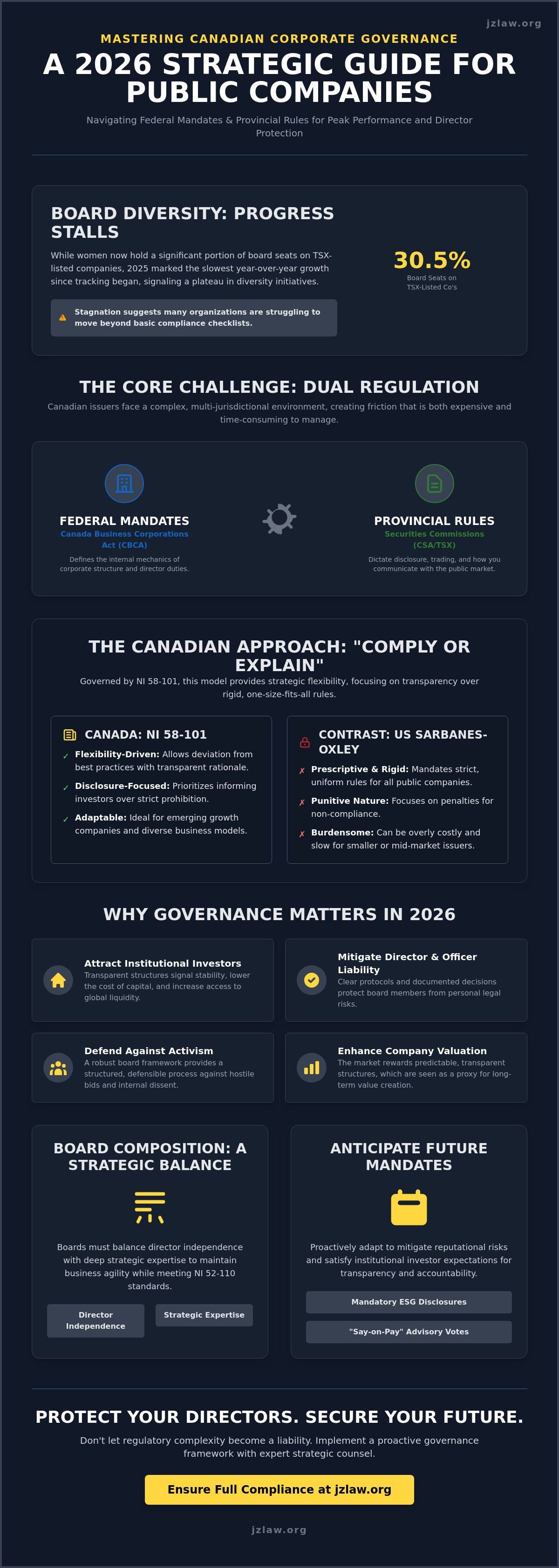
While women now hold 30.5% of board seats on TSX-listed companies, 2025 saw the slowest year-over-year growth since tracking began. This stagnation suggests that many organizations are struggling to move beyond basic checklists. Mastering corporate governance for public companies canada in 2026 requires more than just meeting the minimum; it demands a strategic alignment between federal mandates and provincial securities regulations.
You've likely found that the overlap between the Canada Business Corporations Act and provincial rules creates a friction that's both expensive and time-consuming to manage. It's frustrating to keep pace with new supply chain reporting deadlines or the threat of private litigation under updated greenwashing provisions. This article provides the clarity you need to ensure full compliance with CSA and TSX rules while protecting your directors from personal liability. We'll explore the current pause on expanded diversity rules, the reality of comply or explain mandates, and how to position your governance framework as a tool to attract sophisticated institutional investors.
Key Takeaways
Navigate the multi-jurisdictional Canadian regulatory environment by aligning federal CBCA mandates with provincial securities requirements.
Master the nuances of corporate governance for public companies canada to leverage the "comply or explain" model as a strategic tool for investor transparency.
Balance director independence with strategic expertise to ensure your board meets NI 52-110 standards while maintaining high-level business agility.
Anticipate the transition toward mandatory ESG disclosures and "Say-on-Pay" advisory votes to mitigate reputational risks and satisfy institutional investor expectations.
Implement a proactive governance framework that protects directors from personal liability during complex corporate transactions and securities regulation shifts.
Table of Contents
The Evolution of Corporate Governance for Public Companies in Canada
The regulatory landscape for corporate governance for public companies canada is defined by a unique dual-layered system that balances federal oversight with provincial authority. Unlike more centralized jurisdictions, Canadian issuers must harmonize the requirements of the Canada Business Corporations Act (CBCA) with the specific rules set by provincial securities commissions. This structure is foundational to Canadian corporate law, where the primary objective has shifted from narrow shareholder primacy toward a broader model of stakeholder capitalism. In 2026, the focus is on long-term value creation, requiring directors to consider the interests of employees, creditors, and the environment as part of their fiduciary duties. The Canadian Securities Administrators (CSA) and the Toronto Stock Exchange (TSX) act as the primary gatekeepers. They ensure that market integrity remains high while providing the flexibility necessary for diverse business models, from junior miners to tech giants, to thrive in a competitive global market.
Why Governance Matters in the 2026 Canadian Market
Effective governance isn't merely a defensive measure; it's a critical driver of a company's valuation and market perception. Institutional investors in 2026 prioritize issuers with transparent, predictable structures, as these organizations often enjoy a lower cost of capital and greater access to global liquidity. A robust board oversight framework serves as the first line of defense against shareholder activism and hostile takeovers, providing a structured, defensible process for evaluating unsolicited bids or internal dissent. Mastering the nuances of corporate governance for public companies canada is also essential for mitigating director and officer (D&O) liability. By establishing clear protocols and meticulously documented decision-making processes, boards can protect themselves from the personal legal risks that accompany high-stakes corporate transactions and evolving regulatory scrutiny.
The Comply or Explain Framework
The hallmark of the Canadian approach is the "comply or explain" model, primarily governed by National Instrument 58-101. This framework requires companies to disclose their specific corporate governance practices but allows them to deviate from established best practices if they provide a logical, transparent rationale for doing so. This flexibility is particularly advantageous for mid-market and emerging growth companies that may find rigid, one-size-fits-all mandates overly burdensome or detrimental to their entrepreneurial speed. It stands in stark contrast to the prescriptive, often punitive nature of international standards like the American Sarbanes-Oxley Act. By focusing on disclosure rather than strict prohibition, Canada encourages a culture of transparency that respects the unique strategic needs of each issuer while maintaining high standards of accountability.
Core Regulatory Pillars: NI 58-101 and the CBCA
The regulatory architecture supporting corporate governance for public companies canada rests upon two distinct but interlocking foundations: National Instrument 58-101 and the Canada Business Corporations Act. While NI 58-101 dictates how you communicate your governance structure to the public, the CBCA often defines the internal mechanics of your board's composition. For issuers in emerging sectors like cannabis or cryptocurrency, these rules aren't just administrative hurdles. They're strategic guardrails that determine your ability to access capital. If you're currently taking companies public, understanding the interplay between these pillars is the difference between a successful listing and a costly regulatory delay.
National Instrument 58-101 Disclosure Rules
NI 58-101 requires a level of transparency that goes beyond simple financial reporting. You must provide a comprehensive board mandate and clear position descriptions for the chair and CEO. This information is typically delivered through the annual management information circular. For venture issuers in 2026, the filing deadline for annual financial statements remains 120 days after year-end, but the governance disclosure within the circular must be meticulously timed to align with your Annual General Meeting. This process ensures that shareholders have the necessary data to make informed voting decisions, particularly as activism becomes more sophisticated. If you're navigating these requirements, seeking securities regulation counsel can help streamline your compliance efforts.
CBCA Compliance and Federal Mandates
For federally incorporated companies, the CBCA introduces specific mandates that provincial laws may not. One critical requirement is director residency; at least 25% of your board must be resident Canadians. This can be a significant hurdle for international firms looking to list in Canada. Additionally, the CBCA requires disclosure regarding the representation of designated groups, including Indigenous peoples, persons with disabilities, and members of visible minorities, on a comply or explain basis. You can find detailed guidance on these requirements through official Canada Business Corporations Act resources. When combined with the audit committee requirements of NI 52-110, which demand varying levels of independence depending on whether you're listed on the TSX or TSX Venture, the complexity becomes clear. Proactive planning is essential to ensure your board meets these standards without sacrificing strategic speed.
Board Composition: Balancing Independence and Strategic Expertise
A persistent misconception suggests that rigorous independence requirements act as a brake on a company’s strategic momentum. Critics often argue that an independent board lacks the deep operational intimacy required to make rapid decisions in volatile markets. However, the modern reality of corporate governance for public companies canada suggests the opposite. True independence provides the objective distance necessary to evaluate high-stakes risks without the cloud of internal bias. Under National Instrument 52-110, an independent director is defined as someone who has no direct or indirect material relationship with the issuer that could interfere with their exercise of independent judgment. In 2026, the most resilient boards don't just aim for a simple majority of independent members; they strive for a composition where independent voices represent at least two-thirds of the table. This ratio ensures that the board remains a credible supervisor while maintaining enough internal expertise to drive growth.
To achieve this balance, sophisticated issuers now rely on a dynamic skills matrix during the recruitment process. This tool moves beyond basic biographical data to map specific competencies against the company's long-term strategic goals. It allows boards to identify gaps in areas like cybersecurity, international trade, or specific regulatory knowledge before they become liabilities. By treating board composition as a strategic asset rather than a compliance checklist, companies can build a leadership team that is both compliant and competitively formidable.
The Role of Independent Directors
Independent directors serve as the primary safeguards against conflicts of interest, particularly during complex corporate transactions where the interests of management and shareholders might naturally diverge. They're essential for leading audit, compensation, and nomination committees, where impartiality is a regulatory mandate rather than a suggestion. When a board operates with a dual CEO and Chair role, appointing a lead independent director becomes a critical step in maintaining structural balance. This individual coordinates the independent members and ensures that the board’s oversight function remains robust and untainted by executive influence.
Specialized Expertise in Emerging Sectors
Generic governance expertise is no longer sufficient for companies operating in high-regulation environments. For fintech firms, having a director with deep knowledge of cryptocurrency law is now a fundamental board-level requirement to navigate shifting global compliance standards. Similarly, issuers in the energy sector must account for the specific nuances of oil and gas law, especially when managing assets across jurisdictions like Calgary and Denver. Even in the consumer goods space, a board that understands the complexities of the cannabis licensing landscape is better positioned to anticipate regulatory shifts before they impact the bottom line. This specialized knowledge allows the board to provide proactive guidance rather than reactive damage control.
Continuous Disclosure and 2026 ESG Reporting Mandates
The transition from discretionary disclosure to mandatory reporting frameworks has fundamentally altered the responsibilities of the board. In 2026, corporate governance for public companies canada is no longer just about financial audit trails; it's about validating the non-financial metrics that institutional investors use to price risk. This shift requires a proactive integration of Environmental, Social, and Governance (ESG) factors into core disclosure documents. Boards must ensure every environmental claim is backed by verifiable data to avoid the heightened "greenwashing" penalties under the Competition Act, which now include a private right of action for misleading claims. If your organization requires assistance aligning these new mandates with your existing compliance framework, the securities regulation expertise at JZ Law provides the strategic depth needed to navigate these shifts.
The New Standard for ESG Disclosure
While the Canadian Securities Administrators (CSA) paused work on certain expanded climate rules in April 2025, issuers still face rigorous requirements under the Fighting Against Forced Labour and Child Labour in Supply Chains Act. This legislation requires annual reports by May 31, detailing the steps taken to prevent forced or child labour within your supply chain. Social governance has also expanded to include deeper Indigenous engagement and reconciliation efforts. Boards should now integrate these specific responsibilities directly into their formal Board Mandate to demonstrate a commitment to stakeholder capitalism and long-term value creation.
Cybersecurity and Digital Governance
Digital governance in 2026 demands more than just a functional IT department; it requires board-level oversight of AI implementation and data privacy. Public companies must report material cybersecurity breaches to regulators with increased speed and precision. For issuers utilizing blockchain or holding digital assets, disclosure requirements have become more granular to protect against market volatility. Directors are now expected to oversee the ethical implications of AI and the security protocols of decentralized technologies. This ensures that the company's digital transformation doesn't outpace its risk management capabilities.
Executive compensation also remains under the microscope. Although specific "Say-on-Pay" regulations under Bill C-97 are still awaiting finalization of accompanying rules, many TSX-listed companies have adopted advisory votes as a best practice to satisfy institutional shareholders. Transparency regarding incentive-based compensation clawbacks and the well-being of employees is no longer a secondary concern. It's a central component of a modern governance strategy that builds trust and mitigates the risk of shareholder activism during the annual meeting season.
Strategic Counsel: How JZ Law Navigates Public Governance
Effective corporate governance for public companies canada requires a delicate balance between strict adherence to statutory requirements and the flexibility needed to execute a high-level business strategy. Many large firms treat compliance as a rigid, one-size-fits-all exercise that can stifle innovation and slow down decision-making. JZ Law positions itself as a strategic partner that bridges the gap between regulatory rigidity and business agility. By understanding the commercial objectives behind every board decision, the firm ensures that governance structures support growth rather than hindering it. This approach transforms compliance from a mandatory burden into a competitive advantage that builds long-term investor confidence.
The boutique nature of the firm provides a distinct advantage: direct access to the specialized expertise of John Zang. Unlike larger organizations where files are often delegated to junior associates, clients at JZ Law benefit from senior-level counsel on every aspect of their governance framework. This direct engagement is particularly vital during complex corporate transactions or when navigating the volatile regulatory shifts expected throughout 2026. Having a seasoned expert who understands the nuances of both Canadian and international markets allows boards to move forward with the certainty that their legal foundations are secure.
Tailored Governance Frameworks
JZ Law specializes in customizing board charters, committee mandates, and internal policies to fit the specific size, industry, and risk profile of each issuer. Whether your company is operating in the highly regulated cannabis sector or navigating the complexities of cryptocurrency law, a generic template is insufficient. The firm provides ongoing support for continuous disclosure and regulatory filings, ensuring that every management information circular and annual report meets the highest standards of transparency. This tailored approach extends to strategic advice on tax structuring within public transactions, ensuring that governance and fiscal efficiency work in tandem to protect shareholder value.
Proactive Risk Management
The most effective way to manage regulatory risk is to identify and resolve potential issues before they attract the attention of securities commissions. JZ Law conducts comprehensive "mock audits" to identify compliance gaps, offering boards a proactive look at their reporting and oversight protocols. This preventative approach includes detailed advice on director indemnification and insurance protections, which are essential for attracting and retaining high-caliber board members in a litigious environment. JZ Law focuses on strategic transactions and professional legal services in Canada and the US.
As the Canadian market continues to evolve in 2026, robust governance will remain the bedrock of corporate success. It's the foundation upon which the next phase of growth is built, providing the structural integrity needed to navigate economic shifts and technological disruptions. By partnering with counsel that prioritizes both legal precision and strategic insight, public companies can ensure they don't just meet the standards of the day but are prepared for the challenges of tomorrow.
Securing the Future of Your Canadian Public Enterprise
The regulatory landscape of 2026 demands a shift from reactive compliance to strategic foresight. Boards must now navigate the intersection of mandatory ESG reporting and complex federal mandates while maintaining the agility required to lead in high-growth sectors. Mastering corporate governance for public companies canada isn't just about avoiding administrative penalties; it's about building a robust framework that attracts institutional capital and protects leadership from personal liability. Whether your organization operates within the intricate cryptocurrency law sector, the evolving cannabis licensing landscape, or the global energy hubs of oil and gas law, your governance must reflect the specific risks and opportunities of your industry.
JZ Law serves as the essential bridge between rigid regulations and your commercial ambitions. Led by principal lawyer John Zang, the firm offers a sophisticated approach to securities regulation that prioritizes both legal precision and business momentum. By conducting proactive audits and tailoring board mandates to your unique operational profile, we ensure your governance becomes a foundation for growth. Consult with JZ Law for Strategic Public Company Counsel and position your board for success in an increasingly complex market. Your commitment to high standards today will define your organization's resilience tomorrow.
Frequently Asked Questions
What are the mandatory board committees for public companies in Canada?
Under National Instrument 52-110, every public company must establish an audit committee to oversee financial reporting and internal controls. While the TSX requires this committee to be composed entirely of independent directors, the TSX Venture Exchange allows for certain exemptions based on the company's size. Other committees, such as those for compensation and nominating, aren't strictly mandatory by law, but companies must explain their absence under the "comply or explain" model to satisfy exchange requirements.
How does the CBCA diversity disclosure requirement affect my board recruitment?
The CBCA requires federally incorporated public companies to disclose their policies regarding the representation of designated groups, including Indigenous peoples, persons with disabilities, and members of visible minorities. To maintain high standards of corporate governance for public companies canada, boards should use a formal skills matrix to identify diverse candidates who bring both strategic expertise and representative perspectives. This proactive approach helps boards avoid the need to explain a lack of diversity to increasingly vocal institutional investors.
What is the difference between governance requirements on the TSX vs. the TSX Venture?
The primary difference lies in the level of prescriptive detail and the exemptions available for smaller issuers. TSX issuers face more rigorous independence and disclosure requirements, including mandatory majority independence for the board. In contrast, TSX Venture issuers benefit from reduced reporting burdens under NI 52-110, which allows emerging companies to scale their governance practices as they grow. This tiered system ensures that the cost of compliance doesn't hinder the development of mid-market firms.
Can a public company in Canada have a majority of non-independent directors?
Yes, a public company can technically operate with a majority of non-independent directors, especially if it's listed on the TSX Venture Exchange. However, the company must provide a detailed rationale for this board structure in its annual management information circular. In 2026, most institutional investors view a lack of independence as a significant risk factor, so companies often appoint a lead independent director to balance the influence of non-independent members.
What are the 2026 deadlines for filing an annual management information circular?
For 2026, the management information circular must generally be filed and sent to shareholders at least 21 days before the Annual General Meeting. If the company is incorporated under the CBCA, the circular must also be filed with Corporations Canada. It's vital to coordinate these dates with your financial statement filings, which are due 90 days after year-end for TSX issuers and 120 days for venture issuers, to ensure continuous disclosure remains uninterrupted.
How should public companies disclose cybersecurity risks in their AIF?
Public companies should disclose cybersecurity risks in their Annual Information Form (AIF) by focusing on specific, material vulnerabilities rather than generic boilerplate warnings. You need to detail the board’s role in overseeing digital threats and the potential financial or operational impact of a potential breach. This level of transparency is essential for maintaining investor trust, particularly as regulators increase their scrutiny of how companies manage data privacy and AI implementation.
Is "Say-on-Pay" mandatory for all public companies in Canada in 2026?
In 2026, "Say-on-Pay" advisory votes are not yet a universal legal requirement for all Canadian issuers. While amendments to the CBCA under Bill C-97 have been passed, the final regulations governing these votes were still pending as of May 2026. Despite this, many TSX-listed firms have adopted these votes voluntarily. They do this to align with the expectations of sophisticated institutional shareholders who demand greater transparency regarding executive compensation and clawback policies.
How does provincial securities regulation interact with federal corporate law?
Federal law, such as the CBCA, governs the internal "constitution" of the company, including director fiduciary duties and shareholder rights. Provincial securities acts, coordinated through the CSA, regulate how the company interacts with the public markets and its disclosure obligations. Successful corporate governance for public companies canada requires a seamless integration of both legal layers to ensure that internal board actions always meet the external transparency standards required by provincial regulators.



Comments