


Crypto Exchange Licensing in Canada: A Strategic 2026 Compliance Guide
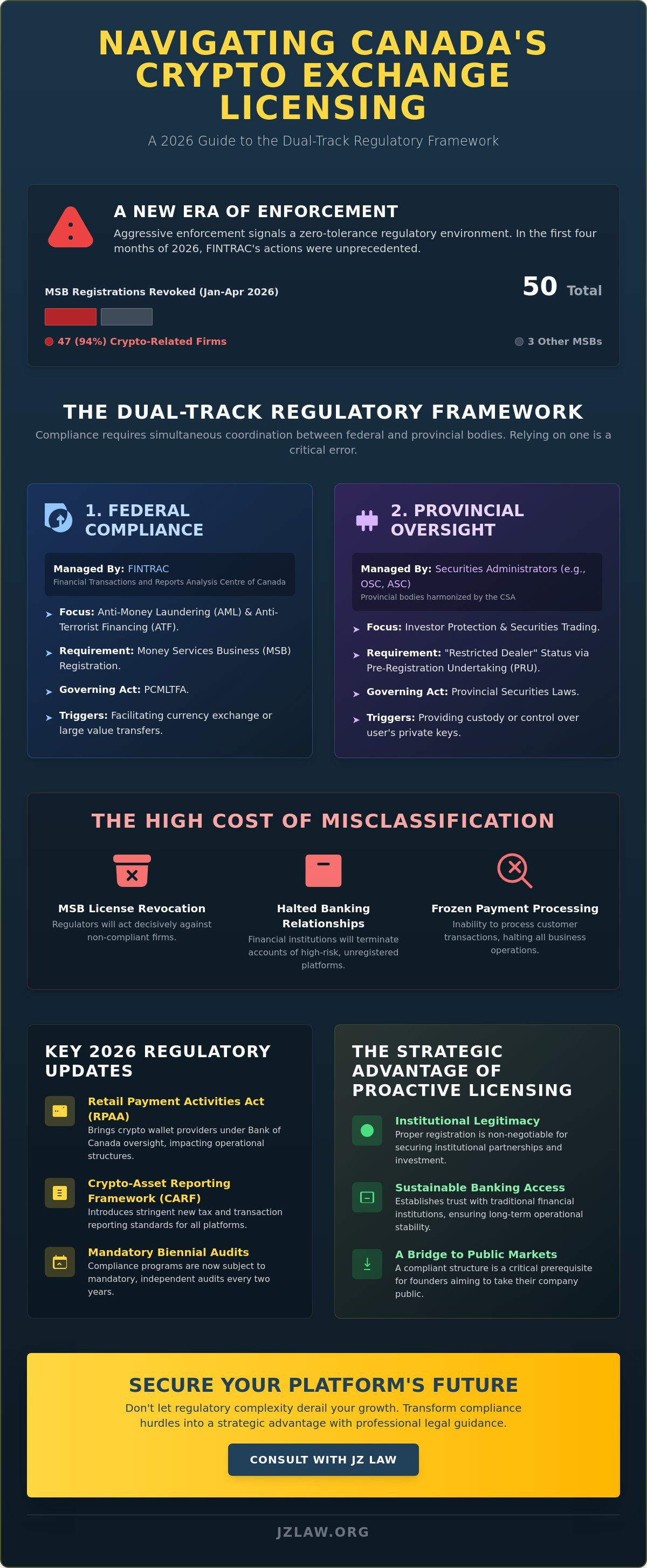
Did you know that during the first four months of 2026, FINTRAC revoked 50 Money Services Business registrations, 47 of which belonged to crypto-related firms? This aggressive enforcement signal confirms that the Canadian regulatory environment has transitioned into a period of uncompromising oversight. You've likely felt the pressure of this shifting landscape, where the overlap between federal AML mandates and provincial securities commissions creates a complex web of obligations that can threaten even the most innovative platforms. Maintaining compliance is no longer a secondary operational task; it's the foundational pillar of your business's survival and growth.
Securing crypto exchange licensing canada requires a sophisticated, dual-track strategy that aligns federal registration with the rigorous expectations of provincial administrators like the OSC. This guide provides the professional precision you need to master the 2026 regulatory updates, including the new Crypto-Asset Reporting Framework (CARF) and the mandatory biennial audit cycles. We'll explore how to transform these regulatory hurdles into a strategic advantage, ensuring your platform meets the institutional standards required for long-term success in the Canadian market.
Key Takeaways
Understand why a simple MSB registration is no longer sufficient and how the dual-track system requires simultaneous federal and provincial coordination to mitigate enforcement risks.
Learn the essential steps for securing crypto exchange licensing canada by implementing the five pillars of a robust AML/ATF compliance program as mandated by FINTRAC.
Navigate the path toward "Restricted Dealer" status and the Pre-Registration Undertaking (PRU) process to ensure your platform remains compliant with provincial securities administrators.
Identify how the 2026 Retail Payment Activities Act (RPAA) brings crypto wallet providers under Bank of Canada oversight and what this means for your existing operational structure.
Discover how a proactive licensing strategy serves as a bridge to institutional legitimacy, tax efficiency, and the long-term goal of taking your company public.
Table of Contents
The Dual-Track Regulatory Framework for Canadian Crypto Exchanges
The Legal Status of Crypto in Canada is defined by a sophisticated interplay between federal anti-money laundering statutes and provincial securities laws. This dual-track system means that crypto exchange licensing canada isn't a singular event but a multi-layered registration process. Federal oversight, managed by FINTRAC, focuses on the movement of capital and the prevention of illicit activities. Provincial oversight, led by bodies like the Ontario Securities Commission (OSC), governs the actual trading of assets and the protection of investors. Relying solely on a federal Money Services Business (MSB) registration is a high-risk strategy that often leads to regulatory friction. If your platform provides custody or creates a contractual obligation to deliver assets, provincial regulators will view you as a securities dealer, regardless of your federal status.
The Canadian Securities Administrators (CSA) work to harmonize these rules across the country, yet the choice of your "home" province remains a strategic decision. Many firms choose Ontario due to the OSC's robust infrastructure, while others find Alberta’s ASC provides a streamlined path for specific corporate structures. This choice influences your long-term reporting requirements and your standing within the broader financial ecosystem. Precision in this early stage prevents the need for costly structural reorganizations later in your business lifecycle.
Federal vs. Provincial Jurisdiction
The division of powers in Canada dictates that while the federal government controls "Banking and the Incorporation of Banks," the provinces hold authority over "Property and Civil Rights," which includes securities trading. Federal AML laws trigger when you facilitate currency exchanges or large transfers exceeding specific thresholds. Provincial laws trigger when the assets being traded are deemed securities or derivatives, or when the platform retains control over the user's private keys. A Crypto Asset Trading Platform (CTP) is legally defined in Canada as an organization that operates a facility that brings together multiple buyers and sellers of crypto assets to trade in instruments that are securities or derivatives.
The Consequences of Regulatory Misclassification
Misunderstanding your classification has immediate, tangible costs. Recent enforcement actions in early 2026 have shown that regulators won't hesitate to revoke MSB licenses for firms that fail to align with provincial standards. Beyond legal penalties, improper licensing halts essential banking relationships and payment processing capabilities. Traditional financial institutions view unregistered platforms as high-risk entities, often resulting in the sudden termination of corporate accounts. Securing "Restricted Dealer" status serves as a vital bridge, allowing platforms to operate under specific conditions while they transition toward full compliance. This proactive alignment is also a critical step for founders who envision eventually taking companies public through the Canadian capital markets.
Federal Compliance: FINTRAC Registration and MSB Obligations
Federal oversight represents the first mandatory hurdle for any entity pursuing crypto exchange licensing canada. Since the March 2026 amendments to the Proceeds of Crime (Money Laundering) and Terrorist Financing Act (PCMLTFA), the standards for entry have reached an unprecedented level of rigor. Registration as a Money Services Business (MSB) isn't merely a paperwork exercise. It's a commitment to a comprehensive anti-money laundering (AML) and anti-terrorist financing (ATF) regime that stands as the bedrock of your platform's operational integrity. FINTRAC has intensified its scrutiny, making it essential to establish your program before you begin serving Canadian clients.
The process begins with a formal FINTRAC MSB Registration. This identifies your business, its owners, and its specific service offerings to the Financial Transactions and Reports Analysis Centre of Canada. While the renewal of this license every two years remains free of charge as of April 2026, the cost of maintaining the required compliance infrastructure is significant. You must implement the five pillars of compliance: appointing a dedicated compliance officer, developing detailed written policies, conducting a formal risk assessment, maintaining ongoing staff training, and undergoing an independent effectiveness review every two years. Failure to maintain any of these pillars can lead to immediate license revocation.
Reporting obligations are equally strict and require automated systems to ensure accuracy. You must submit a Large Virtual Currency Transaction Report for any receipt of $10,000 CAD or more in a single transaction. Suspicious Transaction Reports (STRs) must be filed whenever there are reasonable grounds to suspect money laundering or terrorist financing, regardless of the dollar amount. For 2026, KYC protocols have evolved to prioritize advanced digital ID verification. Modern platforms are now expected to move away from simple document uploads toward biometric and real-time data validation to prevent identity fraud.
The Role of the Compliance Officer
The AML Compliance Officer must possess the authority and resources to act independently within your organization. They're responsible for the day-to-day oversight of your compliance program and serve as the primary point of contact for FINTRAC. While some firms attempt to outsource this function, doing so requires meticulous legal oversight to ensure that accountability remains intact. Every two years, your program must face a mandatory audit. This can be internal or external, but it must be performed by someone who isn't involved in the daily compliance operations to ensure total objectivity.
2026 Travel Rule Implementation
The "Travel Rule" now mandates that all virtual currency transfers of $1,000 CAD or more must include specific originator and beneficiary information. This requires seamless information sharing between virtual asset service providers (VASPs), creating significant technological hurdles regarding data privacy. JZ Law provides a strategic approach to cryptocurrency law integration, helping platforms navigate these information-sharing requirements while maintaining strict adherence to Canadian privacy standards. If you're concerned about your platform's current AML posture, seeking a professional review of your internal protocols is a prudent step toward long-term stability.
Provincial Oversight: Registering with the CSA and OSC
While federal registration addresses the movement of capital, provincial oversight governs the actual relationship between your platform and your clients. In Canada, if a platform retains custody of client assets, the Canadian Securities Administrators (CSA) view those transactions as "crypto contracts." This classification subjects your business to provincial securities law, necessitating a sophisticated approach to crypto exchange licensing canada. For most emerging platforms, the primary entry point is the "Restricted Dealer" category. This is a time-limited registration, typically lasting two years, designed as a bridge to help firms operate while they build the robust infrastructure required for full compliance. Platforms already active in the market must sign a Pre-Registration Undertaking (PRU), which is a public commitment to meet these evolving standards within a specified timeframe.
Operational security is the cornerstone of provincial approval. Regulators generally mandate that at least 80% of all client virtual assets be held in cold storage with a qualified custodian. This requirement significantly reduces the risk of loss through cyberattacks and ensures that the platform doesn't use client assets for its own liquidity needs. Additionally, you must navigate complex investment limits for retail users. While "Accredited Investors" enjoy fewer restrictions, retail clients in many provinces are subject to net purchase limits, often capped at $30,000 for certain crypto assets over a 12-month period. Understanding these tiers is essential for maintaining market integrity and avoiding enforcement actions from the Ontario Securities Commission (OSC).
The Path to Investment Dealer Status
The Restricted Dealer status is not a permanent destination. Eventually, your firm must transition to full Investment Dealer status and seek membership with the Canadian Investment Regulatory Organization (CIRO), formerly known as IIROC. This transition involves meeting rigorous capital requirements and securing comprehensive insurance mandates to protect against theft or insolvency. Aligning with securities regulation standards early provides a strategic advantage, as it builds the institutional-grade legitimacy required for future corporate milestones, such as an initial public offering (IPO) or a major merger.
Market Integrity and Fair Dealing
Provincial regulators prioritize transparency and the prevention of market manipulation. You're prohibited from engaging in proprietary trading on your own platform and must disclose any potential conflicts of interest to your users. Order books and execution prices must be transparent, ensuring that all participants receive fair treatment. Furthermore, the CSA has issued specific guidance on "Value-Referenced Crypto Assets," commonly known as stablecoins. To offer these assets to Canadian residents, platforms must ensure the underlying reserves are composed of highly liquid, low-risk assets and are held by a regulated custodian. This level of scrutiny ensures that your platform remains a trusted participant in the Canadian financial landscape.
Key 2026 Updates: RPAA and Evolving Stablecoin Rules
The regulatory landscape has expanded significantly in 2026, moving beyond the traditional silos of AML and securities law. The Retail Payment Activities Act (RPAA) now represents a critical third pillar in the crypto exchange licensing canada process. This legislation brings virtual currency wallets and payment functionalities under the direct oversight of the Bank of Canada. It's no longer enough to satisfy FINTRAC; you must also demonstrate that your platform's technical and operational risks are managed to a central bank standard. This isn't a mere administrative hurdle. It's a structural shift that treats crypto custodians as Payment Service Providers (PSPs), requiring a level of institutional maturity that many early-stage platforms haven't yet achieved.
Success in this environment requires understanding the interplay between RPAA authorization and FINTRAC registration. While FINTRAC monitors the identity of the participants and the nature of the transactions, the Bank of Canada now monitors the stability of the platform itself. Additionally, 2026 has brought definitive clarity to staking services and yield-bearing products. Regulators now consistently view these as investment contracts, meaning they must be registered as securities under provincial law. Offering these services without a specific provincial exemption is a high-risk activity that can trigger immediate enforcement actions and the suspension of your trading activities.
RPAA Authorization for Crypto Custodians
Any platform performing payment functions, including the holding of funds in a crypto wallet for future transfer, must register as a PSP with the Bank of Canada. This involves rigorous operational risk management frameworks and mandatory incident notification protocols that require reporting technical failures within strictly defined windows. Our team provides strategic guidance on corporate transactions involving PSPs to ensure that mergers or acquisitions don't inadvertently void these essential authorizations. If you're unsure if your current wallet structure triggers these rules, seeking a professional regulatory audit is the most effective way to prevent operational shutdowns.
Stablecoins as Securities or Derivatives
The CSA’s 2026 stance has solidified around Value-Referenced Crypto Assets, with a clear preference for fiat-backed stablecoins over algorithmic models. Platforms are now mandated to provide monthly reserve transparency reports and prove that their stablecoin listings have sufficient liquidity for immediate redemption. All platforms must ensure their value-referenced assets meet the CSA’s updated transparency and liquidity standards by the December 31, 2026, deadline. This requirement ensures that the systemic risk posed by stablecoins is mitigated through verified, high-quality liquid assets held in regulated Canadian accounts, providing a safer environment for retail and institutional investors alike.
Strategic Legal Counsel for Crypto Scaling and Public Markets
Operating a platform in the current environment requires shifting your perspective from mere compliance to long-term valuation. Achieving crypto exchange licensing canada isn't just a hurdle; it's a strategic asset that transforms your business into an institutional-grade entity. This level of regulatory maturity is essential for founders who have the ultimate goal of taking companies public. Public markets and tier-one venture capital firms no longer tolerate regulatory ambiguity. They require a clean bill of health from both federal and provincial bodies before engaging in significant funding rounds or acquisition talks. A robust licensing posture proves that your platform has the internal controls, risk management, and legal oversight necessary for the global stage.
For international crypto entities entering the Canadian market, tax structuring is a critical but often overlooked component of the entry strategy. Moving operations from NYC, Berlin, or other global hubs to Toronto or Calgary requires a precise alignment of corporate tax obligations with Canadian requirements. This involves navigating the complexities of cross-border regulatory friction, especially when dealing with the differing approaches of the SEC and CFTC in the United States versus the CSA in Canada. While the US often relies on enforcement-led regulation, Canada’s 2026 framework provides a clearer, albeit stricter, path for those willing to engage proactively. John Zang’s methodology focuses on high-stakes negotiations that prioritize your business’s operational continuity while satisfying the most stringent regulatory demands.
Licensing as a Prerequisite for IPO and M&A
Institutional investors demand dual-track compliance because it mitigates the risk of sudden platform shutdowns or asset freezes. During a merger or acquisition, legal due diligence will scrutinize every aspect of your MSB registration and provincial dealer status. Any gap in your compliance history can significantly devalue your firm or kill a deal entirely. Our firm provides specialized securities regulation counsel for emerging tech companies, ensuring that your corporate structure is optimized for future liquidity events and institutional partnerships.
Custom Legal Roadmaps for Global Hubs
Every jurisdiction has its own nuances, and a one-size-fits-all approach rarely succeeds in a sector as dynamic as digital assets. Whether you're scaling in Vancouver, Toronto, or Calgary, your legal roadmap must reflect local market conditions and specific provincial expectations. Working with a boutique firm allows for personalized, strategic counsel that larger, more rigid organizations can't provide. We help you anticipate risks before they manifest, protecting your business interests while you focus on technological innovation. To secure your platform's future, Consult with JZ Law for a comprehensive crypto regulatory assessment today.
Positioning Your Platform for Institutional Success
The shift toward a mature, regulated digital asset ecosystem in Canada is now a permanent reality. Navigating the 2026 landscape requires a synthesis of federal AML mandates and provincial securities oversight, ensuring that every operational layer meets the highest standards of market integrity. By proactively addressing the Retail Payment Activities Act and the evolving requirements for stablecoins, your organization does more than avoid enforcement; it builds the foundational trust required to attract institutional capital and sophisticated users. This transition from a reactive posture to a strategic compliance model is what separates market leaders from those vulnerable to sudden regulatory shifts.
Securing crypto exchange licensing canada serves as the critical gateway to high-stakes corporate transactions and the public markets. JZ Law provides the specialized legal precision necessary to manage these complex regulatory intersections. Our boutique service model prioritizes strategic counsel for IPOs and M&A, backed by deep expertise in securities and corporate finance. Secure Your Strategic Regulatory Roadmap with JZ Law and transform compliance from a burden into a primary competitive asset. Your platform's potential for global scaling is within reach when built upon a bedrock of professional legal certainty.
Frequently Asked Questions
Do I need both a FINTRAC registration and a Securities Commission license?
Yes, most platforms operating in this sector must pursue a dual-track registration process to remain fully compliant. You're required to register with FINTRAC as a Money Services Business to satisfy federal anti-money laundering statutes. If your platform retains custody of client assets or facilitates "crypto contracts," you must also obtain registration from provincial bodies like the Ontario Securities Commission or the Canadian Securities Administrators.
How long does it typically take to obtain a crypto exchange license in Canada?
Securing crypto exchange licensing canada is a multi-phased endeavor with varying timelines. Federal registration as an MSB can often be completed within a few months of a clean application. However, provincial registration as a Restricted Dealer is significantly more intensive, frequently requiring six to twelve months of rigorous legal preparation, technical audits, and infrastructure development to meet provincial standards.
What are the minimum capital requirements for a Canadian crypto exchange?
Capital requirements are determined by your specific regulatory track and the volume of assets under your management. While FINTRAC focuses primarily on your AML program's effectiveness, provincial securities regulators mandate specific regulatory capital levels to mitigate operational and insolvency risks. These amounts are calculated during the registration process, taking into account your insurance coverage and your platform's overall risk profile.
Can a foreign crypto exchange operate in Canada without a local office?
Foreign entities serving Canadian residents must register as a Foreign Money Services Business (FMSB) with FINTRAC. While a physical office might not be mandatory for the federal level, provincial securities commissions generally expect a meaningful Canadian presence or a designated legal representative to ensure accountability. Operating without this local nexus often leads to enforcement actions, as demonstrated by the prohibition of several major international exchanges in May 2026.
What is the Retail Payment Activities Act (RPAA) and does it apply to crypto?
The Retail Payment Activities Act is a new regulatory pillar that brings payment service providers under the oversight of the Bank of Canada. It applies to crypto platforms that perform payment functions, including the holding of funds in digital wallets for future transfers. This legislation mandates strict operational risk management and incident notification protocols that exist alongside your existing FINTRAC and provincial securities obligations.
Are stablecoins regulated as securities in Canada in 2026?
Stablecoins are regulated as "Value-Referenced Crypto Assets" under the Canadian Securities Administrators' framework. All platforms must ensure that any stablecoins they list are backed by high-quality liquid reserves held with regulated custodians by the December 31, 2026, deadline. Algorithmic stablecoins face significant hurdles, as the CSA prioritizes fiat-backed models that provide immediate redemption rights and transparent reserve reporting for retail investors.
What happens if I operate a crypto platform in Canada without registration?
Operating without proper registration carries severe legal, financial, and reputational risks. In the first four months of 2026, FINTRAC revoked 50 MSB registrations, including 47 crypto-related firms, signaling a period of aggressive enforcement. Beyond significant administrative monetary penalties, unregistered platforms face permanent bans from the Canadian market and the immediate termination of all local banking and payment processing relationships.
How does the "Restricted Dealer" category work for new startups?
The Restricted Dealer category serves as a temporary, two-year bridge for startups and emerging platforms to operate while they build full institutional capacity. This status allows your firm to grow under specific conditions and oversight while you work toward full Investment Dealer status and CIRO membership. It's a strategic entry point that provides a path to legitimacy without immediately requiring the exhaustive capital mandates of a full-scale investment bank.



Comments