


Environmental Due Diligence for Oil and Gas Sites: A 2026 Strategic Legal Framework
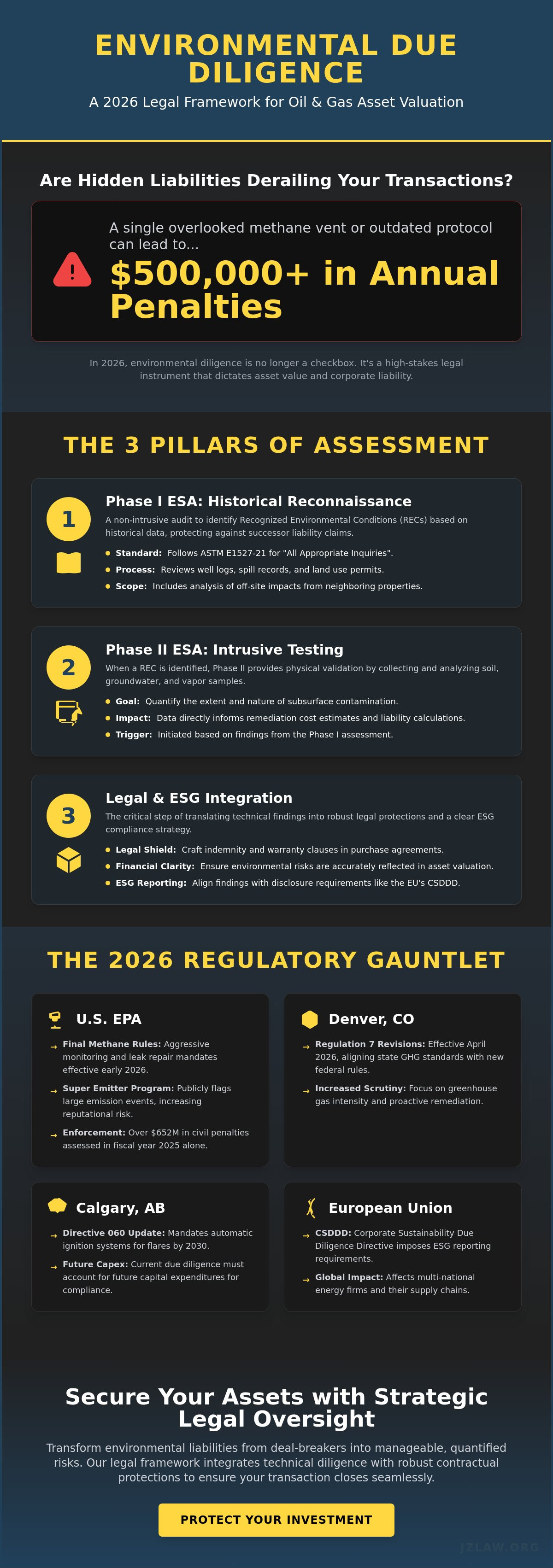
Could a single overlooked methane vent or an outdated flaring protocol cost your firm $500,000 in annual penalties? In 2026, environmental due diligence for oil and gas sites has transitioned from a routine technical checkbox into a high-stakes legal instrument that fundamentally dictates the valuation of energy assets. You likely feel the weight of this shift as the EPA's recent technical reconsiderations and the aggressive rollout of the Super Emitter Program create a landscape where hidden remediation costs can derail even the most promising corporate transactions.
We understand that navigating these multi-jurisdictional requirements, from Colorado's Regulation 7 alignment to the EU's Corporate Sustainability Due Diligence Directive, requires more than just a surface-level assessment. This article provides a sophisticated framework to help you quantify environmental liabilities and secure strategic legal protections within your purchase agreements. By the end of this analysis, you'll possess the clarity needed to ensure your assets meet the rigorous 2026 ESG standards while maintaining a seamless path toward closing your next major deal.
Key Takeaways
Understand how modern environmental due diligence for oil and gas sites has evolved into a sophisticated risk-management framework essential for determining true asset valuation.
Distinguish between Phase I historical reconnaissance and Phase II intrusive testing to effectively identify and quantify potential subsurface contamination.
Learn to translate technical environmental data into robust legal indemnity and warranty clauses that safeguard your firm against future ESG litigation.
Navigate the localized regulatory nuances of the Alberta Energy Regulator and the US EPA to ensure cross-border compliance in markets like Calgary and Denver.
Discover the advantages of integrating strategic legal oversight into corporate transactions to proactively resolve environmental liabilities before they reach the closing table.
Table of Contents
Understanding Environmental Due Diligence in the Modern Energy Sector
Environmental due diligence for oil and gas sites has evolved from a routine technical inspection into a sophisticated risk management process that determines the viability of multi-million dollar transactions. In its earliest iterations, this process focused primarily on identifying visible leaks or obvious soil staining. Today, however, it functions as a comprehensive liability framework designed to uncover latent risks that could impact corporate balance sheets for decades. This shift is driven by the reality that you aren't just purchasing physical infrastructure; you're inheriting the entire environmental history of the asset.
The role of oil and gas law is central to this evolution. Legal standards now require a proactive approach that anticipates regulatory shifts before they manifest as enforcement actions. By 2026, the complexity of these frameworks has reached a point where technical findings must be immediately translated into legal protections. This ensures that environmental due diligence for oil and gas sites serves as a shield against the aggressive enforcement trends seen in both North American and international markets.
The Legal Necessity of Pre-Acquisition Audits
Successor liability remains the most significant threat in any energy asset transfer. Under current regulations, a buyer can be held responsible for contamination they didn't cause if they failed to perform "All Appropriate Inquiries" prior to the purchase. Utilizing a standard Phase I Environmental Site Assessment is the foundational step in establishing a defense against such claims. These audits protect your firm from unforeseen regulatory fines, which the EPA has assessed at over $652 million in civil penalties during fiscal year 2025 alone. Beyond mere protection, these findings directly influence asset valuation. Financing for large scale projects in 2026 often hinges on a clean environmental record, as lenders increasingly view environmental risk as a primary indicator of long term financial stability.
Current Regulatory Drivers in 2026
The regulatory landscape in 2026 is defined by a shift toward proactive remediation and stringent emissions monitoring. The EPA’s final methane rules, effective as of early 2026, and the implementation of the Super Emitter Program have created a environment where large emission events are publicly flagged and verified by third parties. This transparency forces operators to address leaks immediately or face substantial reputational and financial damage. In regions like Denver, revisions to Regulation 7 became effective in April 2026, aligning state standards with federal guidelines to ensure a more uniform approach to greenhouse gas intensity. Similarly, Calgary’s updated Directive 060 requires automatic ignition systems for flares by 2030, signaling that current due diligence must account for future capital expenditures required to maintain compliance.
The Three Pillars of Oil and Gas Environmental Assessment
Executing comprehensive environmental due diligence for oil and gas sites requires a systematic, three-tiered approach that moves from historical analysis to physical validation. By 2026, the integration of Environmental, Social, and Governance (ESG) metrics has transformed these technical assessments into strategic benchmarks for asset valuation. You can't rely on surface-level inspections when the EPA’s Super Emitter Program and state-level regulations in Denver and Calgary now demand granular transparency. A robust assessment ensures that your firm identifies liabilities before they become balance sheet impairments.
Phase I Environmental Site Assessment (ESA)
This initial pillar serves as a historical audit of the asset's lifecycle. Following the ASTM E1527-21 standard, a Phase I ESA focuses on identifying Recognized Environmental Conditions (RECs) through a review of well logs, spill records, and land use permits. For standard commercial properties, these assessments typically cost between $2,000 and $5,000, but oil and gas sites often require more extensive investigations due to their operational complexity. It's vital to analyze off-site impacts, as contamination from neighboring properties can migrate, creating successor liability issues that complicate corporate transactions.
Phase II and Intrusive Testing Protocols
When a Phase I identifies potential concerns, the process transitions to intrusive sampling of soil, groundwater, and air. In the 2026 regulatory environment, testing protocols must specifically address Naturally Occurring Radioactive Material (NORM), brine impacts, and heavy metal concentrations. Operators must align their sampling plans with EPA guidelines on oil and gas waste to ensure that waste streams are managed according to federal standards. Interpreting this data is a critical legal junction; specific contaminant thresholds often trigger mandatory reporting requirements that must be managed to avoid the millions in civil penalties recently assessed by the EPA.
Remediation and Asset Retirement Obligations (ARO)
The final pillar involves quantifying the long-term costs associated with identified liabilities. There's a distinct legal difference between remediation, which involves cleaning up contaminated media, and reclamation, which focuses on restoring the land to its original state. These Asset Retirement Obligations (ARO) must be accurately reflected on the corporate balance sheet to maintain financial integrity. Evaluating these liabilities with the support of specialized legal counsel ensures that your firm isn't blindsided by legacy contamination issues that could derail future financing or divestiture plans. By securing precise cost estimations in 2026, you protect your energy assets from the volatility of shifting environmental standards.
Beyond the Soil: Assessing Legal Liabilities and ESG Risks
Identifying a subsurface leak is a technical engineering task; however, assigning the ultimate financial responsibility for that leak is a strictly legal one. While technical assessments provide the raw data, the true value of environmental due diligence for oil and gas sites lies in how that data is translated into enforceable contractual protections. In the current market, failing to bridge the gap between engineering findings and legal safeguards can leave a firm exposed to legacy liabilities that far exceed the initial asset valuation. This is especially true as corporate transactions in 2026 are increasingly scrutinized through the lens of long term sustainability and climate resilience.
The modern regulatory environment, governed by comprehensive EPA Oil and Gas Sector Regulations, has made the "social license to operate" as critical as the physical permits. You must look beyond soil samples to evaluate how an asset fits into the broader ESG landscape. This includes assessing methane intensity and the potential for future litigation related to historical emissions. When these risks aren't properly quantified and mitigated within the deal structure, the resulting reputational damage can be as costly as the regulatory fines themselves.
Contractual Protections: Representations and Warranties
Precise drafting of environmental representations and warranties is your primary defense against successor liability. In high stakes energy deals, standard "survival periods" for these representations are often extended because environmental contamination can remain latent for years before detection. To manage these risks, sophisticated buyers utilize environmental insurance and escrow holdbacks. These financial mechanisms ensure that funds remain available for remediation if a breach of warranty is discovered post-closing. By structuring these holdbacks around the specific findings of your due diligence, you create a predictable framework for resolving known issues without stalling the transaction.
ESG and Reputational Risk Management
By June 2026, the shift from voluntary to mandatory ESG disclosures has fundamentally altered the due diligence process. Assessments now include rigorous reviews of carbon intensity and methane leakage to comply with the EU’s CSRD and similar reporting mandates in California. You must also manage the legal risks of "greenwashing" by ensuring all regulatory filings are backed by verifiable technical data. Furthermore, securing a social license in sensitive regions requires documented evidence of stakeholder engagement and adherence to legal requirements for Indigenous consultation. These elements are no longer optional; they're essential components of a proactive risk mitigation strategy that protects your firm from future claims and public scrutiny.
Navigating Regulatory Standards in Calgary, Denver, and Beyond
The year 2026 has marked a definitive shift in how international energy hubs regulate asset transfers and environmental accountability. Environmental due diligence for oil and gas sites is no longer a static process but a dynamic response to localized mandates that carry global financial implications. Whether your operations are centered in the Western Canadian Sedimentary Basin or the US Rockies, the burden of proof regarding liability management has shifted heavily toward the operator. Understanding these nuances is essential for any firm looking to maintain a seamless path toward corporate transactions in a multi-jurisdictional environment.
Harmonizing environmental due diligence for oil and gas sites across varied borders remains one of the most significant challenges for modern energy firms. A finding that satisfies the AER in Alberta might not meet the rigorous CSRD requirements in Berlin or the specific pneumatic device phase-out schedules in Colorado. This discrepancy necessitates a unified legal framework that can scale across borders while respecting local enforcement trends. To ensure your assets remain compliant in these complex markets, you can explore our specialized Oil and Gas Law services for strategic guidance.
The Calgary Context: Alberta’s Liability Management Rating (LMR)
Alberta’s regulatory landscape is currently defined by the full transition from the legacy Liability Management Rating (LMR) system to the more comprehensive Holistic Licensee Assessment. Under Directive 088, the Alberta Energy Regulator (AER) no longer relies on a simple ratio of assets to liabilities to approve license transfers. Instead, the AER evaluates a licensee’s entire financial profile, including their history of reclamation and mandatory spend requirements for decommissioning. Navigating the AER’s Integrated Application Registry (IAR) requires a proactive strategy to ensure that closure obligations are accurately reported and funded before they can block a potential sale or merger.
US and European Regulatory Nuances
In the United States, the alignment of state and federal rules has created a more standardized but demanding compliance environment. Colorado’s Regulation 7 revisions became effective on April 14, 2026, bringing state greenhouse gas intensity targets in line with the EPA’s OOOOc guidelines. For operators in Denver and the surrounding Rockies, this includes a mandatory 100% phase-out of certain pneumatic devices by May 2027. These local shifts are mirrored by broader federal enforcement, as seen with the EPA’s Super Emitter Program which publicly identifies major methane leaks.
Across the Atlantic, energy hubs like Berlin and Frankfurt are now governed by the Corporate Sustainability Reporting Directive (CSRD). As of January 1, 2026, large entities must publish their first climate-related risk reports on their websites, with non-compliance carrying potential fines of up to 5% of global annual turnover. These European standards often influence how international firms manage compliance in Vancouver and New York, as global investors increasingly demand a uniform level of environmental transparency across all holdings.
Calgary: Focus on Directive 088 and the Holistic Licensee Assessment for asset transfers.
Denver: Adhere to Regulation 7 revisions regarding methane intensity and equipment phase-outs.
Berlin/Frankfurt: Ensure CSRD reporting is integrated into the broader due diligence framework to avoid turnover-based penalties.
Strategic Transaction Support: How JZ Law Protects Your Energy Assets
Data without strategy is merely noise. In the current regulatory climate, environmental due diligence for oil and gas sites must be treated as a core component of your broader legal strategy rather than a secondary technical exercise. JZ Law excels at this integration. We don't just review reports; we interpret the legal consequences of technical findings to ensure your corporate transactions remain secure. This proactive mindset allows us to identify and resolve potential liabilities long before they threaten to derail a deal at the closing table.
Integrating Law and Science
John Zang coordinates closely with environmental engineers to ensure their technical assessments meet the rigorous evidentiary standards required in 2026. It's vital that an Oil and Gas Law specialist reviews these findings to differentiate between manageable risks and "no-go" scenarios during environmental due diligence for oil and gas sites. By translating soil and groundwater data into contractual protections, we provide you with a clear path forward. This synergy ensures that your firm's prepared for potential litigation or future regulatory audits, maintaining your professional standing in an increasingly transparent market.
Your Partner in Complex Energy Transactions
We provide tailored due diligence frameworks that support your long-term corporate health in Calgary, Toronto, and other global energy hubs. Our commitment to professional dignity and strategic precision means we act as more than just advisors; we're your partners in navigating the complexities of corporate transactions. Whether you're dealing with methane regulations or asset retirement obligations, our approach is designed to provide peace of mind. If you're ready to secure your energy assets, the next step is to contact JZ Law for a comprehensive liability review tailored to your specific operational needs.
Securing Your Energy Assets for a Sustainable Future
The transition toward a more transparent energy market requires a move away from reactive compliance. By integrating technical findings with robust legal safeguards, you can transform environmental risks into predictable business variables. The successful execution of environmental due diligence for oil and gas sites ensures that your firm remains resilient against shifting regulatory tides while preserving the long-term value of your energy assets. We've explored how identifying Recognized Environmental Conditions and structuring precise indemnity clauses creates a foundation for secure corporate transactions in Calgary, Denver, and beyond.
JZ Law brings decades of experience in complex regulatory sectors to every engagement, offering a strategic focus on liability mitigation that safeguards your corporate standing. Our deep roots in the Calgary and Denver energy markets provide us with the localized insight needed to navigate the nuances of 2026 standards. Don't leave your transaction's success to chance. We invite you to Consult with JZ Law for Expert Environmental Due Diligence Support to ensure your next acquisition is built on a foundation of certainty and professional excellence. Your future asset viability starts with a proactive legal framework today.
Frequently Asked Questions
What is the primary goal of environmental due diligence for oil and gas sites?
The primary goal of environmental due diligence for oil and gas sites is the systematic identification and quantification of latent environmental liabilities before a transaction closes. This process protects the buyer from inheriting legacy contamination and ensures that all assets comply with current 2026 standards. By uncovering these risks early, firms can structure agreements that allocate responsibility fairly; this prevents future litigation or unexpected remediation expenses from eroding the deal's value.
How long does a Phase I Environmental Site Assessment typically take in 2026?
A Phase I Environmental Site Assessment typically requires two to four weeks to complete in 2026. This timeline accounts for historical record reviews, site reconnaissance, and the synthesis of data into a formal report. While certain digital record keeping advancements have streamlined the process, the complexity of oil and gas assets often necessitates a thorough manual review to ensure all Recognized Environmental Conditions are accurately identified.
Can a buyer be held liable for environmental damage caused by a previous owner?
A buyer can be held liable for environmental damage caused by a previous owner through the principle of successor liability. Under statutes like CERCLA in the United States or the Environmental Protection and Enhancement Act in Alberta, the current owner is often responsible for remediation regardless of when the contamination occurred. Performing rigorous environmental due diligence for oil and gas sites is the only way to establish a legal defense against such claims.
What are the specific environmental risks associated with abandoned wells?
Abandoned wells present unique risks including methane migration, groundwater contamination, and soil degradation from legacy brine spills. These sites often lack modern containment systems, making them susceptible to leaks that can trigger the EPA’s Super Emitter Program notifications. Identifying these risks during the assessment phase is essential for accurately calculating Asset Retirement Obligations and ensuring the long term safety of the surrounding ecosystem.
How does the Alberta Energy Regulator (AER) influence due diligence in Calgary?
The Alberta Energy Regulator (AER) influences due diligence in Calgary by enforcing Directive 088 and the Holistic Licensee Assessment. This framework requires that any party seeking a license transfer must demonstrate the financial capacity to manage their decommissioning obligations. The AER’s focus on a licensee’s total liability profile means that technical findings must be supported by a clear plan for reclamation and mandatory spending.
What is the difference between environmental due diligence and an ESG audit?
Environmental due diligence focuses on the technical and legal identification of physical site liabilities. An ESG audit examines a company’s broader sustainability footprint. While due diligence is concerned with soil samples and spill history, an ESG audit evaluates carbon intensity, methane reduction targets, and social governance. Both are necessary in 2026 to provide a complete picture of an asset’s risk profile and long term viability.
How do environmental findings affect the final purchase price of an oil and gas asset?
Environmental findings directly impact the final purchase price through downward adjustments or the creation of escrow holdbacks. If a Phase II assessment reveals significant contamination, the buyer typically negotiates a price reduction equivalent to the estimated remediation costs. Alternatively, specific indemnity clauses are drafted to ensure the seller remains financially responsible for any legacy issues discovered within a defined survival period after the closing.
When should a Phase II ESA be commissioned during a transaction?
A Phase II ESA should be commissioned immediately after a Phase I identifies Recognized Environmental Conditions that require physical confirmation. You shouldn't wait until the final stages of a transaction to begin intrusive testing, as the results can fundamentally change the deal’s valuation. Early testing provides the empirical evidence needed to negotiate fair contractual protections and ensures that remediation plans are based on accurate data.



Comments