


Health Canada Notice of Violation: Requesting a Review
The review deadline is strict: responding to a Health Canada notice of violation means submitting a written request no later than 30 days after receiving it, together with any evidence or written submissions for the Minister to consider. Paying the penalty or seeking a compliance agreement can affect what happens next, so the available options should be assessed before taking action.
A notice can raise urgent operational and legal concerns. Your response should address both the alleged non-compliance and the records that support your position. This article explains what the notice means, how to request a review, and how payment or an agreement may affect the consequences.
It also explains what to consider when seeking legal counsel: relevant regulatory experience, careful analysis of the notice and supporting evidence, and a strategy suited to your organization’s circumstances. Understanding the process and its key decision points can help you respond with greater clarity.
Table of Contents
What is a notice of violation?
A Health Canada notice of violation alleges that a person failed to comply with an order. Under the Canada Consumer Product Safety Act, section 31 permits the Minister to order a recall when a product is believed to endanger human health or safety. Section 32 permits measures such as stopping a product’s sale, importation, or manufacture. Health Canada may issue a notice within six months of becoming aware of alleged non-compliance with an order.
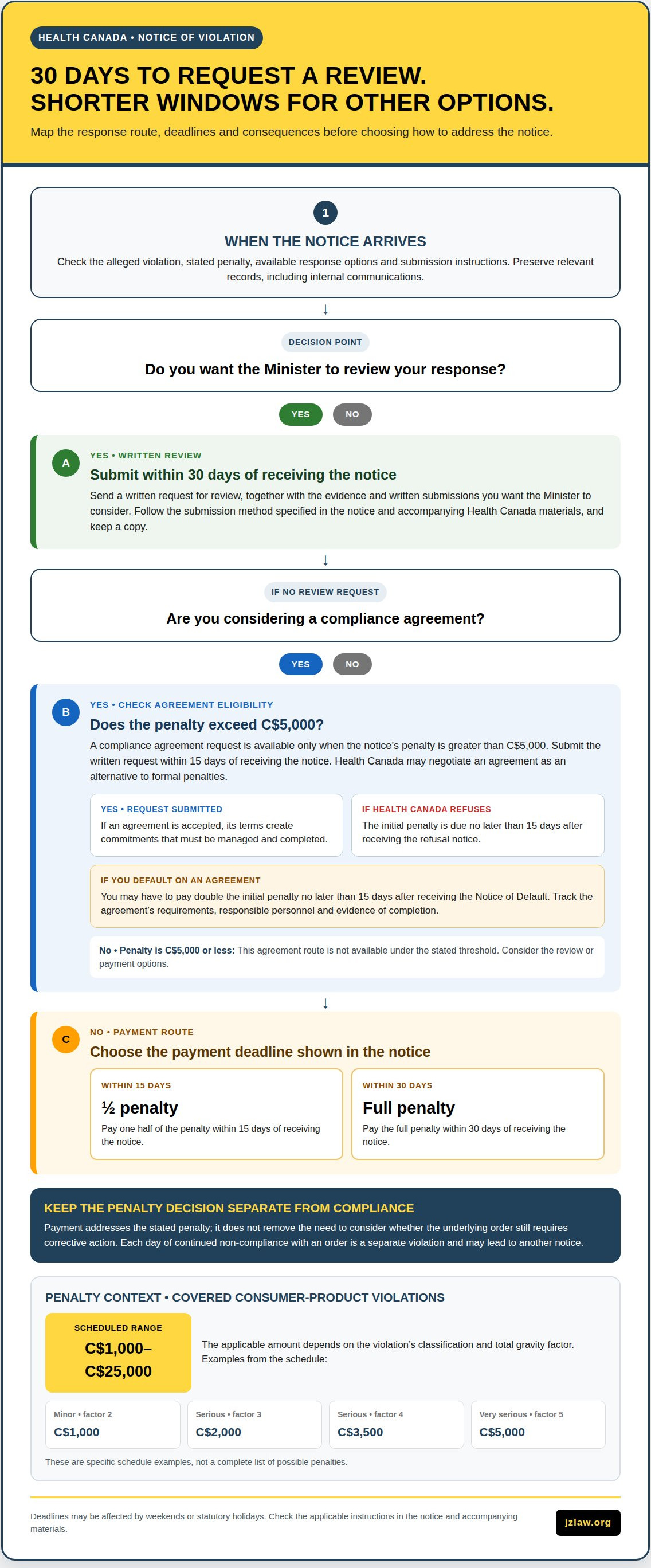
The notice identifies the alleged violation, penalty, and available response options. Responding to a Health Canada notice of violation requires attention to the written-review deadline: request a review no later than 30 days after receiving the notice. Include any evidence and written submissions for the Minister to consider. A person may instead pay one half of the penalty within 15 days, or pay the full penalty within 30 days. Deadlines may be affected by weekends or statutory holidays, so check the applicable instructions.
Minor, serious, and very serious classifications affect penalty calculations, but the review deadline remains 30 days. The written request must include the evidence and submissions for the Minister, whatever the classification. Find the response instructions, contact information, and any applicable forms in the notice and its accompanying Health Canada materials. Follow the submission method specified there, and keep a copy of what you send.
Some notices require action within 24 to 48 hours, including corrective action plans, investigation reports, or product-testing data. Preserve relevant records, including internal communications, as soon as the notice arrives. Each day of continued non-compliance with an order is a separate violation and may lead to another notice.
Drug-related confirmatory-trial commitments are a separate compliance issue. For a drug authorized under the Notice of Compliance with Conditions policy, final trial results must be submitted as a Supplemental New Drug Submission-C within the agreed timeframe. Failure to undertake or complete a confirmatory trial may give Health Canada reason to suspect that the product is unsafe or ineffective at that time. Keep the trial commitment and agreed submission schedule distinct from the response deadlines in a notice of violation.
Consequences of paying or entering an agreement
Payment and a compliance agreement are different ways to address a notice’s administrative monetary penalty. The notice offers a reduced payment of one half if paid within 15 days of receipt, or the full penalty within 30 days. Paying addresses the stated penalty amount; it does not remove the need to consider whether the underlying order still requires action. Each day of continued non-compliance with an order is a separate violation and may result in another notice.
A written review request is another available response, due within 30 days of receiving the notice. Before choosing payment, review, or an agreement, compare the penalty, the alleged conduct, and any continuing order. For example, paying a reduced amount may address the penalty but does not itself demonstrate that the business has completed required corrective measures. Keep the penalty decision distinct from operational steps needed to comply.
A compliance agreement request is available only when the notice’s penalty exceeds C$5,000. Submit the written request within 15 days of receiving the notice. Health Canada may negotiate compliance agreements as an alternative to formal penalties. The agreement’s terms matter: accepting it creates commitments that must be managed and completed, rather than simply replacing the need to address compliance.
If Health Canada refuses the request, the initial penalty is due no later than 15 days after receiving the refusal notice. Default carries a separate, more serious consequence. If a person defaults on an agreement, they may have to pay double the initial penalty no later than 15 days after receiving the Notice of Default. Track the agreement’s requirements, responsible personnel, and evidence of completion to reduce the risk of missed obligations.
These consequences make the choice consequential for both cash flow and ongoing operations. A business weighing the agreement against a review can map the deadlines, obligations, and potential default exposure before responding. For broader legal strategy and business decisions, consider the relevant legal context.
Administrative monetary penalty amounts
For violations covered by Canada’sAdministrative Monetary Penalties (Consumer Products) Regulations, penalties range from C$1,000 to C$25,000. The applicable amount depends on the violation’s classification and total gravity factor. The schedule sets specific amounts for listed combinations, so the penalty in the notice should be assessed against its stated category and factor.
Examples show how those factors affect the amount. A minor violation with a total gravity factor of 2 carries a C$1,000 penalty. A serious violation with a factor of 3 carries C$2,000, while a serious violation with a factor of 4 carries C$3,500. A very serious violation with a factor of 5 carries C$5,000. These examples are specific schedule entries, not a complete list of possible penalties.
What penalties and payment options may apply? For covered consumer-product violations, the scheduled range is C$1,000 to C$25,000. The notice allows payment of half the penalty within 15 days of receipt, or the full amount within 30 days. Compare the amount and classification stated in the notice before selecting a response.
The scheduled penalty is only one part of the decision. Check that the notice identifies the alleged violation and penalty amount, then determine whether the underlying order still requires corrective action. Paying the penalty addresses that penalty, but continued failure to comply with an order may create a separate violation for each day it continues. Distinguishing these issues is important when assessing the business’s potential exposure.
If a written review confirms the notice, the penalty is due within 30 days after receiving the Notice of Decision. That deadline differs from the initial payment period and should be recorded separately. If a response or payment deadline falls on a weekend or statutory holiday, it is due the next business day. Keep the notice, payment record, review submissions, and decision together to track the applicable amount and deadline accurately.
Choosing a lawyer with relevant Health Canada experience
A Health Canada matter can involve regulatory orders, product records, and business operations at the same time. Counsel should assess the notice, the order behind it, and the evidence supporting the alleged non-compliance. Experience with administrative reviews is relevant because a response must address the Minister’s decision, not just describe the business impact. Ask how counsel would identify the key legal and factual issues before recommending a response.
Start by examining how the lawyer assesses evidence. The analysis should link each allegation to relevant records, such as testing data, inspection documents, corrective-action records, and internal communications. A timeline, for example, can show when an order was received, what steps followed, and which records support or contradict the notice. Counsel should explain how the evidence will inform written submissions, rather than simply gather documents without a clear purpose.
Relevant experience also includes understanding how a regulatory response affects operations. A notice may require corrective action as well as a response to the penalty, so the legal analysis should distinguish those obligations. Ask how counsel would coordinate a written review with operational steps, preserve records, and address ongoing compliance concerns. For a consumer product matter, counsel should be able to explain how the order relates to the product and the alleged conduct.
Before retaining counsel, discuss the proposed scope of work, who will handle the file, and how decisions will be communicated. Ask for a clear explanation of the available response paths, their procedural consequences, and the evidence needed for each. A focused discussion should leave you with a practical plan, defined responsibilities, and a record-preservation approach. To discuss the legal strategy for a regulatory matter, connect with legal counsel.
JZ Law: John Zang Services
JZ Law provides legal services in areas including Cannabis Licensing, Securities Regulation, and Taking Companies Public. These services may be relevant when a Health Canada matter intersects with a company’s licensing or securities obligations, or affects its corporate plans. A cannabis-related issue, for example, may raise licensing questions, while a company considering going public may need to assess regulatory and securities considerations alongside its business decisions.
The distinction matters: a notice of violation calls for a response to the specific allegations and deadlines, while related licensing or corporate questions may require separate analysis. JZ Law’s services address these business areas, helping organizations consider regulatory concerns in their wider corporate context.
Contact JZ Law to discuss the related business issues your organization is addressing and whether the firm’s services fit your needs.
Make your next decision with purpose
A considered response to a Health Canada notice of violation starts with understanding how the regulatory issue connects to your organization’s broader priorities. Assess the implications for operations, governance, and future plans, then identify which decisions need legal analysis. This helps align the immediate response with the business decisions that follow.
JZ Law provides legal services including Cannabis Licensing, Taking Companies Public, and Securities Regulation. If these business issues intersect with your situation, discuss how they relate to your next steps. A focused conversation can clarify which matters need attention and help you plan a considered way forward.
Contact JZ Law to discuss your options. A clear, informed next step can help you approach the matter with confidence.
Frequently Asked Questions
How can you request a review?
Submit a written request to the Minister within 30 days of receiving the notice, with the evidence and written submissions you want considered. Organize the material around the notice’s specific allegations: identify each disputed point, then connect it to the relevant records or explanation. Keep a complete copy of the request and supporting documents, along with proof of when and how you submitted them.
What are administrative monetary penalties?
Administrative monetary penalties are financial penalties used to promote compliance with specified orders under the Canada Consumer Product Safety Act. Sections 49 to 66 establish the penalty system for orders made under sections 31 or 32, or reviewed under section 35. They are distinct from a product recall or stop-sale measure: the penalty addresses the violation, while an order may require action concerning the product.
What are the possible outcomes?
A review may confirm the notice, in which case the penalty is due within 30 days after you receive the Notice of Decision. A compliance-agreement request may also be accepted or refused; refusal means the initial penalty is due within 15 days after receiving the refusal notice. Some Health Canada decisions can be challenged in the Federal Court of Canada, and a lawsuit usually must be filed within 30 days of the decision.
What should you include in your written request for a compliance agreement?
Make the written request identify the notice and explain the compliance agreement you are seeking. Include a practical description of proposed corrective measures, who would carry them out, and how progress could be documented. These details help present a clear proposal; the key eligibility and timing rules are that the penalty must exceed C$5,000 and the request must be submitted within 15 days of receiving the notice.
Why might you consider a compliance agreement?
A compliance agreement may be worth considering because Health Canada can negotiate one as an alternative to formal penalties. It may provide a structured way to address compliance through agreed commitments rather than treating payment as the only response. Before pursuing one, assess whether your organization can meet its terms: default may require payment of double the initial penalty within 15 days after receiving a Notice of Default.
What is a Health Canada notice of violation?
A notice of violation alleges that a person failed to comply with an order and sets out the alleged violation and response options. It is different from a Notice of Compliance, which indicates that Health Canada has approved a drug for sale in Canada subject to the notice’s conditions. Identifying the document you received helps determine whether it concerns an alleged violation or a drug approval.



Comments