


How to Prepare a Company for VC Due Diligence in Vancouver
Venture capital due diligence is an examination of a company’s management team, market potential, product or service, customer need and business model. Preparing a company for venture capital due diligence in Vancouver means backing those elements with clear, organized evidence, including a well-maintained due diligence binder.
The review goes beyond the pitch. Investors assess whether the team can execute, whether the competitive case is credible and whether company records support its claims. A consistent process for coordinating information and answering follow-up requests helps keep the review focused.
This guide explains how to strengthen your management team’s readiness, clarify your competitive case, coordinate legal and other advisors, and organize materials for investor review. You’ll also learn to treat due diligence as a structured assessment of both your company and a potential long-term investment partner.
Table of Contents
Management team capabilities and cohesion
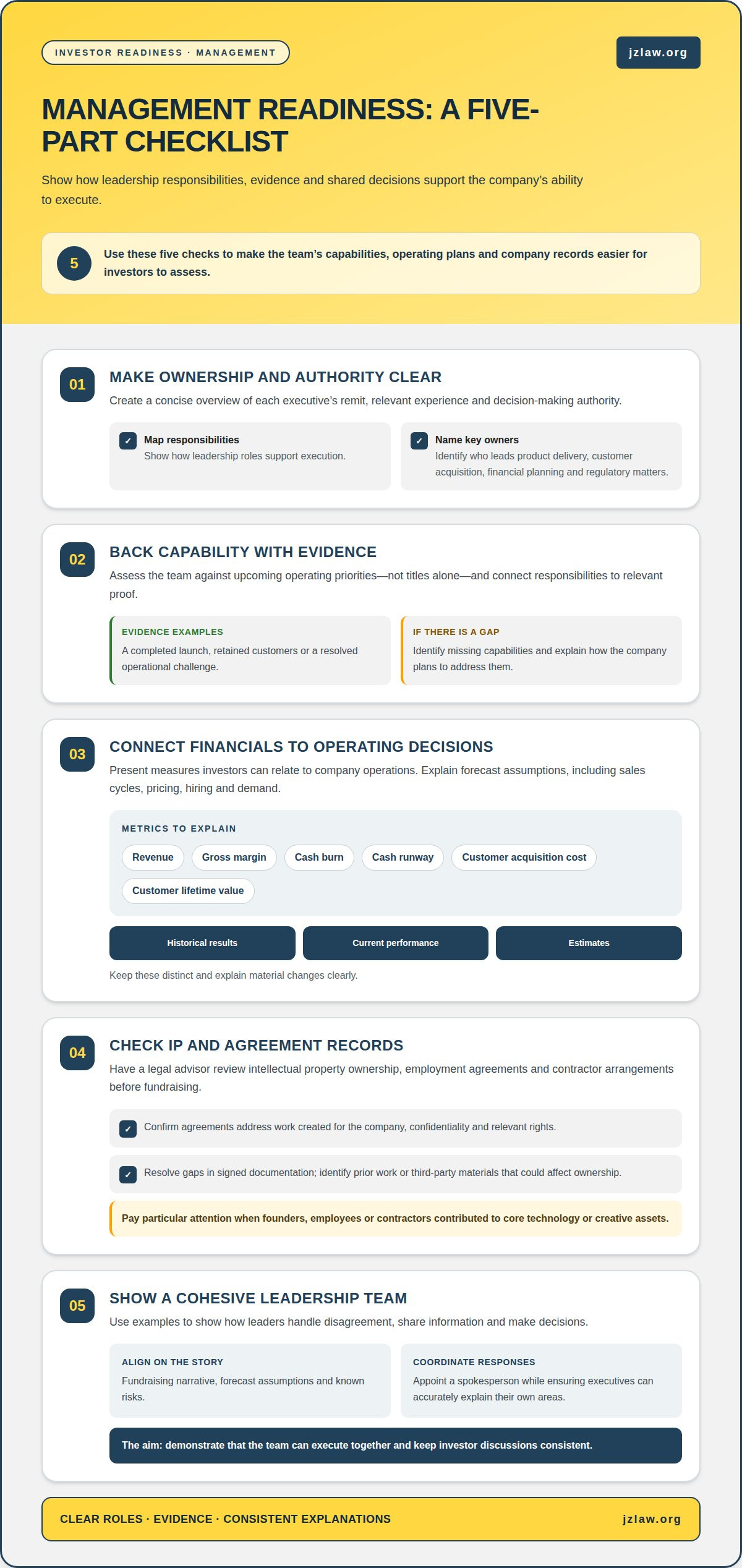
Map each executive’s remit, relevant experience and decision-making authority in a concise team overview. Business due diligence commonly assesses management, market potential, the product or service, customer need and the business model. Preparing a company for venture capital due diligence in Vancouver starts with showing how leadership responsibilities support execution.
Assess the team against upcoming operating priorities, not titles alone. Identify who owns product delivery, customer acquisition, financial planning and regulatory matters. Pair each responsibility with evidence, such as a completed launch, retained customers or a resolved operational challenge. If a capability is missing, explain how the company plans to address the gap.
Present financial metrics and forecasts that investors can connect to operating decisions. Common measures include revenue, gross margin, cash burn, cash runway, customer acquisition cost and customer lifetime value. Explain the assumptions behind projections, including sales cycles, pricing, hiring and demand. Keep historical results, current performance and estimates distinct, and explain material changes clearly.
Have a legal advisor review intellectual property ownership, employment agreements and contractor arrangements before fundraising. Confirm that agreements address work created for the company, confidentiality and relevant rights. Resolve gaps in signed documentation and identify prior work or third-party materials that could affect ownership. This is especially important when founders, employees or contractors contributed to core technology or creative assets.
Test team cohesion with examples of how leaders handle disagreement, share information and make decisions. Align the team on the fundraising narrative, forecast assumptions and known risks so investor discussions remain consistent. When preparing a company for venture capital due diligence in Vancouver, appoint a spokesperson to coordinate responses while ensuring executives can accurately explain their areas. Preparation should show that the team can execute together.
Working with legal and other advisors to prepare for venture capital due diligence
Assign a lead advisor to coordinate legal, financial, privacy and cybersecurity reviews. Clear responsibilities help uncover connected issues before investors ask about them.
Have a professional review privacy, cybersecurity, and regulatory complianceEngage a professional to map personal information, systems, vendors and regulatory obligations across the startup’s operations. For a BC company, the review should assess what data it collects, where it is stored, who can access it, and how incidents are handled. Match the analysis to the business, its customers and markets. Document identified gaps, responsible owners and remediation priorities, rather than presenting policies that don’t reflect actual practices.
Estimate legal and financial due diligence costs with professional advisorsAsk legal and financial advisors to scope their work against the company’s records, ownership structure, contracts and regulatory exposure. For a Vancouver startup, costs depend on the scope of review, record quality and complexity of issues requiring attention; fees are provided after a quote request. A financial advisor can identify work needed to reconcile accounts or support forecasts. An experienced venture investor or fund with in-house counsel may handle part of the legal review, which can reduce overall deal expenses.
Request references when appointing legal advisors, and consider whether the firm has experience relevant to the company’s sector and financing stage. A reference can help assess communication style and investor familiarity. Define who will review corporate governance, intellectual property, contracts and regulatory compliance, then agree on how issues will be prioritized and reported. Keep advice coordinated with financial and operational findings, so one unresolved contract doesn’t contradict the company’s account elsewhere. A focused legal due diligence review can help organize those questions.
Set a clear review process before sharing sensitive records with investors. Ask advisors to distinguish urgent legal liabilities from matters requiring routine clarification, then prepare concise explanations and supporting documents. Unresolved disputes, regulatory non-compliance and problematic contracts can raise concerns, so identify each matter accurately and explain its status. Keep a record of investor questions, assigned responses and outstanding follow-ups so the legal and financial teams work from consistent information.
Competitive differentiation and defensibility
Define the specific customer problem your company solves, then show how its solution differs. Compare the customer’s current alternative with your product or service, using concrete examples such as time saved, workflow changes or a previously unmet need. Separate features from outcomes. Investors need to understand why customers choose your approach, not just hear that it is innovative.
Map competitors according to customer choice, not narrow industry labels. Include direct competitors, substitute products and existing ways customers address the problem. For each, explain differences in target customer, delivery model, pricing approach or capabilities. A clear comparison helps investors judge whether your advantage is meaningful and whether customers have practical reasons to switch.
Connect the competitive case to market evidence. Explain the customer segment you can serve, the conditions supporting demand and the assumptions behind your market estimate. Total addressable market represents the revenue opportunity if a company captured 100% of market share; present it as context, not as a forecast. Then show the reachable segment and the path to serving it.
Identify what could make the advantage durable, such as proprietary processes, specialized expertise, customer relationships or accumulated operating knowledge. Explain how each factor supports retention, improves delivery or makes replication more difficult. Distinguish existing strengths from planned investments. Don’t describe a feature as a barrier unless you can show how it creates a lasting business advantage.
Test the competitive thesis against timing and risk. Explain why customers need the solution now and how regulatory or market changes could affect its feasibility. Use scenario planning to show how the company would respond if adoption slows, a substitute improves or a key assumption changes. This gives investors a more balanced view than a single optimistic forecast.
Having due diligence binders prepared for venture capital review
Prepare an indexed, current binder that connects company records to likely investor questions. Assign one person to coordinate responses and updates.
Have a professional review the cap table and share records for due diligenceEngage a professional to reconcile the cap table with supporting share records before sharing them with investors. Match each holder’s position to the relevant issuance documents, option records and convertible financing agreements. Record discrepancies and their resolutions, rather than relying on an outdated spreadsheet. A clear ownership summary should show how each instrument affects the company’s capitalization and identify documents supporting every entry.
Have a professional gather and organize legal and corporate recordsAssemble governance materials, intellectual property records, contracts and regulatory documents in searchable folders. Include incorporation and organizational records, director and shareholder decisions, material customer and supplier agreements, and documents supporting ownership of key assets. Label files consistently by subject and date, and maintain an index that directs investors to each relevant record. Keep signed versions separate from drafts to avoid uncertainty about which terms apply.
Identify and address common reasons Canadian VCs reject companies during due diligenceHave advisors identify unresolved disputes, regulatory non-compliance and problematic contracts, all potential investment risks. Also reconcile conflicting figures or claims across financial records, customer materials and the pitch. Investors commonly assess management, market potential, the product or service, customer need and the business model, so inconsistent evidence can weaken the case. Prepare a factual explanation for each identified issue, its status and the steps taken to address it.Maintain the binder as new agreements, decisions or investor requests arise, and route responses through its coordinator. For focused support organizing corporate transaction records before review, discuss due diligence preparation.
JZ Law
JZ Law helps founders address legal questions that arise as venture capital discussions progress. Its securities regulation and corporate transaction services are relevant when a proposed investment raises questions about financing documents, governance or transaction structure. Early legal input can help identify issues that may affect investor review and keep decisions aligned with the company’s plans.
Consider turning to JZ Law when investor requests expose unresolved securities or corporate matters, or when the company is assessing a significant transaction. The appropriate support depends on the questions and documents involved, rather than a standard checklist applied to every startup. For a focused discussion about your company’s fundraising-related legal needs, contact JZ Law.
Move forward with a clear financing strategy
Investor review is also an opportunity to consider whether a proposed financing supports the company’s longer-term direction. Before moving ahead, align leadership on the capital required, the decisions it would enable and the obligations the company is prepared to assume. This keeps fundraising connected to strategic priorities rather than treating due diligence as a document exercise alone.
A disciplined approach to preparing a company for venture capital due diligence in Vancouver can help founders enter investor discussions with clarity and assess the relationship and proposed terms carefully. JZ Law advises on securities regulation, corporate transactions and taking companies public, areas that may be relevant as financing plans develop. The appropriate legal focus depends on the company’s objectives and the transaction under consideration.
For guidance on your company’s fundraising-related legal needs, contact JZ Law. A considered next step can keep the process focused and help you move ahead with confidence.
Frequently Asked Questions
What is Due Diligence in Venture Capital?
Venture capital due diligence is an investor’s structured review of a startup before deciding whether to invest. It tests the company’s claims, risks and ability to execute against supporting evidence, rather than relying on the pitch alone. The review may cover commercial, financial, operational and legal questions, with follow-up requests as issues emerge. A favourable business review can lead to a term sheet outlining proposed investment terms.
What documents do Vancouver startups need for venture capital due diligence?
Startups typically prepare corporate formation records, shareholder and director decisions, a current capitalization table, financing agreements, financial statements and forecasts. Investors may also request customer and supplier contracts, intellectual property records, employment and contractor agreements, and materials describing privacy or regulatory practices. Include final signed versions and relevant amendments, and ensure each document reflects the company’s current position rather than an earlier draft.
How should a company organize its data room for VC due diligence?
Organize the data room into clear categories, such as corporate, finance, commercial, people, intellectual property and regulatory records. Use consistent file names that identify the subject and date, and separate signed documents from drafts. A designated coordinator can manage permissions, log investor requests and replace outdated files while preserving a clear record of changes. This structure helps reviewers find information without relying on informal email exchanges.
How long does venture capital due diligence take in Canada, and what are the typical stages?
Duration is driven by the review’s scope, the completeness of company records and the volume of follow-up questions. The process commonly moves from initial screening to detailed business diligence, followed by legal review as an investor approaches a favourable decision. Investors may then issue a term sheet outlining proposed terms. Additional questions or unresolved issues can extend the review, so prompt, coordinated responses help maintain momentum.
Which Vancouver startup lawyers, accountants, or advisors help prepare for VC due diligence?
Legal counsel can review governance, contracts, intellectual property and securities matters, while accountants can explain financial records and forecast assumptions. Depending on the business, founders may also need advisors familiar with its technology, market or regulatory context. JZ Law’s securities regulation and corporate transaction services can help with financing-related legal questions. Choose roles that address the company’s specific gaps and coordinate their advice.



Comments