


How to Take a Company Public on the CSE: The 2026 Founder’s Guide
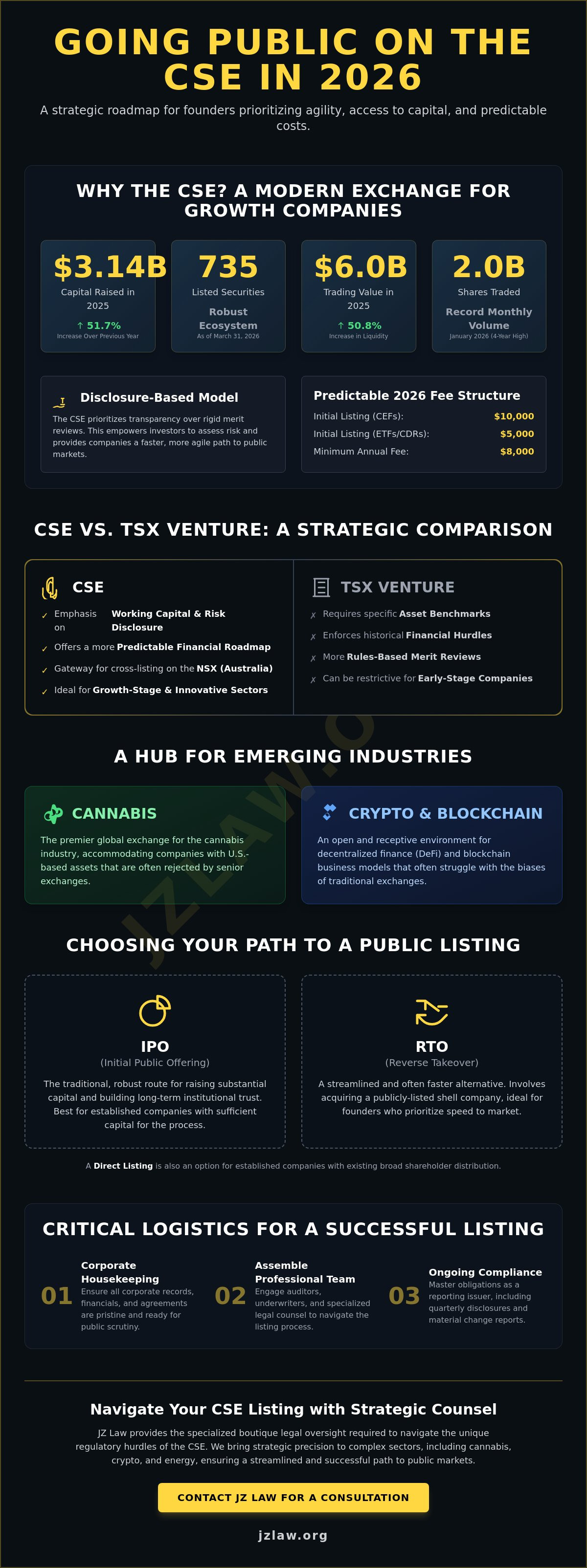
While many founders hesitate at the perceived barriers of public markets, CSE-listed companies raised a staggering $3.14 billion in 2025, which marks a 51.7% increase over the previous year. You likely recognize that achieving shareholder liquidity is essential for long-term growth, yet the high costs and rigid disclosure requirements of senior exchanges often create a sense of apprehension. Understanding how to take a company public on the cse is no longer just an alternative; it's a strategic move for CEOs who prioritize agility and predictable listing costs. As of March 31, 2026, with 735 listed securities on the exchange, the CSE has solidified its position as a robust ecosystem for those who value efficiency over traditional bureaucracy.
This guide offers a comprehensive roadmap to help you navigate the updated 2026 regulatory environment with legal precision and strategic foresight. We'll examine the specific listing fees effective as of April 22, 2026, and the new market-making policies approved by the Ontario and British Columbia Securities Commissions. You'll gain a clear perspective on how to access public capital markets while maintaining the corporate control you've worked hard to build. By the end of this article, you'll understand the exact steps to transform your private enterprise into a publicly traded entity through a streamlined, professional process.
Key Takeaways
Understand why the CSE’s disclosure-based regulatory model provides a faster and more cost-effective path to market compared to traditional senior exchanges.
Evaluate the strategic advantages of a traditional Initial Public Offering versus the speed of a Reverse Takeover to determine the best vehicle for your company's growth.
Master the essential logistics of how to take a company public on the cse, including the critical steps of corporate housekeeping and professional team assembly.
Identify your ongoing compliance obligations as a reporting issuer to ensure seamless adherence to quarterly disclosures and material change reporting.
Learn how boutique legal counsel provides the specialized strategic oversight required to navigate the unique regulatory hurdles of the cannabis, crypto, and energy sectors.
Table of Contents
Why the CSE? Evaluating the Canadian Securities Exchange for 2026
The Canadian Securities Exchange (CSE) has redefined the expectations of growth-stage companies by championing a disclosure-based regulatory model. Unlike the traditional rules-based systems that often stall innovation through rigid merit reviews, the CSE prioritizes transparency and continuous reporting. This approach places the responsibility of risk assessment on the investor, provided the issuer maintains meticulous and honest communication. For entrepreneurs investigating how to take a company public on the cse, this philosophy results in a significantly reduced time-to-market and a more agile corporate structure.
The exchange's efficiency is clearly reflected in its 2026 fee schedule. Initial listing fees for Closed-End Funds (CEFs) are set at $10,000, while Exchange Traded Funds (ETFs) and Canadian Depositary Receipts (CDRs) require a modest $5,000. These streamlined costs, paired with a predictable annual fee structure that starts at a minimum of $8,000, ensure that capital remains focused on operations rather than administrative friction. In 2025, CSE-listed companies raised a total of $3.14 billion, proving that this cost-effective model doesn't sacrifice access to deep pools of capital.
The 2026 market outlook remains exceptionally robust. Trading value in 2025 increased by 50.8% to reach $6.0 billion, and this momentum carried into the first quarter of 2026. With January 2026 recording the highest monthly volume in four years at 2.0 billion shares, the exchange has proven it can provide the liquidity necessary for sophisticated shareholders. This growth is bolstered by the CSE's acquisition of the National Stock Exchange of Australia (NSX), creating a unique bridge for companies seeking international visibility.
CSE vs. TSX Venture: A Strategic Comparison
The primary distinction lies in listing requirements and ongoing maintenance. While the TSX Venture Exchange often demands specific asset benchmarks or historical financial hurdles, the CSE emphasizes working capital and the clear communication of business risks. This shift provides growth-stage CFOs with a more predictable financial roadmap. Additionally, obtaining Reporting Issuer status on the CSE facilitates easier cross-border expansion; it's a streamlined gateway for companies aiming to list on the NSX in 2026 to capture Asia-Pacific liquidity.
Sector-Specific Advantages for Cannabis and Crypto
The CSE remains the premier global destination for the cannabis industry because it accommodates companies with US-based assets that senior exchanges currently reject. This openness extends to decentralized finance (DeFi) and blockchain business models that struggle with traditional banking and exchange biases. Navigating these complexities requires a partner who understands the intersection of technology and regulation. By leveraging JZ Law's specialized knowledge in cryptocurrency law, issuers can secure exchange approval with greater confidence. Understanding how to take a company public on the cse involves recognizing these sector-specific nuances that JZ Law handles with strategic precision.
Choosing Your Path: IPO vs. Reverse Takeover (RTO) on the CSE
Deciding between an Initial Public Offering (IPO) and a Reverse Takeover (RTO) is a strategic pivot that dictates your company's trajectory for years. While the IPO remains the traditional route for building institutional trust, the RTO offers a streamlined alternative that many founders find more compatible with the fast-paced nature of emerging sectors. Understanding how to take a company public on the cse means evaluating which structure aligns with your immediate capital needs and your tolerance for regulatory scrutiny. For established entities with sufficient private capital, a Direct Listing provides a third path, allowing for a public listing based on existing shareholder distribution without the necessity of an underwritten offering.
Each method requires a sophisticated approach to corporate transactions to ensure the resulting entity is structured for long-term growth. In 2025, CSE-listed companies completed 1,211 financings, raising a total of $3.14 billion. This volume of activity underscores the importance of selecting a path that not only provides a listing but also facilitates future capital raises. Whether you choose the transparency of a prospectus or the speed of a merger, the goal remains the same: achieving a liquid, tradable security in a predictable timeframe.
The Mechanics of an RTO: Speed vs. Dilution
Identifying a suitable "shell" company in markets like Calgary or Vancouver is the first critical step in an RTO. Founders must then navigate the 'Change of Business' (COB) rules, which require the exchange to approve the new entity's business plan as if it were a new listing. Most RTOs are structured as a three-cornered merger, where a subsidiary of the public shell merges with your private target company. This structure protects the parent company while ensuring a seamless transition of assets and liabilities. While faster, RTOs can lead to higher dilution if the shell's existing shareholders retain a significant portion of the post-merger entity. If you're weighing these options, consulting with specialized securities counsel can help clarify the tax and equity implications of the merger.
The IPO Prospectus: Building Investor Trust
The traditional IPO requires a 'Long Form Prospectus,' a comprehensive disclosure document that includes three years of audited financial statements and detailed legal opinions. This route involves engaging an 'Agent' or underwriter who markets the shares to their network of investors, which helps establish a broader shareholder base from day one. It's a rigorous process that demands absolute transparency and adherence to strict securities laws. JZ Law’s approach focuses on drafting a prospectus that anticipates the specific concerns of the British Columbia Securities Commission (BCSC) and the CSE. This preventive strategy ensures the document survives regulatory scrutiny without costly delays. Mastering how to take a company public on the cse through an IPO ensures your business enters the market with the highest level of institutional credibility.
Step-by-Step: The CSE Listing Process in 2026
Executing a successful listing requires a transition from entrepreneurial flexibility to institutional discipline. The process is a structured sequence of regulatory milestones that demand absolute precision. Understanding how to take a company public on the cse begins with internal preparation before a single document reaches the exchange. This methodical approach ensures that your business doesn't just list, but thrives in the public eye without the burden of avoidable legal complications.
Step 1: Corporate Housekeeping. Your minute books and share capitalization table must be audit-ready. This involves rectifying any historical share issuance errors and ensuring all director resolutions are properly documented.
Step 2: Engaging the Professionals. You'll need a specialized team, including a securities lawyer to manage the legal framework, an independent auditor to verify financial statements, and a transfer agent to handle shareholder records.
Step 3: Filing the Listing Application. In 2026, this step involves submitting your Preliminary Prospectus or Listing Statement along with the required non-refundable deposit. For instance, Exchange Traded Funds (ETFs) currently require a $2,500 deposit, while Closed-End Funds (CEFs) require $5,000 at the time of application.
Step 4: Addressing Comment Letters. The CSE and provincial commissions, such as the BCSC or OSC, will issue "comment letters" highlighting areas that need clarification or revision. Strategic counsel is vital here to provide responses that satisfy regulators while protecting your business interests.
Step 5: Final Approval and Trading. Once the exchange is satisfied, you'll receive your trading symbol and set a date for the first day of trading, marking your official entry into the public markets.
The Importance of Due Diligence
Regulators require a "clean" legal and professional history for every director and officer involved in the company. JZ Law’s preventive approach identifies potential regulatory hurdles, such as past bankruptcies or litigation, before they become public roadblocks during the exchange review. Due Diligence is the foundational shield against future securities litigation. By conducting exhaustive internal reviews, we ensure that your leadership team meets the high standards of integrity expected by 2026 investors. This proactive scrutiny builds a level of trust that facilitates a smoother approval process.
Timeline and Milestones: What to Expect
The duration of the listing process varies based on the chosen path. A traditional IPO typically spans four to eight months, while an RTO can often be completed within three to five months. During this time, you'll encounter critical "blackout" periods where certain corporate actions are restricted. It's also essential to manage shareholder expectations during the "quiet period," a time when marketing the deal is strictly regulated to prevent artificial inflation of interest. Mastering how to take a company public on the cse requires a deep understanding of these timing nuances to maintain market momentum without violating securities laws.
Ongoing Compliance: Life as a Reporting Issuer
Achieving a listing is a significant milestone, but the first day of trading is merely the beginning of a new regulatory relationship. Once your company becomes a reporting issuer, it enters a regime of continuous disclosure designed to protect the integrity of the capital markets. While the initial phase focuses on how to take a company public on the cse, the long-term success of your venture depends on mastering the rigors of post-listing life. This transition requires a shift from private flexibility to public accountability, where every material event must be communicated with surgical precision.
Under National Instrument 51-102, your company must adhere to a strict schedule for quarterly and annual financial statements. These filings are not just administrative hurdles; they are the primary tools for maintaining investor confidence. Additionally, the British Columbia and Ontario Securities Commissions approved amendments effective February 19, 2026, which introduce tighter restrictions on market-making and promotional activities. These rules prohibit inactive issuers from engaging in promotional efforts and place new responsibilities on those retained for such activities. Navigating these evolving layers of securities regulation requires a proactive legal partner who understands the nuances of the 2026 landscape.
Reporting insiders, including directors and shareholders holding more than 10% of voting shares, must also master the System for Electronic Disclosure by Insiders (SEDI). Any change in ownership must be reported within five calendar days to avoid significant penalties. We provide the strategic oversight necessary to manage these filings, ensuring that your leadership team remains compliant while focusing on corporate growth.
The Duties of Directors and Officers (D&O)
In a public environment, fiduciary duties expand to encompass a broader range of stakeholders. A common trap for CEOs is "selective disclosure," where material information is shared with a limited group before a general public release. This can lead to severe regulatory sanctions and loss of market trust. We recommend establishing an internal Disclosure Committee to review all public communications before they're disseminated. This committee acts as a final filter, ensuring that all material change reports are filed promptly and accurately whenever an event occurs that could reasonably be expected to affect the stock price.
Corporate Governance Standards
Public companies must maintain high governance standards to attract institutional capital. This includes forming an Audit Committee where the majority of members are both independent and financially literate. Furthermore, your executive compensation, including Stock Option Plans and Restricted Share Units (RSUs), must be governed by transparent policies that align with shareholder interests. As you prepare for your first Annual General Meeting (AGM), meticulous planning is required to handle proxy solicitations and shareholder votes. If you need assistance structuring your board or managing these complex filings, you can consult with our securities team to ensure your governance framework is audit-ready.
JZ Law: Strategic Counsel for Your CSE Listing
Navigating how to take a company public on the cse requires more than a legal technician; it demands a strategic partner who understands the business nuances behind the regulations. While "Big Law" firms often burden mid-market companies with excessive overhead and layered hierarchies, JZ Law operates with a boutique focus. This model ensures that CEOs and founders receive direct, senior-level counsel from John Zang, providing the agility necessary to keep pace with the 2026 market. Our approach balances the traditional dignity of the legal profession with a modern, results-driven mindset that prioritizes your company's speed-to-market without compromising regulatory integrity.
Our expertise is specifically tailored to the high-growth, complex sectors that the CSE champions. Whether you're operating in the evolving landscape of cannabis licensing, the technical intricacies of cryptocurrency law, or the traditional foundations of the energy sector, we provide the specialized knowledge required for exchange approval. With a cross-border perspective that spans the financial hubs of Toronto, Vancouver, and Calgary, JZ Law is positioned to support your expansion across Canada and into international markets through the CSE’s global partnerships.
Our support extends far beyond the initial listing date. We recognize that a public company requires sophisticated tax structuring and ongoing support for corporate transactions to maintain its competitive edge. By integrating these services into our core offering, we ensure your corporate architecture is robust enough to handle the 16.8 billion shares in trading volume the exchange saw in 2025.
A Partner, Not Just a Provider
We align our legal strategy with your long-term business exit goals from the very first meeting. This alignment ensures that every decision made during the listing process enhances the value of your entity for future shareholders. We bring a sense of classic dignity to every regulatory negotiation, fostering a respectful and productive relationship with the CSE and provincial commissions. JZ Law’s preventive lens identifies potential compliance gaps early, effectively insulating companies from the financial and reputational damage of costly 2026 enforcement actions. This proactive methodology transforms legal counsel into a strategic asset.
Next Steps: Your Pre-Listing Consultation
Success in the public markets begins with a candid assessment of your current corporate health. During an initial strategy session with John Zang, we'll evaluate your company's readiness for the public spotlight. To make this session most productive, founders should be prepared to discuss their current share capitalization table, historical financial statements, and long-term growth objectives. We'll identify any immediate hurdles in your corporate housekeeping and outline a clear, predictable timeline for your listing. If you're ready to explore how to take a company public on the cse with a team that values precision and efficiency, Consult with JZ Law on your CSE listing strategy to begin your journey toward public capital.
Charting Your Path to Global Liquidity in 2026
Transitioning to a public entity is a transformative milestone that demands both legal precision and strategic foresight. You've explored the advantages of the CSE’s disclosure-based model and the specific mechanics of IPOs versus reverse takeovers. Mastering the nuances of how to take a company public on the cse ensures your business is positioned to capture the robust trading volumes and financing opportunities seen throughout 2025 and early 2026. This process isn't just about a ticker symbol; it's about building a foundation for sustainable shareholder value.
JZ Law provides the boutique efficiency and senior-level precision required to navigate these complex regulatory waters. With deep expertise in the cannabis and cryptocurrency sectors, we bridge the gap between innovative business models and strict securities compliance. Our strategic focus on the Calgary and Toronto markets allows us to offer a cross-border perspective that aligns your listing with long-term growth. We treat your listing as a strategic partnership, not just a transaction.
Don't leave your market debut to chance. Secure your strategic legal counsel for a CSE listing at JZ Law and move forward with the confidence of a partner who understands your vision. Your journey toward public capital starts with a single, well-informed decision.
Frequently Asked Questions
How much does it cost to list on the CSE in 2026?
Initial listing fees effective as of April 22, 2026, are $5,000 for ETFs and CDRs, while Closed-End Funds require a $10,000 fee. Beyond these initial costs, dealers pay a basic monthly participation fee of $1,000. Connectivity involves a one-time $1,500 setup fee and $1,000 monthly per connection. These rates ensure that growth-stage companies can manage their capital with greater predictability than on senior exchanges.
What is the minimum cash requirement to go public on the CSE?
The CSE typically requires issuers to demonstrate sufficient working capital to carry out their stated business plan for at least 12 months. While there isn't a single "hard" number for every sector, most companies find that a minimum of $200,000 in unallocated working capital is necessary to satisfy regulatory scrutiny. This ensures the company remains a going concern post-listing and can meet its continuous disclosure obligations without immediate financial distress.
Can a US cannabis company list on the CSE?
Yes, the CSE remains the primary global destination for US-based cannabis companies. Unlike the TSX or US senior exchanges, the CSE allows issuers with US "plant-touching" assets to list, provided they disclose the specific legal risks associated with US federal law. This unique regulatory stance has made the exchange a vital hub for the North American cannabis industry, allowing these firms to access public liquidity that is otherwise unavailable to them.
What is the difference between a shell company and a CPC?
A shell company is an existing public entity with no active business operations, whereas a Capital Pool Company (CPC) is a specific listing vehicle unique to the TSX Venture Exchange. On the CSE, founders typically use a "clean" shell for a reverse takeover. While both paths allow a private company to go public through a merger, the CSE’s model focuses on the quality of disclosure rather than the rigid structure of the CPC program.
How long does the CSE review process take?
The duration of the review depends on the complexity of your filing and the quality of your initial submission. A traditional IPO generally takes between four and eight months, while a reverse takeover can often be finalized in three to five months. Understanding how to take a company public on the cse involves accounting for "comment letters" from the exchange, which can add several weeks to the timeline if the initial due diligence was insufficient.
What happens if my company fails to meet continuous disclosure requirements?
Failure to meet disclosure requirements typically results in a Management Cease Trade Order (MCTO) or a full Cease Trade Order (CTO). An MCTO restricts insiders from trading while the general public can still trade, but a full CTO halts all trading of the security. If the deficiency isn't rectified promptly, the exchange may move to delist the company entirely, which severely impacts shareholder liquidity and corporate reputation.
Do I need a local Calgary or Toronto lawyer to list on the CSE?
While not a strict legal requirement, having counsel with a presence in Calgary or Toronto is a significant strategic advantage. These cities are the primary hubs for Canadian securities regulation and the CSE’s administrative offices. JZ Law provides the local expertise and regulatory relationships necessary to navigate the British Columbia and Ontario Securities Commissions, ensuring your filing moves through the system with the precision that remote firms often lack.
Can I move from the CSE to the TSX later?
Yes, many successful companies use the CSE as a "launchpad" before graduating to the TSX or another senior exchange. This transition requires meeting higher asset, revenue, and governance benchmarks. However, the experience gained while learning how to take a company public on the cse prepares management for the more rigorous demands of a senior listing. It's a common strategy for companies that need to scale rapidly before seeking institutional-level exposure.



Comments