


Protecting Minority Shareholder Rights in Alberta: A 2026 Strategic Legal Guide
- jzanglaw
- 7 hours ago
- 13 min read
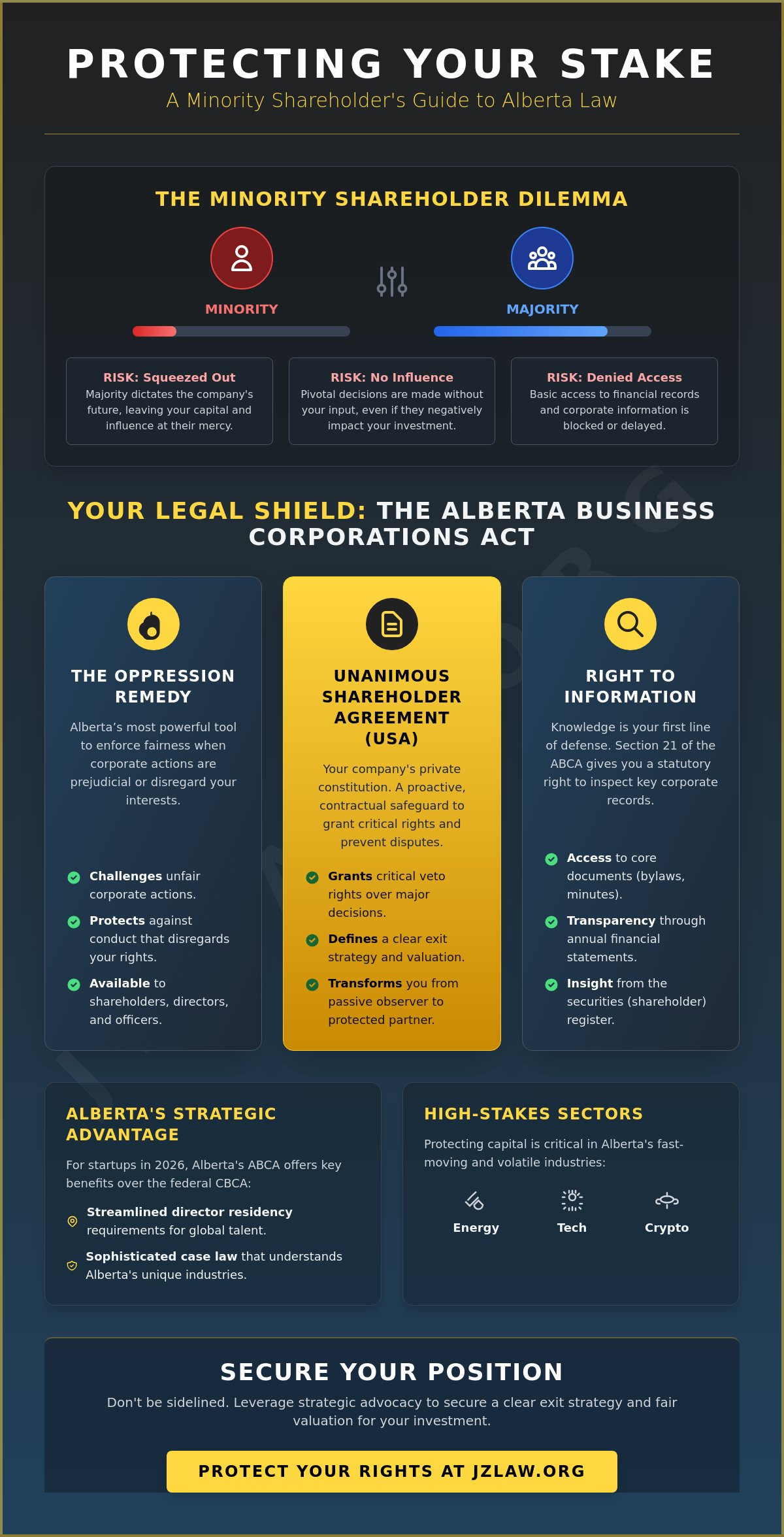
If you hold a minority stake in a private Alberta corporation, your most significant risk isn't market volatility; it's the potential for the majority to unilaterally dictate the company's future while you're left on the sidelines. It's a quiet but pervasive fear for many investors that they'll be squeezed out of a successful venture or denied basic access to corporate financial records. You've likely felt the mounting anxiety that comes when majority directors make pivotal decisions without your input, leaving your capital and your influence at the mercy of their whims.
We understand that protecting minority shareholder rights alberta requires more than just hope; it demands a proactive, strategic framework built on the rigorous application of the Alberta Business Corporations Act. In this guide, you'll learn how to transform your position from a passive observer to a protected partner with enforceable veto rights and guaranteed transparency. We'll examine the specific legal mechanisms available in 2026, from the powerful oppression remedy to the structural safeguards of a Unanimous Shareholder Agreement, ensuring you possess a clear exit strategy and a fair valuation for your investment.
Key Takeaways
Master the nuances of the oppression remedy to effectively challenge corporate actions that are unfairly prejudicial or disregard your interests as a stakeholder.
Explore how a well-structured Unanimous Shareholder Agreement functions as a private constitution to grant you critical veto rights over fundamental company changes.
Implement sophisticated legal frameworks for protecting minority shareholder rights alberta to ensure you aren't sidelined during major corporate transactions.
Identify unique vulnerabilities within Alberta's energy and cryptocurrency sectors, focusing on protecting your capital and influence in high-stakes environments.
Leverage strategic advocacy to secure a clear exit strategy and fair valuation, preventing the common pitfalls of being squeezed out by majority directors.
Table of Contents
The Legal Framework: Minority Rights Under the Alberta Business Corporations Act (ABCA)
Corporate governance in Alberta operates on the fundamental principle of "majority rule," which grants the holders of the most shares the authority to control the board and dictate company direction. While this ensures operational efficiency, it creates a structural vulnerability for minority holders who may find their capital locked in a venture where they have no influence. Without a robust strategy, your investment is subject to the whims of the majority, who might prioritize their own interests over the long term health of the corporation. The ABCA is the legislative bedrock for corporate governance in Calgary and across Alberta.
The law doesn't leave minority holders entirely defenseless against the weight of the majority. Alberta courts apply the "reasonable expectations" test to determine if a shareholder's rights have been violated. This test isn't limited to the literal text of the corporate bylaws; it considers the specific history and commercial context of the relationship between shareholders. If a minority investor joined a company with the understanding that they would have a seat on the board or a specific dividend policy, and the majority later unilaterally rescinds those benefits, the court may intervene. This judicial scrutiny is often the foundation for seeking an Oppression Remedy, which remains the most powerful statutory tool for correcting corporate misconduct.
ABCA vs. CBCA: Why Jurisdiction Matters in 2026
In 2026, the choice between the ABCA and the federal Canada Business Corporations Act (CBCA) is a critical strategic decision. Alberta remains a premier jurisdiction for energy and tech startups because it has streamlined director residency requirements, allowing for global talent to lead local firms without the administrative friction found at the federal level. Additionally, Alberta courts have developed a sophisticated body of case law regarding "unfair prejudice" that reflects the province's entrepreneurial landscape. Protecting minority shareholder rights alberta is often more effective under the provincial act because the local judiciary understands the unique capital structures and rapid scaling common in the Calgary tech and energy sectors.
The Statutory Right to Information
Knowledge is your first line of defense. Under Section 21 of the ABCA, you possess a statutory right to inspect corporate records that the majority cannot easily block. These rights include:
Core Documents: The right to inspect the articles of incorporation, bylaws, and minutes of shareholder meetings.
Financial Transparency: The right to receive annual financial statements to verify how capital is being deployed.
Securities Register: Access to the list of shareholders to understand the current distribution of power.
To exercise these rights, you must issue a formal, written request for records. If the corporation refuses or delays, you can seek a court order to compel disclosure. Ensuring you have consistent access to this data is essential for protecting minority shareholder rights alberta and identifying potential oppression before it results in irreparable financial loss.
The Oppression Remedy: Alberta’s Most Powerful Protection Tool
The Alberta Business Corporations Act (ABCA) provides a versatile shield for those who lack voting control. While the Act establishes the rules, the oppression remedy is the mechanism that enforces fairness when those rules are used as weapons. This remedy is available to a broad range of complainants, including current and former shareholders, directors, and officers. It allows the Court of King’s Bench to intervene when corporate conduct is found to be oppressive, unfairly prejudicial, or characterized by an unfair disregard for a stakeholder's interests. Protecting minority shareholder rights alberta requires a deep understanding of these three distinct legal thresholds.
Oppression typically involves a visible departure from the standards of fair dealing. Unfair prejudice covers acts that might be legal but result in an inequitable impact on a specific party. Unfair disregard is the most flexible tier, often applying when a majority simply ignores the minority's interests during a decision making process. The oppression remedy protects not just legal rights, but the "reasonable expectations" of the parties.
The court's authority in these matters is remarkably expansive. A judge can restrain the conduct in question, appoint a receiver, or even order the liquidation and dissolution of the company if the relationship has become unsalvageable. This flexibility allows for solutions tailored to the specific commercial reality of the dispute, rather than a one size fits all judgment.
Common Examples of Oppressive Conduct
Most disputes in Alberta’s business community arise from a few recurring patterns. You might recognize these tactics if you feel your influence is slipping:
Squeeze-outs: Forcing a minority holder to sell their shares at a significant undervalue through coercive tactics or isolation from corporate affairs.
Compensation Imbalance: Withholding dividends from shareholders while simultaneously increasing the salaries or bonuses of majority management to drain corporate cash.
Dilution: Issuing new shares to insiders for the sole purpose of shrinking your percentage of ownership and neutralizing your voting power.
Derivative Actions: Suing on Behalf of the Corporation
Sometimes the harm isn't done directly to you, but to the company itself. In these cases, a derivative action is the appropriate path. Unlike the oppression remedy, which seeks to rectify a personal wrong, a derivative action allows you to sue third parties or directors in the name of the corporation. Alberta courts require you to prove you're acting in "good faith" and that the action is in the "best interests of the corporation."
The process requires obtaining "leave" from the court before the lawsuit can proceed. This procedural hurdle ensures that the litigation isn't frivolous. Our team at JZ Law provides the strategic counsel necessary to navigate these leave-to-sue applications with precision, ensuring that corporate assets are protected from mismanagement. Choosing between a derivative action and an oppression claim is a tactical decision that defines the trajectory of your legal protection.
Unanimous Shareholder Agreements (USA): Contractual Safeguards
Statutory protections are essential, but they often require costly litigation to enforce after the damage is already done. A Unanimous Shareholder Agreement (USA) acts as a private constitution, allowing parties to override the default "majority rule" of the ABCA and establish their own governance standards. By proactively defining the relationship, you secure rights that the law alone does not guarantee. This is the most effective proactive strategy for protecting minority shareholder rights alberta, as it shifts the burden from reactive court battles to clear, pre-negotiated boundaries.
Without a USA, the majority can often issue shares or sell significant assets with a simple majority vote. Contractual safeguards introduce veto rights for fundamental changes, such as mergers, the sale of primary assets, or the incurrence of substantial debt. Anti-dilution clauses are equally vital; they ensure that if the company raises capital in 2026, you have the right to maintain your percentage of ownership by participating in the round on a pro-rata basis. These provisions prevent the "squeeze-out" scenarios where a minority holder's influence is systematically eroded through the issuance of new equity to insiders.
Essential Clauses for Minority Protection
Effective agreements go beyond high-level concepts and focus on specific operational leverage. Tag-along, or piggy-back, rights ensure that if the majority sells their stake to a third party, you have the right to join that transaction on identical terms. Board representation is another non-negotiable for serious investors; it guarantees you a seat at the table regardless of share percentage. For high-stakes decisions like acquisitions or changes to the nature of the business, super-majority requirements ensure the minority has a functional voice in the company's destiny.
Enforcement and Dispute Resolution
When conflicts arise, the structure of your resolution mechanism determines the cost and speed of the outcome. In 2026, many Alberta businesses prefer private arbitration over public litigation to maintain confidentiality and resolve disputes faster. A well-drafted USA provides the roadmap for these situations, often including "Shotgun" clauses or Rights of First Refusal (ROFR) to manage exits cleanly without devaluing the company. Understanding the interplay between Oppression and Derivative Relief and your contractual rights is key to a robust defense.
Strategic planning at the inception of a venture is the best way to avoid the Court of King’s Bench later. Professional guidance in Strategic Corporate Transactions is essential for structuring these agreements to reflect the unique risks of your industry. By redrafting governing documents to include these safeguards, you take the most critical step in protecting minority shareholder rights alberta and securing your financial future.
Industry-Specific Risks: Energy, Tech, and Crypto in Alberta
General corporate principles provide a baseline, but the practical application of protecting minority shareholder rights alberta changes significantly depending on the sector. In Alberta's resource-heavy economy and burgeoning tech hubs, the nature of your investment dictates the specific legal vulnerabilities you face. A strategy that works for a real estate holding company will likely fail in a high-stakes oil and gas joint venture or a volatile cryptocurrency startup. Each industry has its own "pressure points" where majority interests can easily override minority expectations if not properly checked by industry-specific safeguards.
Tax considerations also play a silent but dominant role in how minority interests are managed. With the Alberta general corporate tax rate at 8% in 2026, and the small business rate at 2%, the way a company structures its income impacts the "fairness" of shareholder distributions. Majority owners might use complex tax structuring to shift profits into areas where minority holders have less entitlement or higher tax burdens. Understanding these fiscal mechanics is essential for ensuring that your net exit value reflects the true worth of your position.
Protecting Interests in Energy Ventures
In Alberta energy ventures, the distinction between a shareholder and a royalty holder is critical. Minority holders in oil and gas corporations often face unique risks related to capital expenditure (CAPEX) calls. If you're a non-operator or a minority investor, the majority may initiate aggressive drilling programs that require immediate capital injections, potentially diluting your stake if you cannot meet the call. Within the Oil and Gas Law framework, transparency in these operations is paramount. Recent 2026 litigation, such as Flowers v Persist Oil and Gas Inc., demonstrates how courts are strictly interpreting lease uses, which directly affects the underlying asset value for shareholders. Ensuring your agreement includes a right of first offer on asset-heavy disposals is a primary method for protecting minority shareholder rights alberta in the energy patch.
Fintech and Cryptocurrency Governance
The cryptocurrency sector presents a new legal frontier where traditional equity often clashes with digital asset allocation. In 2026, as the Canadian Investment Regulatory Organization (CIRO) implements new custody rules for crypto assets, governance in decentralized or semi-decentralized Alberta entities has become more complex. Minority holders must distinguish between their rights as shareholders and their rights as token-holders. Founder disputes often lead to "token-burns" or changes in protocol that can devalue your investment without a single share being traded. Consulting a Cryptocurrency Law expert is the only way to ensure your governance documents account for these digital nuances. If you are navigating a dispute in these emerging sectors, you need a partner who understands the intersection of tech and tradition. Contact JZ Law today to secure your strategic position.
Strategic Advocacy: How JZ Law Protects Your Position
Advocacy in corporate disputes isn't merely about knowing the statutes; it's about the precise application of those rules to achieve a specific commercial objective. John Zang’s approach centers on a meticulous evaluation of the risk profile, ensuring that every move strengthens your leverage without unnecessarily destabilizing the enterprise. Protecting minority shareholder rights alberta is a discipline that requires both the foresight to prevent conflict and the resolve to assert authority when boundaries are crossed. We view our role not just as legal representatives, but as strategic partners who understand that your capital is at stake.
Pre-emptive protection remains the most cost effective strategy for any investor. By reviewing and redrafting governing documents, we close the loopholes that majority directors often exploit during "squeeze-out" attempts or unilateral decision making processes. When a dispute has already matured, our focus shifts to negotiation tactics designed to extract fair value. We aim for resolutions that respect your contribution, often securing buy-outs or restructured governance that restores your influence. If a consensus isn't possible, we're prepared to assert your rights in the Alberta Court of King’s Bench, where we navigate the procedural complexities of the ABCA with surgical precision.
The JZ Law Advantage in Corporate Disputes
We specialize in high-stakes, complex regulatory environments where the margin for error is non-existent. Our firm prioritizes strategic outcomes over billable hours, ensuring that the legal path we choose aligns with your long term financial goals. Whether you're based in Calgary, Toronto, or Vancouver, our counsel is tailored to the specific jurisdictional nuances that impact your position. This modern, business centric approach allows us to manage disputes in the tech and energy sectors with a level of sophistication that traditional firms often lack.
Next Steps for Minority Shareholders
If you suspect your interests are being sidelined, the time for passive observation has ended. Protecting minority shareholder rights alberta begins with a clear assessment of your current legal standing and the documentation of corporate conduct. We recommend the following immediate actions to secure your position:
Audit Your Agreement: Conduct a "health check" on your current shareholder agreement to identify missing veto rights, anti-dilution clauses, or exit strategies.
Evidence Gathering: Document every instance of potential oppressive conduct, including withheld financial statements, excluded meetings, or suspicious capital calls.
Strategic Review: Assess whether the current corporate direction aligns with the "reasonable expectations" established at the start of your investment.
Don't wait for a squeeze-out to become a reality before seeking professional counsel. Contact JZ Law for a strategic consultation on your shareholder rights and take the first step toward securing your corporate future.
Securing Your Strategic Position in Alberta’s Evolving Economy
Navigating the complexities of corporate governance in 2026 requires more than a basic understanding of the law. It demands a proactive stance where statutory remedies and contractual safeguards work in tandem to shield your capital from majority overreach. We've examined how the oppression remedy serves as a vital judicial corrective and why a sophisticated Unanimous Shareholder Agreement remains your most effective pre-emptive tool. Protecting minority shareholder rights alberta is a strategic necessity for long term growth, particularly within the volatile landscapes of energy and emerging tech.
To navigate these high stakes environments with confidence, you need a partner who understands the intricate balance between ABCA and CBCA regulations. Our boutique service, led by principal lawyer John Zang, offers specialized advocacy with a deep focus on oil and gas and the cryptocurrency sector. Secure your corporate interests with expert counsel from JZ Law and ensure your investment is treated with the precision it deserves. You don't have to face the weight of majority decisions alone when you have a strategic partner dedicated to your security.
Frequently Asked Questions
What is the "oppression remedy" in Alberta corporate law?
The oppression remedy is a flexible statutory tool under the Alberta Business Corporations Act designed to protect stakeholders from corporate misconduct. It allows the court to intervene when actions are found to be oppressive, unfairly prejudicial, or characterized by an unfair disregard for a party's interests. This mechanism is the primary way of protecting minority shareholder rights alberta, granting the judiciary broad powers to restrain conduct or restructure the corporation to restore fairness.
Can a majority shareholder fire a minority shareholder who is also an employee?
While a majority can generally terminate an employee, doing so may trigger an oppression claim if the employment was a fundamental part of the shareholder's "reasonable expectations." If the investment was predicated on active participation in management, firing the individual might be viewed as a "freeze-out" tactic. In such cases, the court may look beyond employment law to provide a remedy that addresses the loss of corporate influence and economic benefits.
How much does it cost to sue for shareholder oppression in Alberta?
Legal costs depend on the complexity of the dispute, but the Court of King’s Bench has fixed filing fees for 2026. Commencing an action through a Statement of Claim costs $300, while setting a matter for trial requires a fee of $600. For trials lasting five days or longer, a daily fee of $250 applies. These figures exclude professional legal fees, which vary based on the strategic requirements and duration of the litigation process.
What is a Unanimous Shareholder Agreement (USA) and do I need one?
A USA is a private contract between all shareholders that overrides the default governance rules of the ABCA. It's a critical document for anyone concerned with protecting minority shareholder rights alberta because it can mandate veto rights for major decisions and establish clear exit strategies. Without one, you're largely subject to majority rule, which can leave you vulnerable during fundamental changes like mergers, asset sales, or significant debt acquisitions.
Can I force the company to buy my shares if I am being mistreated?
Yes, the Alberta court has the authority to order a share buyback as a remedy for oppressive conduct. If the relationship between shareholders has become unsalvageable, a judge can compel the corporation or the majority holder to purchase your stake at "fair value." This valuation is typically determined without applying a minority discount, ensuring you receive a proportionate share of the company's total worth despite your lack of voting control.
What happens if a majority shareholder dilutes my shares without my consent?
If the majority issues new shares for an improper purpose, such as intentionally shrinking your ownership percentage, it's often considered oppressive. While companies can raise capital for legitimate business needs, using dilution as a weapon to neutralize a minority holder's influence is a violation of corporate duties. The court can cancel the improperly issued shares, adjust the ownership records, or order compensation to restore your original position and voting power.
How do I get access to the company’s financial records in Alberta?
You have a statutory right under Section 21 of the ABCA to inspect core corporate records and receive annual financial statements. This right includes access to the articles of incorporation, bylaws, minutes of shareholder meetings, and the securities register. If the majority directors refuse your request, you can seek a court order to compel disclosure. Maintaining consistent access to this information is essential for identifying mismanagement or financial irregularities early.
Is there a time limit for filing an oppression claim in Calgary?
The Limitations Act generally requires you to file a claim within two years of discovering the oppressive conduct. This two year period begins when you first knew, or ought to have known, that the majority's actions caused you injury or disregarded your interests. Waiting too long can result in your claim being legally barred, so it's vital to document grievances and seek strategic counsel as soon as you identify potential misconduct.


Comments