


Share Purchase Agreement Lawyer Calgary: Strategic Legal Counsel for High-Stakes Transactions
- jzanglaw
- Jul 5
- 12 min read
Could a single overlooked clause in your acquisition documents expose you to liabilities that outweigh the entire value of the transaction? In Calgary's sophisticated corporate environment, a share purchase agreement is far more than a record of sale; it's a high-stakes instrument of risk mitigation and tax optimization. You likely recognize that the pressure of due diligence and the complexity of Alberta's 2026 regulatory landscape can feel overwhelming, especially when the stakes involve the total transfer of a company's history and its hidden debts. Partnering with a dedicated share purchase agreement lawyer calgary ensures your transaction is not only legally sound but also structured to leverage Alberta's competitive 8% general corporate tax rate while shielding you from unforeseen financial pitfalls.
This article provides a strategic roadmap for achieving a legally bulletproof transaction. You'll learn how to identify undisclosed liabilities before they become your problem, secure clear exit and transition terms, and navigate the specific thresholds of the Investment Canada Act to protect your capital. We'll explore how expert legal guidance tailored for Calgary's corporate landscape can transform a complex deal into a secure, tax-efficient transition that protects your interests from the first draft to the final signature.
Table of Contents
What is a Share Purchase Agreement (SPA) and Why is it Critical for Calgary Businesses?
Anatomy of a Robust Share Purchase Agreement: Key Clauses and Protections
Asset Purchase vs. Share Purchase: Choosing the Right Transaction Structure
Navigating Sector-Specific SPAs: Cannabis, Energy, and Emerging Tech
Why Strategic Legal Counsel is Essential for Calgary Share Transactions
What is a Share Purchase Agreement (SPA) and Why is it Critical for Calgary Businesses?
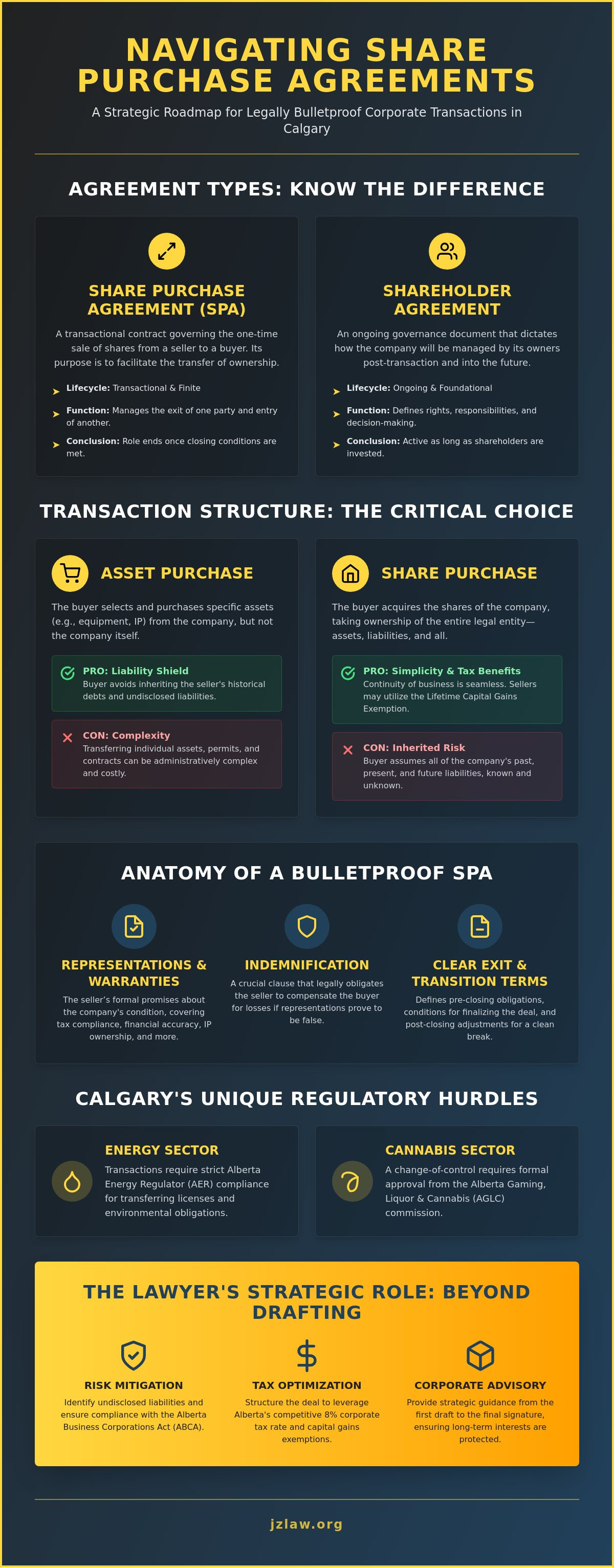
A Share Purchase Agreement (SPA), frequently documented as a Purchase and Sale Agreement (PSA), is the definitive legal contract that governs the transfer of ownership in a private corporation. While an asset purchase allows a buyer to select specific equipment or intellectual property, a share transaction involves the acquisition of the entire business entity. This means the purchaser steps into the shoes of the previous owner, inheriting the company’s full history, including every past tax filing, employee contract, and potential legal claim. Because of this "entity-level" transfer, engaging a share purchase agreement lawyer calgary is a vital step to ensure that the buyer isn't unknowingly assuming catastrophic liabilities that could devalue the investment.
Calgary businesses operate under the rigorous framework of the Alberta Business Corporations Act (ABCA). This legislation sets the ground rules for how shares are issued, valued, and transferred. An SPA that fails to align with these statutory requirements can lead to a transaction being voided or challenged in court years after the closing date. A strategic legal partner doesn't just fill in a template; they structure the deal to protect your capital and ensure the transition complies with Alberta's specific corporate governance standards.
The Legal Significance of Share Transfers in Alberta
In the Alberta corporate landscape, the Minute Book serves as the ultimate source of truth for ownership. If a share transfer isn't meticulously recorded in the central securities register, the law may not recognize the new owner's rights. The ABCA often imposes transfer restrictions that require formal director or shareholder approvals before a sale can proceed. A share purchase agreement lawyer calgary manages these complexities by ensuring all corporate "housekeeping" is completed before funds change hands. Ultimately, the SPA stands as the primary shield against post-closing litigation by defining exactly when the seller's responsibility ends and the buyer's begins.
Share Purchase vs. Shareholder Agreement: Clearing the Confusion
Many entrepreneurs mistake these two documents, yet they serve entirely different lifecycles. An SPA is transactional; its primary function is to facilitate the exit of one party and the entry of another, effectively concluding its role once the closing conditions are met. Conversely, a Shareholder Agreement is an ongoing governance document that dictates how the company will be managed moving forward. For Calgary founders, a share sale often triggers the need to amend or replace an existing Unanimous Shareholder Agreement (USA). You need both instruments to ensure a clean break for the seller and a stable foundation for the buyer's future operations.
Anatomy of a Robust Share Purchase Agreement: Key Clauses and Protections
A well-drafted Definitive Purchase Agreement serves as the technical blueprint for a successful acquisition. It doesn't just outline the purchase price; it allocates risk between the parties through a series of interlocking clauses. For a buyer, the goal is to ensure the company they're acquiring is exactly as described. For a seller, the priority is to limit post-closing liability and ensure a clean exit. Achieving this balance requires a share purchase agreement lawyer calgary who understands the nuances of local industry standards and the specific protections required to safeguard capital in a high-stakes environment.
Representations and Warranties: Protecting the Buyer
Representations and warranties are the seller’s formal assertions regarding the company’s current state. Essential "reps" typically cover financial statement accuracy, tax compliance, and the clear ownership of intellectual property. If these promises prove false, the buyer has a legal path to recovery. To mitigate risk, sellers use "Disclosure Schedules" to list exceptions to these representations. If a liability is disclosed here, the buyer generally cannot claim a breach later. In 2026, many Calgary mid-market deals are increasingly utilizing Representations and Warranties Insurance (RWI). This specialized insurance product shifts the risk of a breach from the seller to an insurer, often simplifying the negotiation of indemnity limits and survival periods.
Indemnification and Escrow: Securing the Deal
Indemnification is the mechanism that provides financial compensation if a representation is breached. These obligations are governed by "Survival Periods," which dictate how long a claim can be brought after closing. While general reps might survive for 18 to 24 months, "fundamental" reps regarding ownership or "tax" reps often survive for much longer. To ensure funds are available for these claims, buyers frequently insist on holdbacks or escrow accounts where a portion of the purchase price is set aside for a fixed term. Sellers often negotiate "Baskets," which act as a deductible to prevent minor claims, and "Caps," which limit the seller’s total liability to a specific percentage of the deal value. Proactively addressing these mechanics with strategic corporate transactions counsel can prevent costly disputes during the post-closing period.
Beyond these financial protections, a robust SPA must include "Conditions Precedent." These are the specific requirements, such as obtaining third-party consents or regulatory approvals, that must be satisfied before the transaction can officially close. Finally, restrictive covenants like non-compete and non-solicitation clauses are essential. They prevent the seller from immediately launching a competing venture or poaching key staff, thereby preserving the goodwill the buyer just paid to acquire. Precision in these clauses isn't just a legal formality; it's the foundation of your investment’s security.
Asset Purchase vs. Share Purchase: Choosing the Right Transaction Structure
Selecting the optimal transaction structure is a pivotal decision that dictates the long term financial and legal health of both parties. In a share purchase, the buyer acquires the entire corporate entity, which includes all assets, contracts, and, crucially, all historical liabilities. Conversely, an asset purchase allows the buyer to "cherry-pick" specific equipment, inventory, or intellectual property while leaving behind unwanted debts or legal entanglements. Because the risks vary so significantly between these two paths, consulting an experienced share purchase agreement lawyer calgary is essential to determine which model aligns with your strategic objectives and risk tolerance.
The choice also creates a fundamental tension regarding tax treatment. Buyers typically favor asset purchases because they can "step up" the cost basis of the acquired assets to the purchase price, allowing for greater future depreciation and tax savings. In a share deal, the buyer simply inherits the company’s existing cost base. Sellers, however, almost universally prefer share sales. This preference is driven by the ability to access significant tax exemptions that are unavailable in asset transactions. Balancing these competing interests requires precise negotiation and a deep understanding of Alberta's 2026 corporate tax environment.
Tax Structuring and the Lifetime Capital Gains Exemption (LCGE)
For Calgary business owners, the primary motivation for a share sale is the Lifetime Capital Gains Exemption (LCGE). This powerful tool can potentially render a significant portion of the sale proceeds tax-free, provided the company meets the "Qualified Small Business Corporation" (QSBC) criteria. In 2026, this requires the corporation to be a Canadian-controlled private corporation where at least 90% of the assets are used in active business at the time of sale. For a more comprehensive look at these requirements, see our guide on Strategic Corporate Transactions 2026. Without a meticulously drafted SPA that accounts for these QSBC rules, sellers risk losing millions in potential tax savings.
Liability Insulation: Why Buyers Often Prefer Asset Deals
Buyers often view asset purchases as a "clean slate" because they can explicitly exclude unknown or contingent liabilities, such as past employment disputes or environmental claims. However, asset deals are frequently more complex to execute. They require the individual assignment of every contract and lease, often necessitating dozens of third-party consents that can delay or derail a closing. A skilled share purchase agreement lawyer calgary can bridge this gap by drafting an SPA with robust indemnities and holdbacks that mimic the liability protections of an asset deal while maintaining the operational simplicity of a share transfer. Ultimately, while an asset purchase acts as a surgical extraction of value, a share purchase represents a wholesale adoption of a company's entire legal and financial footprint.
Navigating Sector-Specific SPAs: Cannabis, Energy, and Emerging Tech
Generic legal templates are insufficient for Calgary’s specialized economic landscape. A share purchase agreement lawyer calgary must account for the specific regulatory bodies governing a target company’s operations to prevent a transaction from triggering unintended legal defaults. In the cannabis sector, for example, a share transfer is often classified as a "change of control" that necessitates prior approval from the AGLC or Health Canada. If these approvals aren't meticulously included as conditions precedent within the SPA, the buyer may find themselves owning a company that has lost its legal authority to operate the moment the deal closes.
Regulatory Hurdles in Calgary’s Key Industries
Energy sector transactions require a distinct analytical lens. An SPA for an oilfield services firm or an exploration company needs deep Oil and Gas Law expertise to address environmental liabilities and Alberta Energy Regulator (AER) compliance. These aren't merely financial risks; they're operational mandates. Change of control clauses in this industry often trigger mandatory reviews of reclamation bonds or license eligibility. Consequently, regulatory due diligence must occur in parallel with financial audits to ensure the buyer isn't acquiring a business that’s legally incapacitated. Secure your next transaction by consulting with John Zang for a sector-specific legal strategy that anticipates these hurdles.
Emerging Tech and Digital Assets
The tech and cryptocurrency sectors introduce unique complexities regarding intellectual property and asset custody. Acquisitions involving digital assets require specific representations concerning FINTRAC registration transfers and the cryptographic security of private keys. In founder-led startups, "Key Person" clauses are essential to ensure the talent behind the innovation remains with the company long enough to facilitate a successful transition. The SPA must also verify a clean "Assignment of Invention" chain to confirm that the company actually owns the software or patents it claims to possess. For startups with international IP holdings, tax structuring becomes a multi-jurisdictional challenge that requires a proactive, strategic approach from a share purchase agreement lawyer calgary who understands the global tech economy.
Whether you're acquiring an energy firm or a fintech startup, the SPA must serve as a tailored instrument of protection. Precision in drafting these sector-specific clauses ensures that your investment is protected from the unique regulatory and operational risks of your industry. A strategic legal partner doesn't just manage the paperwork; they visualize the post-closing operational reality to ensure a seamless transition of ownership.
Why Strategic Legal Counsel is Essential for Calgary Share Transactions
High-stakes transactions demand more than clerical precision; they require a strategic partner who anticipates the complex intersection of law, tax, and business operations. Many firms treat the Share Purchase Agreement as a static template, yet a truly effective share purchase agreement lawyer calgary views the document as a dynamic risk-management tool. At JZ Law, our approach transcends standard document drafting. We provide comprehensive corporate advisory that aligns your legal structure with your long-term commercial goals, ensuring that every clause serves a specific strategic purpose while maintaining professional dignity and logical clarity.
Boutique expertise offers a distinct advantage over traditional "big law" structures. Clients receive direct, senior-level attention from John Zang, whose experience in managing complex regulatory and tax-sensitive deals provides a level of agility that larger organizations often struggle to match. This focused representation ensures that your transaction isn't just another file in a high-volume system. Instead, it's a priority handled with the methodical care and professional composure necessary for long-term trust and success. We don't just execute instructions; we act as strategic partners who understand the business interests and market processes behind the deal.
Proactive risk mitigation begins long before the final SPA is drafted. Involving a share purchase agreement lawyer calgary during the Letter of Intent (LOI) stage is the most effective way to control costs and prevent "deal creep." The LOI sets the commercial floor for the entire transaction. By defining fundamental commercial and legal parameters early, we eliminate the ambiguity that frequently leads to protracted negotiations and expensive post-closing disputes. This preventive mindset is a hallmark of our practice, focusing on the elimination of risks before they can manifest as liabilities.
The JZ Law Advantage: Precision and Strategy
Our firm excels in multi-jurisdictional transactions, seamlessly bridging the legal requirements of Calgary with other global business hubs like Denver and New York City. This international perspective is paired with a commitment to "closing-ready" documentation, which minimizes friction and prevents last-minute delays during the final stages of a deal. We integrate sophisticated tax structuring into every transaction, ensuring that your exit or entry is as capital-efficient as possible under Alberta's 2026 tax framework. Our work is characterized by logical closure and a refusal to accept "standard" terms that don't serve your unique needs.
Getting Started: Your Transaction Roadmap
The roadmap to a successful closing starts with a focused initial consultation at JZ Law. During this session, we analyze your specific objectives and identify potential regulatory or tax hurdles before they become obstacles to your progress. This systematic approach ensures that every deal is handled with the depth and patience it deserves. Securing your corporate interests requires a pro-active stance and a partner who understands the high stakes of Calgary’s corporate landscape. Contact JZ Law to secure your corporate interests and ensure your next transaction is built on a foundation of professional excellence and strategic foresight.
Secure Your Corporate Legacy with Strategic Transactional Counsel
A successful business transition requires more than just a signed document; it necessitates a comprehensive legal strategy that accounts for Alberta's rigorous corporate regulations and the specific operational risks of your industry. Whether you're navigating the complex change of control requirements of the cannabis sector or seeking to maximize tax efficiency through the Lifetime Capital Gains Exemption, the structure of your deal will dictate your financial future. Engaging a dedicated share purchase agreement lawyer calgary ensures that every representation, warranty, and indemnity clause is calibrated to protect your capital and provide a clear, undisputed exit or entry.
JZ Law offers principal-led boutique service, providing the high-level expertise of John Zang in managing complex regulatory and tax-sensitive deals without the friction of traditional large-scale firms. By focusing on proactive risk mitigation and strategic tax-focused corporate counsel, we transform complicated transactions into secure, closing-ready opportunities. Don't leave your high-stakes deal to chance. Consult with JZ Law for your Calgary Share Purchase Agreement to ensure your corporate interests are professionally represented. We're committed to helping you achieve a seamless transition and lasting business success.
Frequently Asked Questions
What is the difference between an Asset Purchase and a Share Purchase in Alberta?
The primary difference lies in the scope of liability; a share purchase transfers the entire legal entity, while an asset purchase involves selecting specific items. In a share deal, the buyer inherits the company’s full history, including every past debt and legal obligation. Sellers in Calgary typically prefer share transactions to access the Lifetime Capital Gains Exemption, which can provide significant tax relief that isn't available in asset-based deals.
How long does it typically take to finalize a Share Purchase Agreement in Calgary?
Finalizing an agreement usually requires four to twelve weeks to complete the necessary due diligence and regulatory reviews. This timeline depends heavily on the complexity of the company’s structure and whether third-party consents are required. Transactions in regulated industries, such as energy or cannabis, may take longer due to mandatory change-of-control approvals from provincial or federal bodies. A methodical approach ensures that no critical details are overlooked during this period.
Can I use a template for a Share Purchase Agreement?
Templates are generally insufficient for high-stakes Calgary transactions because they fail to address specific Alberta tax implications and industry-specific risks. A share purchase agreement lawyer calgary ensures that your contract is tailored to the unique liability profile of the target company. Using a generic form often leads to gaps in indemnification or non-compliance with the Alberta Business Corporations Act, which can result in costly post-closing litigation or tax penalties.
What is a "disclosure schedule" and why is it important for the seller?
A disclosure schedule is a formal list of exceptions to the seller’s representations and warranties. It's a critical defensive tool because it shifts the risk of known issues to the buyer; once a liability is disclosed in this document, the buyer generally cannot claim a breach of contract for that specific issue later. Precise drafting of these schedules is essential for a seller to ensure a clean exit and minimize future indemnity claims.
Do I need a lawyer for a share sale if we already have a Letter of Intent (LOI)?
Legal counsel is essential at this stage because the Letter of Intent only provides a high-level framework rather than binding risk allocation. Involving a share purchase agreement lawyer calgary during the transition from an LOI to a definitive agreement protects you from "deal creep" and unfavorable clauses. Counsel ensures that the complex mechanics of the final SPA accurately reflect the commercial intent while building in necessary protections for your capital.
How does the Alberta Business Corporations Act affect share transfers?
The Alberta Business Corporations Act (ABCA) governs the procedural validity of every share transfer within the province. It dictates how shares must be issued, the requirements for director approvals, and the mandatory updates to the corporation’s central securities register. If these statutory requirements aren't met, the transfer may be legally void. Precision in following these rules is what ensures that the buyer truly owns the shares they've purchased.
What happens if a seller breaches a representation after the deal closes?
Post-closing breaches are resolved through the indemnification mechanism defined in the Share Purchase Agreement. The buyer typically files a claim for financial recovery, which may be paid out of an escrow account or a holdback of the purchase price. These claims are subject to survival periods and financial limits, such as baskets and caps, which are negotiated during the drafting phase to provide certainty for both parties.
Are there specific legal requirements for share sales in the Calgary oil and gas sector?
Calgary energy transactions must satisfy specific Alberta Energy Regulator (AER) requirements regarding license eligibility and environmental liabilities. Deals in this sector often involve Directive 067 reviews to ensure the buyer is a capable operator and has sufficient reclamation security in place. The SPA must include specific representations regarding well-site compliance and historical environmental data to protect the buyer from assuming massive, undisclosed cleanup costs.


Comments