


Strategic Legal Advice for Startups in Calgary: Navigating Complex Regulations in 2026
Could the very regulations you fear actually become your startup's most potent competitive advantage? For high-growth founders, the search for strategic legal advice for startups calgary often begins with a sense of dread over FINTRAC requirements or the intricate cannabis licensing landscape. It's a valid concern, as the complexity of the 2026 regulatory environment can feel like a barrier to entry. You're likely balancing the need for a legally sound corporate structure with the reality of director liability and the prohibitive costs of traditional big-firm services.
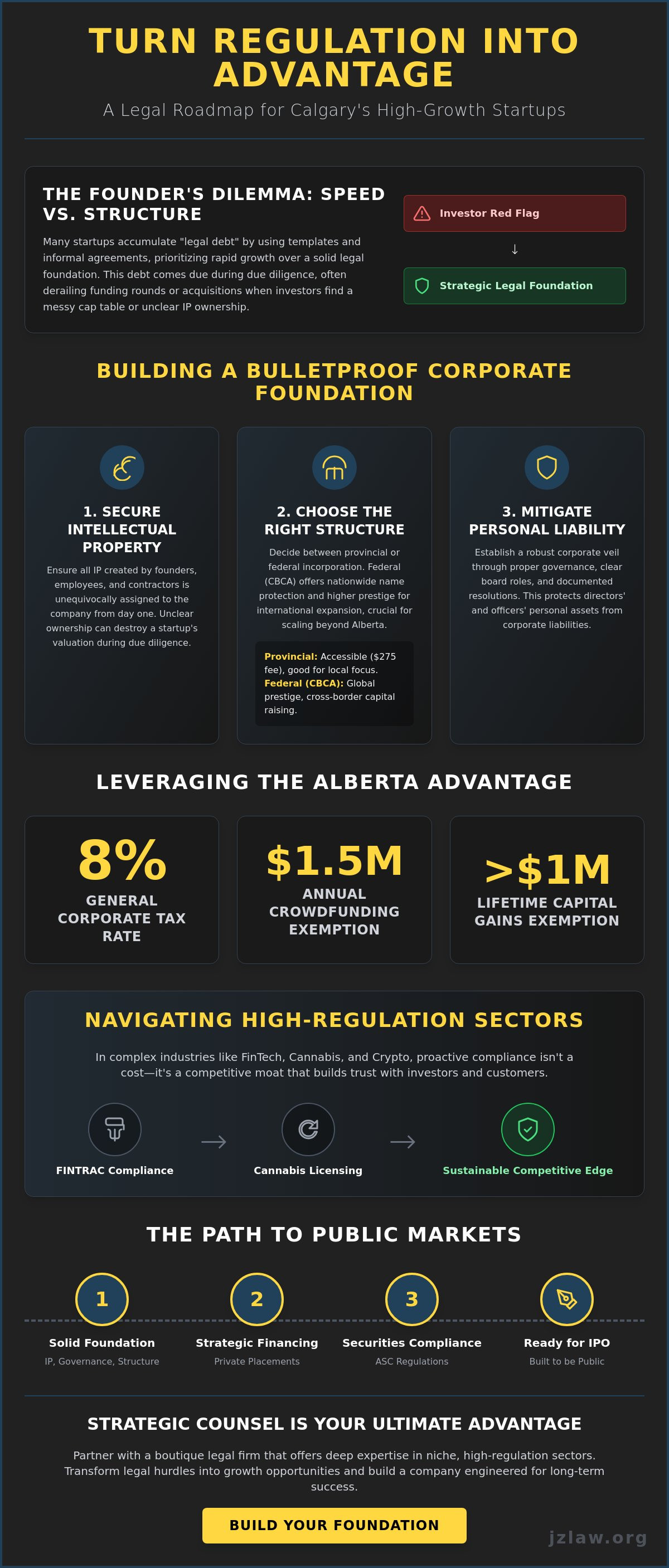
We understand that your goal isn't just to survive a compliance audit, but to build a venture that's inherently ready for future financing or a public listing. This guide provides a comprehensive roadmap for mastering Alberta's unique business climate, from leveraging the 8% general corporate tax rate to utilizing the $1.5 million annual crowdfunding exemption. You'll learn how to establish a robust legal foundation that satisfies AER regulations and protects your leadership team. We'll examine the specific steps required to transition from a local innovator to a market leader prepared for the rigors of an IPO.
Table of Contents
The 2026 Calgary Startup Landscape: Why Legal Strategy Matters Now
Calgary's economic identity has undergone a profound transformation. The city's historical reliance on traditional energy has matured into a sophisticated ecosystem of energy-tech, fintech, and digital innovation. This shift means that the 2026 landscape is no longer just about operational efficiency. It's about regulatory agility. Seeking expert legal advice for startups calgary is no longer a luxury for the established few; it's a foundational requirement for any founder aiming to scale. The current environment demands a proactive approach to compliance, where legal strategy is viewed as a competitive asset rather than a back-office expense.
Many founders fall into the "legal debt" trap by prioritizing speed over structural integrity. They rely on templated documents or informal agreements that inevitably fail under the scrutiny of a Series A due diligence process. If your cap table is messy or your intellectual property isn't properly assigned, sophisticated investors will walk away. A Series A round isn't just a test of your product. It's a rigorous audit of every decision you've made since inception. A generalist lawyer might help you sign a lease, but a strategic corporate counsel ensures your company is built to be bought or taken public.
Understanding the nuances of Canadian corporate law is essential for navigating the interplay between provincial flexibility and federal standards. For instance, Alberta’s 8% general corporate tax rate provides a significant advantage, but capturing that value requires a structure that aligns with both the Alberta Securities Commission and federal tax authorities. We don't just execute transactions; we architect the corporate framework that supports long-term viability.
Beyond Basic Incorporation
While the $275 provincial filing fee makes Alberta incorporation accessible, it's rarely sufficient for high-growth firms. Founders must choose between provincial registration and federal incorporation under the CBCA. Federal status offers nationwide name protection and higher prestige for international expansion, which is vital if you're targeting global markets from a Calgary headquarters. Your choice today dictates your ability to raise capital across borders tomorrow.
The Founder’s Liability Trap
You've worked hard to build your vision, so don't leave your personal assets exposed. Maintaining a robust corporate veil is critical, especially in high-volatility sectors like cryptocurrency or cannabis. Directors and officers in Alberta face specific legal responsibilities that can lead to personal liability if fiduciary duties aren't met. We focus on mitigating these risks through structured governance and comprehensive D&O oversight, ensuring that your innovation doesn't come at the cost of your financial security.
Establishing a Robust Corporate Foundation in Alberta
After you Register a business name in Alberta, the real work of corporate architecture begins. High-growth founders often underestimate the importance of intellectual property (IP) assignment. If the company doesn't own the code, the brand, or the patent, it effectively owns nothing of value. We ensure that every founder, employee, and contractor signs comprehensive assignment agreements from day one. This proactive step is vital when seeking legal advice for startups calgary, as it prevents catastrophic valuation drops during a future acquisition or funding round. Investors don't just buy products; they buy clear, unencumbered ownership of innovation.
Establishing corporate governance early is equally critical for attracting institutional capital. This involves more than just keeping a minute book; it's about creating a transparent framework for decision-making. Clear board roles and documented resolutions signal to venture capitalists that your organization is managed with professional discipline. For companies operating with a remote-first or hybrid workforce, your employment and contractor agreements must also address jurisdictional complexities and data security. A foundation built on precision today eliminates the "legal debt" that often halts momentum during a Series A raise.
Strategic Tax Structuring for Founders
Founders should consider the exit at the moment of inception. The Lifetime Capital Gains Exemption (LCGE) is a powerful tool in Canada, potentially allowing you to shield over $1 million in capital gains from tax upon the sale of your shares. However, qualifying requires strict adherence to specific asset tests and holding periods. We often analyze whether a holding company or direct ownership better suits your long-term objectives. Integrating tax structuring into your corporate roadmap isn't just about saving money; it's about maximizing the wealth you eventually retain from your hard work.
The Shareholder Agreement: Essential Clauses
The "honeymoon phase" of a startup is a dangerous time to ignore potential conflict. A well-drafted Shareholder Agreement acts as the company's constitution, providing clarity when interests eventually diverge. It must include drag-along and tag-along rights to ensure a minority shareholder can't block a beneficial sale of the company. Shotgun clauses provide a definitive mechanism for resolving irreconcilable deadlocks, while vestment schedules for founders ensure that equity stays with those still committed to the vision. These mechanisms avoid costly litigation and keep the focus on growth. If you're ready to move beyond basic templates, exploring bespoke corporate transactions can provide the security your leadership team deserves.
Navigating Complex Regulatory Frameworks in Alberta
Regulatory compliance in 2026 is no longer a simple checkbox; it's a strategic barrier to entry that can be leveraged as a competitive advantage. For Calgary founders, this means understanding how provincial bodies like the Alberta Energy Regulator (AER) and the AGLC interact with federal mandates. While general Alberta Small Business Resources provide a helpful starting point, they often lack the technical depth required for high-growth firms in emerging sectors. Specialized legal advice for startups calgary is essential for developing a "regulatory-first" strategy that identifies potential friction points before they disrupt your go-to-market timeline.
Data privacy adds another layer of complexity to the operational landscape. Startups must reconcile Alberta’s Personal Information Protection Act (PIPA) with federal PIPEDA standards. This is especially vital for fintech and health-tech firms handling sensitive user data, where a single breach or compliance failure can erode investor trust instantly. Simultaneously, energy-tech innovators must stay ahead of AER requirements, ensuring their technology aligns with evolving environmental and operational mandates. Precision in these areas isn't just about avoiding fines. It's about building a brand that institutional partners can trust.
Cryptocurrency and Blockchain Compliance
Determining whether a digital asset qualifies as a security is the most critical question for blockchain ventures today. The Canadian Securities Administrators (CSA) continue to refine their stance, making compliance with provincial securities commissions a moving target. Beyond securities law, startups must implement rigorous Anti-Money Laundering (AML) and Know Your Customer (KYC) protocols to satisfy FINTRAC requirements. Our expertise in cryptocurrency law helps founders navigate these complexities, including the unique legal challenges posed by Decentralized Autonomous Organizations (DAOs).
Cannabis and Regulated Substances
The landscape for cannabis licensing remains one of the most bifurcated regulatory environments in Alberta. Founders must balance AGLC retail requirements with federal production standards under the Cannabis Act. Marketing restrictions are particularly punitive for cannabis-related tech, where even subtle promotional efforts can trigger significant fines. Securing security clearances for key personnel is another hurdle that requires meticulous preparation and a deep understanding of federal background check protocols. Obtaining legal advice for startups calgary ensures that your leadership team is prepared for the rigors of this highly scrutinized industry.
Scaling Toward Public Markets: Securities and Financing
The path from seed funding to venture capital is rarely linear. It requires a fundamental shift from informal networking to rigorous securities compliance. In Calgary, founders can leverage specific exemptions to raise capital without the immediate burden of a full prospectus. For example, the Alberta Start-up Business Exemption (ASC Rule 45-517) allows for raises up to $250,000 per distribution, with a lifetime maximum of $1 million. Navigating these exemptions is a core component of legal advice for startups calgary, as it provides the essential runway needed to reach institutional investors while maintaining regulatory integrity.
Energy-tech firms face unique hurdles where innovation meets legacy regulation. Financing these ventures often necessitates a deep understanding of oil and gas law, particularly when technology integrates with existing mineral rights or surface access agreements. We ensure that your financing structure accounts for these industry-specific complexities, positioning your startup as a viable partner for both tech VCs and traditional energy giants. This intersection of sectors requires a lawyer who understands both the agility of a startup and the rigid compliance standards of the energy industry.
IPO vs. Reverse Merger: Strategic Paths
Choosing the right exit or listing strategy is a high-stakes decision that dictates your company's future trajectory. While a traditional IPO is the gold standard for many, the TSX Venture Exchange's Capital Pool Company (CPC) program offers a compelling alternative. This reverse merger process allows a shell company to acquire an operating business, providing a streamlined path to public markets. We guide founders through the pros and cons of taking companies public, ensuring that your financial reporting and public disclosure systems meet the stringent requirements of the CSA. Preparation for this transition should begin years before the actual listing date.
Venture Capital and Term Sheets
When a VC term sheet arrives, the focus often shifts to valuation, but the most critical clauses are often those regarding liquidation preferences and anti-dilution rights. These terms dictate who gets paid first and how much control you retain after multiple rounds of financing. Protecting founder control is a strategic priority during these negotiations, as excessive dilution can erode your influence over the company's direction. We handle the legal mechanics of the closing process, ensuring your deal closes efficiently without sacrificing your long-term vision. If you're preparing for a significant capital raise, consider our expertise in securities regulation and financing to secure your company's future.
Strategic Counsel: The JZ Law Advantage for Startups
For founders in high-velocity sectors, the traditional big-firm model often feels mismatched with the pace of modern innovation. A boutique approach provides a level of agility and specialized focus that generalist practices simply can't replicate. When you seek legal advice for startups calgary, you aren't just looking for someone to file paperwork. You're looking for a strategist who understands the nuances of securities regulation and the complexities of the digital economy. We prioritize high-stakes corporate transactions over a broad, generalist practice, ensuring that our expertise remains sharp in the areas that matter most to your growth.
John Zang’s practice is built at the intersection of established corporate law and emerging technology. His deep experience in cryptocurrency law and regulatory compliance allows him to foresee obstacles that others might miss. Whether you're navigating the path of taking companies public or structuring a complex cross-border transaction, having direct access to principal counsel is a critical advantage. This isn't just about legal execution; it's about having a seat at the table with a partner who understands your business objectives as well as you do. We don't just react to changes; we proactively position your firm for long-term success.
A Partnership Built on Expertise
We've moved beyond the limitations of the "billable hour" to foster relationships rooted in actual value. Startups require consistent, high-stakes decision-making support that a junior associate at a large firm simply can't provide. By choosing JZ Law, you gain a partner with a global perspective. Our network spans key hubs like Toronto, Denver, and New York City, allowing Calgary-based firms to scale with confidence across international borders. You get the sophistication of a global practice with the personalized attention of a boutique firm.
Next Steps for Calgary Founders
The first step toward a robust legal foundation is a comprehensive "legal health check" of your current corporate structure. We help you prioritize legal tasks based on your upcoming milestones, whether that's a seed round or an eventual exit. It's much easier to fix structural issues early than to wait for a due diligence process to uncover them. Don't let regulatory complexity slow your momentum. We invite you to contact us for a strategic consultation to discuss how we can support your vision. Securing the right legal advice for startups calgary today is the best way to protect the value you're building for tomorrow.
Building a Future-Ready Enterprise in Calgary
The 2026 landscape for high-growth ventures in Alberta is defined by its complexity, but this complexity offers a unique opportunity for those who prioritize structural integrity. By moving beyond basic registration and focusing on robust shareholder agreements and intellectual property protection, you ensure that your company remains attractive to institutional investors. Navigating the intricate requirements of the AGLC or FINTRAC requires more than just generalist support; it demands a partner who understands the nuances of niche regulatory frameworks and the rigors of public market readiness.
Securing specialized legal advice for startups calgary is the most critical investment you can make in your company's long-term viability. JZ Law brings a unique blend of expertise in cannabis, crypto, and securities regulation, offering a strategic focus on complex corporate transactions that generalist firms often overlook. Our Calgary-based principal provides the global reach necessary for firms targeting expansion into markets like Toronto or New York. We invite you to Consult with JZ Law for Strategic Startup Counsel to begin architecting your organization's future with precision. Your vision deserves a foundation that's built to scale.
Frequently Asked Questions
Do I need a lawyer to incorporate my startup in Calgary?
While you can technically file the government paperwork yourself, it's rarely advisable for ventures seeking high-growth trajectories. A lawyer ensures your articles of incorporation and bylaws are structured to accommodate future investment rounds. This proactive approach prevents the "legal debt" that often halts Series A financing. Strategic legal advice for startups calgary provides the structural integrity necessary for long-term institutional trust.
What is the difference between provincial and federal incorporation in Canada?
Provincial incorporation protects your business name within Alberta and is often faster to execute initially. Federal incorporation under the CBCA provides nationwide name protection and carries higher prestige for firms targeting international expansion. However, federal corporations must still complete extra-provincial registration in Alberta. Your choice depends on whether your primary market is regional or global and your long-term scaling objectives.
How does securities law affect my ability to raise money from friends and family?
Any issuance of shares is a trade in securities and must comply with the Alberta Securities Commission's regulations. Raising capital from friends and family usually relies on specific prospectus exemptions. You must ensure every investor meets the legal definition of a "close" relation to avoid regulatory penalties. Accurate documentation of these relationships is essential for maintaining compliance during future due diligence or institutional funding rounds.
What are the legal requirements for a cryptocurrency exchange in Alberta?
You must register as a Money Services Business with FINTRAC and comply with the Canadian Securities Administrators' guidelines for trading platforms. These requirements include robust Anti-Money Laundering and Know Your Customer protocols. Additionally, you'll need to address specific provincial securities laws regarding the custody of digital assets. Failure to meet these standards can lead to significant fines or the immediate suspension of your operations.
Can a Calgary startup sell cannabis products across Canada?
Selling cannabis across provincial borders generally requires a federal production license from Health Canada. Retail distribution is strictly governed by provincial authorities such as the AGLC in Alberta. A Calgary-based tech startup focusing on cannabis must navigate a patchwork of provincial regulations, as each jurisdiction has unique rules regarding marketing, promotion, and shipping. Compliance with the federal Cannabis Act remains the overarching requirement for all operators.
What is a Shareholder Agreement and why is it necessary for founders?
A Shareholder Agreement is a private contract that defines the rights and obligations of the company's owners. It acts as a constitution for the business, including mechanisms for dispute resolution, drag-along rights, and founder vesting schedules. Without this document, internal disagreements can lead to gridlock or expensive litigation. It's a cornerstone of effective legal advice for startups calgary that protects the company's valuation during periods of transition.
How much does legal advice for a startup typically cost in Calgary?
Legal costs for startups in Calgary are determined by the complexity of the regulatory environment and the scope of corporate transactions. While provincial filing fees are fixed, strategic counsel for sectors like energy-tech or fintech involves tailored engagement models. Founders should view legal expenses as a strategic investment in compliance and risk mitigation. Choosing a partner who understands your specific industry delivers more long-term value than seeking the lowest hourly rate.
What legal steps are required to take a Calgary company public on the TSX-V?
Taking a company public on the TSX Venture Exchange requires either a traditional Initial Public Offering or a reverse merger through the Capital Pool Company program. You'll need to prepare a detailed prospectus, provide audited financial statements, and satisfy the listing requirements of the exchange. This process demands a sophisticated corporate governance framework and a system for continuous public disclosure to meet the standards of the Alberta Securities Commission.



Comments