


Tokenization Legal Services in Canada: A 2026 Regulatory & Strategic Guide
- jzanglaw
- Jul 19
- 12 min read
Updated: 6 days ago
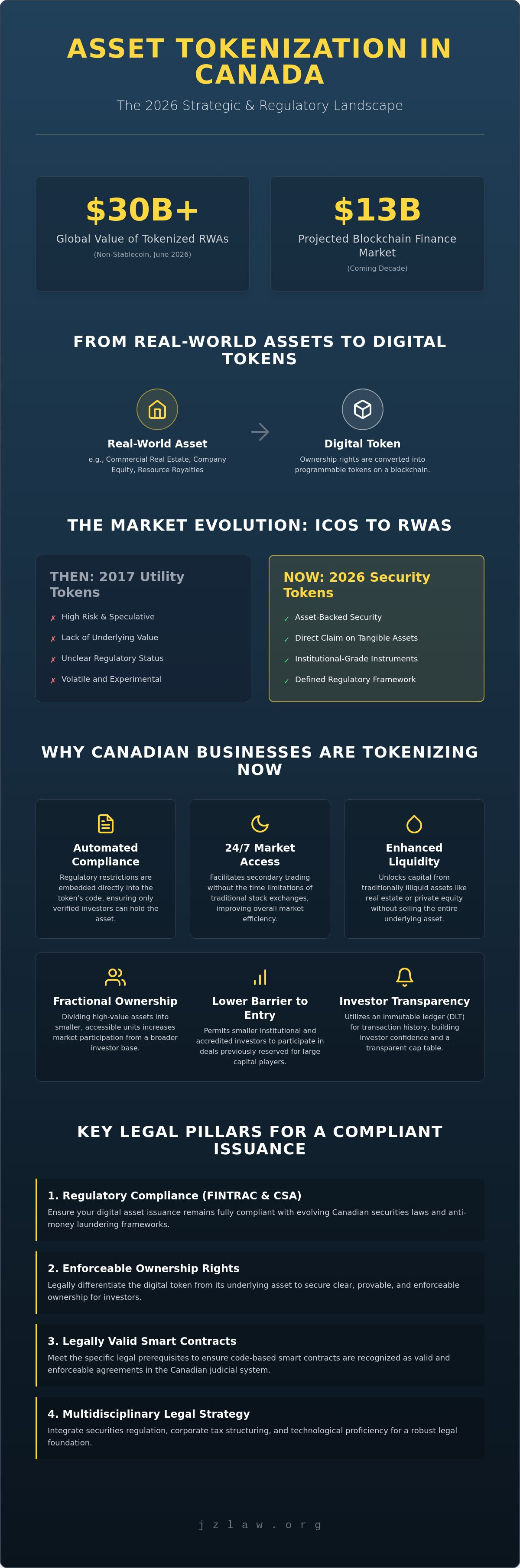
With the global value of non-stablecoin real-world assets surpassing $30 billion in June 2026, the transition from experimental blockchain pilots to mainstream institutional adoption is now an established reality. You likely recognize that while the promise of fractional ownership and enhanced liquidity is significant, the overlapping jurisdictions of the CSA, CIRO, and the Bank of Canada create a regulatory environment that rewards precision and punishes haste. Securing expert tokenization legal services canada is no longer a matter of technical curiosity; it's a fundamental requirement for any organization looking to leverage the $13 billion blockchain finance market projected for the coming decade.
This guide provides the strategic clarity necessary to navigate this sophisticated landscape without the prohibitive costs often associated with traditional, high-overhead firms. We'll provide a clear roadmap for your issuance by analyzing the implications of the 2026 Stablecoin Act, the custody standards recently established by CIRO, and the essential tax structuring required for multi-jurisdictional compliance. By the end of this article, you'll have a comprehensive understanding of how to transform complex regulatory requirements into a secure, scalable foundation for your digital asset strategy.
Table of Contents
The State of Asset Tokenization in Canada (2026)
The digital transformation of capital markets has reached a pivotal milestone in 2026. At its core, asset tokenization involves the digital representation of real-world assets (RWA) on a blockchain, effectively converting ownership rights into programmable digital tokens. It's not merely a technical shift; it's a fundamental restructuring of how value is exchanged. While early iterations of blockchain technology were often mired in speculative volatility, the current Canadian market is defined by institutional-grade, asset-backed securities. Businesses now require specialized tokenization legal services canada to ensure these digital instruments mirror the rigorous standards of traditional finance.
Canada has emerged as a global leader in this sector, particularly within the real estate and energy corridors of Toronto and Calgary. The integration of Distributed Ledger Technology (DLT) has modernized Canadian capital markets by providing a transparent, immutable ledger for transaction history. This technological maturity allows for the seamless issuance and settlement of tokenized bonds and private equity, reducing the friction that historically hindered secondary market trading.
From ICOs to Real-World Assets (RWA)
The era of the 2017 utility token, characterized by high risk and lack of underlying value, has been replaced by the 2026 security token model. Today's market focuses on RWA tokenization, where the digital token represents a direct legal claim on a tangible asset. In Calgary, this often translates to tokenizing oil and gas royalties, while in Toronto, commercial real estate portfolios are being fractionalized to attract a broader investor base. This shift provides essential liquidity to traditionally illiquid assets, allowing owners to unlock capital without selling the entire underlying property or resource; those interested in the professional management of tangible real estate assets can visit A.Z. GWARANCJA Nieruchomości.
Why Canadian Businesses are Tokenizing Now
Efficiency and accessibility drive the current surge in adoption. Tokenization lowers the barrier to entry for fractional investment, permitting smaller institutional and accredited investors to participate in high-value deals. By using programmable smart contracts, businesses can automate complex compliance tasks directly on the blockchain. Key benefits include:
Automated Compliance: Embedding regulatory restrictions directly into the token's code ensures only verified investors can hold the asset.
Fractional Ownership: Dividing high-value assets into smaller, more accessible units increases market participation.
24/7 Market Access: Facilitating secondary trading without the limitations of traditional exchange hours improves overall market efficiency.
From a strategic standpoint, JZ Law views this process as a sophisticated precursor to taking companies public. It allows a firm to build a robust investor cap table and establish a track record of transparent governance long before pursuing a traditional exchange listing. Effective tokenization legal services canada bridge the gap between these innovative digital structures and established corporate law, providing the security needed for long-term growth.
Navigating the Canadian Regulatory Landscape for Digital Assets
The regulatory environment for digital assets in 2026 is defined by a sophisticated interplay between federal oversight and provincial jurisdiction. For any entity issuing digital representations of value, the primary challenge lies in determining whether a token falls under the umbrella of provincial securities law. While the Canadian Securities Administrators (CSA) provide a harmonized approach through National Instruments, the practical application often varies between the Alberta Securities Commission (ASC) and the Ontario Securities Commission (OSC). Engaging tokenization legal services canada is essential to ensure that your corporate structure accounts for these regional nuances while maintaining a cohesive national compliance strategy.
Securities Law and the CSA Sandbox
The CSA Regulatory Sandbox remains a vital pathway for firms launching innovative tokenized offerings that don't fit neatly into existing frameworks. This environment allows issuers to test their models under time-limited exemptive relief, provided they meet rigorous investor protection standards. Most institutional projects rely on prospectus exemptions to streamline the capital-raising process. The Accredited Investor exemption is frequently used for private placements, while the Offering Memorandum (OM) exemption provides a broader reach, though it carries more significant disclosure requirements. Underpinning all these decisions is the legal classification of the token itself. In 2026, the Canadian courts continue to apply the four-pronged Pacific Coast Coin Exchange test to determine if a digital asset constitutes an investment contract, focusing on whether there is an investment of money in a common enterprise with an expectation of profit derived significantly from the efforts of others.
FINTRAC Compliance and AML/KYC Obligations
Beyond securities law, issuers must navigate the 2026 FINTRAC requirements for Virtual Asset Service Providers (VASPs). Any entity involved in the exchange or transfer of digital assets is generally required to register as a Money Services Business (MSB). This registration isn't a mere formality; it mandates the implementation of comprehensive Anti-Money Laundering (AML) and Know Your Customer (KYC) protocols. Modern issuers are increasingly adopting on-chain identity solutions to automate these checks, ensuring that only verified wallets can participate in a token's lifecycle. Reporting obligations for large virtual currency transactions, those exceeding $10,000 CAD, are strictly enforced to prevent illicit financial activity.
Strategic success in this space requires more than just technical knowledge. It demands a partner who understands the business intent behind the technology. If you're preparing for a significant issuance, seeking specialized securities regulation counsel can help you avoid the pitfalls of multi-jurisdictional compliance. By proactively addressing these regulatory hurdles, you can build a project that is both innovative and legally resilient within the Canadian market.
Solving the Legal Hurdles of Distributed Ledger Technology
The implementation of Distributed Ledger Technology (DLT) introduces a fundamental distinction between the digital token and the underlying asset it represents. In the eyes of Canadian law, a token is often categorized as a digital receipt or a chose in action rather than the tangible asset itself. This separation creates a legal "gap" that must be bridged through precise contractual language. To ensure that a digital transfer on the blockchain carries the full weight of a legal title transfer, businesses require sophisticated tokenization legal services canada to architect the underlying agreements that bind digital actions to physical realities.
Data privacy presents another layer of complexity. While blockchain's immutability is its greatest strength, it stands in direct tension with the Personal Information Protection and Electronic Documents Act (PIPEDA). Canadian privacy law emphasizes the right to correct or delete personal data, a concept that is technically incompatible with a permanent public ledger. Resolving this requires a proactive approach, such as utilizing off-chain storage for sensitive identifying information while only recording anonymized hashes on the chain. Additionally, following the publication of CIRO's Digital Asset Custody Framework in February 2026, issuers must now adhere to strict segregation and monitoring standards for digital asset storage to protect holders in the event of an insolvency.
Legal Enforceability of Smart Contracts
Smart contracts operate as self-executing code, but their standing in a Canadian court depends on whether they satisfy the traditional requirements of contract law: offer, acceptance, and consideration. We mitigate the risk of code-based ambiguity by drafting Ricardian Contracts. These instruments link human-readable legal prose directly to blockchain code, ensuring that the parties' intent is explicitly defined and enforceable if a dispute arises. For Decentralized Autonomous Organizations (DAOs), establishing clear, pre-defined dispute resolution mechanisms within the corporate bylaws is essential to prevent jurisdictional uncertainty and ensure business continuity.
Fractional Ownership and Title Transfer
Tokenizing land titles in major urban centers like Vancouver and Toronto involves navigating the rigid requirements of provincial land registries. Currently, the law dictates that the "off-chain" government registry remains the definitive source of truth for property title. Strategic success in this area involves creating a corporate structure where a special purpose vehicle (SPV) holds the physical title, while the digital tokens represent participation rights or shares within that entity. This model relies heavily on an integrated understanding of Real Estate Law to ensure that every on-chain transaction is mirrored by a valid, enforceable interest in the underlying property. By aligning these two ledgers, tokenization legal services canada provide the security necessary for institutional-grade real estate investment.
Strategic Applications: Real Estate, Energy, and Private Equity
Strategic applications of blockchain technology have moved beyond simple digital assets to become essential tools for capital efficiency. Tokenization is now a pillar for sophisticated corporate transactions, allowing firms to execute complex deals with unprecedented speed and transparency. By embedding rights, obligations, and compliance rules directly into a digital format, organizations can streamline the lifecycle of an investment. Utilizing expert tokenization legal services canada ensures that these strategic moves remain firmly grounded in the evolving standards of Canadian capital markets while protecting the interests of all stakeholders.
Tokenizing Commercial Real Estate in Canada
Traditional Real Estate Investment Trusts (REITs) are being reimagined as tokenized vehicles to improve liquidity and investor accessibility. This model allows for the fractionalization of high-value commercial assets in centers like Toronto and Vancouver, providing a secondary market for interests that were previously locked in multi-year holding cycles. Legal frameworks for these vehicles must account for rigorous investor onboarding and strict secondary trading rules to prevent unauthorized transfers. For cross-border property investment, the legal structure must also address complex withholding tax implications and foreign ownership restrictions inherent in Canadian property law. Those exploring international real estate opportunities in dynamic markets like Singapore can learn more about available professional guidance. Smart contracts can automate the distribution of rental income, but the underlying legal architecture must ensure these payments are recognized as valid corporate distributions.
Energy Sector: Oil and Gas Tokenization
In Alberta, the energy sector is utilizing DLT to fractionalize working interests and royalty rights. This approach allows smaller institutional participants to gain exposure to production assets while reducing the administrative burden of traditional registry management. However, any digital issuance must align with the Alberta Energy Regulator (AER) requirements regarding operational liability and environmental reclamation obligations. JZ Law leverages deep expertise in Oil and Gas Law to ensure that tokenized energy interests are structured to withstand regulatory scrutiny and operational shifts. This specialized knowledge is critical when bridging the gap between physical resource management and digital ownership structures.
Private equity and venture capital firms are also adopting DLT to modernize cap table management. By digitizing equity issuance, companies can automate dividend distributions and shareholder voting rights, significantly reducing the overhead of corporate secretarial functions. This is particularly beneficial for high-growth firms preparing for future liquidity events or public listings. Comprehensive tokenization legal services canada provide the necessary bridge between these modern digital tools and the traditional requirements of the Canada Business Corporations Act. If you're ready to integrate these technologies into your next capital raise, contact JZ Law for a strategic consultation to ensure your project is built on a secure legal foundation.
Choosing a Tokenization Legal Partner in Canada
Selecting a partner to lead your digital transformation requires a departure from the traditional Big Law mentality. While large, multi-service firms offer a vast array of general corporate resources, they often lack the specialized agility required to navigate the precise intersection of securities regulation, tax law, and distributed ledger technology. Effective tokenization legal services canada must provide more than just a regulatory checklist; they must offer a multidisciplinary strategy that aligns with your long-term commercial objectives. In an era where the Stablecoin Act and CIRO frameworks have added layers of complexity, having a partner who understands the business intent behind the code is a significant competitive advantage.
The JZ Law Advantage: Boutique Precision
JZ Law distinguishes itself through a principal-led model that ensures high-stakes projects receive the direct attention of John Zang. Clients gain immediate access to deep expertise in Cryptocurrency Law, fostering a level of strategic partnership that traditional firms often delegate to junior associates. Our presence in Calgary, Toronto, and Vancouver allows us to provide local market insights while maintaining a global perspective on digital asset regulation. We prioritize agile response times and a proactive, risk-mitigation mindset, ensuring that your project remains on schedule without compromising on legal integrity or precision.
Beyond Compliance: Strategic Tax and Corporate Structuring
A critical component of any digital issuance is the underlying corporate and tax architecture. The choice between a Limited Partnership (LP) and a traditional Corporation can have profound implications for capital gains treatment and investor distributions. Strategic tokenization legal services canada involve optimizing these vehicles to avoid unintended tax consequences that could erode project value. We focus on several key areas to protect your interests:
Entity Selection: Determining the most tax-efficient jurisdiction and vehicle for the issuing entity based on the underlying asset class.
Characterization of Sales: Analyzing the tax treatment of token sales and distributions to ensure full compliance with CRA guidelines and international treaties.
Future-Proofing: Designing structures that accommodate future liquidity events, such as strategic acquisitions or transitioning to a traditional public listing.
By integrating these complex legal and fiscal threads into a single, cohesive strategy, we provide the security and clarity necessary for institutional-grade success. We don't just ensure you're compliant today; we build the legal infrastructure that supports your growth through 2026 and into the future. This methodical approach ensures that every decision is backed by logical foundation and professional dignity, reflecting a commitment to your long-term business health.
Securing Your Position in the Tokenized Economy
The transition toward tokenized real-world assets is no longer a speculative trend but a structural shift in Canadian capital markets. Success in this environment requires a precise alignment of securities compliance, strategic tax structuring, and technical enforceability. By navigating the complexities of the 2026 CSA Sandbox and FINTRAC requirements, businesses can unlock significant liquidity in sectors ranging from Calgary's energy royalty interests to Toronto's commercial real estate. However, the sophistication of these digital instruments demands a partner who offers more than just standard legal advice.
Expert tokenization legal services canada provide the necessary bridge between innovative technology and established corporate law. JZ Law provides principal-led service by John Zang, offering specialized expertise in Securities Regulation and strategic counsel for Cryptocurrency and Blockchain ventures. This ensures your project is built on a foundation of professional dignity and modern efficiency. We invite you to consult with JZ Law on your tokenization strategy to ensure your next issuance is both legally resilient and strategically optimized. The future of finance is digital; ensure your organization is prepared to lead it.
Frequently Asked Questions
Is asset tokenization legal in Canada?
Yes, asset tokenization is legal in Canada provided the issuance complies with existing securities, tax, and anti-money laundering legislation. The legal status of a token is determined by its underlying characteristics rather than its technical format. Most tokenized real-world assets are classified as securities, which necessitates strict adherence to provincial regulations in jurisdictions like Ontario, Alberta, and British Columbia.
How does the CSA view tokenized securities in 2026?
The Canadian Securities Administrators (CSA) view most tokenized assets as investment contracts, subjecting them to the same rigorous oversight as traditional securities. In 2026, the CSA continues to utilize its Regulatory Sandbox to provide a path for innovative projects to test their models under exemptive relief. This approach ensures that technological innovation doesn't compromise the fundamental principles of investor protection and market integrity.
Do I need to register with FINTRAC to launch a token?
You generally must register with FINTRAC as a Money Services Business (MSB) if your issuance involves the exchange or transfer of digital assets. As of 2026, issuers must comply with Virtual Asset Service Provider (VASP) requirements, which include implementing robust KYC protocols and reporting any transactions that exceed the $10,000 CAD threshold. Utilizing professional tokenization legal services canada is critical to ensuring your reporting systems meet these federal standards.
What is the difference between a utility token and a security token under Canadian law?
The primary difference lies in the "substance over form" principle applied by Canadian courts and regulators. A utility token is designed to provide access to a specific service or product within a platform, whereas a security token represents a financial interest with an expectation of profit derived from the efforts of others. If a token is marketed as an investment or provides a right to future profits, it's almost certainly classified as a security.
Can commercial real estate in Toronto be fractionalized through tokenization?
Yes, commercial real estate in Toronto can be fractionalized by holding the property title within a special purpose vehicle (SPV) and tokenizing the equity or debt interests of that entity. This structure allows for the digital representation of ownership while maintaining a clear link to the physical asset. It requires a sophisticated legal architecture to ensure that the on-chain transfers are recognized as valid legal interests by provincial land registries.
What are the prospectus exemptions available for tokenized offerings in Canada?
Commonly used prospectus exemptions for tokenized offerings include the Accredited Investor, Offering Memorandum, and Friends, Family, and Business Associate exemptions. Each exemption carries specific requirements regarding investor qualifications and disclosure obligations. Selecting the appropriate exemption is a vital strategic decision that affects both the cost of the issuance and the breadth of your potential investor base.
How does JZ Law assist with the tax structuring of a token launch?
JZ Law assists by determining the most tax-efficient corporate vehicle for your issuance, such as a Limited Partnership or a Corporation, to optimize capital gains treatment. We provide tokenization legal services canada that include analyzing the characterization of token sales to ensure compliance with Canada Revenue Agency (CRA) guidelines. Our goal is to prevent unintended tax liabilities that could negatively impact your project's net proceeds and long-term viability.
What is the typical timeline for a legally compliant token issuance in Canada?
A legally compliant token issuance typically requires a timeline of three to nine months from inception to launch. This period accounts for initial corporate structuring, the drafting of comprehensive legal documentation, and necessary interactions with regulatory bodies like the CSA or FINTRAC. Projects involving novel asset classes or those seeking participation in the CSA Regulatory Sandbox may require additional time for detailed review and approval processes.


Comments