


AGLC Application Rejected? Navigating the Board Hearing and Appeal Process in 2026
An AGLC rejection doesn’t have to be the final word on your business. If your aglc application rejected notice has arrived, the next 30 days matter: you must submit an application for a hearing to the Hearing Panel Office within 30 days of receiving the decision. With your investment and future operations at stake, act promptly and build a focused response.
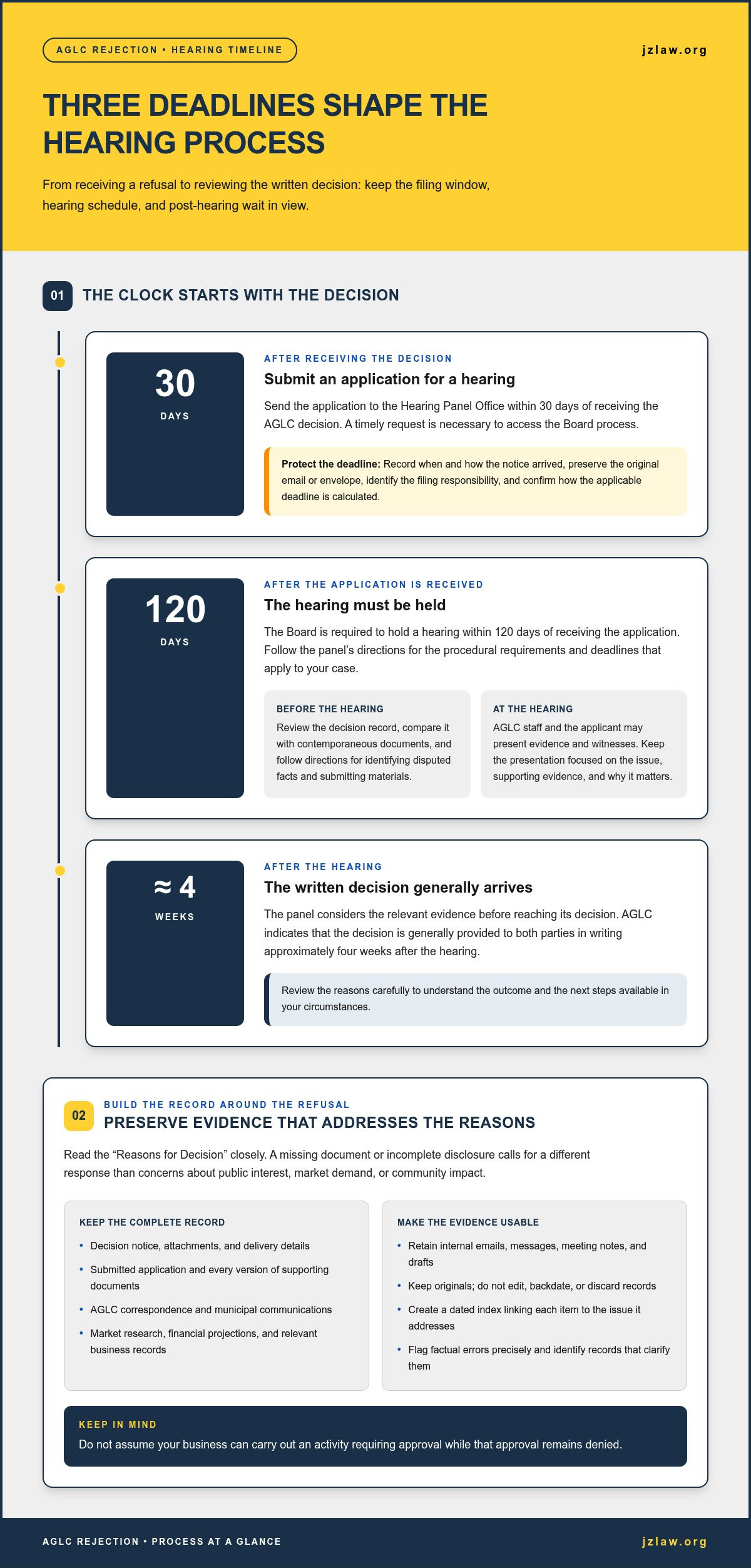
The formal process can be difficult to manage, particularly when a decision involves the Gaming, Liquor and Cannabis Act, its regulations, and AGLC policies. This guide explains how to challenge a rejection, what to expect from the hearing timeline, and how to prepare evidence that addresses the decision’s reasons. The Board is required to hold a hearing within 120 days of receiving the application, and its decision is generally provided in writing approximately four weeks after the hearing.
You’ll also learn how an independent hearing panel considers evidence and witnesses, and why a licensing dispute may require the same careful preparation as a high-stakes corporate matter. JZ Law advises on complex cannabis licensing and regulatory challenges, including issues that intersect with business structure and investment.
Table of Contents
Immediate Steps After Receiving an AGLC Rejection Notice
An AGLC rejection notice communicates that the requested approval has been denied and sets out the decision and its reasons. For a business, that can affect planned operations, investment decisions, contracts, and launch timelines. If your aglc application rejected notice has arrived, treat it as both a formal decision and a time-sensitive record. Save the complete notice, including attachments and delivery details, and rely on the written reasons rather than informal explanations.
The Alberta Gaming, Liquor and Cannabis Commission (AGLC) administers regulatory responsibilities across gaming, liquor, and cannabis. The implications of a refusal depend on the application and decision. Do not assume that your business can carry out an activity requiring approval while that approval remains denied.
The 30-Day Appeal Window
You must submit an application for a hearing to the Hearing Panel Office within 30 days of receiving the AGLC decision. Record when and how the notice arrived, preserve the original email or envelope, and confirm promptly how the applicable deadline is calculated. Don’t wait until the final days: a timely hearing request is necessary to access the Board process, and missing the deadline may prevent you from challenging the refusal through that route.
Make the deadline part of your first response. Assign responsibility for filing, identify the required form and submission method, and leave time to meet procedural requirements. The AGLC hearing process is intended to be fair and independent, but you still have to meet the filing deadline. Treat a missed date as a serious procedural issue, not a minor administrative delay.
Identifying the Grounds for Denial
Read the “Reasons for Decision” closely and separate application deficiencies from substantive concerns. A missing document or incomplete disclosure calls for a different response than a decision based on public interest, market demand, or community impact. Compare the Regulatory Services Division’s findings with the application record. Note specific factual statements, supporting materials, or assumptions that may need to be addressed at a hearing.
This distinction guides what to preserve and what evidence may matter. In gaming decisions, the Board has considered potential financial effects on government revenue and existing charitable gaming operations. Community input and municipal objections may also form part of the record, but their significance depends on the case and the material before the panel.
Start an evidence hold immediately. Preserve the submitted application and every version of its supporting documents, AGLC correspondence, municipal communications, market research, financial projections, and records relevant to the stated reasons. Keep internal emails, messages, meeting notes, and drafts that show who supplied key information and when. Don’t edit, backdate, or discard records. Retain originals and create a dated index that links each item to the issue it addresses.
Compare the decision’s account of the facts with contemporaneous records. Flag errors precisely, such as an outdated projection or a description that omits a relevant document, and identify the source that may clarify the point. Early, disciplined triage gives your hearing preparation a reliable foundation and helps prevent gaps in the business record.
The AGLC Board Hearing Process: A Step-by-Step Overview
Once the Hearing Panel Office receives an application, the matter moves from a licensing decision into a formal hearing process. A hearing must be held within 120 days of receiving the application. The steps below describe the general sequence; follow the panel’s directions for the procedural requirements and deadlines that apply to your case. The official AGLC Board Hearing Process explains the process and available formats.
Submit the hearing application. Complete the required Application for Hearing and send it to the Hearing Panel Office using the method specified by AGLC. Identify the decision you’re challenging and keep proof of submission. An organized filing makes clear what is being appealed and helps prevent confusion at the outset.
Prepare for scheduling. After the application is received, the hearing is scheduled. Consider which format will let you present your case clearly, then organize the people and materials you’ll need around the hearing date.
Review the decision record and directions. Examine the materials provided for the hearing, including any record of the original decision. Compare its account of the application and evidence with your contemporaneous documents. Follow the panel’s directions for responding, identifying disputed facts, and submitting supplementary materials.
Present your case at the hearing. AGLC staff and the applicant may present evidence and witnesses. Prepare a concise sequence: identify the issue, point the panel to the supporting evidence, and explain why it matters to the decision under review. Keep each witness focused on facts they can address directly.
Await the written decision. The panel considers the relevant evidence before reaching its decision. AGLC indicates that the decision is generally provided to both parties in writing approximately four weeks after the hearing. Review the reasons carefully to understand the outcome and the next steps available in your circumstances.
Choosing the Right Hearing Format
Video hearings can reduce travel and simplify participation across locations. An in-person hearing may suit a case where live testimony and document presentation are central. Written hearings are available only in exceptional circumstances, so don’t assume a paper-only process will be accepted just because the dispute appears technical. If you need to travel to Calgary, use the hearing notice to confirm the location and plan for timing, access, and document handling.
Disclosure and the Record of Decision
Use the panel’s scheduling and procedural directions to understand what materials will be circulated and when supplementary documents must be filed. Review the record of the original decision carefully: check that cited documents are included, that dates and figures match your records, and that relevant evidence has not been omitted. Raise specific discrepancies through the process directed by the panel.
For an aglc application rejected dispute, connect the regulatory record to the business consequences without losing focus on the decision under review. Counsel experienced in complex licensing and corporate matters can help organize that strategy. JZ Law’s regulatory and corporate counsel can help businesses assess how the issues fit together.
Analyzing Common Grounds for AGLC Application Denials
An AGLC refusal can turn on different concerns, and an effective response starts by identifying which one drove the decision. Missing disclosures, projected effects on existing operators, community objections, and concerns about an applicant’s integrity call for distinct evidence. Don’t treat “public interest” as a conclusion to rebut in the abstract. Trace the Board’s stated reasons to the underlying facts, assumptions, and applicable requirements.
Market Demand and Economic Impact
For gaming applications, market saturation and a proposed “Distinct Market Area” analysis may focus attention on where customers are likely to come from and whether a new or modified licence could affect existing operators. Examine how the decision defines the relevant market and supports its projections. Community submissions and municipal objections may also inform the Board’s assessment; their presence alone doesn’t show how much weight they carried.
Economic impact can include effects on charitable gaming. In a December 2025 decision, the AGLC Board denied the conversion of two Racing Entertainment Centre licences to full casino licences, citing an estimated $12 million per year in lost slot revenue to the commission and the Government of Alberta, and projected cannibalization of 39% of proposed gaming revenue. Those figures illustrate the issues considered in that case, not an automatic test for every application.
An independent market study can help test disputed assumptions. A useful analysis explains its data, geographic scope, customer assumptions, and methodology, then compares those points directly with the AGLC’s findings. Broad claims that a project will create jobs or attract visitors are less persuasive if they don’t address projected effects on existing operators or charitable revenue.
Integrity and Background Assessments
Gaming applications may involve scrutiny of corporate structures and the suitability of individuals in key positions. Where associate or key-employee disclosures apply, review the requested information carefully and present ownership, control, and relevant relationships consistently. Connect the Board’s stated concern to the requirements for the particular application and the record.
Past regulatory issues or financial instability can raise questions about compliance and reliability. Address them accurately: identify what occurred, provide context and supporting records, and describe any corrective steps without minimizing the issue. Unpaid amounts or inconsistent financial information may also undermine confidence in an application.
Transparency matters when securities disclosures, corporate records, and licensing materials intersect. Reconcile names, ownership details, financial statements, and representations across documents. Unexplained differences can create avoidable concerns about completeness. Distinguish documented facts from assumptions, and answer each stated concern with relevant evidence rather than general assurances. This helps clarify whether the refusal rests on a technical deficiency, an economic assessment, or a broader compliance concern.
How to Build a Compelling Case for Your AGLC Appeal
A strong hearing case does more than repeat the original application. It connects the decision’s stated concerns to reliable evidence, identifies where the underlying analysis may be incomplete or mistaken, and explains what the Board should conclude instead. Give the panel a clear evidentiary reason to change the outcome. Broad assurances or disagreement with the refusal alone are not enough.
Organize the case around a simple sequence: the issue raised in the decision, the relevant evidence, and why that evidence supports a different result. This structure keeps the presentation focused and helps show whether the concern is factual, analytical, or procedural. Administrative fairness means the decision-making process should be fair, impartial, and provide parties a meaningful opportunity to present relevant evidence and respond to the issues in dispute.
Gathering Supporting Evidence
Match each document to a specific concern. Letters of support can show local perspectives, while municipal approvals or correspondence may clarify the project’s planning status. Neither automatically resolves every objection. If concerns involve noise, traffic, operating hours, or public safety, explain the issue and provide a practical mitigation plan with supporting material. Taking objections seriously is more persuasive than dismissing them.
A business plan and financial projections can support a case about viability, but they should make assumptions, funding, expected demand, and foreseeable risks clear. If the decision questions market impact, commission an independent study that directly addresses its methodology and conclusions. Support key figures with their underlying sources and explain how changes in assumptions affect the result.
Select experts for the question they can answer, not simply for their title. An urban planner may address land use or site context; a financial analyst may explain projections or economic assumptions. Make their methods and conclusions clear enough for the panel to assess, and ensure their evidence addresses the issue actually raised.
Witness Preparation and Testimony
An opening statement should briefly identify the decision under review, the central disputed issues, and the evidence that will address them. It is a roadmap, not a substitute for proof. Prepare witnesses to answer accurately and directly, distinguish personal knowledge from opinion, and acknowledge limits rather than speculate. Lay witnesses can describe firsthand community needs or expected local benefits, but their testimony is strongest when specific and relevant.
Prepare for questions from AGLC counsel by reviewing the documents and likely areas of disagreement with each witness. Listen to the full question, answer only what was asked, and correct any genuine mistake plainly. Avoid rehearsed or argumentative responses; credibility depends on precision and consistency with the record.
For an aglc application rejected matter, align the evidence, witnesses, and business strategy before the hearing so the case remains coherent across regulatory and corporate considerations. Discuss your AGLC appeal strategy with JZ Law to develop a focused response to the decision and its business implications.
Strategic Legal Counsel for Complex AGLC Regulatory Matters
An AGLC hearing is a regulatory proceeding with direct consequences for business plans, financing, and operations. Because the hearing panel is separate from the Regulatory Services Division, address the decision through its evidence and reasoning rather than relying on informal discussions with the division to resolve the dispute. Focused legal counsel can help connect the hearing record to the company’s broader regulatory and corporate position.
John Zang’s work on complex licensing matters brings regulatory analysis together with corporate strategy. That matters when a refusal affects more than a permit: it may disrupt financing plans, contracts, or a proposed transaction. A pre-hearing compliance review can identify gaps in records, disclosures, or operating plans, helping the business address them in a disciplined way before the hearing.
An appeal that succeeds may remove one obstacle to a company’s growth plans, but it doesn’t guarantee financing or a public listing. Businesses considering taking a cannabis company public should consider how the licensing dispute, the Board’s decision, and any conditions affect corporate disclosures and readiness. The same coordination matters in corporate transactions, where counterparties may need an accurate account of licence status, conditions, and outstanding regulatory issues.
Beyond the Hearing: Long-term Compliance
A favourable decision is not the end of the regulatory work. If the Board imposes or maintains licence conditions, build them into operating procedures, internal responsibility assignments, and ongoing records. For cannabis businesses, align those controls with applicable licensing obligations and the current business structure. JZ Law’s cannabis licensing work takes a strategic view, connecting immediate compliance steps with longer-term corporate objectives.
Protecting Investor Confidence
A regulatory dispute can raise investor questions about timing, operations, and risk. Legal counsel can help ensure communications are accurate, consistent with the hearing record, and appropriate to the company’s disclosure obligations. Don’t portray a pending appeal as a settled outcome. Explain the current status, material uncertainties, and steps being taken to manage them. A temporary rejection may affect how investors assess a business, depending on the facts, the company’s plans, and the dispute’s outcome.
If your aglc application rejected decision has created regulatory and corporate concerns, a coordinated strategy can help protect your hearing position while keeping business decisions grounded in the current record. Consult with JZ Law to discuss your AGLC appeal strategy.
Make Your Next Move with a Clear Strategy
A licensing setback can put expansion plans, financing, and day-to-day decisions under pressure. Treat the dispute as part of the business’s wider strategy, not as an isolated regulatory problem. Consider what the company needs to protect, which decisions can wait, and how the hearing position aligns with longer-term corporate objectives.
For an aglc application rejected matter, tailored legal guidance can connect the regulatory record with business priorities. JZ Law focuses on complex regulatory sectors and strategic corporate law, helping businesses assess high-stakes licensing appeals alongside broader commercial interests. No appeal guarantees a particular result, but a disciplined plan can help the business make informed decisions. Although AGLC governs Alberta, businesses with stakeholders in Calgary, Toronto, Vancouver, New York City, Denver, Hamburg, Berlin, or Frankfurt may also need to consider how the dispute fits their wider corporate and investment plans.
Secure Your Business Future with JZ Law by discussing a strategy suited to your licensing dispute and corporate objectives.
With careful preparation and a clear view of what comes next, your business can move forward with greater confidence.
Frequently Asked Questions
How long do I have to appeal an AGLC application rejection?
You have 30 days from receiving the AGLC decision to submit an application for a hearing to the Hearing Panel Office. Keep the notice and evidence of when it arrived, then confirm the filing instructions and deadline calculation promptly. Don’t assume that asking questions or discussing the decision with AGLC pauses the timeframe. Missing the deadline may prevent you from challenging the decision through the Board hearing process.
What is the success rate of AGLC board hearings?
There is no single success rate that predicts the outcome of an individual matter. Results depend on the decision under review, the evidence, and the issues raised. Assess whether the record supports your position on each reason for refusal, and distinguish strong evidence from gaps that need to be addressed.
Can I reapply for an AGLC license after being rejected?
A rejection doesn’t, by itself, establish that you’re permanently barred from making another application. Whether reapplying is practical depends on the reasons for refusal, the requirements for that licence, and whether the underlying issue can be corrected. An application with missing information may call for a different response than a substantive concern about market impact. Consider the hearing option and any revised application strategy before deciding which route best protects your business.
What happens during an AGLC board hearing?
The applicant and AGLC staff present relevant evidence, and witnesses may give testimony for the panel to consider. The panel is separate from the Regulatory Services Division and assesses the case independently. Explain how your evidence addresses the decision’s concerns rather than simply restating the original application. After the hearing, the panel deliberates and provides its decision in writing, giving both parties a formal record of the outcome.
Do I need a lawyer for an AGLC hearing?
You aren’t automatically required to have a lawyer, but legal counsel can help assess the decision, organize evidence, prepare witnesses, and present a focused response. That support can be particularly useful if licensing issues overlap with corporate ownership, financing, or investor disclosures. JZ Law advises businesses on complex regulatory matters and corporate strategy. Whether to retain counsel depends on the stakes, complexity, and resources involved in your specific case.
What are the most common reasons for an Alberta cannabis license rejection?
Potential issues include incomplete application materials, disclosure concerns, or failure to meet applicable regulatory requirements. Financial standing and compliance history may also matter, depending on the application and the reasons AGLC gives. Review the written decision and the requirements it cites; a general assumption about why applications are refused won’t replace careful analysis of your own record.
Can I appeal a Board decision to the Court of King’s Bench?
An AGLC Board decision can be challenged by applying for judicial review in the Court of King’s Bench of Alberta. Judicial review is a court process, not simply another Board hearing, so the legal basis and procedure differ. A business with connections in Calgary, Toronto, Vancouver, Hamburg, Berlin, Frankfurt, New York City, or Denver should also distinguish the Alberta decision from regulatory requirements in other jurisdictions. Obtain legal advice promptly about the available grounds and applicable court deadlines.
How much does it cost to file an application for an AGLC hearing?
A C$400 non-refundable fee applies to licence applications, but don’t assume that the same fee applies to a hearing request. Review the current hearing application instructions for any fee and accepted payment method before filing. Keep the hearing filing separate from the original licence application, since they’re different submissions.



Comments