


AGLC Cannabis Compliance Audit: A Strategic Guide to Rejections and Appeals
The most dangerous moment for your Alberta cannabis investment isn't the initial market launch, but the arrival of a formal notice regarding an aglc cannabis compliance audit. With provincial sales reaching C$84.6 million in July 2026 and competition among 749 licensed retailers intensifying, a single administrative oversight in financial disclosure or THC potency variance can jeopardize your entire operation. You've likely invested significant capital and time into your business, and the sudden realization that a 30-day appeal deadline is ticking away creates a pressure that few entrepreneurs are prepared to handle alone.
We understand that the complexity of the AGLC's regulatory framework often feels designed to penalize rather than protect the operator. This guide provides the precise legal strategies and strategic counsel required to navigate these high-stakes audits and successfully overturn license rejections or administrative sanctions. We'll explore the mechanics of the AGLC Board Hearing process, the implications of the June 2026 policy updates, and the rigorous disclosure standards necessary to maintain your standing in Alberta's evolving marketplace. By shifting from a position of passive compliance to active legal advocacy, you can protect your investment and ensure long-term regulatory stability.
Table of Contents
Understanding the AGLC Compliance Audit and Rejection Notice
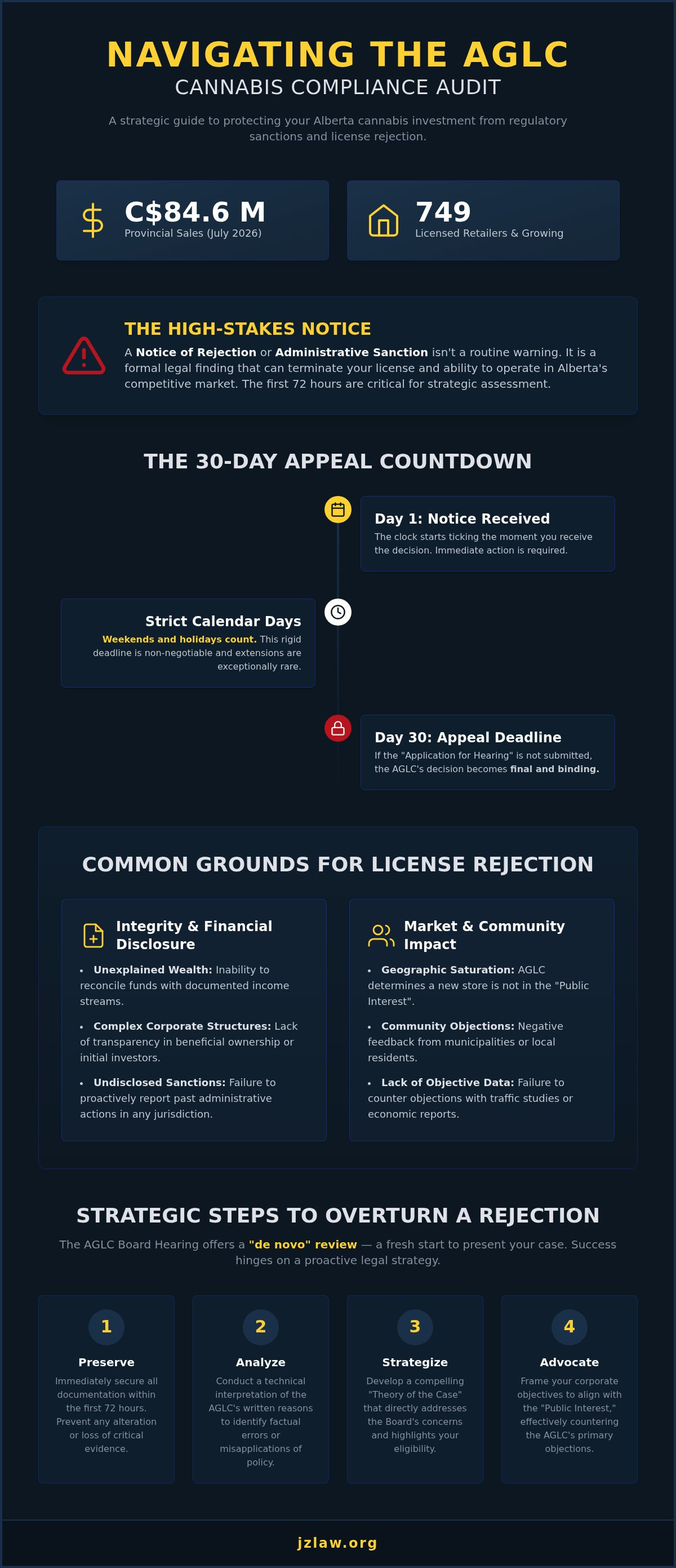
An aglc cannabis compliance audit represents a rigorous, forensic examination of a licensee's operational history, financial integrity, and adherence to the Gaming, Liquor and Cannabis Act. This isn't a routine inspection. It's a deep dive into the internal controls that safeguard your inventory and capital. When a licensee receives a "Notice of Rejection" or an "Administrative Sanction", it's a formal legal finding that can terminate your ability to operate in Alberta's C$84 million monthly market. The Alberta Gaming, Liquor and Cannabis Commission (AGLC) maintains this oversight to ensure every participant meets the highest standards of transparency. Interpreting the technical language within these notices requires a strategic mindset. The first 72 hours after receiving a negative result are vital. You must preserve all documentation and begin a strategic assessment before the clock runs out on your legal options.
The Critical 30-Day Appeal Window
The AGLC operates on a rigid timeline that permits very little deviation following an aglc cannabis compliance audit. An "Application for Hearing" must be submitted within exactly 30 days of receiving a decision. This 30-day window is calculated in calendar days, not business days. This means weekends and statutory holidays don't pause the countdown. If you miss this deadline, the decision effectively becomes final and binding. Extensions are exceptionally rare. They typically require proof of extraordinary circumstances beyond the applicant's control. Treating this deadline as a flexible target is a common error that leads to the permanent loss of significant initial investments.
Decoding the Written Reasons for Decision
Every negative outcome is accompanied by written reasons that require a high level of technical interpretation. You must distinguish between minor procedural errors, such as record-keeping lapses, and substantive failures that go to the heart of your eligibility. In 2026, the AGLC Board increasingly categorizes objections under the broad umbrella of "Public Interest". This can include concerns about market saturation or the background of key stakeholders. Your initial legal assessment should determine if the decision was based on a clear misapplication of facts or an exercise of the Board's broad discretion. Determining this distinction is the first step in building a "Theory of the Case" that can withstand the scrutiny of a formal hearing.
Common Grounds for Cannabis License Rejections in 2026
As the Alberta cannabis market matures, the criteria for license approval have become increasingly granular. An adverse result from an aglc cannabis compliance audit often highlights systemic failures in a company's disclosure protocols or its failure to account for local market dynamics. In 2026, the AGLC has shifted its focus toward the absolute transparency of beneficial ownership and the long-term viability of retail locations within "distinct market areas." Understanding these common pitfalls is the first step in building a resilient application or preparing a robust appeal.
Integrity and Financial Disclosure Failures
The Personal Disclosure Form (PHS) remains a significant hurdle for many applicants. AGLC investigators are trained to identify "unexplained wealth" that can't be reconciled with tax filings or documented income streams. Many startups struggle to document complex corporate structures or the transition of private capital into regulated entities. Even if your business is preparing for a public offering, any lack of clarity regarding initial investors can lead to an immediate rejection. Previous administrative sanctions in other jurisdictions, even for unrelated business activities, must be disclosed proactively to avoid being flagged as an integrity risk.
Market Demand and Community Impact Strategy
With 749 licensed retail stores operating in Alberta as of June 2026, the AGLC scrutinizes new applications for geographic saturation. The Board evaluates whether a new store serves the "Public Interest" or merely contributes to an over-concentrated market. Community objections, often channeled through municipal feedback or local media sentiment, can stall or kill an application. Successful applicants counter these objections with objective data, such as traffic studies or local economic impact reports, rather than relying on emotional appeals. If your application has been flagged for community impact concerns, professional cannabis licensing support can help you develop a data-driven rebuttal that addresses the Board's specific regulatory mandates.
The AGLC also looks for inconsistencies in corporate governance. If your beneficial ownership structure changes during the application process without immediate notification, it suggests a lack of internal control. This perceived instability, often uncovered during a secondary aglc cannabis compliance audit, is a frequent cause for administrative sanctions that can halt your operations before they even begin. Ensuring your corporate records are beyond reproach is essential for navigating these complex integrity checks.
The AGLC Board Hearing: Your Right to Procedural Fairness
The AGLC Board Hearing represents the most critical stage of administrative recourse for an Alberta cannabis licensee. Unlike a standard judicial appeal that might only look for narrow legal errors, this process is a "de novo" review. This legal term signifies that the Board considers the matter with a clean slate, essentially starting the decision-making process from the beginning. They aren't bound by the previous findings of the aglc cannabis compliance audit, which allows you to present new evidence, call witnesses, and correct the record. This independence is a cornerstone of the system. The Hearing Panel operates separately from the Regulatory Services division that conducted the initial investigation, providing a vital check against potential regulatory overreach.
While the process is independent, the burden of proof rests squarely on the applicant. You must demonstrate through credible evidence that you meet all eligibility criteria or that your business operation is in the public interest. It's insufficient to simply assert that the AGLC's initial decision was incorrect. You must build a structured, evidence-based argument that systematically addresses every concern raised in the rejection notice. This requires a deep understanding of administrative law principles to ensure your right to a fair and unbiased process is fully realized.
Procedural Fairness in Regulatory Appeals
In the context of Alberta's regulatory environment, procedural fairness includes the right to be heard and the right to full disclosure. You're entitled to access the complete investigative file compiled during your aglc cannabis compliance audit. This transparency is essential for several reasons:
It allows you to identify if the original decision was based on incomplete or inaccurate data.
It helps uncover potential procedural errors or biases that occurred during the audit phase.
It provides the necessary context to prepare a targeted rebuttal for the Board.
Reviewing this file often reveals the specific "trap" or misunderstanding that led to the initial sanction, allowing for a more focused legal strategy.
Virtual vs. In-Person Hearings in 2026
As of 2026, the AGLC frequently utilizes video conferencing for Board Hearings, though in-person sessions are still available for particularly complex matters. Success in a virtual environment requires strict adherence to technical requirements and professional decorum. The Panel places significant weight on oral testimony and the credibility of witnesses. Witness consistency is paramount when explaining complex corporate transactions or financial disclosures. You should anticipate rigorous cross-examination by AGLC legal counsel. They'll scrutinize every detail of your testimony to find inconsistencies, so a calm and methodical approach is necessary to maintain the integrity of your case.
Strategic Steps to Overturning an AGLC Rejection
Overturning an adverse decision requires a fundamental shift in perspective. You aren't just explaining a business; you're arguing a legal case. The first step involves conducting a rigorous forensic audit of your original application and the responses provided during the aglc cannabis compliance audit. You must identify exactly where the investigator found a lack of internal control or a failure in disclosure. Once these vulnerabilities are identified, you can develop a "Theory of the Case" that aligns with the Public Interest. This strategic framework serves as the lens through which the Board will view all your evidence and testimony.
Engaging expert witnesses is often the defining factor in high-stakes appeals. Market analysts can provide empirical data on Alberta's 749 retail locations to prove that a specific "distinct market area" is actually underserved. Community planners can address municipal zoning or safety concerns with professional authority that carries more weight than simple assertions. Every claim in your written submissions must be supported by these objective sources. Precision in legal briefs is paramount; the Board values clarity and logical structure over emotional rhetoric. A well-drafted brief allows the Panel to understand your position before you even enter the hearing room.
Gathering New Evidence and Correcting the Record
You must distinguish between "new" evidence and "supplementary" information. New evidence includes facts that didn't exist during the initial audit, while supplementary info clarifies existing records. Fixing disclosure gaps in your Personal Disclosure Form (PHS) before the hearing date is essential to demonstrate a commitment to transparency. If community objections were a factor in your rejection, documenting proactive support through local business associations or residents' groups can effectively outweigh negative sentiment. This proactive approach shows the Board that you've addressed the root causes of the initial denial.
Preparing for Panel Inquiries and Cross-Examination
Anticipating questions regarding corporate history and tax structuring is a core part of hearing preparation. The Board will likely probe beneficial ownership details or past administrative sanctions mentioned in the audit report. Maintaining a professional, calm demeanor under intense scrutiny is vital for witness credibility. Your securities regulation counsel plays a critical role here, redirecting inquiries and clarifying testimony to ensure the record remains accurate and favorable to your position. This level of preparation ensures that you don't provide inadvertently damaging answers during high-pressure cross-examination.
Success in these hearings isn't about luck. It's about the methodical assembly of facts and the ability to withstand the scrutiny of AGLC legal counsel. By correcting the record before the hearing begins and presenting a data-backed case, you position your business as a responsible, compliant entity worthy of an Alberta cannabis license. This strategic advocacy is the only way to protect your significant initial investment and ensure long-term operational stability.
JZ Law: Expert Advocacy for Complex Regulatory Appeals
JZ Law serves as a strategic partner for Alberta cannabis operators who recognize that a successful appeal is only the first step toward institutional longevity. When a business is confronted with an aglc cannabis compliance audit, the response shouldn't be reactive. We provide the high-level advocacy necessary to bridge the gap between ambitious business growth and the rigid regulatory frameworks maintained by the AGLC. John Zang’s approach integrates deep regulatory knowledge with a modern business perspective, ensuring that your corporate structure is not only compliant but also optimized for future opportunities like taking the company public. This dual focus on immediate resolution and long-term IPO readiness distinguishes our firm as a lead advocate for complex Board Hearings. We understand that your reputation and investment are on the line, and we treat every regulatory challenge as a strategic hurdle to be cleared with precision and dignity.
Strategic Counsel for High-Stakes Licensing
Our expertise in securities law allows us to manage the complex financial disclosures often flagged during an aglc cannabis compliance audit. We align corporate transactions with AGLC eligibility requirements, ensuring that every beneficial owner meets the Board’s strict standards. This methodology is essential for businesses operating in high-stakes hubs where regulatory scrutiny is intense. For a deeper analysis of these requirements, consult our Cannabis Licensing Guide 2026. We don't just solve the current rejection; we rebuild your regulatory standing to support future expansion.
Proactive Risk Management and Audits
The most effective way to manage an audit is to prevent findings that lead to rejections or sanctions. We conduct comprehensive pre-application audits to identify red flags in your PHS forms or corporate records before they reach an investigator’s desk. For multi-jurisdictional operators, we provide strategic corporate structuring that accounts for the specific nuances of Alberta’s market while maintaining a cohesive national presence. This pro-active approach is detailed in our guide to Strategic Corporate Transactions 2026. By addressing vulnerabilities early, we help you move beyond the hearing phase to focus on sustainable operations.
Moving beyond the hearing room requires a commitment to a culture of compliance that can withstand the evolving standards of the Alberta market. Our firm stays ahead of the latest policy updates, such as the June 2026 changes to sampling and wholesale models, to ensure our clients are never caught off guard by shifting requirements. We don't just act as legal executors. We position ourselves as strategic partners who understand the underlying business interests and market forces at play. By choosing specialized advocacy, you secure a pathway to long-term operational stability and the peace of mind that comes from knowing your regulatory risks are professionally managed.
Securing Your Operational Future in Alberta's Cannabis Market
Navigating the aftermath of a negative aglc cannabis compliance audit requires more than just administrative persistence; it demands a sophisticated legal strategy. You've seen how the 30-day appeal window and the "de novo" hearing process offer a rare opportunity to reset the narrative and correct the record. By addressing integrity concerns and market saturation objections with empirical data, you can transform a rejection into a foundation for long-term operational stability.
JZ Law provides the boutique expertise required to manage these complex regulatory sectors. We don't just act as legal executors. We serve as your strategic partner, aligning your corporate transactions with Alberta's rigid licensing requirements to ensure you're ready for future growth or a potential public offering. Protecting your investment starts with a methodical, calm approach to every regulatory hurdle. If you're facing an administrative sanction or a license denial, don't leave your business's future to chance. Contact JZ Law for a Strategic Consultation on Your AGLC Appeal today. We're here to help you secure the regulatory standing your business deserves.
Frequently Asked Questions
Can I reapply for an AGLC license immediately after being rejected?
You generally can't reapply immediately for the same location if the AGLC Board has issued a final decision. Most rejections based on integrity or public interest require a significant change in circumstances or a mandatory waiting period, often 12 months, before a new application is considered. It's more effective to challenge the original aglc cannabis compliance audit findings through the formal hearing process than to attempt a premature re-application that doesn't address the root cause of the denial.
What is the current cost of an AGLC Board Hearing appeal in 2026?
While the AGLC requires a non-refundable C$400 application fee and a C$3,000 background check deposit for initial licensing, the specific filing fee for a Board Hearing should be confirmed directly with the Board's office for 2026. Costs typically involve legal representation and the preparation of expert evidence rather than just administrative filing fees. Any unused portion of your initial C$3,000 background check deposit is refundable, which can help offset the expenses associated with your strategic defense.
Do I need a lawyer for an AGLC Board Hearing, or can I represent myself?
You're permitted to represent yourself, but the complexity of administrative law makes professional advocacy a strategic necessity. AGLC hearings involve cross-examination by experienced legal counsel and strict adherence to the Gaming, Liquor and Cannabis Act. Specialized counsel understands how to navigate the forensic nature of an aglc cannabis compliance audit and can build a "Theory of the Case" that effectively addresses the Board’s specific regulatory concerns and procedural requirements.
How long does the AGLC appeal process usually take from filing to decision?
The timeline for an AGLC appeal typically spans several months from the initial filing of the "Application for Hearing" to the final written decision. Once your application is submitted within the strict 30-day deadline, a pre-hearing conference is often scheduled to define the legal issues. The Board aims for efficiency, but the volume of evidence and witness schedules can extend the process, especially in high-stakes cases involving complex corporate structures and multiple stakeholders.
What happens if the AGLC Board upholds the original rejection decision?
If the Board upholds the rejection, the administrative decision is considered final within the AGLC framework. Your next legal recourse is a Judicial Review in the Alberta Court of King's Bench. Unlike the Board Hearing, a Judicial Review doesn't re-examine the facts of your case or the results of your aglc cannabis compliance audit; instead, it focuses strictly on whether the Board’s process was legally fair and its decision was reasonable under established administrative law principles.
Can community members or competitors testify at my AGLC hearing?
The AGLC Board often hears from community members or municipal representatives if the rejection was based on "Public Interest" concerns. Competitors don't have an automatic right to testify simply to block a business rival, but they may be heard if they provide relevant evidence regarding market saturation or specific community impacts. Preparing for these third-party interventions is a crucial part of developing a comprehensive hearing strategy that protects your investment.
Is it possible to reach a settlement with AGLC before the hearing date?
It's possible to resolve certain issues through dialogue with AGLC Regulatory Services before the hearing date. If the rejection was based on a specific disclosure gap or a technical error discovered during an audit, providing the missing information or correcting the record can sometimes lead to a reconsideration. However, once a formal hearing is scheduled, the Board typically prefers to let the process conclude with a transparent, evidence-based ruling to ensure regulatory integrity.
What is the difference between a Board Hearing and a Judicial Review?
A Board Hearing is a "de novo" review where the Panel looks at all facts and evidence as if for the first time. In contrast, a Judicial Review is a court process that examines the legality of the Board's decision-making. The court won't grant you a license; it can only strike down a decision and order the Board to hear the matter again if it finds the original process was flawed or the Board exceeded its jurisdiction.


Comments