


Business Partner Quits in Vancouver: 2026 Legal Guide
Only 9% of Canadian small business owners have a formal, written plan for a partner’s exit, despite billions in assets being at risk during ownership transitions. When a colleague suddenly decides to move on, the immediate shock often gives way to a pressing question regarding what to do when a business partner quits Vancouver. It's natural to feel a sense of professional anxiety regarding the BC Partnership Act or the potential for a departing partner to poach your hard-earned client list. You've built this entity with precision; the prospect of a messy valuation or a forced dissolution is a legitimate threat to your legacy.
This guide provides a strategic roadmap to help you navigate the complex legal and financial requirements of 2026. We'll examine how to secure your intellectual property, manage mandatory BC Registry filings like the $20.00 CAD Notice of Change, and execute a fair buyout that preserves your operational capital. By prioritizing a proactive, de-risking approach, you can transform a sudden departure into a structured opportunity for corporate restructuring and long-term stability. Understanding your rights and obligations today ensures that the business you've cultivated remains protected throughout this transition.
Table of Contents
Immediate Steps: Securing Your Business in the First 48 Hours
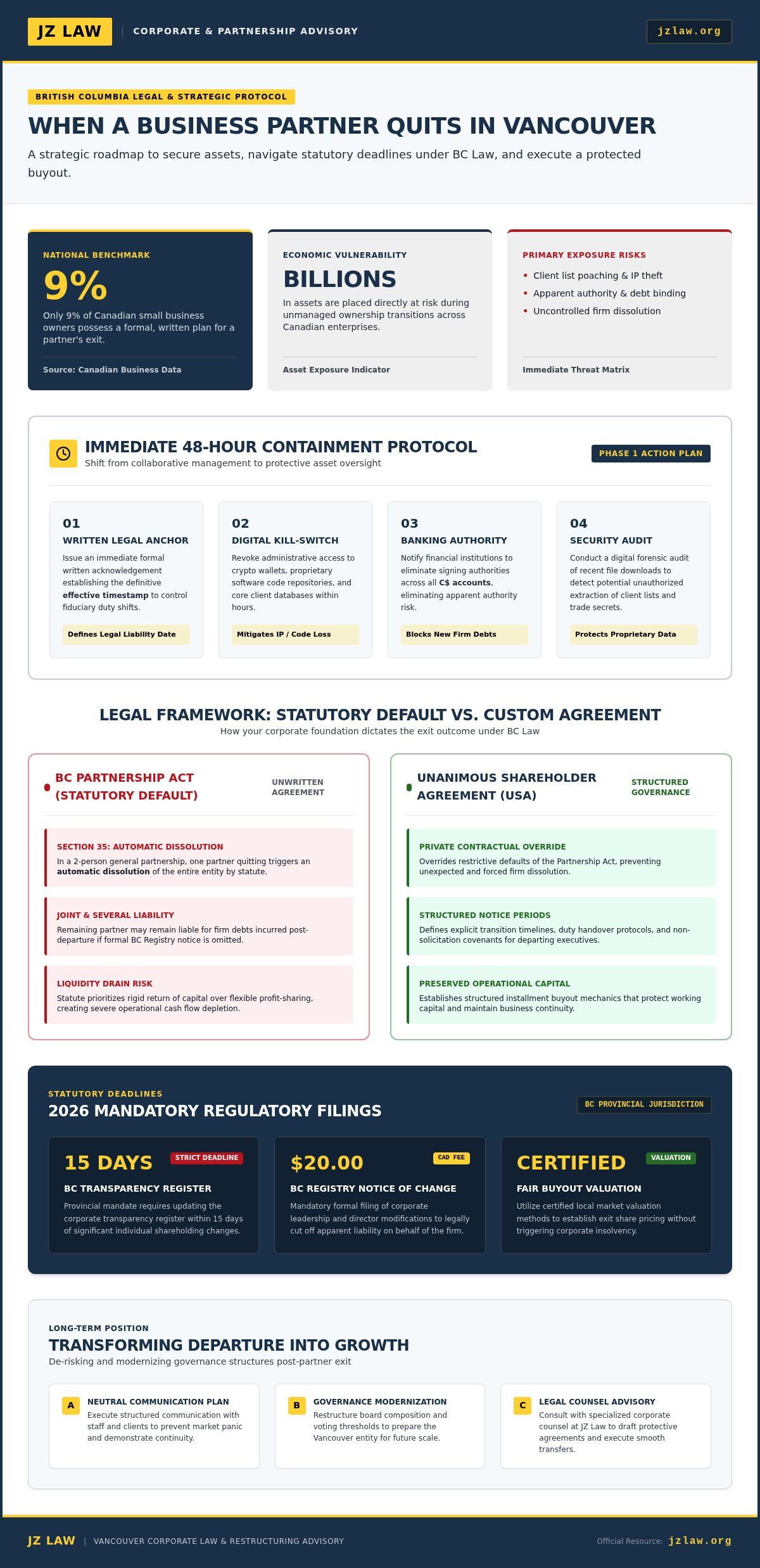
The moment a partner announces their resignation, the business enters a high-stakes period of transition. It's not just a change in leadership; it's a security event that requires immediate, calculated action. Your first priority isn't the long-term buyout, but the containment of operational and legal risks. Determining what to do when a business partner quits Vancouver requires a shift from collaborative management to protective asset oversight. You must issue a formal, written acknowledgement of the resignation immediately. This document serves as a legal anchor that establishes a definitive timeline, which is essential for managing liability and future regulatory filings.
Digital and Financial Asset Protection
Containment begins with your digital infrastructure. In a modern Vancouver enterprise, the physical handover of keys is secondary to the revocation of digital privileges. You need to revoke administrative access to sensitive cryptocurrency wallets, proprietary software code, and client databases within the first few hours. If your firm operates in regulated sectors like cannabis or fintech, the security of these assets is a compliance requirement, not a suggestion. Notify your financial institutions to update signing authorities on all C$ accounts. This prevents "apparent authority" issues where a departed partner could still legally bind the business to new debts or contracts. A thorough audit of recent data downloads is also necessary to identify any potential theft of trade secrets or client lists before they can be used by a competitor.
Establishing the 'Effective Date' of Departure
The exact minute of a partner's resignation carries significant weight under BC law. This timestamp dictates when the partner's fiduciary duties begin to shift and when the remaining entity assumes sole responsibility for new obligations. Many disputes arise when the "effective date" is left ambiguous, leading to conflicts over profit sharing or liability for losses incurred during the notice period. Most structured firms rely on a shareholders' agreement to define these notice periods and the specific steps for a transition of power. If such an agreement isn't in place, the default rules of the BC Partnership Act may apply, which can be far less favorable to the remaining partners. Document every communication regarding the exit; a clear paper trail is your best defense if mediation becomes necessary. Finally, prepare a neutral communication plan for staff and clients. You want to prevent market panic by demonstrating that the departure is being handled with professional dignity and strategic precision.
The Legal Framework: BC Partnership Act vs. Shareholder Agreements
When determining what to do when a business partner quits Vancouver, you must first identify the legal foundation of your entity. For many small firms, this foundation is the BC Partnership Act. Without a written agreement, this statute dictates every aspect of the departure. It's often a rigid framework that doesn't account for modern business complexities or the unique needs of a growing firm. Relying on default legislation can lead to unpredictable outcomes that threaten your operational continuity.
Statutory Defaults in British Columbia
If you operate as a general partnership without a formal contract, Section 35 of the Act provides that any partner may dissolve the firm simply by giving notice. In a two-person partnership, one partner quitting triggers an automatic dissolution because a legal partnership requires at least two people. This creates an immediate risk for the remaining owner. You could be held joint and severally liable for firm debts incurred even after the partner leaves if formal notice isn't provided to the BC Registry. The Act also prioritizes the return of capital over flexible profit-sharing arrangements, which can drain liquidity during a buyout. It's a high-stakes environment where silence in your founding documents equals vulnerability.
The Power of a Unanimous Shareholder Agreement (USA)
Incorporated companies often utilize a Unanimous Shareholder Agreement (USA) to override these restrictive defaults. A well-drafted USA provides a private roadmap for "trigger events," such as voluntary resignation or a forced exit. In Vancouver’s competitive tech and cannabis sectors, a Right of First Refusal (ROFR) is a standard mechanism. It ensures that the remaining shareholders have the first opportunity to purchase the quitting partner’s shares, preventing an outsider from gaining control. These agreements are vital when managing corporate transactions during a leadership shift. They allow you to define the terms of the decoupling rather than letting provincial statutes dictate your future.
Maintaining your corporate "Good Standing" is a continuous requirement throughout this process. You must file a Notice of Change of Directors with the BC Registry within 15 days of the resignation to reflect the new management structure. Failure to do so can result in administrative penalties and complications for your annual report filings. If you're unsure how your current documentation handles these triggers, seeking a review from JZ Law can provide the necessary clarity to protect your interests. Precision in your legal filings is the only way to ensure the departing partner's liabilities don't become your own.
Valuation and Buy-Out Strategies for the Quitting Partner
Determining the financial value of a departing partner's interest is arguably the most contentious phase of a corporate separation. When addressing what to do when a business partner quits Vancouver, you must move beyond subjective sentiment and establish a Fair Market Value (FMV) that withstands legal scrutiny. According to industry data, 43% of business owners report that measuring value is their primary challenge during transitions. A fair valuation prevents the remaining entity from overextending its cash flow while ensuring the departing party receives equitable compensation for their contribution.
Valuation Methodologies for Private Firms
The choice of methodology depends heavily on your industry and asset base. Vancouver-based real estate firms often utilize asset-based valuations, while tech and service providers rely on earnings-based models, such as EBITDA multiples. Valuing 'Goodwill' is particularly complex; if 39% of your operations depend on the active participation of the quitting partner, their departure might significantly impact the firm's future earnings. Engaging an independent Chartered Business Valuator (CBV) is essential to eliminate bias. Their appraisal provides a neutral baseline that can prevent the need for expensive litigation or court-ordered liquidations.
Executing the Buy-Out Agreement
Once a value is established, the structure of the payment determines the firm's survival. Lump-sum cash payments are increasingly rare in the 2026 economic climate. Instead, many firms utilize Vendor Take-Back (VTB) loans or performance-based earn-outs. A VTB allows the remaining partner to pay the purchase price over several years via a promissory note, preserving operational liquidity. If the departure involves a change in control or entity structure, you must also manage municipal requirements, such as a City of Vancouver business licence transfer, which carries a C$201.00 administrative fee.
Strategic tax structuring is vital during the final execution of the 'Release and Settlement' agreement. Leveraging the Lifetime Capital Gains Exemption (LCGE), which is indexed between C$1,250,000 and C$1,275,000 for the 2026 tax year, can significantly reduce the tax burden for the departing shareholder. This document must extinguish all future claims and detail the transfer of securities, especially if the company is being positioned for an IPO. If the exit is the result of a deadlock, a 'Shotgun Clause' in your agreement may be the only way to force a resolution, allowing one partner to name a price at which they'll either buy or sell.
Operational Transition and Regulatory Compliance in Vancouver
Managing the operational shift after a partner departs requires more than just internal reorganization; it demands strict adherence to provincial and municipal regulatory timelines. When you're deciding what to do when a business partner quits Vancouver, you must prioritize your filings with BC Registry Services. Under the Business Corporations Act, you're required to file a Notice of Change of Directors within 15 days, which carries a C$20.00 statutory fee. Simultaneously, you must update your Corporate Transparency Register. Failure to record changes in "significant individuals" within that same 15 day window can trigger administrative fines of up to C$50,000 for individual directors and C$100,000 for the corporation. These aren't mere administrative tasks; they're essential steps to maintain your firm's legal standing and avoid unnecessary financial exposure.
Regulated Industry Requirements (Cannabis & Crypto)
For firms in highly regulated sectors, a partner's exit can trigger complex "Change of Control" reviews that require immediate attention. If your business holds a cannabis licensing agreement, you must notify the Liquor and Cannabis Regulation Branch (LCRB) or Health Canada of any changes to your board or significant shareholders. Cryptocurrency firms face similar scrutiny from FINTRAC and provincial securities regulators, especially if the departing principal was the designated compliance officer or held keys to cold storage. You must ensure that no regulatory triggers occur without prior approval, as an unmanaged exit could jeopardize your operational permits. Securing strategic counsel for these corporate transactions ensures that your licenses remain valid throughout the transition period.
Client and Employee Retention
The departure of a key principal often creates a vacuum that competitors may try to exploit. You need to review the enforceability of non-solicitation clauses, which British Columbia courts interpret with extreme precision. While you generally can't prevent a former partner from working in the same industry, you can protect your proprietary client lists and trade secrets through well-drafted restrictive covenants. Stabilizing your remaining team is equally vital; redistribute responsibilities quickly to prevent burnout and reassure your staff of the firm's direction. Address any "Key Man" clauses in your major commercial contracts immediately. These provisions often allow clients to terminate an agreement if a specific partner is no longer involved, making proactive communication the only way to retain high-value accounts. Finally, don't overlook your commercial real estate lease. If the departing partner provided a personal guarantee to a Vancouver landlord, you'll need to negotiate their release to prevent future legal friction regarding the premises.
Strategic Restructuring: Positioning for Future Growth with JZ Law
While the immediate focus of a corporate separation is often on risk containment, the departure of a major stakeholder provides a rare window to re-evaluate your long-term trajectory. It's the ideal moment to determine if your current structure still serves your ultimate vision. For many Vancouver firms, this transition marks the shift from a private partnership to a more scalable, sophisticated corporate model. You might even consider whether the current landscape makes it the right time to take the company public, especially if the exit allows for a more streamlined board of directors and a clearer path to the capital markets.
From Decoupling to Expansion
Restructuring is more than just a legal necessity; it's a strategic "reset" for your capital table. A partner leaving allows you to remove legacy interests that might otherwise hinder future investment or institutional participation. You can use this phase to explore targeted mergers or acquisitions that fill the expertise gap left by the departing principal, effectively turning a loss into a growth catalyst. John Zang’s approach to complex securities and corporate transactions focuses on this type of proactive evolution. By aligning your cap table with institutional standards now, you prepare the entity for future capital raises or a strategic exit of your own, ensuring that the business remains attractive to sophisticated investors.
Why a Boutique Corporate Firm is Essential
High-stakes corporate transitions require a level of precision and strategic foresight that large-firm overhead often obscures. JZ Law provides partner-led counsel that prioritizes strategic outcomes over billable volume, offering the agility needed to manage rapid changes in leadership. This boutique approach is particularly effective when navigating niche sectors such as oil and gas or high-value real estate transactions. When you're determining what to do when a business partner quits Vancouver, you need a strategic partner who understands the market's nuances and the regulatory landscape of 2026.
Modernizing your Shareholder Agreement is the final, essential step in preventing future "quitting" crises. JZ Law specializes in drafting robust, future-proof documents that include clear exit formulas, deadlock resolutions, and restrictive covenants tailored to your specific industry. This ensures that any future transition is a planned, predictable event rather than an operational emergency. Contact JZ Law for a confidential assessment of your partner departure strategy. We don't just manage the legal decoupling; we position your business for its next stage of global evolution.
Securing Your Corporate Legacy Through Strategic Transition
Navigating the departure of a principal requires a balance of immediate containment and long-term vision. By securing your digital infrastructure within the first 48 hours and addressing mandatory BC Registry filings, you protect the firm from unnecessary liability. Moving beyond the rigid defaults of provincial statutes toward a modernized shareholder agreement ensures that your business remains resilient against future disruptions. When you're determining what to do when a business partner quits Vancouver, remember that this transition is an opportunity to refine your capital table and prepare for future growth or a potential public listing.
JZ Law provides the strategic oversight necessary for these high-stakes corporate transactions. Our specialized regulatory knowledge in sectors like Cannabis and Securities allows us to manage complex decoupling with a business-first approach. We don't just handle the paperwork; we act as a strategic partner to ensure your entity thrives after the restructuring. Secure your business's future-consult with JZ Law on your partner transition today. With the right legal framework and a proactive mindset, your company's most successful chapters are yet to be written.
Frequently Asked Questions
Can a business partner just quit without notice in British Columbia?
Under the BC Partnership Act, if no fixed term or written agreement exists, a partner can terminate the partnership at will by giving notice to all other partners. However, most formal shareholder agreements mandate a specific notice period, often 60 or 90 days. Quitting without such notice when a contract is in place can lead to a breach of contract claim and potential liability for resulting operational losses.
What happens if we don't have a written Partnership Agreement in Vancouver?
Your firm defaults to the rules of the BC Partnership Act, which can be highly disruptive. Any partner can dissolve the entire business at any time simply by giving notice. In a two-person firm, one partner quitting automatically forces a legal dissolution under Section 36. You'll also remain joint and severally liable for firm debts until a formal change is recorded with the BC Registry.
How do I calculate the value of my partner's share if they leave?
Calculation requires determining the Fair Market Value using asset-based or earnings-based methods, such as an EBITDA multiple. In Vancouver, courts often rely on appraisals from a certified Chartered Business Valuator to resolve disputes. You must account for tangible assets, shareholder loans, and 'Goodwill'. Relying on simple book value is rarely sufficient for a fair, legally defensible buyout that withstands a potential audit.
Is a non-compete clause enforceable in BC if a partner quits?
BC courts view non-compete clauses with high scrutiny and generally find them unenforceable unless they're reasonable in geographic scope and duration. They must protect a legitimate proprietary interest without being overly restrictive to the individual's livelihood. Most Vancouver firms find that well-drafted non-solicitation clauses, which protect specific client lists and trade secrets, are more likely to be upheld than broad, industry-wide non-compete restrictions.
Do I need to notify the BC Registry when a partner resigns?
Yes, you must file a Notice of Change of Directors within 15 days of the resignation under the Business Corporations Act. The provincial filing fee is C$20.00. Additionally, you must update the Corporate Transparency Register within 15 days to reflect changes in "significant individuals." Failure to meet these deadlines can result in administrative fines reaching up to C$100,000 for the corporation, depending on the severity of the delay.
What is a 'Shotgun Clause' and should I use it now?
A shotgun clause is a mandatory buy-sell mechanism where one partner offers to buy the other's interest at a specific price. The other partner must then either accept the offer or buy out the proposer at that same price. It's an effective way to resolve deadlocks but carries significant risk if you lack the liquidity to buy the other partner out at the price they've set.
How does a partner's exit affect my cannabis or crypto license in Canada?
A partner's departure often triggers a mandatory notification to regulators like Health Canada or FINTRAC. In the cannabis sector, failing to report a departing significant shareholder or director can jeopardize your operating license. Cryptocurrency firms must also update their compliance registers and security protocols. These updates are critical for maintaining the legal standing of your regulated entity during a transition and ensuring you don't breach federal compliance rules.
Can I stop my partner from taking our clients to a competitor?
This depends on the presence of a valid non-solicitation clause in your partnership or shareholder agreement. While you can't prevent a former partner from working in the industry, you can legally restrict them from actively soliciting your established client base. Determining what to do when a business partner quits Vancouver involves auditing your existing contracts to ensure these proprietary protections are enforceable and properly documented under BC law.


Comments