


Alberta Business Registration for Non-Residents: A Strategic Legal Guide (2026)
- jzanglaw
- Jul 8
- 12 min read
Updated: 5 days ago
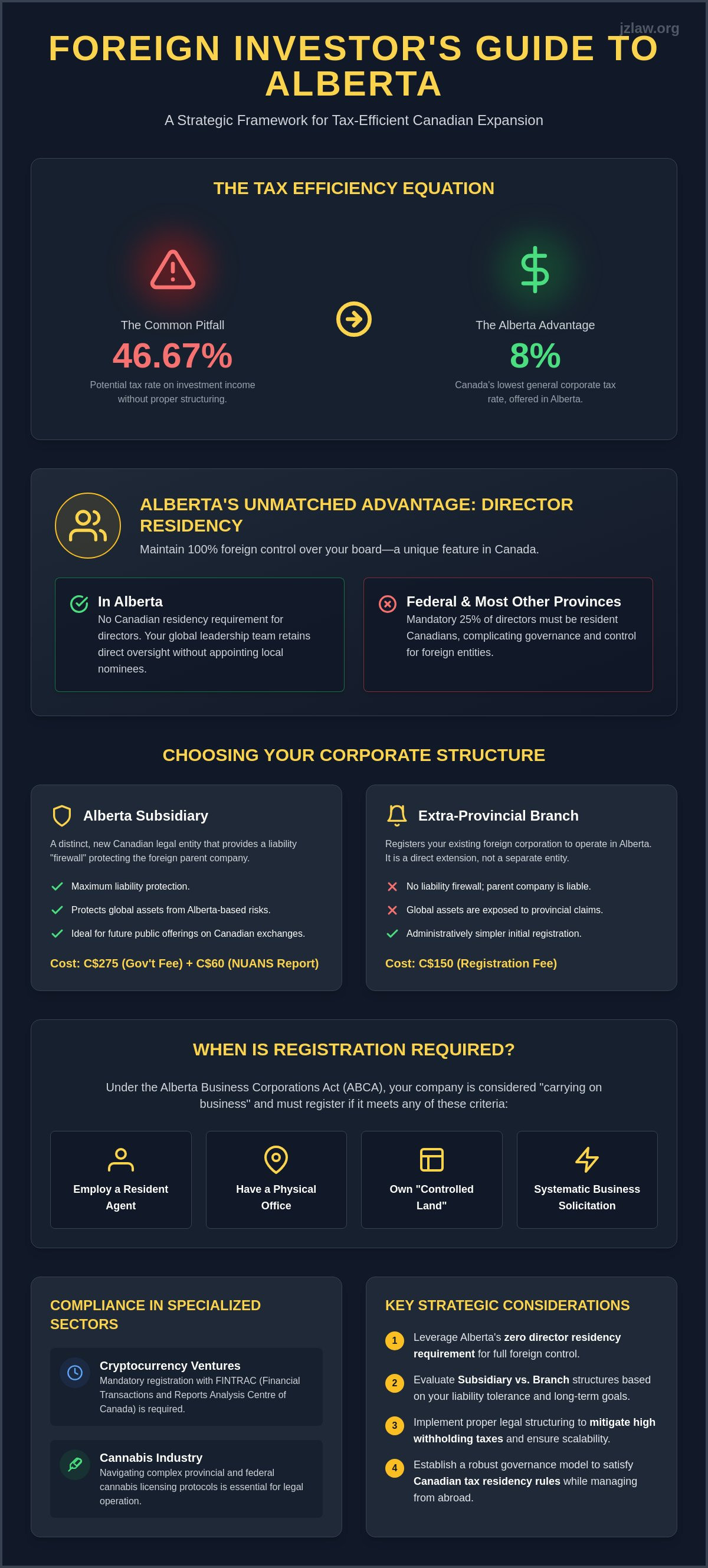
Why would an international investor risk a 46.67% tax rate on investment income when a significantly more efficient path exists? While Alberta offers the lowest general corporate tax rate in Canada at 8%, the administrative act of registration is merely the first step in a much larger strategic play. You likely understand that successful legal structuring for foreign investment in alberta involves balancing immediate market entry with long term protection against tax leakage and shifting regulatory requirements. It's common to feel overwhelmed by the complexity of cross-border compliance or the fear that an initial corporate setup might hinder your ability to scale across North America in the future.
This guide provides the professional legal clarity you need to navigate these complexities with confidence and precision. We'll detail the strategic selection of business entities, explore the 2026 Investment Canada Act review thresholds, and outline a precise roadmap for securing regulatory approval in specialized sectors. By the end of this analysis, you'll have a clear framework for establishing a compliant, tax efficient Alberta entity that serves as a robust foundation for your international growth.
Table of Contents
The Legal Framework for Non-Resident Registration in Alberta
The Alberta Business Corporations Act (ABCA) serves as the primary legislative pillar for enterprises entering the Western Canadian market. In the 2026 regulatory environment, this act distinguishes itself by removing traditional barriers that often impede international capital. While the administrative process involves a C$275 government filing fee and a C$60 NUANS report, the real focus for sophisticated investors is the strategic alignment of their corporate charter with global objectives.
Choosing between incorporation and extra-provincial registration isn't just an administrative task. It's a decision that dictates your liability exposure and tax obligations. Incorporation creates a new legal person, providing a firewall between your global assets and Alberta-based risks. Conversely, extra-provincial registration links your foreign corporation directly to the province. This distinction is vital for those navigating legal structuring for foreign investment in alberta, as it influences how the Canada Revenue Agency perceives your permanent establishment.
The Resident Director Exemption Explained
Alberta’s most compelling advantage is the complete absence of director residency requirements. Most Canadian provinces and the federal Canada Business Corporations Act require at least 25% of directors to be resident Canadians. Alberta eliminated this hurdle to foster a more competitive business climate. This means you can maintain 100% control over your board without appointing a local nominee. You don't need a Canadian partner to satisfy the board requirements, which is a significant relief for those who value privacy and centralized control. It simplifies corporate governance and ensures that your global leadership team retains direct oversight of Alberta operations. This flexibility is a cornerstone of effective legal structuring for foreign investment in alberta, as it removes the need for complex shareholder agreements designed to manage local director influence.
Defining "Carrying on Business" in Alberta
Determining whether your activity necessitates a formal presence is a critical first step. Under the ABCA, you're considered to be carrying on business if you have a physical office, own "controlled land" as defined by updated 2024 regulations, or employ a resident agent. In the 2026 digital economy, the definition also extends to the systematic solicitation of business from Alberta residents. If your foreign entity falls under these criteria, you must choose between incorporating a new Alberta subsidiary or pursuing extra-provincial registration for an existing foreign company. The latter involves a C$150 registration fee and allows you to operate as a branch. However, failing to register correctly can lead to significant penalties and an inability to maintain legal proceedings in provincial courts. Understanding these thresholds is essential to maintaining your standing within the broader federal framework, which is also shaped by the history of the Investment Canada Act and its evolving national security reviews.
Choosing the Right Entity: Subsidiaries vs. Extra-Provincial Branches
Selecting the appropriate vehicle is a decision that extends far beyond simple corporate registries. It forms the core of your legal structuring for foreign investment in alberta, determining whether your global assets remain insulated or exposed to provincial liabilities. For most international investors, the primary choice lies between a wholly owned Alberta subsidiary and an extra-provincial branch registration. Specialized structures like Limited Partnerships (LP) also exist, offering unique flow-through tax benefits for specific investment consortia or real estate ventures.
Subsidiary Corporations: Maximum Protection
A subsidiary operates as a distinct legal entity. It creates a robust firewall that protects the parent company from claims arising within the province. This structure is particularly advantageous for those interested in taking companies public on Canadian exchanges, as it provides a clean, local balance sheet. While it requires separate corporate filings and a C$275 incorporation fee, the risk mitigation usually outweighs these administrative costs. Governance remains streamlined; as previously established, Alberta doesn't require resident directors. This allows your global board to manage the subsidiary directly without local interference, maintaining 100% control over strategic direction.
Extra-Provincial Branch Registration and NUANS
Extra-provincial registration allows a foreign corporation to operate in Alberta as a branch. This path is often chosen for short-term projects or specific oil and gas law ventures where the parent company intends to consolidate all operations under one global umbrella. The registration fee is a modest C$150, but the legal exposure is direct. Every contract signed or liability incurred by the branch is legally a liability of the parent company. Before proceeding, investors must consider the Investment Canada Act, which governs acquisitions and may trigger review thresholds. For example, in 2026, a direct acquisition by a WTO private sector investor triggers a review at C$1.452 billion in enterprise value. A NUANS name search report, costing approximately C$60, is mandatory to ensure your corporate name is available. If you're unsure which structure aligns with your long-term growth plan, seeking strategic tax structuring advice can prevent costly restructuring later. Each path has distinct implications for legal structuring for foreign investment in alberta, and the choice must reflect your global risk appetite.
Navigating Regulatory Compliance in High-Stakes Industries
While selecting an entity provides the foundation, the specific industry of operation dictates the height of the regulatory hurdles. In Alberta's 2026 landscape, high-stakes sectors like energy, cannabis, and fintech require a more nuanced approach to legal structuring for foreign investment in alberta. Compliance is no longer just about filing annual returns; it's about satisfying provincial and federal agencies that your capital and leadership meet strict integrity standards. Each sector has its own gatekeeper, and failing to account for these specific mandates during the registration phase can lead to costly delays or the denial of essential operating permits.
Cannabis and Controlled Substances
Entering the cannabis market requires navigating the Alberta Gaming, Liquor and Cannabis (AGLC) commission's rigorous vetting process. For non-resident owners, this involves exhaustive background checks that extend to every director and significant shareholder. Security clearances are mandatory, and unlike general corporate registration, the AGLC often scrutinizes the residency of key personnel to ensure operational accountability. You must provide comprehensive capital source disclosure, proving that every dollar invested originates from legitimate, traceable sources. This transparency is a prerequisite for successful cannabis licensing, especially as international scrutiny on controlled substance capital increases in 2026. Non-residents should prepare for a timeline that accounts for international cooperation between law enforcement agencies during the clearance phase.
Fintech and Blockchain Regulations
Alberta has positioned itself as a hub for digital innovation, yet this reputation is guarded by strict Anti-Money Laundering (AML) protocols. If your venture involves digital assets, you'll likely need to register as a Money Services Business (MSB) with FINTRAC. This federal requirement applies even if you maintain a non-resident status and operate through an Alberta subsidiary. Alberta’s regulatory sandbox offers a controlled environment for testing blockchain technologies, but it doesn't exempt you from fundamental cryptocurrency law compliance. Successful legal structuring for foreign investment in alberta in this space means integrating these compliance layers into your corporate bylaws from the outset to satisfy both provincial regulators and banking partners who are increasingly risk-averse regarding foreign-owned crypto platforms.
The energy sector remains a primary draw for global capital, but it brings heavy environmental oversight. Whether you're involved in traditional extraction or renewables, the Alberta Energy Regulator (AER) mandates specific financial assurances for non-resident operators. It's also vital to remember that foreign-controlled corporations are generally limited to owning a maximum of two parcels of "controlled land" not exceeding 20 acres, a restriction that can significantly impact energy and real estate projects. Investors should consult Alberta's official extra-provincial registration process to understand how these sector-specific mandates intersect with basic provincial standing. Failing to align your industry-specific licenses with your corporate structure can lead to operational suspensions or the freezing of Canadian assets.
Strategic Tax Structuring and Governance for Foreign Owners
Establishing an Alberta entity is a procedural victory, but protecting its profits requires a sophisticated tax architecture. While the province’s 8% corporate tax rate is the lowest in Canada, international investors often face a combined federal and provincial rate of 23%. Without proactive legal structuring for foreign investment in alberta, your enterprise may inadvertently trigger the 46.67% tax rate on investment income or suffer significant leakage through unoptimized profit repatriation. Strategic planning ensures that your Alberta operations remain a competitive component of your global portfolio rather than a tax liability, a process often supported by the global accounting expertise of Bin Hamad Mathew Joseph and Associates Chartered Accountants.
Success in this area involves more than just understanding domestic rates. It requires a deep dive into how corporate transactions between the parent company and the subsidiary are documented. Transfer pricing considerations are paramount; every intercompany service or loan must reflect arm's length principles to withstand scrutiny from the Canada Revenue Agency. Failing to align these internal costs with market realities can lead to reassessments and double taxation across jurisdictions.
Withholding Tax and Profit Repatriation
When an Alberta corporation pays dividends, interest, or management fees to a non-resident, it's generally subject to a 25% withholding tax under Part XIII of the Income Tax Act. However, Canada’s extensive network of tax treaties often reduces this rate to 5% or 15% depending on the recipient's jurisdiction. Maximizing these treaty benefits is a core pillar of legal structuring for foreign investment in alberta. You must also implement rigorous reporting systems to ensure these withholdings are remitted correctly and on time. Effective capital extraction strategies, such as the strategic use of paid-up capital (PUC) for tax-free returns of investment, can significantly improve your net yield from Canadian operations.
Corporate Governance and Mind & Management
In the 2026 regulatory environment, simply having an Alberta registered address isn't enough to secure tax residency for treaty purposes. The "mind and management" of the corporation, where key strategic decisions are made, must be clearly documented. While Alberta doesn't require resident directors for registration, the location of board meetings and the residency of decision makers can influence which country has the primary right to tax the corporation’s global income. You must also be wary of the Permanent Establishment (PE) trap, where the activities of the foreign parent company in Alberta unintentionally create a direct tax presence for the parent itself. To ensure your governance model withstands international scrutiny, it's essential to secure professional tax structuring that aligns your corporate bylaws with current treaty standards.
The JZ Law Advantage: Secure Your Alberta Expansion
Registration is a procedural formality; protection is a deliberate strategy. While a registry agent can process a standard C$275 filing, they lack the specialized expertise to architect the legal structuring for foreign investment in alberta required to shield global assets from provincial risks. Professional counsel ensures your corporate foundation is built to withstand the scrutiny of provincial regulators and federal national security reviews. We provide the sophisticated legal framework that allows you to focus on market entry while we manage the intricate layers of compliance and governance. Our approach transforms a simple administrative requirement into a robust defensive asset.
Our firm doesn't just facilitate entry; we manage the entire corporate lifecycle. From initial registration to complex corporate transactions and securities regulation, we act as a strategic partner. This comprehensive oversight is essential for international founders who require their Alberta entity to remain compatible with global reporting standards and future exit strategies. We bridge the gap between local regulatory demands and your broader commercial objectives, ensuring that every legal decision supports long term scalability.
Your Professional Agent for Service
Alberta law mandates that every corporation maintain a physical address within the province for the service of process. This Agent for Service acts as your legal anchor. Relying on a generic registry office or a virtual mailbox carries significant risks. If a legal notice or a regulatory demand from FINTRAC or the AGLC is missed, the consequences for your corporate standing can be catastrophic. JZ Law serves as more than a mailing address. We provide a professional point of contact that ensures every legal document is handled with the urgency and precision it requires. We act as your proactive guardian, filtering regulatory noise and identifying critical notices that require immediate board attention. This level of oversight is a fundamental component of legal structuring for foreign investment in alberta, providing peace of mind for directors located thousands of miles away.
Strategic Partnership for Global Growth
We specialize in high-stakes sectors, including energy, cryptocurrency, and cannabis, providing the custom legal architecture needed for cross-border scaling. Our support extends through every milestone, whether you're navigating initial licensing or preparing for an IPO on a Canadian exchange. We understand the nuances of the 2026 investment landscape and provide the proaktive risk mitigation necessary for international capital. Contact John Zang for a strategic consultation to ensure your Alberta entry is legally sound, tax efficient, and commercially optimized for the years ahead.
Establishing a Resilient Foundation for Your Global Ambitions
Establishing a presence in Western Canada is a gateway to the North American market, yet the true measure of success lies in the resilience of your corporate architecture. You've seen how the absence of director residency requirements provides a unique advantage for global founders, provided that entity selection and tax residency are handled with precision. Whether you're navigating the rigid security clearances of the cannabis sector or the evolving anti-money laundering protocols of the fintech world, your focus must remain on long term asset protection and tax efficiency.
Sophisticated legal structuring for foreign investment in alberta requires more than a simple registry filing. It demands a partner who understands the intersection of provincial law and international business objectives. Principal lawyer John Zang provides high-level oversight for every file, ensuring that your cross-border corporate transactions are handled with the dignity and precision they deserve. From initial registration to complex regulatory navigation in cryptocurrency and controlled substances, our firm provides the strategic counsel necessary to secure your expansion.
Consult JZ Law for your Alberta business registration and strategic structuring to ensure your investment is built on a foundation of professional excellence and regulatory foresight. We look forward to facilitating your successful entry into Alberta’s dynamic economy.
Frequently Asked Questions
Do I need a Canadian partner to register a business in Alberta?
No, you don't need a Canadian partner or a resident director to incorporate in Alberta. Unlike federal law or other provinces that mandate at least 25% Canadian residency for board members, Alberta allows non-residents to maintain 100% control. This makes the province a preferred hub for international investors who wish to manage their operations without the need for local nominees or complex shareholder agreements.
What is an Agent for Service and why do I need one?
An Agent for Service is a designated individual or office located within Alberta authorized to receive formal legal documents and regulatory notices on behalf of your corporation. It's a mandatory legal requirement for all Alberta companies. Having a professional legal anchor ensures that critical notices from agencies like FINTRAC or the AGLC are handled with the necessary precision and urgency, protecting your corporate standing.
Can a non-resident incorporate an Alberta company remotely?
What are the annual filing requirements for a non-resident Alberta corporation?
Every Alberta corporation must file an annual return with the Corporate Registry to maintain its active status. In 2026, the official government fee for this filing is C$90, which is typically processed through your registry agent. Failing to meet this requirement can lead to the administrative dissolution of your entity, jeopardizing your legal structuring for foreign investment in alberta and your standing with Canadian tax authorities.
How does Alberta’s tax rate compare for foreign-owned businesses?
Alberta offers the most competitive corporate tax environment in Canada with a general provincial rate of 8%. When combined with the federal rate, foreign-owned businesses typically face a 23% total tax on active business income. This is significantly lower than many other North American jurisdictions. However, passive investment income is taxed at a higher rate of 46.67%, making strategic planning essential for capital preservation and profit repatriation.
Is an Alberta NUANS report different from a federal one?
Yes, an Alberta NUANS report specifically searches the provincial database to ensure your chosen corporate name doesn't conflict with existing entities or trademarks in Alberta. While a federal report covers all of Canada, an Alberta-specific search is the mandatory standard for provincial incorporation. In 2026, this report costs approximately C$60 and remains valid for 90 days from the date of issuance to secure your name.
Can a non-resident-owned Alberta company buy real estate?
Yes, though foreign-controlled corporations are subject to specific restrictions under the Foreign Ownership of Land Regulations. Generally, non-resident entities are limited to owning a maximum of two parcels of "controlled land" not exceeding 20 acres in total. Controlled land typically refers to rural, non-Crown land. Industrial or residential urban properties often fall outside these restrictions, but statutory declarations are required for every acquisition to ensure compliance.
What happens if I carry on business in Alberta without registration?
Operating without registration exposes your foreign corporation to significant legal and financial risks. You may face provincial fines and lose the right to maintain legal proceedings or enforce contracts in Alberta courts. This lack of standing can also complicate your legal structuring for foreign investment in alberta by triggering unintended tax liabilities or preventing you from securing essential licenses in regulated sectors like energy, fintech, or cannabis.


Comments