


Corporate Governance for Public Companies in Alberta: 2026 Legal Framework
- jzanglaw
- 2 days ago
- 12 min read
In 2026, the role of the board has evolved from a passive oversight body into a high-stakes strategic shield where a simple misunderstanding of regulatory nuances is no longer just a risk; it's a direct liability. You likely recognize that balancing the rigorous Alberta Business Corporations Act (ABCA) with shifting Canadian Securities Administrators (CSA) requirements feels like trying to hit a moving target, especially within the volatile energy and technology sectors. This guide provides the clarity you need to master corporate governance for public companies alberta by detailing the latest fiduciary standards and strategic mandates for the current fiscal year.
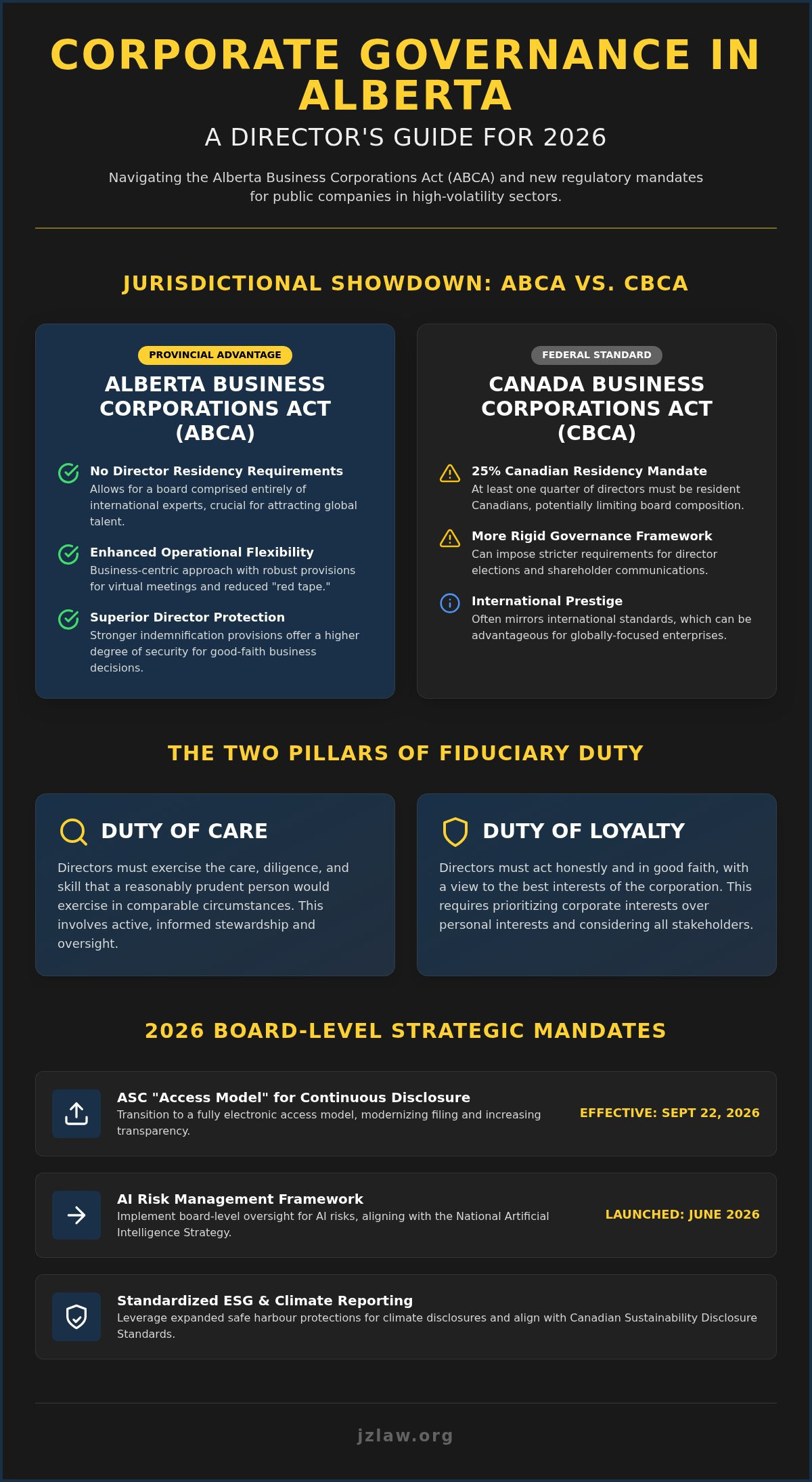
We'll explore how to navigate the Alberta Securities Commission (ASC) "access model" for continuous disclosure that takes effect on September 22, 2026, alongside the board's new responsibilities under the National Artificial Intelligence Strategy launched this June. You'll gain a clear understanding of how to leverage the Securities Act amendments which now offer expanded safe harbour protections for climate-related disclosures. By the end of this analysis, you'll possess a structured framework for board composition and compliance that transforms regulatory pressure into a distinct competitive advantage.
Table of Contents
The Alberta Regulatory Landscape: ABCA vs. CBCA in 2026
Effective corporate governance for public companies alberta represents more than a checklist of statutory obligations; it's a sophisticated framework designed to balance executive authority with shareholder protection. Within this jurisdiction, governance is defined by the interplay between provincial legislation and securities regulation. The Alberta Business Corporations Act (ABCA) serves as the primary legislative pillar, providing the structural rules for corporate existence. While many entities consider federal incorporation, the ABCA has been intentionally refined to offer a more flexible, business-centric environment that distinguishes it from the federal counterpart. Understanding these nuances is a fundamental component of this Canadian Corporate Law Overview, which highlights how provincial autonomy shapes the Canadian commercial landscape.
Choosing between the ABCA and the Canada Business Corporations Act (CBCA) involves weighing administrative ease against national prestige. In 2026, Alberta's regulatory environment remains highly competitive. The province has prioritized reducing "red tape," making the ABCA particularly attractive for entities in high-growth or volatile sectors. While the CBCA often mirrors international standards, it can occasionally impose more rigid requirements regarding director elections and shareholder communications. Alberta's approach focuses on empowering boards to act decisively while maintaining transparent oversight, a balance that's critical for public entities navigating the complexities of the Calgary-based energy and tech markets.
Key Jurisdictional Advantages of Alberta Incorporation
Alberta's legislative framework offers specific incentives that enhance board efficiency. One of the most significant advantages is the total elimination of director residency requirements. Unlike the CBCA, which mandates that at least 25% of directors be resident Canadians, the ABCA allows for a board comprised entirely of international expertise. This flexibility is vital for Alberta companies seeking global talent in specialized fields. Additionally, Alberta law provides robust provisions for virtual shareholder meetings, ensuring that companies can engage their investor base regardless of geographic location. The province's specific provisions for director indemnification also offer a higher degree of security, allowing directors to focus on long-term strategy without the constant shadow of personal liability for good-faith business decisions.
The Role of the Alberta Securities Commission (ASC)
The Alberta Securities Commission (ASC) acts as the primary regulatory watchdog for reporting issuers within the province. Its mandate is to foster a fair and efficient capital market while protecting investors from malpractice. Central to this mission is National Instrument 58-101, which requires public companies to provide detailed disclosure of their corporate governance practices. This isn't a "one size fits all" requirement; instead, it's a "comply or explain" model that respects the unique needs of different issuers. In 2026, we've observed an enforcement trend focusing heavily on the accuracy of these disclosures, particularly regarding how boards oversee emerging risks. The ASC's transition to an electronic "access model" for continuous disclosure in late 2026 further underscores the shift toward a modernized, digitally-integrated regulatory environment that rewards transparency and precision.
Board Composition and Fiduciary Duties: The 2026 Standard
The 2026 standard for board mandates in Alberta has shifted from a model of passive oversight to one of active, informed stewardship. Under Alberta's Business Corporations Act, directors are bound by the dual pillars of fiduciary duty: the Duty of Care and the Duty of Loyalty. While these principles are long-standing, their application in 2026 has become increasingly rigorous. The Duty of Loyalty requires directors to act honestly and in good faith with a view to the best interests of the corporation. In the current regulatory environment, "best interests" is interpreted broadly, often requiring boards to consider the impact of their decisions on a diverse range of stakeholders, including employees, creditors, and the environment, particularly within Alberta's sensitive industrial sectors.
Establishing effective corporate governance for public companies alberta now requires a board that isn't just independent in name, but possesses the technical literacy to oversee complex technological and environmental shifts. Director independence is no longer determined solely by a lack of direct financial ties. In 2026, the Alberta Securities Commission (ASC) and proxy advisors scrutinize "interlocking boards" and long tenures more closely, ensuring that independent directors can provide truly objective challenges to management. This objectivity is essential when managing the significant liability risks associated with public disclosure, where even a perceived failure in oversight can lead to costly derivative actions or regulatory interventions.
The Duty of Care in a Volatile Market
The Duty of Care demands that directors exercise the care, diligence, and skill that a reasonably prudent person would exercise in comparable circumstances. Alberta courts continue to apply the Business Judgment Rule, which protects directors from being second-guessed on the merits of their decisions, provided those decisions were made on an informed basis. In 2026, being "informed" requires more than just attending meetings. It necessitates a proactive reliance on professional reports and the strategic use of independent board committees. Audit, Compensation, and Governance committees must operate with a high degree of autonomy to ensure that high-stakes decisions, such as executive pay or financial restatements, are insulated from management bias.
Board Diversity and Competency Matrices
Modern board composition is increasingly dictated by sophisticated competency matrices that go beyond basic financial literacy. ASC disclosure requirements in 2026 have expanded to include detailed reporting on board diversity that encompasses skill sets, geographic experience, and specialized knowledge. We've seen a sharp rise in the demand for "Cyber-Literate" and "ESG-Fluent" directors who can translate complex technical risks into strategic board-level discussions. Implementing a robust, annual board evaluation process is no longer optional; it's a critical tool for identifying gaps in expertise before they become liabilities. Boards that prioritize these evaluations often seek specialized securities regulation advice to ensure their internal structures withstand regulatory scrutiny and support long-term corporate health.
Sector-Specific Governance: Oil & Gas, Cannabis, and Tech
Effective corporate governance for public companies alberta requires a granular understanding of the specific operational risks that define the province's industrial landscape. A generic approach to board oversight often fails in high-stakes environments where regulatory bodies like the Alberta Energy Regulator (AER) or Health Canada impose stringent, non-negotiable mandates. In 2026, the intersection of environmental compliance and fiduciary duty has become a focal point for litigation and regulatory intervention. Boards must now demonstrate that they've implemented rigorous internal controls that are specifically calibrated to their sector's unique legal and economic volatility.
Governance in the Alberta Energy Sector
For energy entities, the board's role in oversight has expanded to include the systematic management of decommissioning liabilities and Asset Retirement Obligations (ARO). The AER's increasingly proactive stance on financial security for well-site closures means that boards can no longer treat environmental cleanup as a distant balance sheet item. Directors must ensure that the corporation's strategic risk management framework accounts for the full lifecycle of energy assets, from exploration to final reclamation. This level of oversight is essential for maintaining investor confidence and securing the social license to operate. You can explore deeper insights into these requirements in our analysis of Oil and Gas Law: Strategic Legal Frameworks.
Regulatory Rigour for Cannabis Public Companies
Publicly traded cannabis firms navigate a double layer of oversight that combines traditional securities regulation with intense federal licensing mandates. Board members are responsible for ensuring that internal controls for inventory and security are robust enough to satisfy both Health Canada auditors and the ASC's disclosure standards. In 2026, we've seen heightened scrutiny regarding how these firms report biological assets and valuation adjustments. Boards that lack specialized expertise in this area risk significant restatements and loss of market credibility. If your organization is moving toward an IPO, understanding the nuances of Taking Your Cannabis Company Public is a critical first step in building a compliant governance structure.
Technology and cryptocurrency firms face a different set of challenges, primarily centered on rapid scaling and the lack of a single, comprehensive federal AI statute. Instead, these boards must piece together compliance from provincial initiatives and the National Artificial Intelligence Strategy launched on June 4, 2026. Effective governance here means establishing "Cyber-Literate" board committees that can oversee digital asset security and the ethical adoption of AI. This proactive stance is supported by the latest CSA Guidance on ESG Disclosure, which provides a roadmap for preventing "greenwashing" and ensuring that ESG-related claims are backed by verifiable data. By integrating these sector-specific mandates into the broader governance framework, Alberta boards can transform regulatory compliance into a strategic shield.
Modern Compliance: ESG, AI, and Disclosure Mandates
The 2026 standard for corporate governance for public companies alberta has reached a point where digital and environmental stewardship are inseparable from core fiduciary obligations. Boards can't view ESG or AI as peripheral concerns anymore; they're now central to capital access and long-term risk mitigation. This shift is driven by a regulatory environment that rewards precision and penalizes ambiguity. The move toward mandatory climate-related financial disclosures was significantly accelerated by 2025 amendments to the Alberta Securities Act. These amendments empowered the Alberta Securities Commission to expand safe harbour protections, which encourages boards to provide more robust, forward-looking climate reporting by reducing the immediate threat of liability for good-faith projections.
While these safe harbour provisions offer a degree of protection, they don't shield an entity from the legal implications of "greenwashing." Public filings in 2026 face intense scrutiny from both regulators and institutional investors who demand verifiable data over aspirational statements. Inaccurate environmental claims can lead to significant enforcement actions and a permanent loss of market credibility. Strategic boards seeking to align their internal policies with these rigorous 2026 mandates should consult with expert securities regulation counsel to ensure their disclosure frameworks are both robust and compliant.
The Board’s Role in AI Governance
The launch of Canada's National Artificial Intelligence Strategy on June 4, 2026, established a new benchmark for board-level oversight. Directors are now responsible for implementing ethical AI frameworks that address data privacy and algorithmic transparency. This oversight is critical for mitigating liability related to algorithmic bias, which can result in discriminatory outcomes or severe data breaches. Disclosure requirements for AI-driven business models have also tightened; companies must now clearly articulate how AI influences their strategic decision-making and risk profile. Boards that fail to develop a "cyber-literate" sub-committee risk being blindsided by the rapid pace of technological regulation.
ESG Disclosure and Capital Markets
Alberta public companies are increasingly benchmarking their performance against the International Sustainability Standards Board (ISSB) and the new Canadian Sustainability Disclosure Standards (CSDS). These frameworks provide a unified language for reporting, making it easier for global investors to assess an entity's ESG maturity. In 2026, we've seen a clear trend of integrating ESG metrics directly into executive compensation packages. This alignment ensures that management's incentives are tied to sustainable growth rather than just short-term financial gains. Effective governance now requires a systematic approach to tracking these metrics, ensuring that every claim in a sustainability report is backed by the same level of rigour as a traditional financial statement.
JZ Law: Strategic Governance Counsel for Alberta Boards
JZ Law, under the leadership of John Zang, serves as a strategic partner for entities navigating the intricate lifecycle of a public corporation. We don't just provide legal opinions; we build robust governance structures that withstand the scrutiny of the Alberta Securities Commission and institutional investors alike. Our approach to corporate governance for public companies alberta is rooted in a deep understanding of both the Alberta Business Corporations Act and the practical realities of the capital markets. Whether you're a private entity preparing for an initial public offering or an established reporting issuer managing complex Corporate Transactions, our counsel is designed to align regulatory compliance with your broader commercial objectives. We recognize that in 2026, a board's reputation is its most valuable asset, and we work tirelessly to protect it through meticulous planning and execution.
Boutique Expertise for Complex Mandates
Choosing a boutique firm means your board receives direct, partner-level attention for sensitive matters that often get lost in the hierarchy of larger organizations. We specialize in the unique dynamics of Calgary’s mid-cap and small-cap sectors, where the overlap between operational energy risks and securities law requires a surgeon's precision. Our focus remains on proactive risk mitigation. We identify potential governance gaps, such as board competency deficiencies or disclosure weaknesses, before they evolve into reactive legal crises. This method ensures your leadership remains focused on growth rather than damage control. By maintaining a lean, expert-driven structure, we provide the high-level representation of a national firm with the agility and personal commitment of a dedicated strategic advisor.
Securing Your Board’s Future
Engaging with JZ Law begins with a comprehensive governance audit to benchmark your current policies against the 2026 standards discussed throughout this guide. For firms on the path to an IPO, we develop custom frameworks that establish the necessary internal controls and board committees from the outset. This foundational work is essential for a successful transition to the public markets, ensuring that your entity meets all corporate governance for public companies alberta requirements before the first share is traded. If you require specialized Securities Regulation counsel to navigate the ASC’s new electronic access model or the latest AI and ESG mandates, John Zang provides the sophisticated representation your board requires. We invite you to contact our office to schedule a confidential consultation and secure a strategic shield for your organization’s future.
Securing Strategic Resilience for Alberta Boards
The regulatory landscape of 2026 demands that boards move beyond basic compliance to embrace a role as a proactive strategic shield. You've seen how the ABCA provides a flexible foundation; yet, the true challenge lies in navigating the intersection of ASC mandates and sector-specific risks. Whether it's managing decommissioning liabilities in the energy sector or overseeing the ethical adoption of artificial intelligence, the standard for corporate governance for public companies alberta has never been higher. Proactive risk mitigation is now the only reliable way to ensure long-term capital access and maintain stakeholder trust in a volatile global market.
JZ Law offers the specialized expertise needed to manage these complexities with partner-level precision. With deep knowledge of Alberta Securities Commission compliance and a proven track record in the Oil & Gas and Cannabis sectors, we serve as a strategic partner for IPOs and high-stakes corporate transactions. Your board's future depends on the precision of today's decisions, and we're committed to helping you lead with confidence and professional dignity. Consult with JZ Law for Strategic Corporate Governance Counsel to secure your organization's regulatory standing and commercial success.
Frequently Asked Questions
What is the difference between ABCA and CBCA for public companies?
The primary distinction lies in director residency requirements and legislative flexibility. The ABCA does not mandate that any directors be resident Canadians, whereas the CBCA requires a 25% residency threshold. Alberta's statute also provides unique provisions for corporate waivers of business opportunities; this makes it a more adaptable jurisdiction for international boards and specialized sectors.
Are Alberta public companies required to have a majority of independent directors?
While Alberta's Business Corporations Act doesn't strictly mandate a majority, the Alberta Securities Commission requires detailed disclosure of director independence. Most major exchanges, such as the TSX, require at least two independent directors. However, institutional investors and proxy advisors in 2026 effectively demand a majority to ensure robust corporate governance for public companies alberta.
What are the 2026 ESG disclosure requirements for Calgary-based companies?
Companies must now align their reporting with the Canadian Sustainability Disclosure Standards (CSDS), which harmonize with international ISSB frameworks. Following 2025 amendments to the Alberta Securities Act, companies also benefit from expanded safe harbour protections for forward-looking climate disclosures. These protections are contingent on meeting rigorous data verification standards to avoid greenwashing allegations.
How does the Alberta Securities Commission (ASC) regulate corporate governance?
The ASC regulates through a "comply or explain" model, primarily governed by National Instrument 58-101. Starting September 22, 2026, the commission will also implement an "access model" for continuous disclosure, which permits electronic delivery of key documents. This shift rewards organizations that maintain high levels of transparency and digital integration in their reporting cycles.
What is the board’s liability regarding AI implementation in 2026?
Directors face personal liability if they fail to exercise due diligence in overseeing AI-driven business models and data privacy. Under the National Artificial Intelligence Strategy launched in June 2026, boards are expected to mitigate algorithmic bias and security risks. Failure to establish a cyber-literate committee can be interpreted as a breach of the fiduciary duty of care in this high-tech landscape.
Can an Alberta public company hold entirely virtual shareholder meetings?
Yes, recent amendments to the ABCA expressly permit corporations to hold virtual shareholder meetings. The board must ensure that the technology used allows all participants to communicate concurrently and vote securely. This flexibility has become a standard feature for Calgary-based entities seeking to engage a geographically diverse investor base without the overhead of physical venues.
What governance documents are mandatory for a TSX or TSX-V listing?
Listing on these exchanges requires a comprehensive suite of oversight documents, including a formal Board Charter and an Audit Committee Charter. You'll also need a Code of Business Conduct and Ethics, a Disclosure Policy, and an Insider Trading Policy. These documents must be reviewed regularly to ensure they reflect the current 2026 regulatory environment and exchange-specific mandates.
How often should an Alberta public company review its governance policies?
Best practices dictate an annual review of all core governance policies to ensure they remain aligned with evolving ASC mandates. Significant corporate transactions or major legislative shifts, such as the 2026 AI and ESG updates, should trigger an immediate audit. Regular evaluations allow boards to identify and mitigate risks before they manifest as regulatory non-compliance or costly litigation.


Comments