


Asset Purchase Agreement Alberta: A Strategic Legal Guide for 2026
- jzanglaw
- Jul 13
- 12 min read
Updated: Jul 20
The most dangerous liability in a corporate acquisition isn't found on the balance sheet, but in the regulatory gaps of a poorly drafted contract. In the 2026 market, where the Alberta Energy Regulator (AER) has set the orphan fund levy at C$154.56 million and iGaming regulations are rapidly evolving, a standard template simply won't suffice. Executing a robust asset purchase agreement alberta requires a sophisticated understanding of how to isolate high-value assets while insulating the buyer from the seller’s historical indiscretions.
You likely recognize that while asset deals offer superior tax flexibility compared to share sales, the complexity of transferring titles and securing regulatory pre-clearance can easily derail a closing. This guide provides the strategic clarity you need to master these complexities, ensuring a seamless transfer of ownership and full compliance in Alberta’s most demanding industries. We'll examine the nuances of Section 167 GST elections, the impact of 2026 AER administration fees on transfers, and the specific clauses required to mitigate post-closing risks in a high-stakes environment.
Table of Contents
What is an Asset Purchase Agreement (APA) in Alberta?
An Asset Purchase Agreement (APA) serves as the definitive legal instrument for transferring specific business components from a seller to a buyer. Unlike a merger or a share acquisition, an asset purchase agreement alberta allows for the selective acquisition of inventory, intellectual property, equipment, and goodwill. This granular approach ensures that the buyer doesn't inadvertently assume the seller’s historical legal liabilities or corporate obligations. The perimeter of the transaction is strictly defined by the 'Schedule of Assets', a comprehensive ledger that distinguishes exactly what crosses the closing line and what remains with the vendor.
In the Alberta market, this structure provides a level of control that share deals lack. By focusing on the underlying assets rather than the corporate shell, parties can isolate value and mitigate the risks inherent in complex industries. It's a surgical tool that requires meticulous drafting to ensure every piece of equipment, every customer contract, and every trademark is legally accounted for during the transition.
While the focus of an APA is often on industrial equipment or intellectual property, many corporate entities also use these agreements to acquire high-value cultural assets; for those looking to diversify a corporate portfolio with unique contemporary African artworks, check out Artgal.Online.
APA vs. Share Purchase: The Strategic Choice
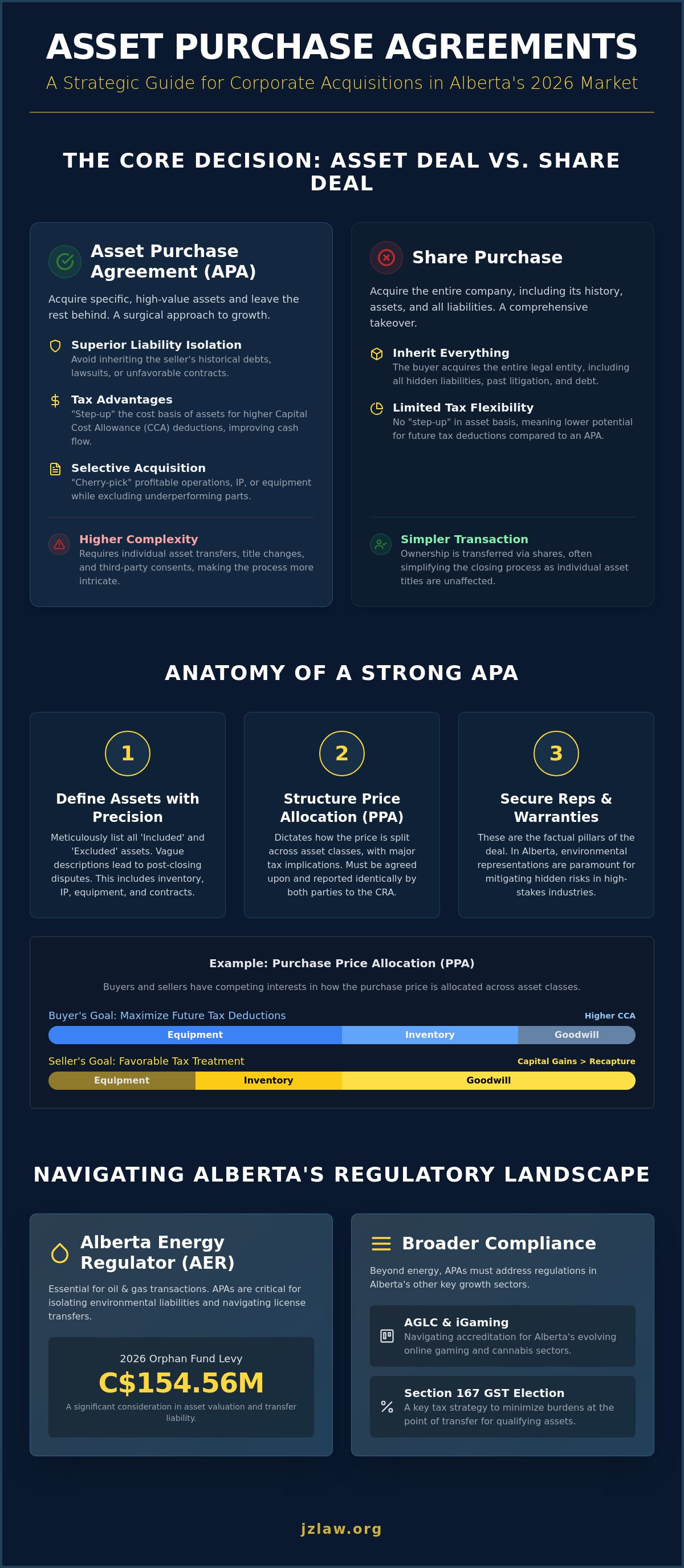
In a share purchase, the buyer acquires the entire legal entity, including its history and any potential skeletons. In contrast, an APA offers superior liability isolation. Buyers can "cherry-pick" profitable assets while leaving behind debt, litigation, or unfavorable contracts. From a tax perspective, buyers often prefer assets because they can "step up" the cost basis of the acquired items. This allows for higher Capital Cost Allowance (CCA) deductions in future years, improving post-closing cash flow. However, this precision comes with increased complexity. Every asset class, from real estate to proprietary software, requires individual transfer documentation and, in many cases, third-party consents to be valid.
When to Use an APA in Alberta's 2026 Market
The current economic climate in Western Canada makes the asset purchase agreement alberta a preferred vehicle for several strategic scenarios. For companies navigating oil and gas law, an APA is essential for carve-outs of specific well sites or midstream infrastructure. This is particularly true when a buyer wants to avoid the broader environmental liabilities or the impact of the parent company’s Liability Management Rating (LMR). In the technology sector, it's the standard for acquiring intellectual property without the operational baggage of a startup. Finally, in insolvency proceedings managed by firms like MNP or Alvarez & Marsal, an APA provides a clean break, allowing the buyer to purchase distressed assets free and clear of most encumbrances.
Key Provisions: Structuring the Deal for Alberta Assets
The strength of an asset purchase agreement alberta lies in its ability to define the transaction's boundaries with surgical precision. Unlike a share sale where you inherit a company's entire history, an APA allows you to specify exactly which items cross the closing line. This process begins with the meticulous categorization of 'Included' and 'Excluded' assets. In a typical Alberta energy or manufacturing deal, this means listing every piece of equipment, proprietary software license, and customer contract. Using a detailed Guide to Asset Transactions helps parties avoid the common pitfall of vague asset descriptions, which often lead to post-closing ownership disputes.
Purchase Price Allocation (PPA) is another critical provision that demands early negotiation. The PPA dictates how the total C$ consideration is distributed across asset classes, such as inventory, equipment, and goodwill. In Alberta, this allocation has significant tax consequences. Buyers generally prefer allocating more to depreciable assets to maximize future Capital Cost Allowance (CCA) claims, while sellers may seek an allocation that triggers capital gains rather than income-heavy recapture. For a deal to remain defensible under CRA scrutiny, both parties must report identical figures, making the PPA clause a cornerstone of the agreement.
Representations and Warranties in High-Stakes Deals
Representations and warranties are the factual pillars upon which the deal is built. In Alberta's 2026 market, environmental "reps" are paramount for any deal involving real estate or oil and gas assets. Sellers must warrant that their operations comply with Alberta Energy Regulator (AER) standards and that no undisclosed contamination exists. For tech and cryptocurrency startups, the focus shifts to intellectual property ownership and data security. Additionally, the Alberta Employment Standards Code requires specific attention to labor reps. Since the 2026 update increased job-protected leave for long-term illness to 27 weeks, buyers must ensure they're fully aware of any existing employee leaves they might be assuming as a successor employer.
Risk Mitigation: Survival Periods and Baskets
Indemnification clauses serve as the buyer’s primary recourse if a seller’s representation proves false. Strategic negotiation focuses on survival periods, which determine how long these promises remain enforceable after closing. While fundamental reps like title and authority often last indefinitely, general reps in mid-market Alberta deals typically survive for 12 to 24 months. To prevent minor claims from disrupting the partnership, parties use "baskets" (a minimum threshold before claims can be made) and "caps" (the maximum total liability). We're seeing an increased reliance on Rep and Warranty Insurance in Alberta to bridge the gap between a buyer's need for security and a seller's desire for a clean exit. Securing expert corporate transactions counsel ensures these risk-mitigation tools are calibrated to your specific industry risks.
Regulatory Compliance: AER, AGLC, and Securities
The execution of an asset purchase agreement alberta involves more than just a private consensus between two commercial parties. In Alberta’s high-stakes industrial landscape, the transfer of assets often requires the explicit approval of provincial and federal oversight bodies. These regulatory hurdles act as mandatory "Conditions Precedent" that must be satisfied before a deal can legally close. For public companies, the Alberta Securities Commission (ASC) also introduces specific disclosure requirements, particularly with the new access model for continuous disclosure coming into force on September 22, 2026. This modernization shifts how investors access financial statements during significant asset disposals, making transparency a core component of the transaction timeline.
Energy Sector Asset Transfers
Within the framework of oil and gas law, the Alberta Energy Regulator (AER) maintains a rigorous vetting process for license transfers. A critical factor in this process is the Liability Management Rating (LMR) or the newer holistic licensee capability assessment. If a buyer's post-transaction LMR falls below required thresholds, the AER may demand significant security deposits or block the transfer entirely to protect the public from reclamation costs. Deal valuations must also account for the 2026/2027 orphan fund levy, which is set at C$154.56 million. Since AER administration invoices are sent on April 1, 2026, with payment due by May 1, 2026, closing dates must be strategically aligned to ensure all regulatory fees and penalties are addressed before the title passes.
Cannabis and Crypto: The New Frontier
The digital and highly regulated sectors face their own unique compliance paths. When transferring assets in the cannabis industry, buyers must navigate cannabis licensing through the AGLC, which involves exhaustive background checks and financial security clearances for all new beneficial owners. This scrutiny extends to Alberta’s newly launched regulated iGaming market, which went live on July 13, 2026. All new operators or asset purchasers in this space are now required to obtain RG Check accreditation to meet responsible gaming standards. In the technology sector, particularly under cryptocurrency law, the transfer of codebases and digital assets often triggers FINTRAC reporting requirements and SEC considerations if the deal involves multi-jurisdictional stakeholders. JZ Law ensures that these regulatory pre-clearances are integrated into the APA to prevent post-closing enforcement actions.
The Road to Closing: Due Diligence and Tax Structuring
The transition from a signed asset purchase agreement alberta to a funded closing requires a disciplined approach to verification and financial engineering. While the agreement sets the legal framework, the due diligence phase is where the buyer confirms that the assets are physically and legally sound. This process isn't merely a formality; it's a proactive risk-mitigation exercise that uncovers encumbrances, environmental liabilities, and operational bottlenecks. In Alberta’s 2026 market, where the general corporate tax rate remains at 8%, the financial success of a deal often hinges on how effectively the parties structure the transfer to preserve liquidity and maximize future deductions.
The Due Diligence Checklist
A comprehensive checklist begins with Personal Property Security Act (PPSA) searches to ensure all equipment and inventory are free from undisclosed liens. For transactions involving physical premises, buyers must navigate real estate law requirements, including verifying Land Titles. As of May 1, 2026, the fee for a Transfer of Land in Alberta is a C$50 base fee plus C$5 for every C$5,000 of the property's value. Industrial assets require Phase I and, if necessary, Phase II Environmental Site Assessments (ESAs) to identify contamination risks that could lead to future reclamation orders. Verifying these details before the "Closing Agenda" is finalized prevents late-stage price renegotiations or deal failure.
Tax Structuring and GST Implications
One of the most critical steps in the closing process is the Section 167 GST election. This allows the buyer and seller to jointly elect to have no GST apply to the sale of a business as a going concern, provided the buyer acquires all or substantially all of the assets necessary to carry on the business. Failing to file the GST Section 167 election form correctly can result in an immediate 5% tax hit on the purchase price, creating significant cash flow strain. Strategic tax structuring also addresses Capital Cost Allowance (CCA) recapture. Sellers must be wary of recapture taxes if the sale price of equipment exceeds its undepreciated capital cost, while buyers seek to maximize their cost basis for future depreciation.
Employee transfers add another layer of complexity. Under the Alberta Employment Standards Code, a buyer who continues the business is often deemed a successor employer. With the January 1, 2026, update increasing job-protected leave for long-term illness to 27 weeks, buyers must audit the seller’s payroll and benefits records to identify any active or pending leaves they'll be required to honor. Managing these liabilities requires a precise closing agenda that moves systematically from lien clearances to funding. If you're preparing for a high-stakes acquisition, securing expert corporate transactions counsel is essential to ensure your tax elections and due diligence protocols are airtight.
Strategic Legal Counsel: Why JZ Law for Alberta APAs
The finalization of an asset purchase agreement alberta is the culmination of months of strategic planning and meticulous negotiation. While the initial Memorandum of Understanding (MOU) provides the foundational deal structure, it's the definitive agreement that governs the long-term success of the acquisition. At this stage, the focus shifts from high-level commercial intent to the rigorous legal precision required to protect your capital. JZ Law, led by John Zang, specializes in bridging this gap, providing the sophisticated counsel necessary to navigate Alberta’s complex regulatory environment without the detached overhead of traditional "Big Law" firms.
Managing the Deal Lifecycle
The journey from a non-binding Letter of Intent (LOI) to a binding APA is often where "deal creep" begins to erode value. As negotiations extend, fatigue can lead to overlooked details in the schedules or poorly defined post-closing covenants. We ensure that the transition remains disciplined, keeping the legal framework strictly aligned with your original commercial goals. This includes addressing the operational realities of the transfer, such as the C$50 base fee for Land Titles or the AER’s 2026/2027 fiscal year requirements. By maintaining a proactive stance, we help clients avoid the stagnation that often plagues multi-jurisdictional transactions involving parties in Calgary, Toronto, or New York; in these cross-border cases, Fridman Legal provides essential counsel for navigating US bankruptcy laws and strategic debt restructuring.
JZ Law: Your Strategic Corporate Partner
Our firm isn't merely a service provider; we position ourselves as strategic partners who understand the interplay between market forces and regulatory constraints. Whether you are taking companies public or executing a private carve-out in the energy sector, our approach is rooted in professional dignity and modern efficiency. John Zang provides personalized, high-level representation, ensuring that your Alberta-based assets are integrated into your broader corporate strategy with surgical precision. We offer a boutique experience where your file receives the attention of a senior partner who has managed complex deals across Canada and the US. Our goal is to create a sense of security and professional calm throughout the most high-stakes closings.
To ensure your transaction is handled with the methodology and care it deserves, contact JZ Law to secure your next Alberta asset purchase and mitigate the risks of the 2026 regulatory landscape.
Navigating the Future of Alberta Corporate Transactions
Executing a successful asset purchase agreement alberta in 2026 demands a synthesis of regulatory foresight and financial precision. By prioritizing rigorous due diligence and leveraging strategic tax elections like Section 167, you can isolate high-value assets while effectively mitigating the hidden liabilities common in the energy and cannabis sectors. The transition from a preliminary framework to a definitive closing requires a partner who understands the nuances of AER compliance and the complexities of modern securities law. JZ Law provides the boutique expertise and global transactional reach necessary to manage these high-stakes deals with professional dignity.
Whether you're navigating multi-jurisdictional M&A or localized asset transfers, our commitment to strategic tax structuring and regulatory excellence ensures your interests are protected at every stage of the deal lifecycle. We invite you to Secure Your Next Alberta Asset Purchase with JZ Law and benefit from a partnership that values both commercial efficiency and legal certainty. Your next acquisition is a catalyst for growth; ensure it's built on a foundation of precision and professional integrity.
Frequently Asked Questions
Is an Asset Purchase Agreement legally binding in Alberta?
Yes, an asset purchase agreement alberta becomes a legally binding contract once it's executed by authorized signatories from both the buyer and the seller. The agreement is governed by Alberta’s common law and relevant statutes, such as the Sale of Goods Act, ensuring that all terms regarding asset transfer, payment, and indemnification are enforceable in provincial courts. Precision in the drafting of conditions precedent is essential to ensure the contract remains valid throughout the closing process.
What is the difference between an APA and a Share Purchase Agreement?
The primary distinction lies in the perimeter of the acquisition. In an APA, you selectively purchase specific assets and assume only designated liabilities, whereas a Share Purchase Agreement involves buying the entire corporation, including its complete legal and financial history. This makes the APA a superior tool for buyers who wish to avoid undisclosed historical baggage or litigation risks associated with the seller's corporate entity.
Do I have to pay GST on an asset purchase in Alberta?
GST is generally applicable at a rate of 5% on the purchase price of taxable business assets. However, parties can often avoid this immediate cash outlay by filing a joint election under Section 167 of the Excise Tax Act. This election allows the transaction to occur on a tax-free basis if the buyer's acquiring all or substantially all of the assets of a going concern, preserving critical liquidity for post-closing operations.
How do I transfer an AER oil and gas license in an asset deal?
Transferring an AER license requires a formal application and approval from the Alberta Energy Regulator, which acts as a mandatory condition precedent for closing. The regulator assesses the buyer’s Liability Management Rating (LMR) and overall capability to manage reclamation obligations. In 2026, buyers must also ensure that all orphan fund levies and administration fees are settled before the AER will process the transfer application.
Can I buy the assets of a cannabis business in Alberta without a license?
You may purchase physical assets like real estate or equipment without a license, but you can't legally possess cannabis inventory or operate the retail business without AGLC approval. The asset purchase agreement alberta must be structured so that the transfer of regulated inventory only occurs once the buyer's secured the necessary provincial security clearances and retail cannabis licenses. Operating without these approvals can lead to immediate enforcement actions.
What are the risks of using a template for an Alberta APA?
Generic templates often fail to address Alberta-specific regulatory requirements, such as AER license transfers or AGLC background checks. They also frequently omit critical 2026 updates to the Alberta Employment Standards Code, such as the increased 27-week job-protected leave for long-term illness. Relying on a standard form can leave you exposed to inherited liabilities or failed regulatory pre-clearance, potentially derailment of the entire transaction.
How long does it take to close an asset purchase in Calgary?
A typical asset purchase in Calgary takes between 60 and 120 days to reach final closing. While the legal drafting can be completed relatively quickly, the timeline's often dictated by third-party consents and regulatory approvals. If the deal involves AER license transfers or AGLC clearances, you should expect the process to lean toward the longer end of that spectrum due to the mandatory vetting periods.
What happens to employees in an Alberta asset purchase?
The buyer's not legally required to hire the seller's employees, but those who are retained are protected by successor employer rules under the Alberta Employment Standards Code. The seller is generally responsible for termination notice or severance pay for any staff not moving to the new entity. Buyers must carefully audit existing employment contracts to understand their obligations regarding years of service and accrued benefits for the employees they choose to hire.


Comments