


IPO Lawyer Calgary: A Strategic Guide to Taking Your Company Public in 2026
- jzanglaw
- 4 hours ago
- 12 min read
What if the most significant risk to your 2026 public listing isn't the volatility of the S&P/TSX Composite, but the rigid corporate structure you established years ago? Transitioning from a private entity to a reporting issuer requires more than just financial auditing; it demands a sophisticated legal architecture that can withstand the scrutiny of the Alberta Securities Commission. As you prepare for this milestone, securing an experienced ipo lawyer calgary becomes the difference between a stalled prospectus and a successful bell-ringing ceremony on the TSX or TSX Venture Exchange.
You likely recognize that the path to a public listing is fraught with overwhelming regulatory complexity and the high cost of potential non-compliance. This guide provides a strategic roadmap to master the intricacies of the IPO process, offering expert legal insights on securities regulation and corporate structuring. You'll discover how to minimize regulatory friction and choose the ideal exchange for your long-term growth. We will examine the specific 2026 listing requirements, the nuances of ASC filing fees, and the strategic advantages of principal-led legal counsel in Calgary’s evolving economic climate.
Table of Contents
The Calgary Public Markets Landscape in 2026
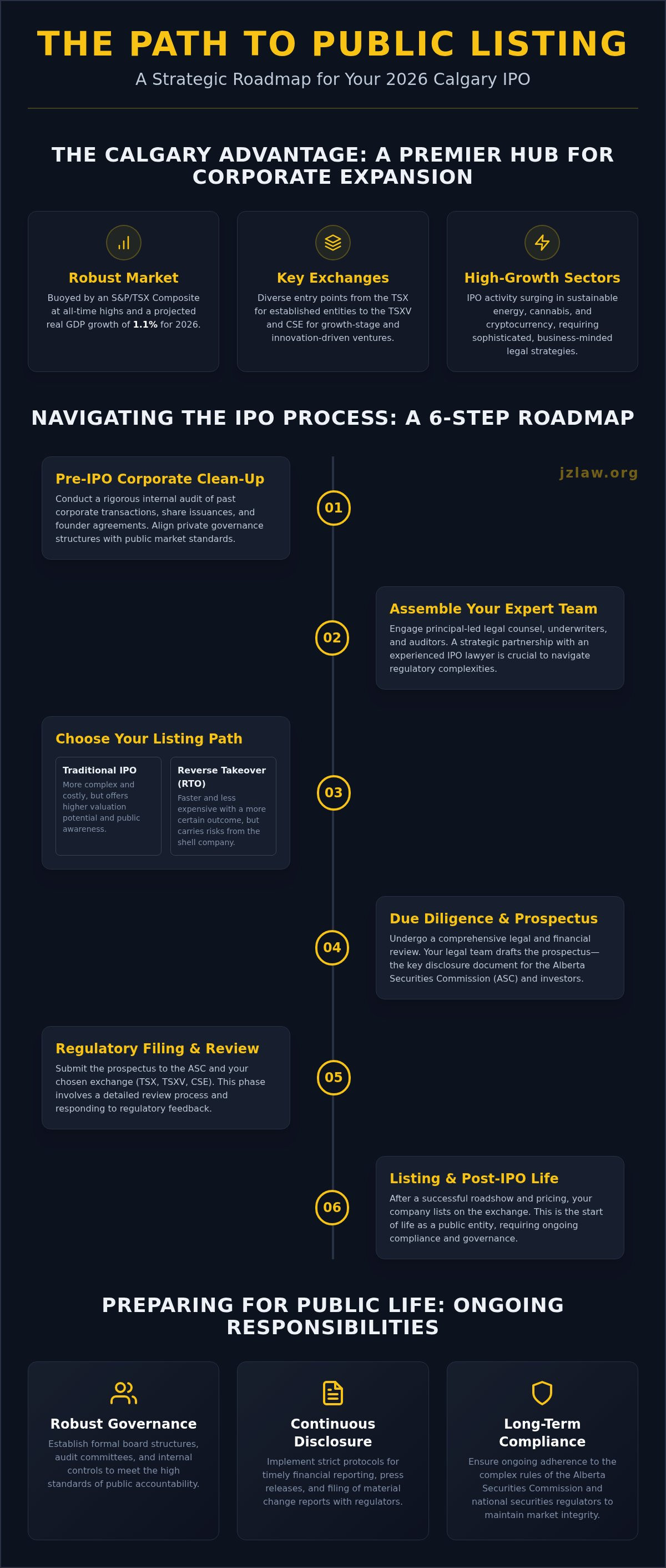
Calgary’s capital markets have matured into a sophisticated ecosystem where traditional industrial expertise meets rapid technological adoption. In 2026, the city stands as a premier hub for corporate expansion, buoyed by the S&P/TSX Composite reaching all-time highs and a projected real GDP growth of 1.1% for the year. For a founder, understanding what is an initial public offering involves more than financial preparation; it requires a deep integration with local regulatory bodies. An ipo lawyer calgary acts as the essential bridge between ambitious corporate vision and the rigorous standards of the Alberta Securities Commission (ASC).
The regulatory environment has shifted toward a preference for specialized, boutique counsel. While large firms often delegate complex files to junior associates, modern issuers increasingly seek principal-led advice. This strategic partnership ensures that the nuances of securities regulation are handled with the precision necessary to avoid the high cost of non-compliance. Calgary remains a vital center because it offers a unique concentration of capital and industry-specific knowledge that larger, more generalized markets often lack.
Key Players: ASC, TSX, and the CSE
The hierarchy of Canadian exchanges offers diverse entry points for growing companies. While the TSX serves established entities with high capitalization, the TSX Venture Exchange (TSXV) remains the cornerstone for Calgary’s growth-stage ventures. The ASC serves as the primary provincial regulator, ensuring market integrity through a coordinated fee approach in 2026 that keeps registration costs neutral for individual registrants. Many local issuers prefer the TSXV due to its tailored requirements, such as the 1 million share public float for Tier 1 listings, which allows for a disciplined transition into the public markets. The Canadian Securities Exchange (CSE) also provides a flexible alternative, particularly for companies in innovation-driven sectors that require a streamlined path to liquidity.
Emerging Sectors Driving Calgary IPOs
Calgary’s IPO activity is no longer confined to traditional resource extraction. The landscape now includes a surge in ventures related to cannabis licensing and firms navigating the complexities of cryptocurrency law. These sectors require an ipo lawyer calgary who understands the nuances of digital assets and highly regulated substances. Even the energy sector has evolved, with sustainable energy firms and modern oil producers leveraging record cash flows to seek public listings. This diversification ensures that Calgary remains resilient, offering a robust platform for companies that prioritize both innovation and regulatory compliance.
Navigating the IPO Process: A Step-by-Step Roadmap
The transition from a private enterprise to a public entity is a transformative event that requires meticulous preparation. It's not merely a financial transaction; it's a complete overhaul of how your business operates and communicates. Engaging an ipo lawyer calgary early in the process allows you to identify structural weaknesses that could delay your listing or decrease your valuation. This roadmap breaks down the journey into manageable phases, each requiring a blend of legal precision and strategic foresight. Success in the 2026 market depends on your ability to anticipate regulatory hurdles before they manifest as costly delays, and for founders, this preparation should also include a plan to explore Revocable Living Trusts to manage the significant personal wealth the listing will generate.
Before filing any documents, your company must undergo a rigorous internal audit. This involves a comprehensive review of past corporate transactions to ensure all share issuances and board resolutions were executed correctly. Historical agreements with founders, employees, and third parties often contain clauses that are incompatible with public market requirements. Similarly, ensuring compliance with real estate law and intellectual property protections is vital to securing your asset base. Corporate clean-up is defined as the alignment of private governance with public standards. A preliminary consultation with a strategic legal partner can identify these gaps early in the planning phase.
Phase 2: Prospectus and Regulatory Filing
The prospectus is the most critical document in the IPO process. It serves as both a disclosure document for the Alberta Securities Commission and a marketing tool for potential investors. Drafting this requires close collaboration between your legal team, underwriters, and auditors to ensure every claim is substantiated. You will need to refer to the official TMX listing guides to meet the specific requirements of your chosen exchange. In 2026, the ASC requires a prospectus filing fee of C$2,000, with additional costs if selling security holders are involved. Once the preliminary prospectus is filed, the ASC and the exchange will issue comment letters. Your ipo lawyer calgary must respond to these inquiries with technical accuracy to move toward the final prospectus and the eventual roadshow.
The final stage involves the roadshow, where management presents the business case to institutional investors. While finance professionals lead the pitch, your legal team ensures that all communications stay within the "quiet period" restrictions. After the roadshow, and upon receipt of a final receipt from the ASC, the company is cleared for its official listing. This structured approach minimizes friction and prepares the organization for the continuous disclosure obligations of public life. Following this sequence ensures your company enters the market with a foundation built for long-term growth.
Choosing Your Listing Path: IPO vs. Reverse Takeover (RTO)
Selecting the appropriate vehicle for public market entry is a strategic decision that dictates your company’s capital structure for years. While the traditional Initial Public Offering (IPO) is often viewed as the gold standard for established firms, the Calgary market frequently utilizes the Reverse Takeover (RTO) to achieve liquidity more rapidly. An ipo lawyer calgary provides the necessary oversight to weigh these options against your long-term growth objectives and current market conditions. The choice isn't merely about administrative preference; it's about aligning your corporate trajectory with the specific demands of Canadian investors in a year defined by both opportunity and volatility.
The Traditional IPO Path
The traditional path involves a direct issuance of shares to the public through a comprehensive prospectus. It's best suited for companies with established historical earnings and a brand presence that can attract institutional interest during a roadshow. This method offers the highest potential for prestige and a premium valuation, but it requires navigating strict "quiet period" rules and significant regulatory hurdles. For instance, a TSXV Tier 1 listing in 2026 requires a public float of 1 million shares and at least 250 public shareholders, each holding a board lot. Despite the rigorous requirements, the transparency of a traditional listing often results in better long-term share liquidity and higher investor trust.
The RTO and CPC Alternative
A Reverse Takeover occurs when a private company merges with an existing public shell company, effectively taking over its listing. In Calgary, this often involves a Capital Pool Company (CPC), a unique Canadian vehicle designed to facilitate listings for emerging firms. This path is popular because it can often be completed in weeks rather than the months required for a traditional IPO. While it offers more cost certainty, it's not without risk. You inherit the history and potential liabilities of the shell company, making deep due diligence mandatory. Emerging tech and cannabis firms often favor this route for its speed, provided they can still meet the exchange's original listing requirements. Your ipo lawyer calgary will lead the investigation into potential shell companies to ensure that your private governance isn't undermined by the shell's past transactions. This is particularly vital in 2026, as geopolitical tensions and upcoming USMCA renegotiations in July have increased market uncertainty, making the speed of an RTO an attractive strategic alternative.
To determine the best fit for your organization, consider these primary factors:
Speed to Market: RTOs are generally faster, providing a streamlined route to liquidity during favorable market windows.
Regulatory Scrutiny: Traditional IPOs require a more extensive prospectus review by the Alberta Securities Commission.
Liability Profile: IPOs offer a clean slate, whereas RTOs require vetting the shell company’s historical corporate transactions.
Shareholder Base: Traditional listings often build a broader, more diverse shareholder base from the outset.
Preparing for Public Life: Governance and Securities Compliance
Transitioning to a public company requires a permanent shift in corporate DNA. It's not enough to reach the listing date; you must maintain it through rigorous adherence to securities regulation. An ipo lawyer calgary ensures that your leadership team understands the gravity of their new fiduciary duties. This involves establishing a board of directors with independent oversight to protect minority shareholders and provide strategic guidance. Without a board that can challenge management, a company risks losing the confidence of the very investors who provided the capital for growth.
Continuous disclosure is the lifeblood of public market transparency. In 2026, the Alberta Securities Commission (ASC) enforces strict filing deadlines that vary depending on your issuer status. Venture issuers generally have 120 days after year-end for annual filings and 60 days for interim reports. Non-venture issuers face tighter windows of 90 and 45 days, respectively. Managing Management’s Discussion and Analysis (MD&A) and financial reporting requires a disciplined internal calendar to avoid "cease trade" orders that can devastate a company's reputation and liquidity.
Developing a Compliance Culture
Effective governance starts 12 to 24 months before the IPO. You need to implement internal controls and ethical standards that go beyond basic accounting. In 2026, the legal implications of ESG (Environmental, Social, and Governance) reporting have become a primary focus for institutional investors in the Calgary energy and tech sectors. Failing to document your sustainability initiatives or social impact can lead to regulatory scrutiny or "greenwashing" liability. Establishing these protocols early ensures that compliance is a core function rather than a reactive burden during the listing process.
Navigating Post-Listing Regulatory Audits
Once listed, the ASC continues to monitor public companies in Alberta through periodic reviews and audits. Common compliance traps for newly public companies include improper handling of material non-public information and failing to enforce blackout periods. These periods restrict insiders from trading shares around the release of financial results to prevent even the appearance of insider trading. An ipo lawyer calgary helps draft these internal policies to ensure every executive and board member remains compliant. If you are ready to build a robust governance framework, you can consult with John Zang to secure your company's future.
Why Partner with JZ Law for Your Calgary Public Listing
Selecting an ipo lawyer calgary is a decision that impacts your company’s trajectory far beyond the initial listing ceremony. At JZ Law, we position ourselves as more than legal executors; we're strategic partners dedicated to the long-term viability of your public enterprise. Our approach is defined by principal-led counsel, ensuring that every client works directly with John Zang. This direct engagement eliminates the communication gaps often found in larger organizations where high-stakes files are delegated to junior associates. By maintaining this high level of seniority on every file, we provide the sophisticated, business-minded strategies necessary to navigate the 2026 market with confidence.
Boutique Agility vs. Big Law Bureaucracy
The traditional "Big Law" model often prioritizes billable volume over strategic precision. In contrast, a boutique firm offers a lean, agile structure that responds to market shifts in real-time. This agility is vital when dealing with the volatility of Canadian capital markets or the nuances of ASC regulatory inquiries. You get direct access to senior expertise for critical decision-making, which speeds up the listing process and reduces the likelihood of costly errors. We offer tailored fee structures and a focused allocation of resources, ensuring that your capital is used efficiently to achieve a successful listing rather than supporting a massive firm's overhead.
Specialized Industry Knowledge
Success in the public markets requires more than a general understanding of securities law; it demands niche expertise in high-growth, high-regulation sectors. We've built our reputation on navigating the complex intersection of capital markets and emerging industries like cryptocurrency and cannabis. For companies in the energy sector, our insights into oil and gas law provide a distinct advantage in meeting the Alberta Energy Regulator (AER) and ASC compliance standards. This industry-specific knowledge reduces regulatory friction during an IPO because we anticipate the concerns of regulators before they're even raised.
Our commitment to your success extends beyond the closing of your initial offering. We focus on building a long-term partnership that supports your continuous disclosure obligations and future capital-raising efforts. Whether you're a tech startup looking at an RTO or an established energy firm pursuing a traditional IPO, the right ipo lawyer calgary will provide the stability and foresight needed to thrive. If you're ready to discuss your public market goals with a firm that understands the Calgary landscape, contact JZ Law for a strategic consultation. We'll help you build a corporate structure that isn't just compliant, but optimized for sustainable growth.
Securing Your Corporate Future in the Public Markets
Taking your company public in 2026 is a complex but rewarding endeavor that demands a blend of technical precision and strategic foresight. Success requires more than just meeting the TSX or CSE listing requirements; it involves building a governance framework that can withstand the scrutiny of the Alberta Securities Commission. By prioritizing a thorough corporate clean-up and selecting the most efficient listing path for your industry, you position your organization for sustainable liquidity and investor trust.
Frequently Asked Questions
What is the minimum valuation required for an IPO on the TSX Venture Exchange?
The TSX Venture Exchange doesn't mandate a specific minimum market valuation, but it enforces strict financial resource requirements for its different tiers. For a Tier 1 listing in 2026, a company must demonstrate adequate working capital for 18 months and at least C$200,000 in unallocated funds. These thresholds ensure the issuer has the liquidity to sustain operations while meeting the public float requirement of 1 million shares.
How long does the typical IPO process take for a Calgary company?
A traditional IPO for a Calgary company typically spans six to twelve months from the initial planning phase to the final listing. This timeline accounts for corporate restructuring, financial audits, and the Alberta Securities Commission’s prospectus review process. If speed is a primary objective, a Reverse Takeover (RTO) can often be completed in significantly less time, sometimes within a few weeks, provided the shell company is already compliant.
Can a Calgary-based company list on the NASDAQ or NYSE directly?
Calgary-based companies can list directly on the NASDAQ or NYSE, though they must comply with both Canadian and U.S. securities laws. This cross-border path requires registration with the U.S. Securities and Exchange Commission (SEC) and meeting stringent capitalization and governance standards. Most local firms choose a dual-listing approach or start on a Canadian exchange like the TSX before graduating to American markets to manage the initial regulatory burden.
What are the main differences between the TSX and the Canadian Securities Exchange (CSE)?
The TSX is Canada’s senior exchange, requiring higher capitalization and more rigorous continuous disclosure than the Canadian Securities Exchange (CSE). While the TSX offers greater prestige and access to institutional capital, the CSE is often preferred by emerging tech and cannabis firms due to its streamlined listing process and lower maintenance fees. Selecting the right platform depends on your company’s growth stage and the specific expectations of your target investor base.
How much does an IPO lawyer typically cost in Calgary?
Legal fees for a public listing vary based on the complexity of the corporate structure and the chosen listing path. Factors influencing the total investment include the length of the due diligence phase, the number of jurisdictions involved, and whether the company is pursuing a traditional IPO or an RTO. An ipo lawyer calgary typically provides a structured estimate after reviewing the company’s historical records and specific regulatory requirements for the 2026 market.
What is a "quiet period" in the context of an IPO?
A "quiet period" is a regulated timeframe during the IPO process when a company is restricted from making promotional statements that could artificially influence share prices. This period begins when the preliminary prospectus is filed and lasts until the listing is completed. During this time, management must limit communications to factual business developments to ensure all potential investors rely solely on the information provided in the official prospectus documents.
Does JZ Law handle cross-border listings between Canada and the US?
JZ Law provides strategic counsel for companies navigating complex securities regulation, including those looking at expansion beyond the Alberta market. We help clients structure their entities to meet the high standards required for modern capital markets in various jurisdictions. Our focus is ensuring your corporate foundation is robust enough to support long-term growth and potential future listings, providing the stability an ipo lawyer calgary offers to ambitious founders.
What happens if a company fails to meet continuous disclosure requirements?
Failing to meet continuous disclosure requirements can lead to severe penalties, including administrative fines and the issuance of a "cease trade" order by the Alberta Securities Commission. A cease trade order effectively halts all trading of the company’s securities, which can devastate shareholder liquidity and market reputation. Persistent non-compliance may also result in delisting from the exchange, making it vital to maintain a disciplined and professional reporting calendar.


Comments