


California Cannabis Distribution License Guide: 2026 Regulatory Framework
Updated: Aug 28
In 2026, securing a california cannabis distribution license is no longer a mere administrative checkbox; it's the most critical financial instrument in your corporate arsenal. You've likely realized that the friction between Type 11 and Type 13 tiers, coupled with the logistical burden of QA testing coordination, can quickly compromise your operational efficiency. The persistent shadow of 280E tax implications makes strategic structuring a necessity rather than an option for those aiming to protect their margins in a competitive market.
This guide provides the sophisticated clarity required to master the Department of Cannabis Control’s current mandates while positioning your business for long-term growth. You'll learn how to navigate the complexities of the 2026 regulatory framework, minimize tax liabilities through precise corporate engineering, and secure a valid DCC license that stands up to investor scrutiny. We'll examine the technical distinctions between distribution tiers, the implications of federal rescheduling, and the specific steps needed to build a scalable, high-stakes cannabis enterprise that thrives within California's rigorous legal landscape.
Table of Contents
Decoding the California Cannabis Distribution License Tiers
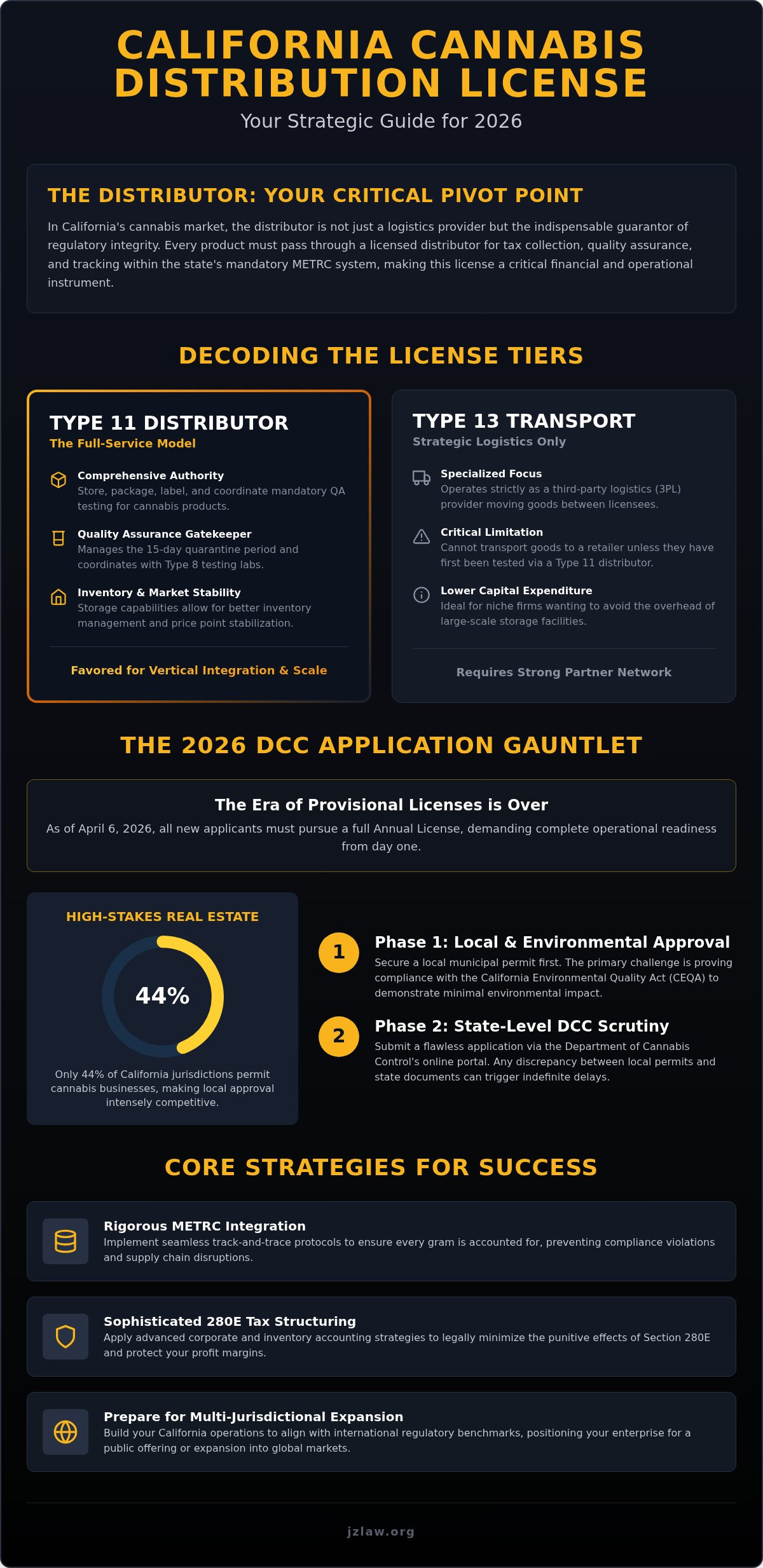
The distributor serves as the indispensable pivot point within the state's mandatory track-and-trace ecosystem. Understanding the nuances of a california cannabis distribution license requires a look beyond simple logistics; it involves recognizing the distributor as the primary guarantor of regulatory integrity. Since the foundational history of cannabis legalization in California, the Department of Cannabis Control (DCC) has refined these roles to ensure that no product reaches a shelf without rigorous verification. Every gram of cannabis must pass through a licensed distributor to ensure that taxes are accounted for and safety standards are met.
Type 11: The Full-Service Distribution Model
The Type 11 license represents the most comprehensive authority available for supply chain management. These licensees aren't just transporters. They serve as the official gatekeepers of the market. A Type 11 holder is authorized to store cannabis goods, package and label products for other licensees, and facilitate the mandatory quality assurance process. The distributor manages the critical 15-day quarantine period, during which they coordinate with licensed Type 8 laboratories to ensure every batch meets state safety standards. This model provides the storage capabilities essential for market stability, allowing operators to manage inventory fluctuations and maintain a consistent supply for retail partners. In a volatile market, the ability to hold product until price points stabilize is a significant revenue driver.
Type 13: Strategic Transport and Third-Party Logistics
For businesses focused strictly on the movement of goods, the Type 13 Transport Only license offers a specialized path. This tier allows a company to operate as a third-party logistics provider without the significant overhead associated with large-scale storage facilities. However, strategic limitations exist. Type 13 licensees cannot transport goods to a retailer unless those goods have already been processed through a Type 11 distributor for testing and quality assurance. This creates a dependency that requires careful partnership management. It's an ideal choice for niche logistics firms looking to minimize initial capital expenditure while supporting a larger network of cultivators and manufacturers. You don't need a massive warehouse to succeed here, but you do need a robust network.
As we navigate the 2026 landscape, the market increasingly favors the Type 11 california cannabis distribution license for enterprises seeking vertical integration. The ability to control the quality assurance timeline and manage bulk inventory in-house provides a competitive edge that simple transport models lack. By internalizing the distribution function, companies can reduce the friction points that often lead to costly retail delays and inventory bottlenecks. This strategic positioning is vital for those aiming to build an investment-ready enterprise capable of scaling beyond local jurisdictions.
The 2026 Application Process and DCC Requirements
By 2026, the regulatory landscape has matured, and the era of provisional licenses is officially over. As of April 6, 2026, the Department of Cannabis Control (DCC) requires all new applicants to pursue an annual california cannabis distribution license from the outset. This shift demands a higher level of preparation, as the state no longer allows for the "learn as you go" approach that characterized the early years of legalization. You're now expected to demonstrate full operational readiness before the first delivery van leaves your facility.
Success in this environment depends on a dual-track strategy: securing local municipal approval while simultaneously preparing for state-level scrutiny. With only 44% of California jurisdictions currently permitting cannabis businesses, the competition for viable real estate is intense. You'll need to navigate the DCC's online portal with absolute precision, ensuring that every document reflects your operational reality. Any discrepancy between your local permit and state application can trigger a secondary review process that stalls your launch indefinitely.
Phase 1: Local Land Use and CEQA Compliance
Securing a local permit in cities like Los Angeles or Sacramento is merely the beginning. The most significant hurdle for permanent licensing in 2026 is compliance with the California Environmental Quality Act (CEQA). You must prove that your distribution hub won't negatively impact the surrounding environment through traffic, waste, or energy consumption. Proactive legal strategies and environmental impact reports are no longer optional; they're the primary tools used to mitigate bureaucratic delays that can last for several quarters. Failing to address CEQA early is one of the most common reasons for application stagnation.
Phase 2: State-Level Submission and Background Checks
The state-level submission phase involves a granular look at your business's inner workings. You must adhere to specific Department of Cannabis Control (DCC) requirements, which include submitting comprehensive premises diagrams that detail your security protocols and quarantine zones. The DCC's vetting process for financial interest holders is exhaustive, designed to eliminate any possibility of undisclosed ownership. Every individual with a 20% or greater interest, or anyone who exercises significant control over the business, must be listed and vetted through a background check; for those who need to address past legal challenges to ensure a smooth vetting process, the Law Offices of Gary Churak offers the criminal defense expertise necessary to navigate such complexities.
For those who qualify, the 2026 Equity Fee Relief program provides a critical financial bridge, potentially waiving the $1,000 application fee and offering tiered relief for annual fees that range from $200 to $180,000 based on revenue. Managing these variables requires a sophisticated licensing approach that integrates local land use with state mandates. By addressing these requirements systematically, you can transition from an applicant to a fully licensed operator with minimal friction.
The operational heart of a california cannabis distribution license lies in its role as the final arbiter of product safety. Distributors don't just move boxes; they provide the critical oversight that prevents contaminated or mislabeled products from reaching consumers. This responsibility requires a meticulous approach to Quality Assurance (QA) that begins the moment a batch enters your facility. You're required to verify that all packaging and labeling comply with current DCC standards while ensuring the Certificate of Analysis (COA) matches the physical inventory in every detail.
When a batch fails to meet safety or potency standards, the distributor manages the high-stakes remediation process. Depending on the type of failure, you may coordinate with manufacturers for reprocessing or, in cases of severe contamination, oversee the mandatory destruction of the inventory. Adhering to the California Cannabis Distribution License Requirements ensures that these remediation protocols are documented with surgical precision, protecting your business from the liability of a public health incident or regulatory clawback.
Managing the Testing Laboratory Relationship
State law mandates an "arms-length" relationship between your distribution firm and any licensed Type 8 testing laboratory. This independence is designed to eliminate conflicts of interest and ensure the scientific integrity of every sample. During the mandatory 15-day quarantine period, your staff must facilitate the laboratory's access to the batch for randomized sampling while maintaining strict environmental controls to prevent cross-contamination. In 2026, the holder of a california cannabis distribution license carries the ultimate legal burden for ensuring that every Certificate of Analysis accurately reflects the chemical profile and safety of the batch before it enters the retail market.
METRC Compliance and Chain of Custody
Mastering the CCTT-Metrc track-and-trace system is your most effective compliance shield against administrative holds and license revocation. Every transaction, transfer, and change in inventory status must be reported in real-time to maintain a perfect chain of custody. This isn't just a regulatory chore; it's a strategic data asset. High-level METRC integration allows you to provide investors with transparent reporting on inventory turnover and supply chain efficiency. To maintain this standard, you'll need to implement rigorous staff training programs that prioritize data accuracy over speed. A single entry error can trigger a DCC audit, so building a culture of precision is essential for any scalable cannabis enterprise.
Strategic Corporate Structure and Tax Optimization (Section 280E)
Operating with a california cannabis distribution license places your enterprise in a unique, albeit challenging, financial position. Unlike cultivators or retailers, distributors sit at the center of the supply chain, managing high volumes of physical inventory and significant logistical overhead. This position makes the business particularly vulnerable to the predatory nature of IRS Section 280E. While federal rescheduling to Schedule III in early 2026 has initiated a shift in the tax landscape, the historical burden of 280E remains a primary concern for audits and legacy liabilities. Success requires a corporate structure that prioritizes the maximization of 'Cost of Goods Sold' (COGS) over simple service-based accounting.
Choosing between an LLC and a C-Corp is a decision that dictates your future access to capital. While LLCs offer pass-through flexibility, most venture capital firms and institutional investors prefer the rigid governance and clean cap tables of a C-Corporation. This structure is particularly vital for those with an eye toward taking companies public. A C-Corp allows for the implementation of holding company strategies that can isolate intellectual property and real estate assets from the operational risks of the distribution hub, providing a robust layer of protection for your most valuable holdings.
Mitigating 280E and Tax Structuring
The 'Separate Trade or Business' theory remains a cornerstone of tax mitigation for sophisticated distributors. By legally segregating non-cannabis activities, such as general logistics or consulting, from the direct handling of cannabis, you can protect a portion of your deductions from 280E scrutiny. This requires meticulous record-keeping and a logical allocation of shared expenses, such as rent and utilities, between the different arms of the business. The precision of your tax structuring directly dictates your enterprise's EBITDA and, consequently, its terminal valuation in a potential acquisition or public offering.
Navigating these financial waters requires more than a standard accountant; it demands a deep understanding of the intersection between state mandates and federal tax law. Securing a cannabis licensing strategy that incorporates this level of financial engineering is the only way to build a sustainable business in the 2026 market. If you're ready to optimize your corporate framework for maximum growth, you should consult with our strategic legal team to evaluate your current entity structure.
Scaling Beyond California: Expansion to Global Cannabis Hubs
California's regulatory environment is the most demanding testing ground in the world. Success in securing and maintaining a california cannabis distribution license provides more than local market access; it establishes a rigorous operational blueprint that is highly exportable to other high-stakes jurisdictions. As you look toward expansion in 2026, the sophisticated compliance protocols you've developed under the DCC's watch become your most valuable intellectual property when entering markets like New York or Colorado. You aren't just moving product; you're leveraging a proven system of regulatory integrity.
Interstate and International Regulatory Alignment
Expanding your footprint to Denver or NYC requires a precise calibration of your existing SOPs. While the New York Office of Cannabis Management (OCM) shares certain structural similarities with California's system, the nuances of local social equity mandates and labor peace agreements require a specialized approach. Similarly, entering the Canadian markets in Toronto or Vancouver demands a shift from state-level compliance to federal oversight under Health Canada. The industrial complexity of these large-scale distribution hubs often mirrors the logistical demands found in oil and gas law, where environmental safety and chain-of-custody protocols are paramount. Managing this multi-jurisdictional footprint requires a unified corporate transactions strategy to ensure that capital flows and compliance reporting remain synchronized across international borders.
The Future of Distribution: Interstate Commerce and Legal Readiness
The federal rescheduling of medical cannabis to Schedule III in April 2026 has fundamentally altered the long-term trajectory of the industry. Forward-thinking operators are already preparing their distribution infrastructure for the eventual reality of interstate commerce. This involves positioning hubs near major port cities and global logistics centers to facilitate future trade. Strategic readiness in California today serves as the foundation for future entries into European markets, including Hamburg and Berlin, where medical frameworks are rapidly evolving. A centralized legal partner doesn't just manage your current filings; they monitor global regulatory shifts to ensure your enterprise remains a step ahead of the competition. Contact JZ Law to secure your california cannabis distribution license with a strategic long-term view that encompasses both local dominance and global expansion.
Securing Your Enterprise's Future in the Global Cannabis Supply Chain
The 2026 market demands a sophisticated synthesis of regulatory precision and strategic corporate engineering. Maintaining a california cannabis distribution license is no longer a localized administrative task; it's the cornerstone of an investment-ready enterprise capable of navigating the friction between state mandates and federal tax constraints. By prioritizing rigorous METRC integration and proactive tax structuring, you move beyond the role of a simple logistics provider to become a vital strategic partner in the global supply chain. This foundation allows you to scale with confidence into new jurisdictions, from the burgeoning markets of New York to the established hubs in Canada and Europe.
If you're ready to solidify your position in this high-stakes sector, Schedule a Strategic Licensing Consultation with JZ Law to ensure your corporate framework is built for longevity. Our expertise in complex regulatory sectors and specialized focus on tax structuring provides the security your business needs to thrive. The road to a scalable, multi-hub operation begins with a single, well-executed strategy. We're here to help you build a legacy of professional excellence and long-term market dominance.
Frequently Asked Questions
What is the difference between a Type 11 and Type 13 distribution license in California?
A Type 11 license permits comprehensive operations including storage, packaging, and the mandatory coordination of laboratory testing. It serves as the primary gatekeeper for retail entry. Conversely, a Type 13 license is restricted to transport only, meaning you can move goods between other licensees but can't store them or deliver directly to retailers unless the products have already passed through a Type 11 facility. Choosing between them depends on your capital and storage goals.
How much does a California cannabis distribution license cost in 2026?
The initial application fee for a california cannabis distribution license is $1,000 as of 2026. Beyond this entry cost, annual licensing fees are scaled according to your business's gross annual revenue, ranging from a minimum of $200 to a maximum of $180,000. Equity applicants may qualify for specific fee waivers or relief programs, provided they meet the DCC's established criteria for ownership and background. These costs don't include local municipal permitting fees or required security investments.
Can a distributor also hold a cultivation or retail license in California?
California's regulatory framework allows for vertical integration, meaning a single entity can hold cultivation, manufacturing, and retail licenses alongside their distribution permit. This structure is often preferred for businesses seeking to control their entire supply chain and maximize internal efficiencies. However, each license requires a separate application and must comply with local zoning ordinances. You must also maintain strict separation of activities within your facility to meet specific Department of Cannabis Control safety standards.
What are the security requirements for a licensed distribution premises?
Distribution premises must adhere to rigorous security mandates to prevent diversion and theft. This includes the installation of commercial-grade locks, 24/7 video surveillance with a minimum 90-day storage capacity, and professional alarm systems with remote monitoring. You're also required to establish limited-access areas where only authorized personnel can handle cannabis goods. A comprehensive security plan, detailing these measures and your employee check-in protocols, is a mandatory component of the state application process.
How long does it take to get a cannabis distribution license from the DCC?
The timeline for obtaining a distribution license typically ranges from six to twelve months, though this depends heavily on your local jurisdiction's responsiveness. Because you must secure a local permit before the state will issue an annual license, municipal bottlenecks are the most common cause of delay. Once the DCC receives a complete application, their review process focuses on environmental compliance and financial disclosures. Ensuring your initial submission is error-free can significantly expedite the state's final approval.
What is the role of a distributor in the California cannabis testing process?
The distributor acts as the official coordinator for mandatory quality assurance testing. You're responsible for holding cannabis batches in a secure quarantine area while a licensed Type 8 laboratory collects randomized samples. Once the lab issues a passing Certificate of Analysis, you must verify that the results match the batch's weight and packaging before it moves to retail. This role ensures that no untested or contaminated product reaches consumers, placing the legal burden of safety on your operations.
Is a local permit required before applying for a state distribution license?
Yes, obtaining local authorization is a mandatory prerequisite for securing a california cannabis distribution license. The DCC won't grant an annual license without proof that your business complies with all municipal zoning and land-use regulations. Since only 44% of California's cities and counties currently permit commercial cannabis activity, your first step should be identifying a jurisdiction with a favorable regulatory environment. This local permit serves as the foundation for your entire state-level application strategy.
How does Section 280E affect California cannabis distributors?
Section 280E significantly impacts a distributor's profitability by prohibiting the deduction of ordinary business expenses from gross income. While you can deduct the Cost of Goods Sold, other costs like marketing, general labor, and administrative overhead are non-deductible under federal law. This creates an artificially high tax burden that can erode margins. Strategic corporate structuring and meticulous expense allocation are essential to mitigate these effects and protect the financial health of your distribution enterprise in 2026.


Comments