


Cannabis Business Lawyer: Myth-Busting Global Regulatory Complexity in 2026
What if the perceived volatility of the 2026 global market is actually the most predictable path to institutional capital for Canadian firms? Many operators feel that the shifting legal sands between Health Canada regulations and the emerging German MedCanG framework create an impossible compliance burden. You likely recognize that a single oversight in cross-border documentation can result in millions of C$ in lost revenue or permanent license revocation. Partnering with a specialized cannabis business lawyer is no longer a luxury for those managing these risks; it's a fundamental requirement for maintaining operational continuity in a high-stakes environment where the margin for error has effectively vanished.
This article provides the strategic clarity you need to navigate these complex intersections of licensing and international trade. You'll learn how to transform regulatory friction into a distinct competitive advantage that ensures your enterprise remains public-market ready. We'll examine the specific legal mechanisms required to mitigate enforcement risks across North American and European jurisdictions, providing a clear blueprint for securing a robust licensing foundation throughout 2026.
Key Takeaways
Understand why navigating the 2026 post-rescheduling landscape requires a specialized cannabis business lawyer rather than a generalist to manage hyper-local regulatory nuances.
Compare the distinct operational requirements of Alberta’s AGLC against international frameworks like Germany’s CanG to ensure seamless cross-border compliance.
Identify the critical legal milestones necessary for a successful transition from a private entity to a public listing on the TSX, beginning with foundational shareholder agreements.
Master the "zoning-first" strategy for securing commercial leases in hubs like Calgary, ensuring your real estate commitments align with strict municipal land-use bylaws.
Explore how integrating fintech and cryptocurrency legal frameworks can provide innovative solutions for capital flow and payment processing in global cannabis markets.
Table of Contents The 2026 Cannabis Landscape: Why a Generalist Lawyer Isn't Enough Navigating Cross-Border Compliance: From Health Canada to Germany's CanG Myth vs. Reality: Why Startups Fail the "Public-Ready" Test Securing Your Future: Licensing, Real Estate, and Transactional Law The JZ Law Advantage: Strategic Counsel in Global Hubs
The 2026 Cannabis Landscape: Why a Generalist Lawyer Isn't Enough
The 2026 market doesn't reward generalists. Following the federal rescheduling shifts across North America, the cannabis business lawyer has transitioned from a niche advisor to a core strategic pillar. Relying on a standard corporate attorney for licensing is a gamble that ignores the granular reality of the global regulatory landscape. While a generalist understands fiduciary duties, they often lack the technical depth to manage the friction between municipal bylaws and federal oversight. This isn't just about paperwork; it's about survival in a sector where the rules change by the postal code.
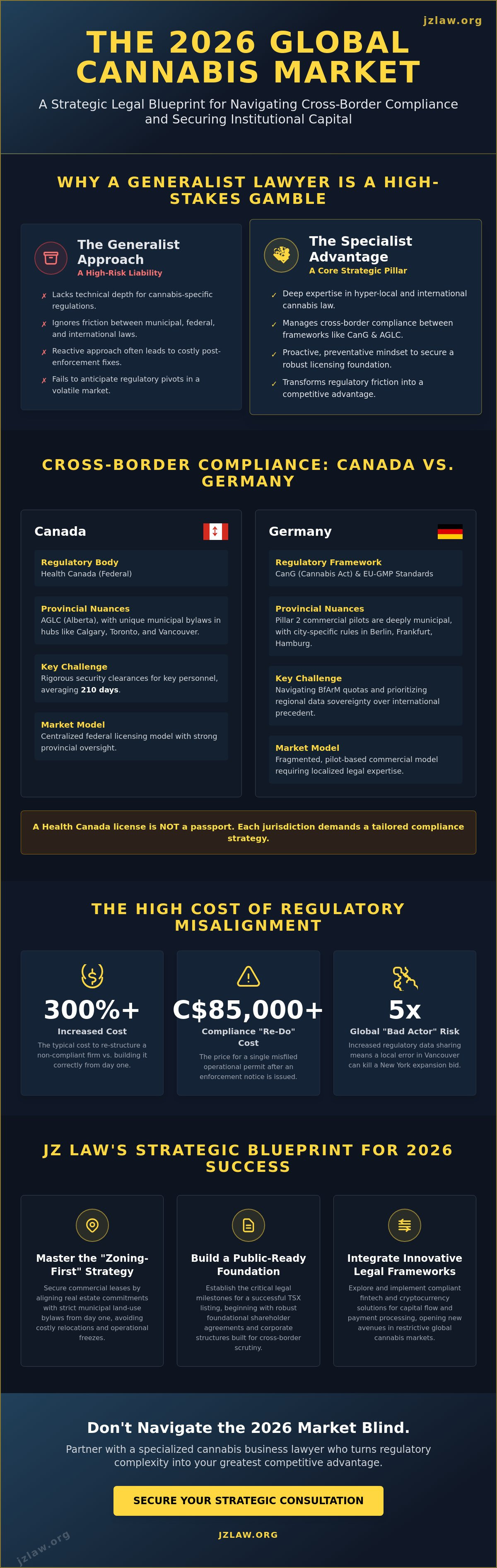
A Calgary-based retail startup focuses on AGLC compliance and specific Alberta land-use bylaws. Conversely, a Frankfurt medical distributor must satisfy strict EU-GMP standards and BfArM quotas. These aren't just different rules; they're entirely different legal languages. A mistake in interpreting a local zoning ordinance can stall a multi-million dollar launch. By the time a 2026 audit occurs, the damage is usually irreversible. Proactive compliance prevents the "re-do" costs that can exceed C$85,000 for a single misfiled operational permit. Waiting for an enforcement notice is a terminal business mistake.
The High Stakes of Regulatory Misalignment
Minor oversights in a Vancouver land-use application can trigger "bad actor" clauses in a New York expansion bid. In 2026, regulators share more data than ever. If your corporate structure wasn't built for cross-border scrutiny, you'll spend five times the initial investment to fix it. Municipal bylaws in cities like Kelowna or Toronto add layers of complexity that federal laws don't cover. Businesses that fail to align their local permits with their federal licenses face immediate operational freezes.
Data Sharing: Increased transparency between international regulators means local errors have global consequences.
Structural Integrity: Corporate frameworks must be built for 2026 compliance from day one.
Cost of Failure: Re-structuring a non-compliant firm often costs 300% more than doing it right initially.
JZ Law: Beyond Standard Corporate Counsel
John Zang approaches these challenges with a specific focus on high-volatility sectors. JZ Law isn't a factory for transactional paperwork. It's a boutique firm designed for the 2026 entrepreneur who views legal counsel as a strategic partnership. Whether you're integrating crypto-payment rails or securing an export permit, you need a cannabis business lawyer who anticipates the next regulatory pivot before it hits your balance sheet. Our approach prioritizes a preventative mindset, ensuring that your business remains resilient against the inevitable shifts in the global market.
Navigating Cross-Border Compliance: From Health Canada to Germany's CanG
A persistent myth in the global market suggests that securing a license in a sophisticated jurisdiction like Canada simplifies entry into European or American markets. The reality is far more fragmented. By 2026, the regulatory divide has widened as regions move from general legalization to hyper-specific commercial models. While a Health Canada license demonstrates operational competence, it doesn't serve as a passport. Each hub, from Berlin to New York City, maintains unique hurdles that require a cannabis business lawyer to dissect before capital is deployed.
The German CanG (Cannabis Act) Pillar 2 commercial pilots have reached a critical phase in 2026. Unlike the centralized Canadian model, these pilots are deeply municipal. Success in the European market now depends on securing local expertise in Hamburg, Berlin, and Frankfurt, where city-specific regulations dictate supply chain logistics. Attempting to apply a "one-size-fits-all" compliance strategy often results in costly delays or rejected applications because German authorities prioritize regional data sovereignty over international precedent.
The Canadian Context: Calgary, Toronto, and Vancouver
In 2026, Health Canada's licensing landscape remains rigorous. Security clearance timelines for key personnel currently average 210 days, a slight increase from 2024 levels due to enhanced vetting protocols. Annual regulatory fees for micro-cultivators have stabilized, but craft producers must still account for approximately C$23,000 in base administrative costs before a single seed is planted. The recent conclusions of the Cannabis Act review have finally provided relief for micro-producers by streamlining excise duty applications, yet the burden of proof for "security by design" remains high.
For entrepreneurs in Calgary or Vancouver exploring retail expansion, understanding the intersection of different regulated industries is vital. Those interested in how beverage regulations mirror cannabis retail should consult the Alberta Liquor License Guide 2026 for strategic cross-over insights. This preventive legal approach ensures that a single compliance failure in one sector doesn't jeopardize licenses in another.
The US and European Frontier: NYC, Denver, and Berlin
The contrast between New York's MRTA and Alberta's AGLC requirements is stark. While Alberta focuses on a highly structured, private-retail model with strict separation of trade, New York continues to prioritize social equity licensing and aggressive enforcement against unlicensed storefronts. Navigating these differences requires a cannabis business lawyer who understands that "compliance" in Manhattan often involves community board negotiations that don't exist in the Calgary market.
On the international stage, Denver-based firms are increasingly looking to export proprietary technology and genetics to Frankfurt. These transactions are complicated by the evolving status of federal cannabis legislation in the United States, which still impacts banking and international trade insurance. Berlin and Hamburg's pilot projects serve as the primary commercial testing grounds for Europe in 2026, making it essential to align US intellectual property protections with the specific data-tracking requirements of the German "Track and Trace" system.
Managing these complexities requires more than just a legal representative; it demands a partner who can anticipate shifts in international treaties. If you're planning a multi-jurisdictional expansion, seeking comprehensive legal counsel early in the process is the most effective way to protect your global interests.
Myth vs. Reality: Why Startups Fail the "Public-Ready" Test
Many founders view a public listing on the TSX or NASDAQ as a finish line. It's actually a rigorous beginning. A common myth suggests that going public is merely about the IPO event itself. The reality is that public readiness begins with your first shareholder agreement. Investors in 2026 demand a clean cap table without the "friends and family" baggage that complicates institutional due diligence. Engaging a cannabis business lawyer early ensures that every equity issuance and convertible note aligns with future exchange requirements. If you're planning this transition, understanding the specific roadmap in Taking Your Cannabis Company Public is essential for avoiding early structural mistakes.
Securities Regulation and Corporate Finance
The Public Company Readiness audit involves a deep dive into three years of audited financials and a meticulous review of governance protocols. In the Canadian sector, many founders opt for Reverse Mergers (RTOs) because they're often faster than traditional IPOs. However, RTOs carry hidden liabilities from the shell company that can derail a C$50 million valuation overnight. Founders in Toronto and New York must prioritize legal transparency to manage investor expectations. This means disclosing every regulatory inquiry or license delay from day one. A cannabis business lawyer provides the strategic oversight needed to ensure these disclosures don't spook the market but instead build long term credibility.
Financials: Must meet IFRS or GAAP standards depending on the target exchange.
Governance: Independent board committees are no longer optional for mid-cap cannabis firms.
Regulatory History: A single compliance gap in 2024 can block a listing in 2026.
Tax Structuring for Growth and Exit
Taxation remains the primary hurdle for valuation. While Section 280E is a US federal constraint, it directly affects Canadian companies with American subsidiaries. This often increases the effective tax rate to 70% or higher, severely impacting cash flow. Strategic tax structuring involves creating tax-efficient corporate shells that protect global operations from being tainted by US-based liabilities. This architecture is vital for maximizing ROI during a corporate transaction or acquisition. It ensures the corporate structure allows for a seamless transfer of assets without triggering massive capital gains penalties. Proper planning prevents the common mistake of having a "messy" exit where taxes eat 40% of the founder's payout.
Success in the 2026 market depends on being "exit-ready" at every stage of growth. This requires a shift from a reactive legal posture to a preventive, strategic mindset. By building the company on a foundation of public-ready standards, you don't just prepare for an IPO; you create a more resilient, valuable business for any potential suitor.
Securing Your Future: Licensing, Real Estate, and Transactional Law
Securing a commercial lease in Calgary or Denver requires more than a signature on a standard form. One persistent myth suggests that zoning is purely the city's responsibility. In reality, zoning represents a cannabis business lawyer’s first priority. In Calgary, for instance, Land Use Bylaw 1P2007 mandates strict 150-metre setbacks from schools and emergency shelters. Failing to verify these micro-locations before signing can lead to a total loss of initial capital. The intersection of cannabis and Real Estate Law in high-demand urban hubs demands a proactive, defensive strategy to ensure long-term viability. We don't just review contracts; we audit the physical and legal geography of your investment.
Drafting supply agreements and joint ventures requires foresight into the 2026 regulatory environment. Contracts must account for potential shifts in federal THC limits or packaging requirements. A robust agreement includes "change in law" provisions that trigger automatic renegotiation periods, preventing a total breach of contract if Health Canada updates its Industry Guide. This level of precision ensures that your operational partnerships remain solvent even when the legislative ground shifts.
Commercial Real Estate and Zoning Hubs
Local nuances vary significantly between jurisdictions. While Hamburg focuses on social club proximity under its latest Pillar 1 regulations, Vancouver’s "Green Zones" have evolved since the 2018 Cannabis Act to manage retail density through strict municipal permits. Negotiating "regulatory out" clauses is essential for any dispensary lease. These provisions allow tenants to terminate a lease without heavy penalties if the municipality denies their business license. Protecting investments in specialized cultivation facilities is equally vital; with high-grade HVAC and security systems often costing over C$300 per square foot, your lease must explicitly define these as tenant improvements to prevent asset forfeiture.
M&A and Strategic Corporate Transactions
Acquiring an existing license in Ontario or Colorado requires a rigorous due diligence checklist that goes beyond simple financial audits. You must verify the seller’s compliance history with the AGCO and ensure that all C$200,000+ equipment liens are cleared before closing. Managing the transfer of licenses during a change of control involves complex regulatory filings that often take 90 to 120 days to process. JZ Law facilitates high-stakes M&A through precision due diligence, ensuring every corporate asset is vetted against current 2026 standards. This meticulous approach prevents the buyer from inheriting undisclosed regulatory fines or operational suspensions from the previous owner.
Protect your capital and ensure your facility meets every municipal requirement by engaging a strategic legal partner for your next transaction.
The JZ Law Advantage: Strategic Counsel in Global Hubs
Success in the international market requires more than a local permit. It demands a legal partner who understands the friction between different sovereign systems. JZ Law provides this bridge, offering a multi-jurisdictional reach that spans from the regulatory heart of Hamburg to the mature markets of Vancouver. Choosing a cannabis business lawyer from a boutique firm ensures your enterprise isn't just another file in a cabinet. You receive direct access to principal counsel, ensuring that every high-level strategic decision is vetted by experienced eyes. This model prioritizes accountability and precision over billable volume.
Fintech remains a primary barrier for Canadian and European operators. John Zang utilizes his specialized knowledge in Cryptocurrency Law to architect payment and investment solutions that bypass traditional banking bottlenecks. This cross-sector expertise allows JZ Law to implement secure, compliant financial structures that smaller, single-focus firms cannot replicate. Whether you're dealing with C$10 million in venture capital or complex cross-border tax liabilities, the firm’s precision remains the constant factor in your growth strategy.
Why Niche Expertise Matters
Regulatory frameworks in oil and gas, digital assets, and cannabis share a common DNA. They're high-stakes, heavily scrutinized, and subject to rapid political shifts. JZ Law thrives in these volatile environments. While traditional firms avoid the "high-risk" label, we manage the complexity with a structured, preventive approach. We position our clients as the next generation of industry leaders by applying the rigorous compliance standards found in the energy sector to the cannabis space. This methodology identifies and mitigates litigation risks long before they manifest in a courtroom.
Contact JZ Law for a Strategic Consultation
Securing your market position in 2026 requires immediate action. Whether you need a comprehensive regulatory audit or a roadmap for international expansion, our team provides the professional excellence your brand deserves. You can book a consultation through our primary hubs to discuss your specific operational needs and client security protocols. For those beginning their journey, our Cannabis Licensing Guide 2026 offers a foundational look at the requirements across global hubs. Retaining a cannabis business lawyer with a global perspective is the most effective way to safeguard your capital and your corporate reputation.
Mastering the 2026 Regulatory Frontier with Strategic Precision
The global cannabis market in 2026 demands more than just basic legal adherence; it requires a proactive strategy that anticipates the friction between Canada's evolving Cannabis Act and emerging frameworks like Germany's CanG. Many entrepreneurs underestimate the rigor of the "public-ready" test, a failure that often stalls expansion when corporate governance doesn't meet institutional standards. Partnering with a specialized cannabis business lawyer ensures your venture isn't just compliant but is structurally optimized for expansion across critical hubs like Calgary, New York, Berlin, and Hamburg. JZ Law provides this high-stakes expertise through a principal-led boutique model, offering the sophisticated counsel found in global firms with the focused attention your specific assets require. By prioritizing a preventive approach to licensing and transactional law, you secure a foundation capable of withstanding the volatile shifts of this industry. Your long-term success depends on legal architecture that's as ambitious as your business goals.
Frequently Asked Questions
What is the difference between a cannabis lawyer and a standard business lawyer?
A cannabis business lawyer specializes in the intricate intersection of commercial law and the strict regulatory frameworks governing controlled substances. While a standard business lawyer handles general corporate governance, a specialist manages the specific compliance requirements of the Cannabis Act and provincial regulations. This expertise is critical because a single oversight in security protocols or packaging standards can lead to immediate license revocation or substantial administrative penalties for the operator.
Can a Canadian cannabis company go public on a US stock exchange in 2026?
Canadian cannabis companies can list on major US exchanges like the NASDAQ or NYSE in 2026 if they don't have direct plant-touching operations in the United States. Following the 2024 rescheduling of cannabis to Schedule III, the legal landscape shifted, but federal illegality remains a barrier for direct operators. Most Canadian firms utilize "Exchangeable Share" structures to maintain compliance while positioning themselves for full US entry once federal legalization or the SAFER Banking Act provides clearer pathways.
How much does it cost to obtain a cannabis retail license in Berlin or Hamburg?
Obtaining a commercial cannabis retail license in Berlin or Hamburg depends on the specific parameters of the Pillar 2 regional pilot projects launched in late 2024. Administrative application fees typically range from C$15,000 to C$35,000, excluding the costs for security infrastructure and mandatory staff training. These figures are based on 2025 municipal data from German health authorities and vary significantly based on the size of the retail footprint and local zoning requirements.
What are the biggest legal mistakes cannabis startups make during their first year?
The most frequent legal error cannabis startups make is failing to secure intellectual property rights before entering the market. Data from 2024 industry reports suggests that 40% of new ventures face trademark disputes because they didn't conduct comprehensive searches across multiple jurisdictions. Another critical mistake involves poorly drafted partnership agreements that lack clear exit clauses, leading to protracted litigation when the initial business model requires a pivot due to regulatory shifts.
Does JZ Law handle criminal defense for cannabis-related charges?
JZ Law focuses exclusively on corporate, regulatory, and commercial legal services for the cannabis industry. Our firm doesn't provide criminal defense for individual charges or illicit activities. We operate as a strategic partner for legitimate businesses, ensuring that our clients maintain strict adherence to the Cannabis Act and international trade laws. This preventive approach helps entrepreneurs avoid the legal pitfalls that lead to criminal exposure in the first place.
How does federal rescheduling in the US affect Canadian cannabis exporters?
The US federal rescheduling to Schedule III in 2024 facilitates easier medical cannabis exports from Canada by reducing the administrative burden of DEA import permits. This change allows Canadian producers to supply the US medical market more efficiently, as it acknowledges the drug's accepted medical use. However, bulk recreational exports remain prohibited under international treaties like the 1961 Single Convention on Narcotic Drugs, meaning the impact is primarily felt in the pharmaceutical and research sectors.
What is "Pillar 2" of the German cannabis law and how does it affect businesses?
Pillar 2 of the German Cannabis Act (CanG) establishes regional pilot programs for commercial supply chains and retail sales in selected cities. Unlike the non-profit social clubs of Pillar 1, this phase allows businesses to test the viability of a regulated market over a five year period. It affects businesses by creating a framework for licensed production and distribution, provided they operate within the designated "model regions" and comply with strict data collection requirements for scientific evaluation.
How long does the due diligence process take for a cannabis company acquisition?
The due diligence process for a cannabis company acquisition typically takes between 45 and 90 days. This timeline is longer than standard M&A transactions because it requires a granular audit of cultivation licenses, pesticide testing records, and provincial supply agreements. A cannabis business lawyer must verify that the target company hasn't committed any regulatory infractions that could jeopardize the transfer of licenses, as these assets represent the primary value of the deal.


Comments