


Commercial Eviction Process 2026: A Strategic Guide for Global Business Hubs
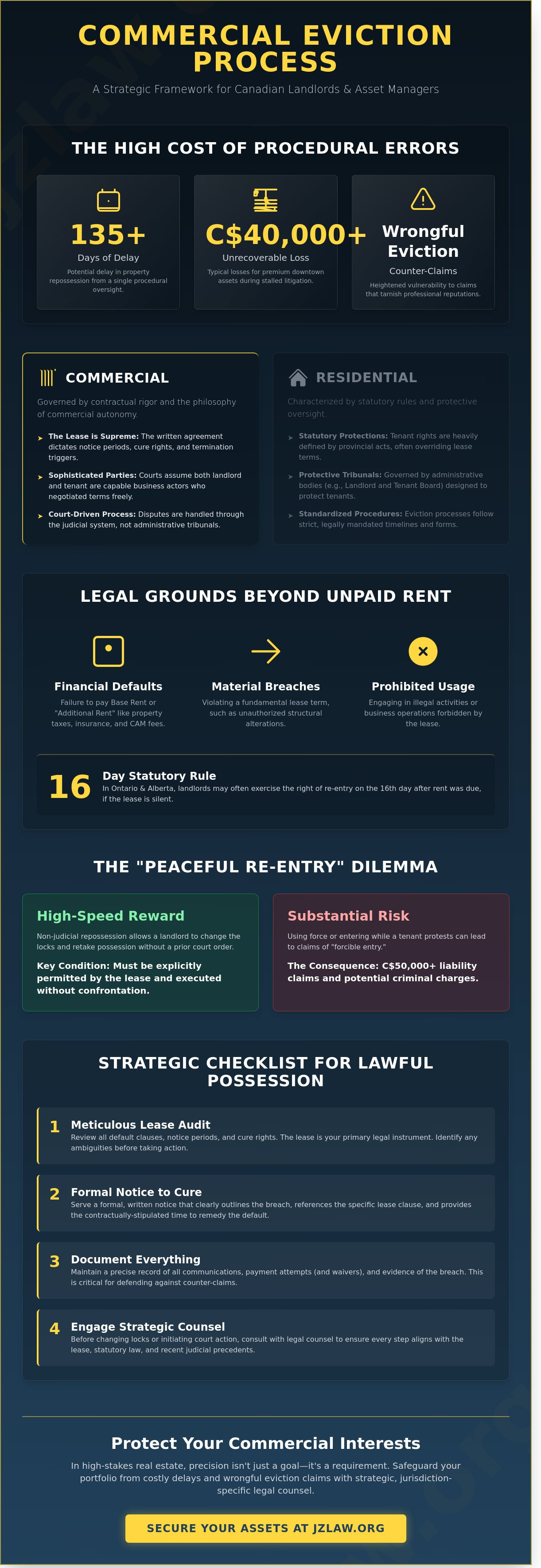
Did you know that a single procedural oversight in the Canadian commercial eviction process can delay property repossession by over 135 days, often resulting in unrecoverable losses exceeding C$40,000 for premium downtown assets? You're likely already concerned that every week of stalled litigation represents more than just lost rent; it's a period of heightened vulnerability to "wrongful eviction" counter-claims that can tarnish a professional reputation. We recognize that in high-stakes real estate, the goal isn't just to remove a tenant, but to do so with a level of precision that safeguards your entire portfolio.
This guide provides a professional, jurisdiction-specific framework designed to help you navigate these complexities with a strategic, preventive mindset. You'll gain the clarity needed to execute a lawful repossession while mitigating financial loss and avoiding the technical errors that frequently reset the legal clock. We'll outline the specific 2026 regulatory requirements for Canada's global business hubs, ensuring your path to property recovery is both efficient and legally sound.
Key Takeaways
Master the distinction between statutory residential rules and the contractual rigor required for a successful commercial eviction process in high-stakes Canadian real estate markets.
Identify critical material breaches, such as unauthorized structural alterations or prohibited usage, that empower landlords to exercise termination rights beyond simple non-payment of rent.
Understand jurisdictional variances by comparing the efficiency of Toronto’s Writ of Possession against other global hubs to better forecast asset recovery timelines.
Adopt a strategic two-step framework for lawful possession, beginning with a meticulous lease audit of default clauses and the formal service of a Notice to Cure.
Discover how preventative lease drafting and strategic counsel protect C$-denominated assets during complex corporate transactions involving distressed commercial properties.
Table of Contents Understanding the Commercial Eviction Process in 2026 Legal Grounds for Commercial Eviction: Beyond Unpaid Rent Eviction Timelines: A Comparative Analysis of Global Hubs A Strategic Checklist for Lawful Possession How JZ Law Protects Your Commercial Interests
Understanding the Commercial Eviction Process in 2026
The commercial eviction process is a sophisticated legal mechanism designed to balance property rights with contractual obligations. In 2026, this process remains a primary remedy for landlords facing material breaches, such as non-payment of rent or unauthorized alterations. It's fundamentally different from residential proceedings. Residential tenants often benefit from the protective oversight of administrative tribunals, but commercial entities operate under a philosophy of commercial autonomy. This means the courts assume both parties are sophisticated business actors capable of negotiating their own terms.
While the general eviction process typically involves a series of notices and judicial hearings, the commercial sphere grants significantly more power to the written agreement. The lease agreement is the supreme document in these transactions. It defines notice periods, cure rights, and the specific triggers for termination. If your lease stipulates a three-day cure period for rent arrears, that timeline supersedes the broader defaults found in many provincial statutes. Precision in drafting these clauses is what separates a protected asset from a legal liability.
The Legal Foundation: Contract vs. Statute
The Commercial Tenancies Act (CTA) provides a default framework across Canadian provinces, yet its application varies by city. In Calgary and Vancouver, the CTA dictates the rights of distress and re-entry if the lease is silent. Conversely, the legal landscape in New York City relies heavily on Common Law precedents and the Real Property Actions and Proceedings Law. International investors must also account for European standards; for instance, the Bürgerliches Gesetzbuch (BGB) in Berlin and Hamburg requires a more formal judicial approach than the self-help remedies common in North America. Following a 4.2% increase in commercial defaults in late 2025, many jurisdictions have tightened the interpretation of these statutes to ensure procedural fairness.
The Concept of "Peaceful Re-entry"
Peaceful re-entry is the non-judicial repossession of a property following a material breach. This allows a landlord to change the locks and retake possession without a prior court order, provided the lease permits it and the action occurs without physical confrontation. It's a high-speed alternative to the traditional commercial eviction process, but it carries substantial risks. If a landlord uses force or enters while a tenant is present and protesting, they may face claims for "forcible entry." Such mistakes can lead to significant C$50,000 or higher liability claims for business interruption. Every step must be documented to prove that the repossession was conducted without a breach of the peace.
Contractual Primacy: The lease terms dictate the specific steps of the eviction.
Statutory Defaults: The CTA applies only when the lease is silent or ambiguous.
Jurisdictional Variance: Procedures in Vancouver differ significantly from those in New York or Berlin.
Risk Management: Forcible entry can lead to criminal charges and civil damages.
Legal Grounds for Commercial Eviction: Beyond Unpaid Rent
The commercial lease is a sophisticated instrument where every clause serves as a potential trigger for legal action. While non-payment is the most frequent catalyst, the 2026 legal landscape sees a rise in "material breaches" related to property use and regulatory compliance. A material breach occurs when a tenant violates a fundamental term of the agreement, such as performing unauthorized structural alterations or engaging in prohibited business activities that devalue the asset. Landlords must act with precision, as the commercial eviction process requires a strict adherence to notice requirements to avoid claims of wrongful distraint.
Non-Payment of Rent and Financial Defaults
Financial defaults extend beyond the failure to provide the monthly base rent. Modern Canadian leases often categorize "additional rent" to include property taxes, insurance premiums, and common area maintenance (CAM) fees. In jurisdictions like Ontario and Alberta, the Commercial Tenancies Act provides a 16-day statutory rule. This means a landlord may typically exercise the right of re-entry on the 16th day after rent was due, provided the lease doesn't specify a different grace period. Precision is required here; accepting a partial payment of C$2,500 toward a C$10,000 debt can inadvertently waive your right to evict for that period. Our firm recommends a preventive review of all ledger entries before issuing a notice of forfeiture to ensure no waiver has occurred.
Regulatory and Industry-Specific Breaches
As specialized sectors expand, lease enforcement has become increasingly technical. Tenants in high-growth industries face unique compliance hurdles that, if cleared incorrectly, grant the landlord termination rights. Key areas of concern include:
Cannabis Operations: Failure to maintain valid cannabis licensing or violating municipal zoning bylaws constitutes a major default.
Digital Infrastructure: Cryptocurrency mining or data centers that exceed their allocated power draw, often capped at specific kVA limits, can threaten the building's electrical integrity.
Financial Compliance: Failure to maintain C$5 million in comprehensive general liability insurance or breaching securities regulations in fintech hubs provides grounds for immediate legal intervention.
The complexity of these breaches often impacts commercial eviction timelines, especially when tenant insolvency is involved. If a tenant files for protection under the Bankruptcy and Insolvency Act (BIA) or the Companies' Creditors Arrangement Act (CCAA), an automatic stay of proceedings usually halts the eviction. This legal shield prevents landlords from recovering the premises without seeking leave from the court, a process that requires a strategic, business-oriented approach to protect the landlord's equity and minimize vacancy losses.
Eviction Timelines: A Comparative Analysis of Global Hubs
Managing a commercial property portfolio requires an understanding that local jurisdictions dictate the speed of the commercial eviction process. A "one-size-fits-all" timeline doesn't exist. In bustling hubs like San Francisco, a 'Unlawful Detainer' action can often conclude within 60 to 120 days for uncontested cases, though contested matters can extend much longer. Similarly, in Calgary, the process is influenced by local court procedures. Projections for 2026 indicate that court backlogs in major metropolitan areas will likely extend contested litigation by an additional 22%. To mitigate these risks, sophisticated landlords are increasingly utilizing arbitration clauses to bypass traditional court delays and secure faster resolutions. JZ Law advises clients to consider these strategic tools to navigate varying North American standards.
Timeline Factors in Canada: Focus on Alberta
In the Canadian landscape, particularly within Alberta, the duration of the commercial eviction process depends heavily on whether the matter is contested in the Court of King's Bench. Uncontested cases in Calgary may reach a resolution in approximately 60 to 75 days. If a tenant submits a formal defense, the timeline frequently exceeds 200 days. Efficiency varies by province, with JZ Law specializing in Alberta's unique requirements:
Alberta (Calgary): The Court of King’s Bench maintains specific procedural requirements for "originating applications" that differ from other provincial systems. Local practice often requires a formal demand for possession before the court will entertain an application, and JZ Law ensures all prerequisites are meticulously met.
Other Canadian Jurisdictions: While JZ Law focuses on Alberta, it's important to note that provinces like Ontario and British Columbia also utilize their respective Superior Courts, where high caseloads in major cities such as Toronto and Vancouver can extend hearing dates.
Execution: Once a judge grants an order, the Sheriff holds the exclusive legal authority to execute the Writ of Possession. Landlords can't engage in self-help remedies; they must rely on the Sheriff to regain physical control, a step that typically adds 10 to 14 days to the final phase across Canada.
The Process in California: San Francisco and Beyond
In California, particularly in key business centers like San Francisco, the commercial eviction process is governed by 'Unlawful Detainer' actions. Landlords must typically serve a Three-Day Notice to Pay Rent or Quit, or a Notice to Perform Covenants or Quit, before initiating legal proceedings. If the tenant fails to comply, the landlord can file a complaint. While expedited summary proceedings are available, the judicial process is thorough, emphasizing strict adherence to notice requirements and procedural rules. Contested cases, especially those involving complex lease disputes, can extend timelines significantly, often ranging from 3 to 6 months or longer if appeals are involved. This structured approach ensures due process for all parties, making precise and legally compliant notice preparation paramount. JZ Law provides expert guidance to navigate California's specific regulations, ensuring landlords pursue the most efficient path while mitigating risks of procedural errors.
A Strategic Checklist for Lawful Possession
Executing a successful commercial eviction process requires a disciplined adherence to procedural milestones. In Canada, where commercial tenancies are primarily governed by the specific terms of the lease and provincial statutes like the Ontario Commercial Tenancies Act, any deviation from the agreed-upon protocol can lead to costly litigation. Landlords must follow a four-step strategic framework to mitigate the risk of a wrongful eviction claim.
Step 1: Meticulous lease review. You must identify the specific "Default" and "Notice" clauses that dictate how and when a tenant is considered in breach. These clauses often define different timelines for monetary versus non-monetary defaults.
Step 2: Formal service of notice. Depending on the breach, you must serve a "Notice to Cure" or a "Notice of Default" exactly as prescribed by the lease. Failure to provide the required number of clear days for a remedy can invalidate the entire process.
Step 3: Documenting the breach. Building a rigorous evidentiary trail is essential. This includes financial records, photographic evidence of property damage, or logs of repeated lease violations.
Step 4: Executing re-entry or filing a Statement of Claim. Once the notice period expires without a cure, you may choose to exercise "self-help" re-entry or initiate formal court proceedings to regain possession.
Effective Notice Delivery and Documentation
While many landlords assume registered mail is sufficient, it often falls short under judicial scrutiny because tenants can refuse delivery or claim they never received the contents. Professional personal service by a licensed bailiff or process server provides an affidavit of service, which serves as indisputable proof in court. Your internal rent ledger must be maintained with absolute precision; any ambiguity in how payments are applied or how late fees are calculated can undermine your credibility during a hearing. The "Notice to Cure" serves as the primary defense against wrongful eviction claims by demonstrating that the tenant was given a fair and contractually mandated opportunity to rectify their breach.
The "Right of Distress": Seizing Tenant Assets
The right of distress allows a landlord to seize and sell a tenant's personal property to recover rent arrears. This is a powerful tool, yet it's fraught with legal complexities regarding priority. Under Canadian law, secured creditors with a perfected security interest under the Personal Property Security Act (PPSA) often take precedence over a landlord’s lien. You must also avoid the "double-dipping" trap; you cannot usually distrain tenant assets and terminate the lease for eviction simultaneously. Choosing to distrain affirms the lease's continued existence, meaning you must decide whether you want the money or the keys, as attempting both at once often results in a court-ordered stay of proceedings.
If you are facing a complex tenant default, our team provides the
necessary to protect your commercial assets and ensure a lawful transition of possession.
How JZ Law Protects Your Commercial Interests
JZ Law functions as a strategic partner for landlords and institutional investors who manage high-value portfolios across Canada and international markets. Our firm provides precise counsel for corporate transactions involving distressed assets, ensuring that new acquisitions aren't hindered by unresolved tenancy liabilities or hidden encumbrances. We understand that the Canadian commercial real estate sector, especially within the oil and gas industries of Calgary or the tech sectors in Vancouver, demands a sophisticated approach to risk mitigation. By leveraging our cross-border expertise from offices in New York and Berlin, we provide a global perspective that strengthens local enforcement strategies.
Preventative Strategy: The "Bulletproof" Lease
Asset protection starts well before a tenant fails to meet their financial obligations. Our methodology focuses on commercial lease negotiation that prioritizes clarity and rapid enforcement capabilities. We draft rigorous default clauses that eliminate ambiguity from the commercial eviction process, giving property owners the power to act without hesitation. Our drafting includes:
Defined Abandonment: We create specific criteria for "Abandonment" that allow for immediate repossession, bypassing months of unnecessary litigation if a tenant disappears.
Structured Personal Guarantees: We ensure financial recovery by drafting guarantees that hold individual stakeholders accountable, regardless of corporate insolvency or shell company structures.
Sector-Specific Provisions: We tailor clauses to handle the unique environmental and equipment risks found in the energy and technology sectors, ensuring specialized assets are protected.
Tactical Litigation and Dispute Resolution
When a dispute escalates, we perform a rigorous cost-benefit analysis to determine whether to pursue a settlement or aggressive court action. While a structured settlement can often preserve the liquidity of a C$10 million asset more effectively than a trial, we're prepared to litigate forcefully when a tenant's breach is egregious. JZ Law utilizes a robust network in Denver, Vancouver, and Frankfurt to track assets and enforce judgments across international borders.
We don't believe in a one-size-fits-all approach. Instead, we analyze the tenant's financial health and the current market demand for the space before recommending a path forward. Our goal isn't just to resolve a single conflict, but to secure the long-term viability of your commercial portfolio. Contact JZ Law today for a strategic evaluation to ensure you're fully protected throughout the commercial eviction process.
Securing Your Corporate Real Estate Strategy
Managing high-value property portfolios in 2026 demands a shift from reactive litigation to proactive asset protection. The modern commercial eviction process is no longer just about recovering arrears; it's a complex maneuver influenced by sector-specific regulations in industries like cannabis and digital assets. Recent data from Canadian legal reviews suggests that minor procedural errors in notice delivery can delay possession by 45 to 90 days, potentially costing landlords thousands in lost opportunity. Success requires a meticulous approach to navigating the specific timelines of global hubs across Canada, the United States, and Germany. By implementing a preventative strategic checklist before disputes arise, you ensure your interests remain secure regardless of market volatility. Our firm brings specialized expertise to high-stakes regulatory environments, ensuring your legal standing is unassailable. It's vital to have a partner who understands the intersection of technology, law, and global commerce. We're ready to transform your legal challenges into a structured path for long-term operational stability.
Frequently Asked Questions
How long does the commercial eviction process typically take in 2026?
The commercial eviction process in 2026 typically spans 90 to 180 days from the initial notice to the final writ of possession. While summary proceedings can expedite matters, current judicial trends suggest that 72% of contested cases require at least two court appearances. We advise clients to initiate the process immediately after a default to mitigate escalating financial exposure and ensure a faster resolution.
Can I change the locks on a commercial tenant if they haven’t paid rent?
You can often change the locks through a process called self-help repossession, provided your lease agreement explicitly grants this right and you don't use unreasonable force. In provinces like Alberta, the law allows this after rent has been overdue for a specific period, often 14 days. It's a high-stakes move that requires a strategic approach to avoid claims of wrongful eviction or illegal conversion of the tenant's property.
What is the difference between a "Notice to Cure" and a "Notice to Quit"?
A Notice to Cure identifies a specific lease violation and provides a set timeframe, usually 15 to 30 days, for the tenant to fix the issue. In contrast, a Notice to Quit acts as a formal termination of the lease agreement, requiring the tenant to vacate the premises by a certain date. Navigating the commercial eviction process requires precise timing between these two documents to ensure the landlord maintains a position of legal strength.
Does the commercial eviction process differ for cannabis-related businesses?
Evicting a cannabis-related business involves additional layers of regulatory compliance due to the sensitive nature of the inventory and federal licensing requirements. Landlords must coordinate with provincial regulators to ensure that seized product is handled by authorized personnel, as unauthorized possession can lead to fines exceeding C$10,000. These cases require a specialized legal strategy to manage the intersection of property law and the federal Cannabis Act.
Can a commercial tenant stop an eviction by paying the arrears late?
A tenant can often halt the proceedings by applying for "relief from forfeiture" in court, provided they pay all outstanding C$ arrears and the landlord's legal costs. Judges grant this relief in a high percentage of cases where the tenant demonstrates a viable plan to remain current and the breach wasn't malicious. Our office focuses on preventive lease drafting to include clauses that protect the landlord's interests when chronic late payments occur.
What happens to a tenant’s equipment and inventory after a commercial eviction?
Landlords in Canada often exercise the right of distress, which allows them to seize and sell a tenant's inventory to recover unpaid rent. This process must be conducted by a licensed civil enforcement agency or bailiff to ensure the sale meets provincial legal standards. If the assets are sold, the proceeds first cover the C$ costs of the seizure and then the rent arrears, with any surplus returning to the tenant.
Is a court order always required to evict a commercial tenant in Calgary or New York?
A court order isn't always required in Calgary if the landlord uses peaceable self-help repossession, but it's almost always mandatory in New York under strict state statutes. In Calgary, roughly 40% of commercial evictions are handled via reentry without a judge's intervention. However, obtaining a court order is the safer path to prevent the tenant from filing an injunction or a lawsuit for damages after the locks are changed.
Can I sue for the remaining balance of the lease after evicting the tenant?
You can sue for the remaining balance of the lease, though you have a legal duty to mitigate your losses by making reasonable efforts to find a new tenant. Courts typically award the difference between the original rent and the market rate you receive from a new occupant. If the property sits vacant for six months despite your documented efforts to lease it, you can claim the full C$ value of that lost rent in your statement of claim.


Comments