


Cannabis Compliance Consultant Alberta: Strategic Legal Frameworks for 2026
- jzanglaw
- Aug 4
- 12 min read
In the high-stakes 2026 market, a single administrative oversight in your AGLC reporting isn't just a clerical error; it's a direct threat to your corporate valuation and future IPO eligibility. As Alberta transitions toward a privately managed consignment model, the margin for error has narrowed, making the role of a specialized cannabis compliance consultant alberta more critical than ever for maintaining institutional-grade operations. You've likely felt the mounting pressure of managing a competitive footprint among 751 licensed stores while balancing Health Canada requirements against provincial mandates. The complexity of dual-tier reporting often feels like a barrier to the very growth it's supposed to regulate, especially when internal compliance costs continue to escalate.
This article will demonstrate how to transform these regulatory hurdles into a strategic legal framework that protects your license and prepares your business for future financing. We'll examine the latest AGLC updates, including the shift to private consignment and the reduction of sample record-keeping requirements to two years, to ensure your organization remains audit-ready and positioned for long-term expansion. By aligning your operational protocols with sophisticated legal structures, you can secure a bulletproof regulatory standing that appeals to the most discerning investors.
Table of Contents
Navigating the Alberta Cannabis Regulatory Landscape in 2026
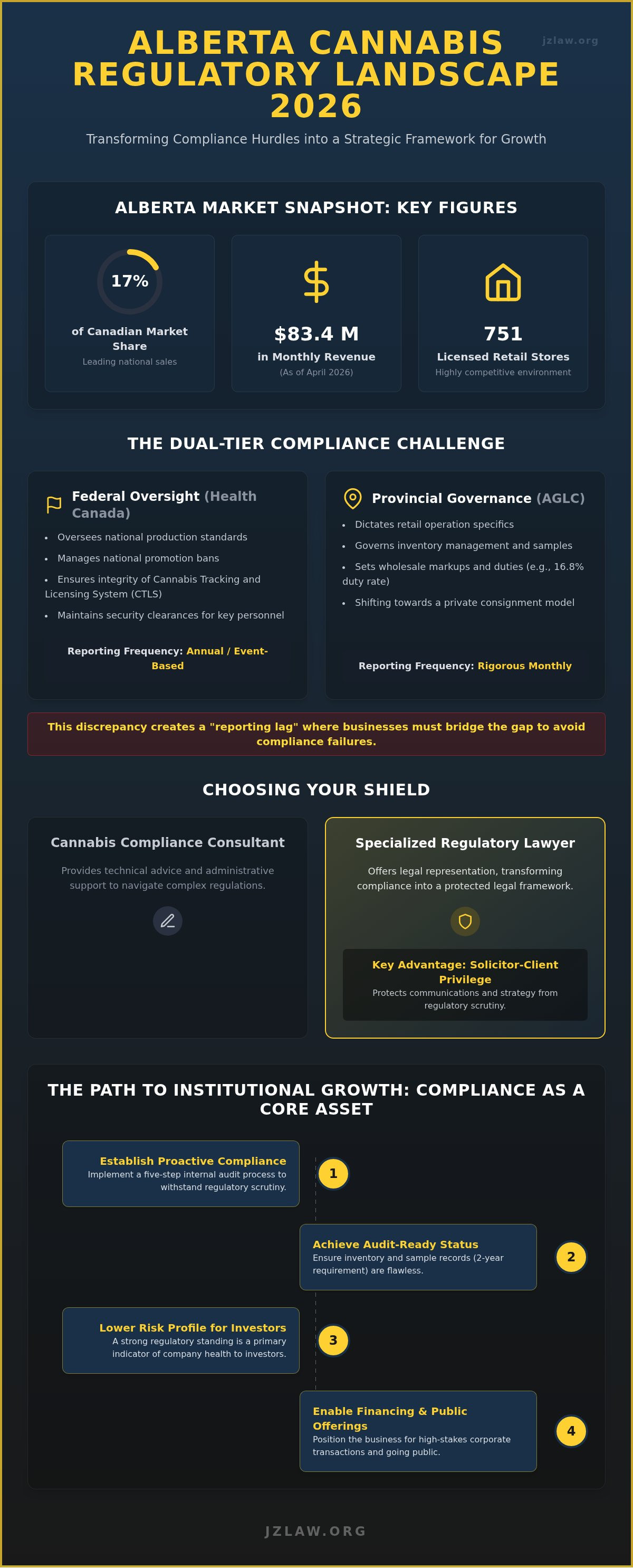
Alberta’s cannabis market in 2026 has transitioned from a period of chaotic expansion to one of calculated sophistication. While the province continues to lead national sales, accounting for 17% of the Canadian market with $83.4 million in monthly revenue as of April 2026, the competitive environment is dense. With 751 licensed retail stores currently operating, the distinction between survival and failure often rests on the caliber of your regulatory framework. A specialized cannabis compliance consultant alberta provides more than just administrative support; they act as a strategic architect for your business’s legal foundation. This role requires a deep synthesis of Provincial and Territorial Cannabis Laws, ensuring that every operational decision aligns with both local mandates and federal oversight. Navigating a landscape where a $400 application fee is merely the entry point to a complex $700 annual licensing cycle requires a partner who understands the long-term fiscal implications of compliance.
Institutional investors now view compliance as a primary indicator of a company’s health. For craft producers and retailers alike, moving toward institutional-grade compliance is no longer optional if the goal is to secure corporate financing or prepare for the rigorous process of taking a company public. Stability in your regulatory standing suggests a lower risk profile, which directly influences your ability to negotiate favorable terms during high-stakes corporate transactions. By treating compliance as a strategic asset rather than a cost center, you create a barrier to entry for less disciplined competitors.
The Role of the AGLC in Alberta Retail
The Alberta Gaming, Liquor and Cannabis (AGLC) remains the primary authority governing the retail sector. As of June 2026, the AGLC has signaled a significant shift by moving toward a privately managed consignment model for wholesale distribution. Operators must adapt to these changes while maintaining strict adherence to the updated 2026 handbook. Compliance pitfalls often emerge in inventory management and the handling of samples. While SKU-size limitations on samples were removed on June 10, 2026, the requirement to maintain accurate records for two years remains a non-negotiable standard for store inspections. Failing to master these provincial nuances can lead to administrative penalties that jeopardize your standing with federal authorities.
Federal Oversight: Health Canada's 2026 Priorities
While the AGLC manages the storefront, Health Canada’s 2026 inspection cycle focuses heavily on the integrity of the Cannabis Tracking and Licensing System (CTLS). Federal authorities are increasingly scrutinizing the alignment between physical inventory and digital reporting to prevent diversion. Maintaining security clearances for key personnel and corporate directors is another area where errors can be catastrophic to operations. A professional cannabis compliance consultant alberta ensures that these federal requirements don't just meet the minimum threshold but are integrated into a robust, audit-ready operational culture. This proactive stance prevents the administrative delays that often stall growth in this highly regulated sector, allowing leadership to focus on market expansion rather than damage control.
The Dual-Tier Challenge: Federal vs. Provincial Compliance
Success in Alberta’s cannabis sector requires a sophisticated understanding of the friction between two distinct regulatory bodies. Many businesses fail because they treat provincial AGLC rules and the Federal Cannabis Act as separate entities. In reality, they're deeply intertwined. While the federal government oversees production standards and national promotion bans, the AGLC dictates the specifics of retail operations and wholesale markups, such as the current 16.8% provincial duty rate. A specialized cannabis compliance consultant alberta bridges these gaps, ensuring that a decision made to satisfy a provincial inspector doesn't inadvertently trigger a federal violation.
The administrative burden is often lopsided. Alberta operators are subject to rigorous monthly reporting to the province, while federal Health Canada requirements typically operate on an annual or event-based schedule through the CTLS. This discrepancy creates a "reporting lag" where data submitted to one agency may be months out of phase with the other. Strategic documentation is the only solution. By creating a unified SOP framework that addresses both tiers simultaneously, you'll eliminate the risk of contradictory filings. This centralized approach is a hallmark of institutional-grade operations, making your business more attractive for strategic legal consulting and future investment.
Standard vs. Micro-Licensing Compliance
In the 2026 regulatory cycle, micro-licensees have become a primary target for administrative audits. Health Canada has observed that smaller operators often lack the rigorous internal controls found in standard-class facilities. While the initial security requirements for a micro-processing license are less intensive, the reporting accuracy must be identical to that of a multi-national producer. Scaling from a micro to a standard license involves more than just physical expansion; it requires a complete recalibration of your compliance infrastructure to handle increased scrutiny of security clearances and inventory flow.
Retail Compliance: Alberta's Specific Hurdles
Alberta retailers must navigate a minefield of provincial "inducement" rules that are among the strictest in Canada. Accepting any benefit from a licensed producer to influence product placement can result in immediate license suspension. Digital compliance is another area where errors are common. Alberta’s rules regarding social media advertising and website age-gates are highly specific, often conflicting with broader federal guidelines on promotion. Beyond basic SellSafe certification, your staff must understand the legal nuances of these supplier relationships to prevent accidental non-compliance. Protecting your $700 annual license fee and $3,000 background check deposit requires constant vigilance against these provincial pitfalls.
Consultant vs. Regulatory Lawyer: Choosing Your Shield
Choosing between a technical expert and a legal representative is often the difference between managing risk and eliminating it. While a cannabis compliance consultant alberta excels at optimizing your daily inventory workflows or refining your security protocols, they cannot provide the legal shield known as solicitor-client privilege. This distinction becomes paramount during a regulatory investigation or a surprise audit by provincial authorities. If you disclose a compliance failure to a technical consultant, that information is discoverable in a court of law. Privilege isn't a luxury. It's a fundamental legal right that protects your business during the most vulnerable moments of a regulatory audit.
When you work with a lawyer, your communications remain confidential. This allows for a candid assessment of operational vulnerabilities without fear of self-incrimination. During voluntary disclosures to Health Canada or the AGLC, a legal advisor ensures your response is framed within the context of AGLC Cannabis Legislation, protecting your license while demonstrating a commitment to rectification. A technical cannabis compliance consultant alberta may know the rules, but only a lawyer can defend your interests when those rules are used against you. The cost-benefit analysis favors legal counsel when you consider that a single license revocation can end your business instantly.
When to Engage a Cannabis Business Lawyer
Strategic planning starts early. Engaging legal counsel for cannabis licensing during the pre-application phase ensures your corporate structure is sound before you commit to the $3,000 background check deposit. If you receive a "Notice of Non-Compliance," your first instinct shouldn't be a technical fix; it must be a legal review. This is especially true during strategic corporate transactions and M&A, where a single unresolved regulatory flag can devalue your company by millions or derail a merger entirely.
Protecting Your IP and Corporate Assets
Compliance inspections often require revealing sensitive operational data. Without legal structures to protect your proprietary genetics or processing techniques, you risk exposing your trade secrets to the public record. A lawyer drafts shareholder agreements that include specific "bad actor" clauses. These protect the corporation’s license if a single director’s personal background check fails the AGLC's rigorous standards. By proactively structuring your assets, you ensure that compliance requirements don't compromise your competitive advantage.
Confidentiality: Only legal counsel offers solicitor-client privilege for sensitive disclosures.
Strategic Response: Lawyers frame non-compliance issues to mitigate provincial penalties.
Asset Protection: Ensure trade secrets remain private during mandatory inspections.
Operational Audit Readiness and Risk Mitigation
Building a culture of compliance ensures that your operational integrity doesn't collapse when key personnel depart. In the high-turnover environment of the 2026 cannabis market, relying on the knowledge of a single individual is a significant corporate risk. True readiness is achieved through institutional memory, where systems and redundancies protect the license regardless of staffing changes. A professional cannabis compliance consultant alberta helps formalize these processes, transforming them from informal habits into a rigorous, "litigation-ready" framework. This systemic approach is what separates transient businesses from those prepared for long-term institutional growth.
For Alberta operators, the 2026 internal audit should follow a precise five-step process. First, conduct a gap analysis against the latest AGLC handbook updates. Second, validate your Standard Operating Procedures (SOPs) through random staff interviews to ensure actual practices match written protocols. Third, perform a physical site assessment to verify that security hardware and Good Production Practices (GPP) logs are current. Fourth, reconcile your digital records with physical inventory to identify discrepancies before an inspector does. Finally, have your findings reviewed by legal counsel to ensure that any necessary corrective actions are documented under solicitor-client privilege. This proactive cycle prevents minor administrative errors from escalating into license-threatening violations.
Leveraging technology is no longer optional for risk mitigation. Moving away from manual spreadsheets to integrated ERP systems allows for automated compliance tracking and real-time data visualization. These systems reduce the human error factor that often leads to Good Production Practices (GPP) pitfalls, such as missed sanitation logs or environmental monitoring gaps. When your data is centralized and automated, you're not just meeting the minimum requirements; you're building a scalable model that appeals to sophisticated investors.
Site Inspection Survival Guide
Preparing for unannounced AGLC inspections requires constant readiness. Your staff must know exactly where digital backup systems are stored and how to produce real-time records on demand. Managing the inspector relationship is equally vital. Employees should be trained to maintain professional boundaries, providing accurate answers to specific queries without volunteering extraneous information that could expand the scope of the audit. A calm, organized facility that produces requested documents within minutes sends a powerful message of competence to provincial authorities.
Inventory and Financial Compliance
Inventory discrepancies are the primary trigger for immediate, deep-dive audits, as they often suggest "black market leakage" to regulators. Avoiding these red flags requires a meticulous alignment of your physical stock and digital reporting. Furthermore, your financial reporting and tax structuring must adhere to cannabis-specific accounting rules that account for the unique provincial markups and federal excise duties. For businesses with public market ambitions, implementing Sarbanes-Oxley (SOX) style internal controls early is a strategic move that simplifies future auditing requirements. To ensure your financial and operational protocols are robust enough for institutional scrutiny, consider a comprehensive legal audit of your current structures.
Scaling Beyond Compliance: Financing and Going Public
For institutional investors, regulatory compliance isn't a secondary operational detail; it's the primary metric for risk assessment. In a market where Alberta projects to receive $229 million in cannabis tax revenue for the 2026-27 fiscal year, the scale of the industry has attracted sophisticated capital that demands rigorous transparency. These investors don't just look at your monthly sales of $83.4 million; they look for the structural integrity that prevents a single administrative error from devaluing their entire investment. A specialized cannabis compliance consultant alberta acts as the bridge between your daily shop-floor reality and the high-level expectations of a board of directors or a venture capital firm.
Regulatory due diligence has become the centerpiece of Alberta cannabis M&A. When acquiring or selling existing licenses, the "skeletons" in a company’s reporting history can lead to significant price adjustments or the total collapse of the deal. JZ Law positions itself at this critical intersection, ensuring that your operational compliance is robust enough to withstand the scrutiny of a formal audit during corporate transactions. By aligning your legal structuring with your growth objectives, you transform compliance from a burden into a primary driver of corporate valuation.
Preparing for an IPO or Reverse Merger
The path to taking your cannabis company public requires a level of governance that exceeds standard retail requirements. You must clean up any historical regulatory discrepancies before filing a prospectus with the relevant securities commissions. Your corporate governance must match the strict exchange requirements of the TSX or CSE, which often include specific internal control mandates that mirror SOX compliance. A flawless compliance history is the non-negotiable prerequisite for any cannabis entity seeking a public listing on a major Canadian exchange. Without this foundation, the costs of legal remediation during the IPO process can be prohibitive.
Strategic Growth and License Acquisition
Navigating the legalities of buying or selling existing Alberta cannabis licenses involves a complex transfer process through the AGLC. This includes a fresh round of background checks for new associates and a $3,000 deposit for the investigation. Acquiring distressed assets requires an even deeper level of due diligence to ensure you aren't inheriting unresolved "Notices of Non-Compliance" or physical facility deficiencies that will require expensive retrofitting. Whether you're expanding your footprint or preparing for an exit, professional guidance is essential. Contact JZ Law for a consultation on securities regulation and the strategic legal frameworks required for sustainable cannabis growth.
Securing Your Future in the 2026 Alberta Market
The transition from a maturing retail market to an institutional-grade industry requires a fundamental shift in how you perceive regulatory obligations. By integrating your operational protocols with a robust legal strategy, you transform administrative requirements into a primary driver of corporate valuation. This proactive approach ensures that your business remains audit-ready while simultaneously preparing for high-stakes opportunities, such as taking your company public or navigating a complex merger. True market leadership in this sector belongs to those who view compliance as a strategic asset rather than an operational burden.
Partnering with a specialized cannabis compliance consultant alberta who understands the intricate intersection of AGLC mandates and securities regulation is essential for long-term stability. JZ Law provides boutique legal services with principal-level attention, bridging the gap between provincial oversight and global corporate finance. Our expertise in Health Canada frameworks and Alberta's evolving retail landscape ensures your organization is built on a foundation of precision and foresight. Secure your business with JZ Law's strategic cannabis compliance counsel. We look forward to helping you build a resilient and scalable corporate legacy.
Frequently Asked Questions
What is the difference between an Alberta cannabis consultant and a cannabis lawyer?
The primary difference lies in solicitor-client privilege and the capacity for legal representation during an investigation. While a cannabis compliance consultant alberta offers technical expertise in optimizing workflows and AGLC reporting, a lawyer provides a protected legal shield that ensures your sensitive disclosures remain confidential. This privilege is essential during audits, as it allows for a candid assessment of operational failures without the risk of those communications being discoverable by regulators.
How much does a cannabis compliance audit cost in Alberta in 2026?
The investment for a comprehensive compliance audit depends on the scale of your operations and the complexity of your license type. Factors such as the number of retail locations, the volume of production records, and the depth of your financial integration generally dictate the scope of the work. Operators should seek a customized assessment that reflects their specific risk profile and corporate goals, particularly if they are preparing for future financing.
Can I lose my AGLC retail license for a single record-keeping error?
While the AGLC typically employs a progressive discipline model for minor administrative oversights, a single significant failure related to inventory diversion can lead to immediate license suspension. Regulators view recurring record-keeping errors as a sign of systemic failure in corporate control. If an error suggests a risk of product entering the illicit market, the provincial authority has the power to revoke your $700 annual license and seize your background check deposit.
What are the Health Canada security clearance requirements for Alberta business owners?
Health Canada requires rigorous security clearances for all key personnel, including directors, officers, and individuals in positions of significant influence. In Alberta, this process is mirrored by the AGLC's requirement for a $3,000 background check deposit for applicants and their associates. These investigations examine criminal history, financial associations, and personal background to ensure that no individuals with links to organized crime hold a stake in the legal industry.
How often does Health Canada conduct site inspections for micro-cultivators?
Health Canada utilizes a risk-based inspection model, meaning the frequency of visits often depends on your past compliance history and the accuracy of your CTLS reporting. Many micro-cultivators experience inspections annually, but unannounced visits can occur at any time if data discrepancies suggest operational issues. Maintaining a "culture of compliance" ensures that your facility is ready for an inspector regardless of the timing or frequency of their arrival.
Does Alberta allow cannabis delivery and what are the compliance rules?
Alberta allows licensed private retailers to provide delivery services directly to consumers at their residential addresses. Compliance requires that the delivery be performed by employees of the licensee who have completed SellSafe training. Operators must also maintain strict records of each transaction, ensure that delivery vehicles are secure, and utilize robust age-verification protocols at the point of handover to prevent sales to minors.
What should I do if I receive a Notice of Non-Compliance from Health Canada?
You should immediately engage legal counsel to review the notice and draft a formal response before taking any other action. A Notice of Non-Compliance requires a precise rectification plan that addresses the root cause of the cited violation within a specific timeframe. Framing your response through a legal lens ensures that you protect your license while demonstrating to federal authorities that you have implemented institutional-grade corrective measures.
How does compliance impact the valuation of my cannabis business for sale?
Compliance is a primary driver of business valuation because institutional investors view regulatory standing as a core indicator of risk. A clean audit history and a robust internal framework significantly increase your company's multiplier during a sale or merger. Conversely, unresolved regulatory "skeletons" can lead to steep devaluations or the complete collapse of a transaction during the due diligence phase of a corporate acquisition.


Comments