


Cannabis Corporate Restructuring in Denver: A Strategic Legal Guide
What if a restructuring that eases financial pressure creates a licensing problem instead? For a Denver cannabis company, a change in ownership, entity structure, or operations can raise regulatory questions alongside business ones. Cannabis corporate restructuring Denver therefore starts with the company’s objectives, then assesses each proposed change against Colorado and federal constraints.
When cash flow tightens or operations become difficult to sustain, familiar corporate options may not fit the cannabis industry. Changes involving ownership or investors can raise regulatory issues, while federal restrictions can complicate bankruptcy and financing routes. The right path depends on the business problem, the company’s licenses, and the outcome its owners need.
This guide explains how to define restructuring objectives and assess potential paths, including corporate transactions and state-level alternatives, while accounting for Colorado and Denver licensing considerations. It also outlines how to coordinate legal, regulatory, financial, and operational decisions before implementation. A tailored strategy helps a company assess its options methodically and reduce the risk that a business solution creates avoidable compliance issues.
Table of Contents
Cannabis Corporate Restructuring in Denver: Identify the Business Problem First
Corporate restructuring is a deliberate change to a company’s organization, ownership, obligations, or operations to meet a business objective. A Denver cannabis company might reorganize entities, renegotiate obligations, adjust operations, or consider a transaction involving investors or ownership. The appropriate approach depends on what the company needs to accomplish, not simply on the label attached to a proposed deal.
Strategic reorganization and distress-driven restructuring are different. A profitable company may restructure to simplify operations, address investor disagreements, or prepare for expansion. A company under financial pressure may need to stabilize cash flow, reconsider obligations, or assess whether it can continue operating in its current form. Neither circumstance automatically means the company is insolvent or must enter an insolvency proceeding.
Restructuring is a broad business process; insolvency is a financial condition, while an insolvency proceeding is a formal legal process that may address it. These concepts can overlap, but they do not have identical legal consequences. Available procedures depend on applicable law and the company’s circumstances. Financial strain alone does not establish that a particular statutory remedy is available.
Which business pressures may call for restructuring?
Liquidity pressure, investor disagreement, operational complexity, planned expansion, or a change in ownership can each prompt a restructuring review. The objective guides the analysis. A cash-flow challenge calls for scrutiny of near-term obligations and operating needs. An investor dispute may focus attention on governance documents and decision-making rights. Expansion may require a review of entity structure, contracts, and regulatory implications. Identifying the specific problem helps distinguish a practical business change from a solution that does not address the underlying issue.
For a Denver business, the assessment should account for Colorado regulation, relevant local licensing, entity documents, contracts, and day-to-day business realities. Before choosing a path, clarify what must change, what needs to remain stable, and which stakeholders or contractual commitments may be affected.
Why cannabis companies need a distinct legal assessment
State authorization does not remove federal-law considerations. Federal treatment can affect familiar financing and insolvency options, so a cannabis company should not assume that procedures used by businesses in other industries will apply in the same way. Colorado and Denver may also each have relevant licensing requirements. Assess a proposed ownership, control, or entity change against applicable state and local rules instead of treating it as an ordinary corporate update.
Build the review around the company’s actual structure and footprint. Identify its operating entities, licenses, ownership interests, contracts, assets, and locations. This creates a clearer picture of which changes may require regulatory attention before implementation. For broader context on the industry’s commercial and regulatory environment, see this Cannabis industry overview. Companies evaluating licensing implications can also consult the cannabis licensing and regulatory guide.
How Colorado Cannabis Rules Shape a Denver Restructuring
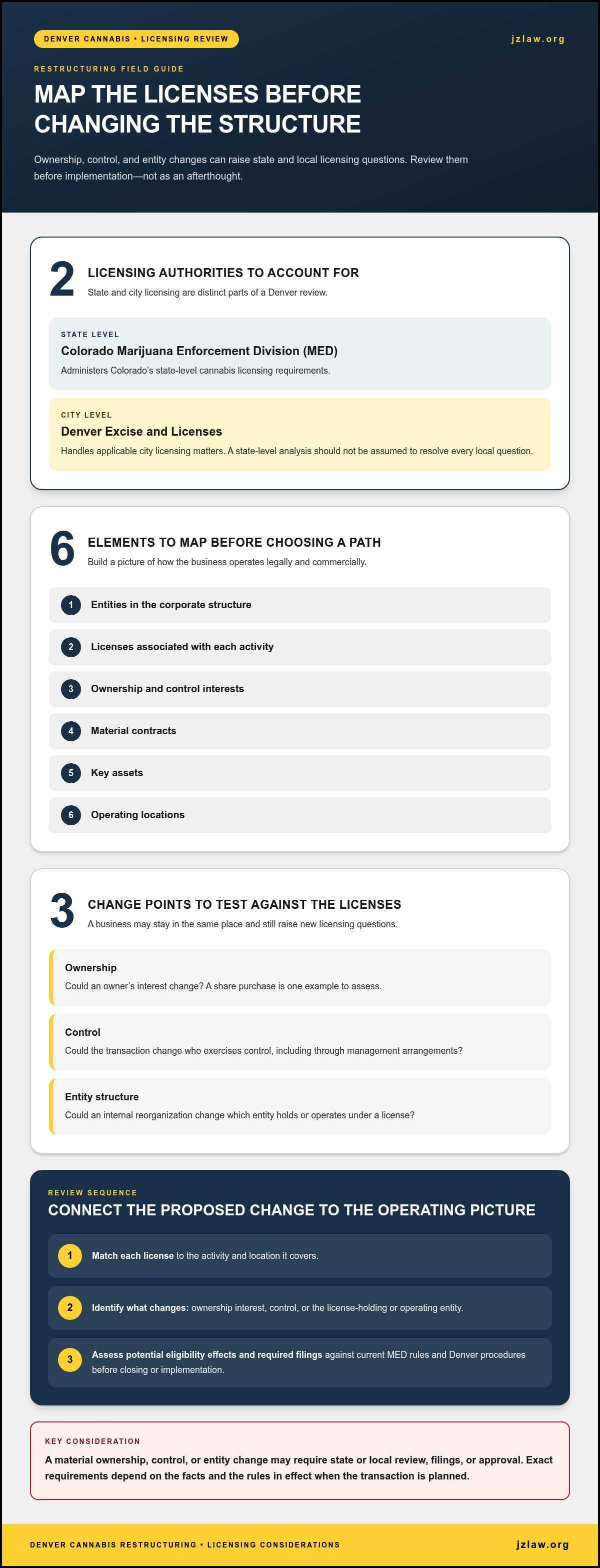
Before selecting a transaction structure, build a clear picture of how the business operates legally and commercially. Identify each entity in the corporate structure, the licenses associated with its activities, ownership and control interests, material contracts, key assets, and operating locations. This map can show whether a proposed change affects only one entity or has potential consequences for multiple licenses, agreements, or sites.
Regulatory review should happen before implementing a material change in ownership, control, or entity structure, because the change may require state or local review, filings, or approval. Exact requirements depend on the facts and the rules in effect when the transaction is planned. Treating a restructuring as an internal corporate matter without examining licensing implications can create avoidable implementation risk.
Colorado and Denver licensing questions to assess
Colorado’s Marijuana Enforcement Division (MED) administers state-level cannabis licensing requirements. Denver’s Excise and Licenses department handles applicable city licensing matters. These authorities have distinct roles, so a state-level analysis should not be assumed to resolve every local licensing question.
Start by matching each license to the activity and location it covers. Then examine whether the proposed transaction changes an owner’s interest, who exercises control, or the entity that holds or operates under a license. A share purchase, internal reorganization, or change to management arrangements can raise different questions, even if the business’s storefront or facility stays the same. Assess potential eligibility effects and required filings against current MED rules and Denver procedures before closing or implementing the change.
Entities and ownership: Record the license-holding entity, its owners, and any proposed changes in control.
Operations and locations: Connect each licensed activity to its relevant facility or premises.
Contracts and assets: Identify agreements, leases, and assets that may be affected by the restructuring.
This groundwork supports cannabis corporate restructuring Denver by linking transaction planning to the company’s actual regulatory footprint, rather than relying on a generic corporate checklist.
Federal constraints and insolvency uncertainty
State authorization does not eliminate federal-law considerations. Federal restrictions can complicate access to ordinary bankruptcy processes, particularly where a business’s operations or assets involve cannabis. Avoid reducing the issue to a blanket claim that every cannabis company is eligible or ineligible for bankruptcy relief. The analysis may depend on the company’s activities, assets, structure, jurisdiction, and applicable statutes and court decisions.
State-law alternatives may be relevant in some circumstances, but their availability and consequences are jurisdiction-specific and should be assessed against current law. Before relying on any insolvency or restructuring route, evaluate its legal basis, potential effect on licensed operations, and practical implications for creditors and stakeholders. For a coordinated assessment of corporate transaction and cannabis regulatory considerations, JZ Law’s legal counsel can help frame the issues around the company’s proposed changes.
Compare Restructuring Paths for a Denver Cannabis Company
Once the business objective is clear, compare possible paths by what each is intended to change and what it depends on. The options below are starting points for analysis, not promises of a particular result. More than one may be relevant, but combining them can introduce additional approvals, negotiations, and implementation steps.
When an internal reorganization may fit
An internal reorganization may be worth considering if the challenge is duplicated entities, unclear decision-making, or business lines that no longer fit the company’s priorities. Review formation and governing documents, ownership rights, existing agreements, and possible tax consequences before making changes. Simplifying a corporate chart does not by itself remove licensing requirements, creditor rights, or contractual obligations. The structure must work both on paper and in the company’s regulated operations.
When a negotiated transaction may be considered
A sale, merger, recapitalization, or investor arrangement may suit objectives that an internal adjustment cannot achieve. Asset sales, mergers, and ownership transfers require transaction-specific review. The parties need to understand what is included, which liabilities remain, how contracts may be affected, and what licensing or ownership procedures may apply. A public-market pathway is a distinct and complex objective, not a default solution for a company seeking capital.
For each option, compare the expected business effect with its dependencies, timing considerations, required stakeholder decisions, and regulatory questions. A transaction that appears straightforward commercially may be more demanding once license eligibility, securities issues, tax treatment, and contract provisions are analyzed together. The strategic corporate transactions guide offers broader context for assessing transaction structure and execution.
For cannabis corporate restructuring Denver, the useful comparison is not simply which path is fastest. It is which option aligns with the company’s objective and can be implemented within its legal and commercial constraints. Coordinated corporate and cannabis regulatory counsel can help assess those considerations in relation to the proposed transaction.
A Practical Due-Diligence Checklist Before Restructuring
A disciplined review connects the proposed change to the company’s records, stakeholders, and regulatory position before anyone commits to a transaction. For cannabis corporate restructuring Denver, sequence matters: clarify the objective first, then establish what the business owns, owes, operates, and has agreed to do. Legal, financial, tax, and operational analysis should inform the same decision rather than proceed in isolation.
Define the objective. State what the restructuring is meant to achieve, such as changing governance, addressing obligations, or supporting a different operating model. Identify what must change and what the business needs to preserve.
Gather and organize records. Collect entity and ownership documents, financial information, material contracts, licenses, and records of known disputes. Note gaps or inconsistencies instead of assuming the paperwork reflects current practice.
Map affected stakeholders. Identify owners, investors, creditors, employees, counterparties, and relevant regulators. Record how the proposed change could affect each group’s rights, responsibilities, or ongoing relationship with the company.
Assess regulatory and other dependencies. Determine which approvals, notices, consents, or amendments may apply to the specific structure and transaction. Verify each requirement against current rules and the facts.
Compare options before committing. Weigh legal, financial, tax, and operational implications together, then set decision points for further review before signing, closing, or making public representations.
Records and stakeholders to map
Review formation documents, operating agreements, shareholder records, financing documents, and material contracts alongside current financial information and license records. Compare the documents with how the company actually operates, including who makes decisions and which entities hold key assets or agreements. Map the people and organizations affected by the proposal, and preserve accurate records while the assessment is underway.
Corporate and ownership records: Formation documents, governance agreements, ownership ledgers, and financing arrangements.
Business and regulatory records: Financial information, material contracts, licenses, asset records, and known disputes.
Stakeholder map: Owners, investors, creditors, employees, counterparties, and relevant regulators.
Limit access to confidential business information to those who need it for the assessment, and keep a reliable record of documents reviewed and decisions made. An organized file supports a more accurate comparison of alternatives and reduces the risk that a material commitment or dispute is overlooked.
Questions to resolve before implementation
Before execution, clarify the intended operating model, ownership structure, and treatment of existing obligations. Identify which approvals, notices, consents, or contract amendments may be needed, and assign responsibility for verifying each item. Set decision gates so regulatory analysis and stakeholder requirements are addressed before documents are finalized or public statements describe a change as settled.
There is no reliable universal timeline for a cannabis restructuring. Timing and filings depend on current rules, company structure, transaction design, and agency review. Coordinate legal, financial, tax, and operational work before an irreversible step. A change that is workable on paper must also be implementable in the licensed business. Plan your restructuring with coordinated legal counsel grounded in the company’s facts.
Plan Cannabis Corporate Restructuring with Denver-Focused Legal Counsel
A restructuring plan must work across the company’s commercial priorities, corporate structure, and cannabis regulatory obligations. For a Denver cannabis business, that means evaluating the proposed change as a connected legal and operational project, not simply drafting transaction documents or revising an entity chart. Tailor the analysis to the company’s objectives, existing commitments, and operating circumstances.
In cannabis corporate restructuring Denver, coordinated planning can help owners and executives understand which decisions are linked, what must be verified, and what needs to happen before implementation. JZ Law advises on corporate transactions, cannabis licensing considerations, transaction documents, and tax structuring as connected parts of a restructuring assessment.
What a focused legal assessment should address
A focused assessment connects the business objective to the documents and obligations that govern the company. For example, consider a proposed ownership change alongside governance rights, financing terms, material contracts, applicable state and local licensing requirements, and potential tax consequences. Where relevant, the review may also identify federal, securities, or insolvency questions that affect the proposed path.
Recommendations should explain the basis for each option, including its assumptions, dependencies, risks, and next decisions. This gives decision-makers a practical way to distinguish issues that can be resolved through documentation from those that may depend on regulatory review, stakeholder consent, or further financial analysis.
Clarify the goal: Define the intended ownership, governance, and operating model.
Map constraints: Connect governing documents, contracts, licenses, and relevant legal considerations to the proposed change.
Compare paths: Evaluate alternatives against the objective, dependencies, and implementation risks.
Plan execution: Document decisions, identify required workstreams, and sequence implementation steps.
Discuss your Denver cannabis business restructuring
Owners and executives can make an initial discussion more focused by outlining the company’s structure, the objective behind the proposed restructuring, and the immediate concerns driving the review. Relevant entity records, licenses, financing documents, and material contracts can help frame the questions against the company’s actual arrangements.
JZ Law provides counsel on cannabis licensing and regulation, corporate transactions, and tax structuring to help coordinate these considerations. The appropriate analysis depends on the company’s facts, so no particular route, approval, outcome, or timeline should be assumed in advance. A useful first step is to describe the proposed change and identify the decisions that need legal and business review.
Discuss your cannabis business legal needs with JZ Law and begin assessing the considerations relevant to your company’s restructuring objectives.
Make the Next Restructuring Decision with Clarity
A restructuring decision can shape more than ownership or operations. It can affect how the company meets its obligations, preserves business relationships, and positions itself for its next stage. Before committing to a path, identify the decisions that cannot easily be reversed and the assumptions that still need testing. That discipline gives owners and executives a clearer basis for weighing options and coordinating implementation.
For cannabis corporate restructuring Denver, a focused legal assessment can help translate the company’s objectives into practical next steps while accounting for its particular structure and circumstances. JZ Law works with cannabis licensing and regulatory issues alongside corporate transactions and tax structuring. Denver is among the firm’s markets, alongside Calgary, Toronto, Vancouver, New York City, Denver, Hamburg, Berlin, and Frankfurt. The appropriate approach depends on the company’s facts, not a standard formula.
Bring forward the business objective and the questions that matter most to your owners or leadership team. Explore a tailored restructuring assessment with JZ Law to consider the legal and business issues before moving forward. With a deliberate plan, your company can approach its next decisions with greater clarity.
Frequently Asked Questions
What does corporate restructuring mean for a cannabis business?
For a cannabis business, restructuring means changing how the company is organized or operates to address a defined business need. For example, owners might revise governance arrangements to clarify decision-making while keeping the licensed operating entity intact. The practical question is which relationships or processes need to change, and whether the proposed adjustment affects license obligations, contracts, creditor rights, or investor protections.
Can a Denver cannabis company restructure without changing its license?
Possibly, if the proposed changes do not affect the license-holding entity or trigger a regulatory filing or review. A change to internal procedures may have different implications from a new owner, control person, or entity structure. Because cannabis licenses are not simply transferable to a new owner, assess the exact transaction and current state and Denver requirements before treating the license as unaffected.
Can a cannabis company file for bankruptcy in Colorado?
There is no universal yes-or-no answer. Federal bankruptcy eligibility can be complicated by a company’s cannabis activities, assets, and the law applied by the court. A business should not assume that a familiar bankruptcy process will be available or that relief is categorically barred. Before taking action, counsel should assess the company’s specific operations, relevant federal statutes, and current decisions in the appropriate jurisdiction.
What are alternatives to bankruptcy for a cannabis business in financial distress?
Potential approaches may include negotiated creditor arrangements, revised investor terms, an asset or business sale, operational changes, or a state-law receivership where legally available. Each option has different effects on control, obligations, and licensed operations. Colorado law includes a process for court-appointed receivers, including registration with the MED as a temporary appointee within seven days of appointment. Availability and suitability depend on current law and the company’s circumstances.
Does selling or transferring a Denver cannabis business require regulatory approval?
It may. The regulatory analysis depends on whether the deal changes ownership, control, the licensed entity, or operations, and on which state and Denver licenses are involved. Colorado cannabis licenses cannot be directly assigned or transferred to a new owner, so a sale should not be treated as an ordinary transfer of a business asset. Identify applicable filing, review, or approval requirements before setting a closing plan.
What documents should a cannabis company gather before restructuring?
Gather current entity formation and governance records, ownership ledgers, investor and financing agreements, license records, material contracts, and financial statements. Also collect amendments and side letters, debt schedules, regulatory correspondence, notices of disputes, and records of pending claims. Comparing signed documents with actual ownership, decision-making, and operations can expose inconsistencies early and help the company avoid building a proposal on outdated or incomplete information.
How long does cannabis corporate restructuring take in Denver?
There is no standard timeline for cannabis corporate restructuring Denver. Duration depends on the company’s structure, transaction design, record readiness, stakeholder negotiations, current filing requirements, and any agency review. A straightforward internal change may involve different steps from a transaction that affects licensed ownership or control. Build a realistic schedule only after identifying required decisions, consents, submissions, and dependencies, and allow for follow-up questions during regulatory review.



Comments