


How to do due diligence when buying a Denver dispensary
A dispensary purchase can look sound on paper and still turn on whether its licence, lease, and site approvals will support the transaction. Due diligence for buying a dispensary in Denver is a structured review of the business’s financial and tax records, operations, compliance history, contracts, licences, and permits before closing. Buyer due diligence typically takes 30-to-90 days, and Colorado’s cannabis business licensing transfer review can add months to the acquisition timeline.
Revenue and asking price matter, but they do not reveal every risk that could affect ownership or operations. Due diligence for buying a dispensary in Denver means testing the seller’s claims against the records and identifying issues to resolve, address in the deal terms, or weigh before proceeding.
This guide explains what due diligence means in a cannabis transaction and how to organize the review. You’ll learn which financial and tax records to examine, how to assess timelines, and what to look for in contracts, licences, and permits, with particular attention to the regulatory steps involved in a Denver-area acquisition.
Table of Contents
Reviewing business, financial, and regulatory records
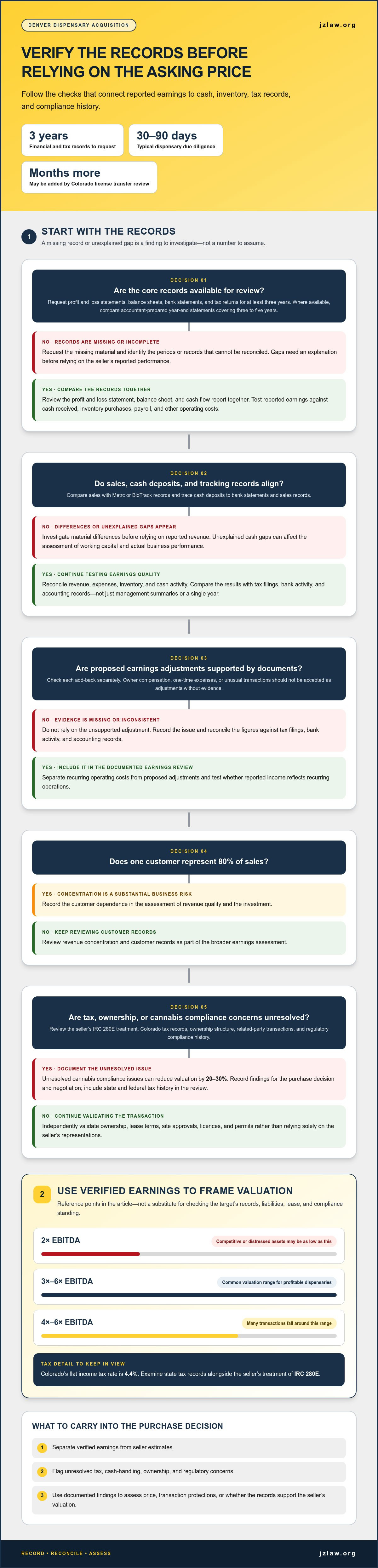
There’s no single typical Denver dispensary purchase price; it depends on earnings, assets, lease terms, regulatory standing, and liabilities. Profitable cannabis dispensaries commonly command 3× to 6× EBITDA, with many transactions around 4× to 6×; competitive or distressed assets may fall to 2×.
Use these steps to verify the target’s records and identify financial or regulatory issues before committing to the investment.
Review Financial StatementsRequest profit and loss statements, tax returns, balance sheets, and bank statements for at least three years. Where available, compare them with accountant-prepared year-end financial statements covering three to five years. This helps trace performance across reporting periods and identify gaps that need an explanation.Review the profit and loss statement, balance sheet, and cash flow report together. Check whether reported earnings align with cash received, inventory purchases, payroll, and other operating costs. Compare sales figures with records in Metrc or BioTrack, the state tracking systems identified for checking dispensary revenue. Investigate material differences before relying on reported revenue to assess profitability.Examine tax returns and supporting records for potential liabilities, including the seller’s treatment of IRC 280E. Colorado’s flat income tax rate is 4.4 percent, so include state tax records in the review. Trace cash deposits to bank statements and sales records; unexplained gaps can affect your view of working capital and the business’s actual performance.
Assess Earnings QualityRequest a quality-of-earnings review to test whether reported income reflects recurring operations. Have the buyer’s attorneys and accountants assess the target’s financial information alongside relevant transaction documents. Reconcile revenue, expenses, inventory, and cash activity instead of relying on management summaries or a single year’s results.Separate recurring operating costs from proposed adjustments, and request documents supporting each add-back. Owner compensation, one-time expenses, or unusual transactions may affect an earnings calculation, but should not be accepted as adjustments without evidence. Compare adjusted figures with tax filings, bank activity, and accounting records to find inconsistencies.Review revenue concentration and customer records as part of the assessment. If one customer represents 80% of sales, that dependence may create a substantial business risk. Also examine ownership structure, related-party transactions, and regulatory compliance records. Unresolved cannabis compliance issues can reduce valuation by 20-30%, so record findings for the purchase decision and negotiation.
Evaluate Purchase Cost and ValuationBuild a valuation range from verified earnings, not the seller’s asking price alone. Profitable cannabis dispensaries are typically valued at 3× to 6× EBITDA, while many transactions fall around 4× to 6×. Competitive markets or distressed dispensary assets may be valued as low as 2×. These multiples are reference points, not a substitute for reviewing the target’s records.Compare the proposed multiple with the target’s financial performance, compliance history, lease obligations, and operating risks. A higher multiple needs support from durable earnings and reliable documentation. Unresolved liabilities or inconsistent records can weaken the case. Model how changes to revenue, expenses, and proposed adjustments affect the investment before accepting the valuation.Record each finding and its effect on the proposed terms. Separate verified earnings from seller estimates, and flag unresolved tax, cash-handling, ownership, or regulatory concerns. This gives the buyer a documented basis to negotiate price and transaction protections, or to reconsider the investment if the records do not support the seller’s valuation.
Due diligence timelines
Plan the acquisition around both buyer review and regulatory approval, since they run on different schedules. Cannabis dispensary due diligence typically takes 30-to-90 days; Colorado’s licensing transfer review can add months.
For a Denver acquisition, sequence document review, negotiated diligence conditions, required approvals, and closing. Build in enough time to address red flags before they affect valuation or closing plans.
Map the Buyer Due Diligence TimelineSet a written diligence calendar as soon as the seller provides access to records. Legal due diligence typically takes 3 to 6 weeks, while a broader business acquisition can take six to 12 weeks or longer. Dispensary reviews commonly run 30-to-90 days, depending on the target’s complexity and the condition of its records.Use the longer end of the range when financial, ownership, or compliance materials arrive in stages. Well-organized records and clean compliance can support a 30-45 day process. Track unanswered requests and assign each action to a responsible team member, so delays and red flags don’t remain hidden.
Sequence the Acquisition StepsStart with a document request and organize the review into financial, legal, operational, and regulatory workstreams. Buyers can conduct diligence before signing a definitive purchase agreement, after signing but before closing, or across both periods. Agree when access begins and record which findings must be resolved before moving forward.Set the diligence contingency against the actual work plan. A buyer’s due diligence contingency is commonly limited to 30-60 days, so allocate that time deliberately. A real estate transaction can require at least 30 days of due diligence after agreement with the seller, making lease and site review important schedule items.
Build regulatory review into the critical path instead of treating it as a final formality. Colorado cannabis business licence transfer review can add months to an acquisition timeline. Submit required materials promptly, track outstanding items, and account for approval timing when setting the expected closing date. Signing the purchase agreement does not, by itself, complete the ownership change.Before closing, compare the diligence calendar with the purchase agreement’s deadlines and conditions. Identify which findings require a response, revised terms, or a decision to proceed. If the review uncovers a lease issue, coordinate its resolution with the transaction schedule; real estate diligence can be relevant to assessing lease and site-related matters.Keep buyers, sellers, and advisers working from one current timeline. Record milestones such as document delivery, review completion, regulatory submissions, and closing conditions. If an approval remains outstanding, update the schedule and communicate its effect rather than treating an outdated target date as a reliable closing plan.
What is due diligence in a cannabis transaction?
In a cannabis transaction, due diligence is the buyer-led review of the business, its claims, and the proposed terms. It helps determine whether the operating model, ownership structure, and purchase agreement align with the buyer’s objectives.
Plan Due Diligence TimingSchedule the review before signing, after signing but before closing, or across both periods. Buyers use each approach depending on access and transaction terms. Cannabis due diligence questionnaires can run dozens of pages, so organize requests around financial, operational, ownership, and regulatory records.Set the diligence period in the purchase agreement and calendar every deadline. A buyer may lose the right to walk away over unsatisfactory diligence once the agreed period ends. Manage the review actively and independently verify material seller claims, including land ownership or lease, licence status, business ownership, and site approvals.
Set Purchase Agreement ProtectionsDefine the diligence period, access to records, closing conditions, and how to address unresolved findings. Tie each condition to a specific transaction need, such as regulatory approval or landlord consent. The agreement should also state what happens if a condition is unmet by its deadline.Document seller representations about licences, ownership, contracts, and site approvals, then compare them with reviewed records. Identify which discrepancies require correction, revised terms, or a decision not to close. Some cannabis dispensary sales include a seller transition period of 30-90 days; specify responsibilities and handover expectations if the deal uses one.
Compare an outright purchase, partnership, and franchise structure before choosing a transaction model. An outright purchase may transfer control of the target, while a partnership shares ownership and decision-making. A franchise centers on operating within an agreed business framework. Assess each model against your ability to direct operations, allocate risk, and meet the deal’s conditions.For each structure, map who controls operating decisions, holds the relevant business interests, and carries contractual responsibilities. Review how the agreements address governance, transfer rights, and exit options. The right model depends on the buyer’s objectives and risk appetite, as well as the assets and obligations included in the transaction.
Test the business’s customer assumptions against actual sales records and local purchasing patterns. U.S. cannabis consumers aged 21-34 accounted for nearly 50% of usage as of 2025, but that broad demographic figure doesn’t establish demand at a particular Denver location. Compare the target’s transaction history, product mix, and repeat purchasing patterns with its own operating plan.Use the findings to assess whether projected revenue reflects demonstrated customer behavior or seller assumptions. If the target relies on a narrow customer base or a particular purchasing trend, consider the effect on its operating plan and valuation. Record evidence and unanswered questions before the diligence period ends, then make closing decisions against the agreement’s stated conditions.
Colorado tax elections and acquisition diligence
Investigate tax exposure, banking records, licence continuity, and transaction structure before acquiring a Colorado cannabis business. For an asset sale, the Colorado Department of Revenue administers the state’s sales tax clearance process.
Map the seller’s tax filings to the proposed transaction structure. Analyze asset and ownership interests separately, then identify the tax accounts, liabilities, and records associated with each. Review filed returns, payment histories, assessments, and correspondence together. This can reveal differences between the seller’s reported activity and obligations tied to the assets or entity being acquired.Request documentation of the seller’s tax elections and accounting methods. Compare them with filed returns and transaction schedules, and record any proposed changes for the acquisition plan. Do not assume the seller’s tax treatment automatically suits the buyer’s structure. Its effect depends on the transaction form, assets transferred, and intended operations.
Include Colorado sales tax clearance in the asset-sale work plan. The Colorado Department of Revenue administers the process, so track the seller’s filings, relevant account information, and clearance status alongside other closing requirements. Reconcile sales records with tax returns and deposits, and list unresolved differences for follow-up before closing.For state income tax analysis, account for Colorado’s single-factor sales apportionment formula. Colorado uses market-based sourcing for service revenue. Identify the business’s sales and service activities, then assess how its revenue records inform the state tax position. Keep this analysis separate from purchase price allocation and seller representations.
Test cannabis-specific tax exposure against federal and state records. Review how the seller treated IRC 280E, then compare the supporting workpapers with tax filings and financial statements. The relevant question is whether the recorded treatment aligns with the business’s documented activity. Preserve the records and findings in the transaction file so they can inform valuation and the agreement’s tax provisions.Prepare a schedule of known tax balances, disputed items, filing gaps, and correspondence. Link each item to its tax period, supporting document, and responsible party. This gives buyers a clear basis for deciding which liabilities need transaction protections, adjustments, or resolution before closing.
Treat banking records as a separate diligence workstream. Match bank statements to sales reports, deposits, cash logs, tax filings, and payment processor records. Review account ownership, outstanding loans, guarantees, and contractual terms that could affect access after closing. Record mismatches between operating records and deposits, and determine whether they affect working capital or the buyer’s ability to operate.Finally, connect each finding to an action in the acquisition documents. Assign responsibility for outstanding tax filings or balances, specify how supporting records will be delivered, and align payment or closing conditions with the agreed treatment. For a Denver dispensary acquisition, this keeps tax, banking, and regulatory diligence tied to the transaction.
Legal contracts, licences, and permits
For a Denver dispensary, assess zoning, location, and operating permissions against the exact site and its approvals. Due diligence for buying a dispensary in Denver should also cover environmental and building records, security arrangements, lease terms, and landlord consent to an assignment.
Check Contracts, Licences, and PermitsRequest the dispensary’s current licence, site approvals, permit records, and regulatory correspondence. Match each document to the business entity, ownership, address, and activities being acquired. Cannabis transactions may require approvals from state and municipal authorities; a licence transfer can take from 30 days to over six months.Build approval requirements into the transaction schedule and closing conditions. Review supplier, service, equipment, and other material agreements for change-of-control restrictions, termination rights, and outstanding obligations. If a contract cannot transfer automatically, identify the required consent and include it in the deal plan.
Verify Zoning and Local Operating RulesCheck zoning and land-use records for the dispensary’s exact Denver address, then compare the approvals with the business’s current retail activity. Confirm that the approved site and operating scope reflect the intended use after the acquisition. Assess distance limits and local operating conditions against the rules and approvals that apply to that location.Review site plans, permits, inspection records, and conditions attached to approvals. Compare them with the premises as currently configured, including customer areas, storage, and access points. A mismatch between approved plans and actual use can create a practical obstacle, even if the seller’s licence documents appear current.
Examine environmental and building records for notices, unresolved inspection items, repair obligations, and concerns about prior site use. Compare permits and plans with visible conditions, including ventilation, electrical systems, water management, and alterations. Record each issue, its supporting document, and who must address it under the purchase agreement.Assess security arrangements against documented operating procedures and installed equipment. Review access controls, alarm and camera records, incident documentation, and responsibility for ongoing maintenance. Keep the review tied to the premises and operating records; do not assume equipment or procedures transfer without reviewing the relevant contracts and handover terms.Review the lease for its term, renewal options, permitted use, assignment language, and landlord consent requirements. A lease nearing expiry can affect continuity, while an assignment restriction can delay closing. Confirm whether the lease has been renewed or the landlord will consent to assignment, and coordinate this with site approvals and the transfer plan.Colorado law provides a sale-of-business exception to the state’s non-compete restrictions. Have the transaction documents reflect the actual business sale and define any related obligations clearly. Treat due diligence for buying a dispensary in Denver as a site-specific review of contracts, licences, and approvals. For focused review of transaction terms, request corporate transaction counsel.
JZ Law: John Zang Services
JZ Law provides legal guidance on cannabis licensing and corporate transactions. Consider legal counsel when a dispensary acquisition involves licence-transfer questions, complex ownership arrangements, or agreements that need to align with regulatory approval and closing conditions.
JZ Law’s services include Cannabis Licensing, relevant when evaluating licence status and transaction-related licensing issues. The firm also offers Securities Regulation and Taking Companies Public for businesses with broader corporate plans involving securities matters or a public-company transaction.
For a focused discussion about your acquisition or licensing matter, contact JZ Law or visit jzlaw.org.
Make Your Next Move Deliberately
A disciplined approach to due diligence for buying a dispensary in Denver turns a complex review into a decision framework. Before proceeding, identify which findings affect your willingness to buy, which belong in the transaction documents, and which need a defined resolution with the seller. Keep those priorities aligned with your ownership goals and operating plans.
JZ Law offers John Zang Services, including Cannabis Licensing for licensing-related transaction issues and Taking Companies Public for broader corporate plans involving a public-market strategy. Legal support can connect the commercial decision with the regulatory and corporate steps that follow, helping you approach the transaction as a coordinated process rather than a series of separate tasks.
Bring your acquisition priorities and outstanding transaction questions into a focused discussion. Discuss your dispensary purchase with JZ Law and take the next step with a clear view of the issues that matter to your decision.
Frequently Asked Questions
How is diligence conducted?
Buyers organize diligence evidence into financial, operational, contractual, and regulatory workstreams. The buyer’s attorneys and accountants can review records against the seller’s claims, while the buyer directs the process and tracks unanswered requests. For example, compare a sales report with bank deposits and inventory movement, then document any unexplained difference. Prioritize findings by their effect on operations, ownership, liabilities, or the ability to close.
How long does legal due diligence take?
Legal due diligence typically takes 3 to 6 weeks, depending on the target’s size and complexity. A dispensary review may take longer if contracts, ownership records, or regulatory documents require clarification. Keep a request log that identifies each document, its reviewer, and any follow-up needed. This helps distinguish time spent on legal analysis from delays caused by missing records or transaction decisions.
How long is the due diligence period?
A dispensary buyer’s due diligence commonly takes 30-to-90 days, while the purchase agreement sets the contractual review period. A buyer contingency is often limited to 30-60 days, so align deadlines with the work required and the seller’s document delivery. Track the date each contractual right expires. Do not assume that a longer review automatically extends the right to withdraw or renegotiate.
What proof do buyers expect that cannabis products are tested?
Buyers can request laboratory testing reports or certificates of analysis for specific product batches. Match each report’s batch identifier to product labels, inventory records, and the seller’s tracking data. A report for one flower lot, for example, does not establish testing documentation for another. Record discrepancies, missing batch links, or products whose supporting documents do not match the inventory presented for sale.
What should you be looking for before signing a deal?
Before signing, assess whether the agreement clearly identifies what is being acquired, the closing conditions, and how diligence findings will be handled. Check that schedules describe material contracts, liabilities, ownership interests, and disclosed disputes. For example, the agreement should address what happens if a landlord refuses consent to a lease assignment. Note which representations rely on records and which obligations continue after closing.
What licenses and approvals are required to buy and operate a dispensary in Denver, Colorado?
Required approvals depend on the business activities, ownership structure, and specific site. Review a retail dispensary’s cannabis licence, applicable state and municipal approvals, and site-related permits. Compare the approved business entity and address with the proposed transaction and intended operations. Cultivation or manufacturing can involve different permits, so do not assume a retail licence covers other activities.
Can Denver cannabis business licenses be transferred to a buyer, and what is the approval process?
A licence transfer requires regulatory review and approval; it shouldn’t be treated as automatic upon signing a purchase agreement. Cannabis dispensary licence transfer approval can take from 30 days to over six months. The review concerns the transaction and relevant licensing documents, with state and municipal authorities potentially involved. Build the transfer process into closing conditions, and distinguish regulatory approval from any separate lease or site consent.
What are the Colorado and Denver taxes, fees, and ongoing compliance costs for a dispensary?
Colorado’s flat income tax rate is 4.4 percent, and an asset sale’s sales tax clearance process is administered by the Colorado Department of Revenue. Ongoing costs depend on the dispensary’s site, lease, staffing, contracts, and operating activities. Build a forecast from the target’s actual tax filings, invoices, and recurring obligations. Separate transaction-related liabilities from future operating expenses so each is reflected in the buyer’s financial plan.



Comments