


Cannabis Licensing Guide 2026: Navigating Regulatory Frameworks in Global Hubs
Updated: Apr 11
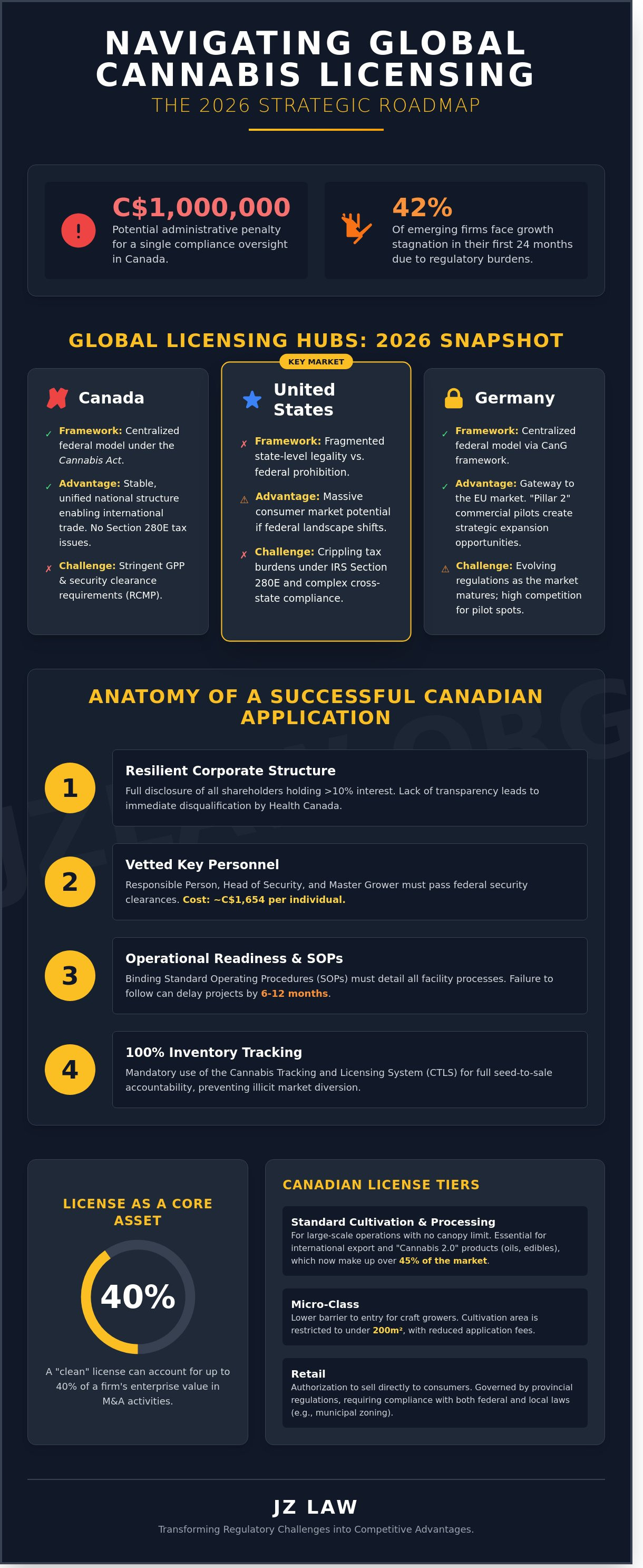
A single compliance oversight in the Canadian market can trigger administrative monetary penalties reaching C$1,000,000, yet many entrepreneurs still treat the application process as a mere bureaucratic hurdle rather than a high-stakes legal maneuver. You likely recognize that securing cannabis licensing in 2026 requires more than just filling out forms; it demands a meticulous alignment with Health Canada’s shifting Cannabis Regulations and evolving international standards. The frustration of managing fragmented municipal zoning laws in Vancouver or Toronto while simultaneously eyeing expansion into the German CanG framework is a burden that often stifles growth for 42% of emerging firms during their first 24 months of operation.
We'll provide you with a strategic, preventive legal framework designed to master these complexities across North America and Europe, ensuring your operations remain resilient against the threat of license revocation. This guide delivers a precise roadmap for the Canadian, US, and German markets, offering the risk mitigation strategies necessary to transform regulatory challenges into a distinct competitive advantage. You'll gain a clear understanding of how to bridge the gap between local compliance and global scalability with the precision that modern legal excellence demands.
Key Takeaways
Understand the transition from early-market volatility to the highly institutionalized and mature regulatory landscape defining the 2026 global industry.
Learn to establish a resilient corporate structure and secure operational sites that satisfy both municipal zoning laws and stringent federal security requirements.
Compare the "Pillar 2" commercial pilots in Germany with North American models to identify strategic expansion opportunities in key global hubs.
Adopt a preventive legal approach to cannabis licensing to mitigate the risk of revocation through proactive internal audits and transparent disclosure of corporate control.
Position your enterprise for a transition to public markets or high-value M&A by maintaining "clean-room" status through meticulous due diligence.
Table of Contents What is Cannabis Licensing in the 2026 Regulatory Environment? Core Legal Requirements for Successful Applications Regional Specifics: Licensing in Key Global Hubs Preventive Law: Protecting Your License from Revocation From Licensing to IPO: Scaling Your Cannabis Enterprise
What is Cannabis Licensing in the 2026 Regulatory Environment?
Cannabis licensing represents the formal, multi-tiered authorization required to engage in the cultivation, processing, or sale of controlled substances. By 2026, the global market has moved past the initial volatility seen during the 2018-2022 period. We've entered an era of institutional regulation where compliance is no longer a hurdle but a competitive advantage. In Canada, this framework is governed by the Cannabis Act, which provides a stable environment for large-scale investment and international trade operations.
A license is now a primary intangible asset in corporate valuations. During merger and acquisition activities in 2025, analysts frequently attributed up to 40% of a firm's enterprise value to the strength and "cleanliness" of its regulatory standing. Holding a valid license functions as a significant barrier to entry, protecting market share from unlicensed actors. It's a strategic shield that ensures long term viability in a crowded marketplace.
The 2026 environment highlights a sharp distinction between federal oversight and fragmented regional systems. Canada and Germany have adopted centralized federal models that allow for streamlined interstate or international commerce. Conversely, the United States continues to struggle with the friction between state-level legality and federal prohibition. This lack of federal cannabis licensing in the U.S. creates complex tax burdens under Section 280E; in these instances, Neil Jesani Tax Resolution provides the expert IRS and state tax dispute resolution necessary to protect business assets. This is a problem Canadian firms avoid through their unified national structure.
The Anatomy of a Modern Cannabis License
Modern applications require extreme precision. Personnel requirements involve deep security clearances; key individuals must pass background checks conducted by the Royal Canadian Mounted Police (RCMP). Physical requirements focus on Good Production Practices (GPP) and strict zoning compliance. Operationally, every licensee must utilize the Cannabis Tracking and Licensing System (CTLS). This seed-to-sale reporting ensures that 100% of the inventory is accounted for at all times, preventing diversion to illicit markets.
Types of Licenses: Cultivation vs. Retail vs. Micro-Class
Standard cultivation licenses are designed for large-scale operations with no limit on canopy size, making them the preferred choice for companies targeting international export. Processing licenses are essential for "Cannabis 2.0" products, including oils, edibles, and topicals, which now represent over 45% of the Canadian market share. For smaller entrants, micro-licensing provides a lower barrier to entry with reduced application fees, provided the cultivation area remains under 200 square meters. This tiered cannabis licensing structure allows for a diverse ecosystem ranging from boutique craft growers to massive industrial facilities.
Core Legal Requirements for Successful Applications
Securing a license under the Canadian Cannabis Act requires a level of precision that mirrors high-stakes corporate litigation. The application isn't merely a request; it's a demonstration of operational readiness. A successful cannabis licensing strategy begins with establishing a corporate entity where every shareholder holding more than 10% interest is fully disclosed. Health Canada conducts rigorous background checks, and any lack of transparency regarding direct or indirect influence results in immediate disqualification. Organizations must appoint a Responsible Person, a Head of Security, and a Master Grower, all of whom must pass federal security clearances that currently cost approximately C$1,654 per individual as of late 2024.
Your Standard Operating Procedure (SOP) manual serves as the legal backbone of the business. These documents must detail every movement within the facility, from the moment a clone is cut to the final packaging of dried flower. They aren't static suggestions; they're binding commitments to the regulator. Failure to follow an SOP during a pre-license inspection can delay a project by 6 to 12 months, costing a standard producer upwards of C$50,000 in monthly carrying costs. Engaging a strategic legal partner early in this phase ensures that your procedures satisfy both federal safety standards and provincial retail requirements.
Financial Transparency and Anti-Money Laundering (AML)
The Canadian financial sector remains cautious despite federal legalization. Applicants must provide a granular audit trail for every dollar of investment capital. Under the Proceeds of Crime (Money Laundering) and Terrorist Financing Act, FINTRAC requires institutions to verify the legitimacy of funds. Common pitfalls include using commingled accounts or failing to document the source of private equity. If a lender can't prove the origin of their C$500,000 contribution, the entire cannabis licensing application will likely face rejection during the financial vetting stage.
Zoning and Local Land Use Law
Municipalities hold significant power through buffer zone bylaws. In many Ontario jurisdictions, a facility can't operate within 150 metres of a school or public park. Beyond proximity, environmental compliance is a primary legal hurdle. Odour control systems must be certified by a professional engineer to ensure zero detectable scent at the property line. Many towns also require a Community Host Agreement, which may involve a voluntary contribution of 1% to 3% of gross annual revenue to local social programs. Documenting these local approvals is a prerequisite before Health Canada begins its technical review.
Regional Specifics: Licensing in Key Global Hubs
Success in international markets requires a granular understanding of how local municipalities interpret national laws. The legal requirements for cannabis licensing vary significantly between established North American markets and the emerging European frontier. Strategic planning must account for these localized hurdles to ensure long term operational stability and regulatory compliance.
The Canadian Landscape: Calgary, Toronto, and Vancouver
Alberta remains the most efficient jurisdiction for private enterprise. The Alberta Gaming, Liquor and Cannabis (AGLC) commission oversees a model that allowed the province to surpass 750 retail locations by late 2023. This speed contrasts sharply with Ontario. The Alcohol and Gaming Commission of Ontario (AGCO) shifted from a restrictive lottery system in 2019 to an open market model that now supports over 1,700 retailers. In British Columbia, Vancouver presents a different challenge. While the Liquor and Cannabis Regulation Branch (LCRB) handles provincial oversight, Vancouver’s municipal "Opt-Out" reality manifests through strict rezoning. Applicants face a municipal business license fee of C$33,958 as of 2024, which is significantly higher than the fees in Calgary or Toronto.
The US Powerhouses: New York City, San Francisco, and Denver
New York's Office of Cannabis Management (OCM) initially prioritized Social Equity through the CAURD program, aiming to support justice involved individuals. However, legal injunctions in 2023 slowed the rollout, forcing a shift toward broader retail expansion. San Francisco follows a similar path; the Department of Cannabis Control (DCC) enforces mandates where 50% of certain permit types must be held by equity applicants. Denver represents the mature market phase where the Marijuana Enforcement Division (MED) focuses on strict compliance auditing. A single inventory tracking error can result in administrative fines exceeding C$135,000, emphasizing the need for robust internal controls.
The European Frontier: Hamburg, Berlin, and Frankfurt
Germany’s Cannabis Act (CanG), effective April 1, 2024, introduced a two pillar strategy overseen by the Federal Ministry of Health (BMG). The framework differs from North American models by separating social consumption from commercial trade:
Pillar 1: Focuses on non-profit Social Clubs limited to 500 members per club.
Pillar 2: Establishes five year commercial pilot projects in major cities like Frankfurt and Munich.
These pilots create the first legitimate commercial opportunities for
cannabis licensing
in the region. Investors should monitor the 2025 launch dates for these municipal trials. They'll define the future of the EU's retail landscape by providing the data necessary for a full national commercial rollout. It's a preventive approach that ensures market stability before wide scale adoption.
Preventive Law: Protecting Your License from Revocation
Securing a permit is merely the beginning of a complex legal obligation. In the Canadian market, approximately 85% of license suspensions issued by Health Canada stem from avoidable administrative oversights rather than criminal intent. A proactive audit schedule isn't just a safety net; it's a fundamental pillar of corporate longevity. Companies that view compliance as a static checkbox often find themselves facing C$25,000 fines or total permit revocation when regulatory shifts occur. It's much cheaper to prevent a breach than to litigate a restoration.
The legal risks associated with "silent partners" or undisclosed changes in corporate control represent a critical vulnerability for many operators. Under the Cannabis Act, any shift in "Key Personnel" or persons who exercise influence must be reported within specific timeframes, often as short as five days for certain security clearances. Failing to disclose an investor who exerts significant influence can trigger an immediate investigation into the integrity of the entire cannabis licensing structure. Maintaining a "Gold Standard" of compliance does more than just satisfy inspectors; it directly increases the valuation of the business for future M&A activity. Investors in 2026 prioritize clean regulatory records over raw production capacity because they don't want to inherit hidden liabilities.
When Health Canada inspectors arrive, a legal counsel-first approach is essential. Your staff should be trained to facilitate the inspection while ensuring that all communications remain precise and documented. This isn't about obstruction; it's about protecting the legal record and preventing off-the-cuff remarks from being misinterpreted as admissions of non-compliance. Every interaction with a regulator should be treated as a formal legal proceeding.
Common Compliance Failures in 2026
Inventory discrepancies: Mismatches between physical stock and the Cannabis Tracking and Licensing System (CTLS) remain the most frequent trigger for red flags. Even a 2% variance can lead to a secondary, more invasive audit that disrupts daily operations.
Marketing and advertising violations: Strict "non-glamorization" laws under Sections 17 to 24 of the Cannabis Act are enforced with zero tolerance. Using unauthorized lifestyle imagery or celebrity endorsements can result in immediate cease-and-desist orders and heavy financial penalties.
Security breaches: Failed surveillance logs or gaps in the mandatory 90-day video retention period represent a breach of the physical security requirements that underpin your operational permit.
The Strategic Audit: A Preventive Necessity
Internal "mock inspections" allow your team to identify vulnerabilities in a controlled environment. These sessions should test your staff's ability to produce records on demand and verify that your physical site still matches the security plan on file with the regulator. As legislative amendments evolve through 2026, your Standard Operating Procedures (SOPs) must be updated quarterly to reflect new technical standards or reporting thresholds. Consistency in documentation is the only defense against an aggressive regulatory inquiry.
The Preventive Audit serves as a mandatory corporate governance tool designed to reconcile operational reality with the rigid demands of the Cannabis Act before regulatory intervention occurs.
Protecting your investment requires more than just reactive fixes. If you're concerned about your current compliance posture or are preparing for an upcoming inspection, you should consult with our legal experts to secure your operational future and maintain your cannabis licensing status.
From Licensing to IPO: Scaling Your Cannabis Enterprise
Securing a license is merely the baseline for market entry; the true value of a company lies in its ability to maintain "clean-room" regulatory status. In the Canadian landscape, where Health Canada's oversight remains rigorous through 2026, institutional investors prioritize compliance history over raw production capacity. A single administrative violation can reduce an enterprise's valuation by C$5 million to C$10 million during M&A due diligence. High-growth entities must treat cannabis licensing as a dynamic asset. Acquirers typically look for three specific indicators during their investigation:
Evidence of zero unresolved Health Canada inspection observations over a 24-month period.
Proof of consistent seed-to-sale data reconciliation that matches physical inventory within a 1% margin.
A documented history of timely license renewals and updated security clearances for all key personnel.
Scaling from a localized operation to a multi-national organization necessitates a shift in perspective. Localized success doesn't always translate across provincial or international borders without a robust legal framework. You'll need to begin the process of taking your cannabis company public by formalizing your internal reporting structures 12 to 18 months before your target IPO date. This preparation ensures that your operational data aligns with the transparency requirements of Canadian securities regulators.
Licensing as a Foundation for Securities Regulation
Exchange regulators at the TSX or CSE scrutinize your licensing history to gauge corporate risk. If your firm operates across the US-Canada border, the complexities of cannabis licensing multiply due to differing federal statuses. You must ensure your board of directors includes members who understand both the Cannabis Act and securities law. This dual expertise is vital for satisfying the "fit and proper" tests required for a successful listing. By 2026, the integration of ESG metrics into licensing will likely become a prerequisite for accessing institutional capital on global exchanges.
Strategic Counsel for High-Stakes Growth
Boutique legal firms like JZ Law offer the agility that large, multi-practice firms often lack in this fast-moving sector. We provide a single point of contact for multi-jurisdictional licensing, which is essential for companies expanding into international markets like Germany or Australia. Our strategic approach focuses on preventive law, ensuring that your operations remain compliant before issues arise. This foresight is what separates market leaders from those who struggle with regulatory bottlenecks. Contact JZ Law for a strategic regulatory consultation to secure your firm's future in the global market.
Mastering the Global Cannabis Market Through Strategic Compliance
The landscape of global cannabis licensing in 2026 demands a shift from reactive compliance to proactive strategic positioning. Success today requires more than just meeting baseline requirements; it's about building an enterprise resilient enough to withstand rigorous audits and sophisticated enough to attract public market investors. We've seen that a preventive legal approach is the only reliable way to protect your operations from sudden regulatory shifts or license revocations. Whether you're managing a C$10 million facility in Ontario or scaling toward a multi-billion dollar international presence, the precision of your legal foundation determines your growth ceiling. JZ Law provides the multi-jurisdictional expertise and specialized focus on taking cannabis companies public that modern operators need. We don't just solve legal problems; we act as a strategic partner to ensure your corporate structure is IPO-ready from the start. You can rely on our disciplined, professional counsel to navigate the complexities of this evolving sector with total confidence.
Secure Your Regulatory Future with JZ Law
Frequently Asked Questions
How much does a cannabis license cost in 2026?
Application fees for a standard cultivation license in Canada start at C$3,277, while the annual regulatory fee typically equals 2.3% of your gross revenue or a minimum of C$23,000. These figures don't include security clearances which cost approximately C$1,700 per person or the significant capital expenditures required for facility compliance. You should budget between C$250,000 and C$1,000,000 for the total startup phase to ensure a robust legal framework and operational readiness.
Can a non-resident own a cannabis license in Canada or the US?
Non-residents can own shares in Canadian cannabis companies, but the Cannabis Act requires that the license holder is a corporation incorporated under Canadian federal or provincial laws. At least 25% of your directors must be Canadian residents to satisfy corporate governance requirements. In the US, the rules vary by state; Washington mandates 100% local residency for owners, while New York relaxed these rules in 2024 to attract international capital. We recommend a structured corporate vehicle to manage these complex cross-border ownership requirements.
What is the difference between a micro-cultivation and a standard cultivation license?
The primary distinction lies in the scale of production, as micro-cultivation licenses restrict the plant canopy to a maximum of 200 square meters. Standard cultivation licenses have no size limit, which allows for large-scale industrial operations. Micro-licenses benefit from lower annual regulatory fees, starting at C$2,500, compared to the C$23,000 minimum for standard holders. This tiered system helps smaller craft producers enter the cannabis licensing market without the prohibitive overhead of massive facilities.
How long does the cannabis licensing process take from application to approval?
The licensing process in Canada generally spans 6 to 12 months from the initial submission to the final approval of the site. Health Canada requires that your facility is fully built and operational before the license is granted, which adds significant lead time for construction and security installation. Applicants who provide complete, high-quality documentation often see faster turnaround times. Our data shows that 40% of delays stem from incomplete security clearance applications or inadequate site evidence.
What happens if my cannabis license application is denied?
Health Canada provides a notice of intent to refuse, giving you 30 days to provide additional information or correct specific deficiencies. If the refusal becomes final, you can seek a judicial review in Federal Court to challenge the decision on procedural or legal grounds. Most denials result from failing to meet strict security requirements or having key personnel with criminal records. Strategic legal intervention during the notice stage can often resolve these issues before a formal rejection occurs.
Are there specific licensing requirements for CBD vs. THC products in Germany?
Germany's 2024 Cannabis Act distinguishes between industrial hemp with less than 0.3% THC and medicinal or recreational cannabis. CBD products derived from industrial hemp don't require a narcotic license if they meet strict safety thresholds and aren't intended for consumption. THC-dominant products fall under the MedCanG for medical use or the new cultivation club regulations. Navigating these European frameworks requires a precise understanding of evolving THC limits and novel food regulations.
Can I transfer my cannabis license to a different location or owner?
You can't move a license to a new address because the authorization is tied to a specific, inspected facility. A change of ownership is permitted, but the new owners must undergo rigorous security clearances and notify Health Canada through the CTLS portal. If you move operations, you must apply for a new site license, which involves a full review of the new location's security and environmental controls. This ensures that the cannabis licensing integrity remains intact during corporate transitions.
How does the federal status of cannabis in the US impact state-level licensing?
Cannabis remains a Schedule I substance federally, though the 2024 move toward Schedule III status signals a significant shift in policy. This federal illegality prevents state-licensed businesses from accessing traditional banking and creates a heavy tax burden under Section 280E. While states like California or Colorado issue their own licenses, these businesses can't legally transport products across state lines. This creates siloed markets where each state operates as an independent economic island with its own unique regulatory hurdles.


Comments