


Cannabis product packaging and labeling in Canada: requirements and noncompliance
Updated: 3 days ago
A cannabis label in Canada must meet mandatory federal requirements, with Quebec rules adding another layer for products sold in the province. Labels generally need product identity, the dealer’s name and principal place of business, a lot number, a packaging date in YYYY-MM-DD format, applicable health warnings, and THC and CBD information; required information must appear in English and French. A cannabis product packaging and labeling lawyer in Canada can help assess how those requirements apply to a product and its market.
It’s easy to treat packaging as a design and production task, but a compliant package must also meet detailed rules for presentation, safety, and product claims. A missed requirement can have regulatory and commercial consequences, so understand the rules before printing labels or distributing products.
This article explains federal cannabis packaging and labelling requirements, where Quebec’s framework applies, and how rules can vary by product type. It also describes potential consequences of noncompliance and how a focused legal review can help licensed businesses make informed decisions.
Table of Contents
Principal display panels and required label information
Canada’s Cannabis Regulations set packaging requirements that vary by product type and label area. The principal display panel and supporting panels must work together so consumers can identify the product and find mandatory information.
Principal Display Panel Requirements
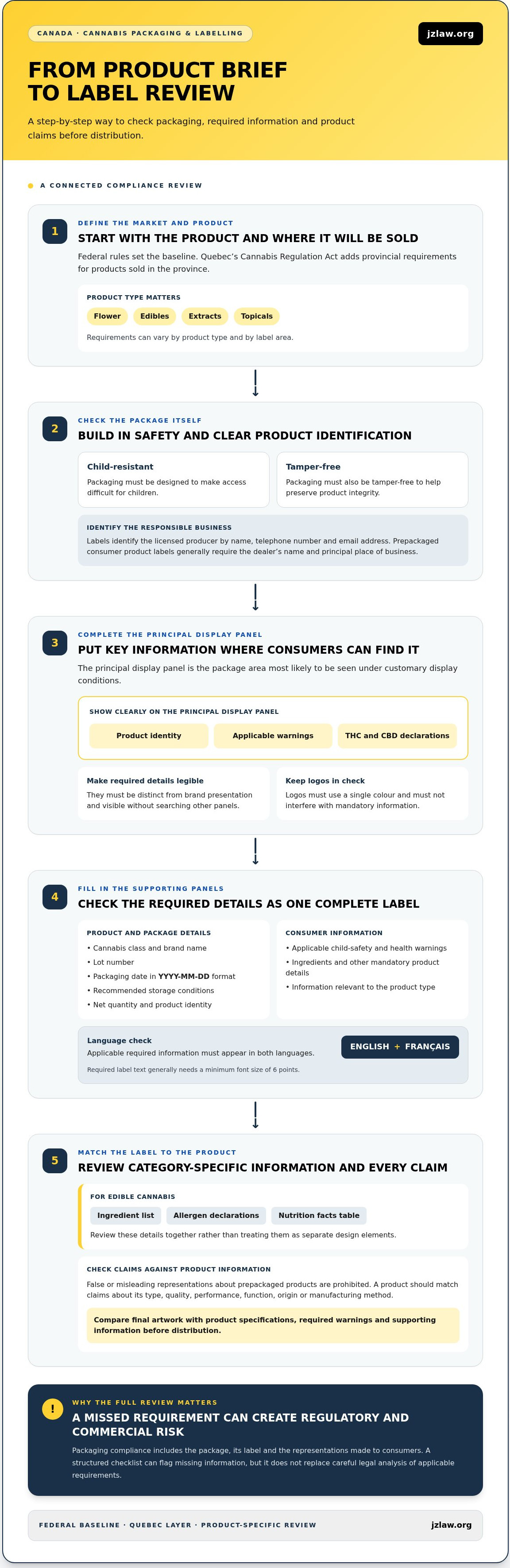
The principal display panel is the package area most likely to be seen under customary display conditions. Show the product identity, applicable warnings, and THC and CBD declarations clearly. Place these details where consumers can find them without searching other panels. Required information must be legible and distinct from brand presentation. Logos must use a single colour and must not interfere with mandatory information.
Child-Resistant Packaging and Product Details
Child-resistant packaging is designed to make access difficult for children, and cannabis packaging must also be tamper-free. These safeguards help protect consumers and preserve product integrity. Labels identify the licensed producer by name, telephone number, and email address. They also state the cannabis class, brand name, lot number, recommended storage conditions, and packaging date. Show the date in YYYY-MM-DD format, and include applicable child-safety and health warnings.
Net Quantity and Dealer Information
Net quantity tells consumers how much product the package contains, while dealer information identifies the responsible business. Canadian prepackaged consumer product labels generally require both net quantity and the dealer’s principal place of business. Product identity must also be displayed, so shoppers can connect the quantity declaration with the item. Required label text generally needs a minimum font size of 6 points, helping keep declarations readable on compact packaging.
Mandatory Consumer Label Information
Mandatory consumer information includes product details, ingredients, and warnings relevant to the product type. Edible cannabis labels require an ingredient list, allergen declarations, and a nutrition facts table. These details help consumers understand the product’s contents and assess relevant dietary information. Applicable label information must appear in English and French. Review the ingredient list, allergen statement, and nutrition facts table together, rather than treating them as separate design elements.
What if I Fail to Comply With Health Canada’s Cannabis Regulations?
Canadian cannabis packaging and labelling requirements are set out in the Cannabis Act and Cannabis Regulations. False or misleading representations about prepackaged products are prohibited, making label accuracy a regulatory concern.
When choosing counsel, look for experience with cannabis regulation, product claims, and packaging compliance. A cannabis product packaging and labeling lawyer in Canada can review label content against applicable federal and provincial requirements.
Compliance and Enforcement Consequences
Noncompliance occurs when a package or label fails to meet an applicable legal requirement, including requirements for accurate product statements. Consequences depend on the issue and the rules involved. Misleading claims can create regulatory exposure and undermine consumer confidence. A product must match claims about its type, quality, performance, function, origin, or manufacturing method. For example, a stated product feature should accurately describe the product.
Review claims alongside supporting product information before distribution. This can help identify inconsistencies in quantity, origin, or performance statements before they appear on consumer packaging.
Packaging and Labelling Compliance
Consumer packaging compliance involves reviewing the package, its label, and the representations made to consumers. The Consumer Packaging and Labelling Act and its Regulations apply to packaging, labelling, sale, importation, and advertising of prepackaged and certain other products. A structured checklist can organize requirements by product type and flag missing information.
Use the checklist to compare final artwork with product specifications, required warnings, and claims. A tool can support the review, but it doesn’t replace careful legal analysis of the cannabis regulations.
Choosing a Compliance Lawyer
Choose a lawyer who understands cannabis regulation, label claims, and the business implications of compliance decisions. Ask how they would review the product category, package artwork, quantity statements, and supporting evidence together. This helps keep advice focused on the actual product and its intended market.
Legal review can examine draft labels and identify issues for resolution before packaging is used. A company seeking a Health Canada packaging or labelling compliance review can organize its product details and draft artwork, then obtain legal analysis against the applicable requirements. Lawyer fees depend on the case and are provided after a quote request; the work involved, product complexity, and documents to review affect the cost.
For cannabis businesses addressing regulatory obligations, cannabis licensing counsel may help connect compliance questions with licensing considerations.
Canadian and Quebec cannabis packaging and labelling laws
Federal cannabis rules establish the baseline, while Quebec also has provincial legislation. Across Canada, provinces and territories primarily regulate retail systems, distribution, minimum age, and consumption.
Canadian and Quebec Requirements
The federal framework sets cannabis product standards and packaging rules, while Quebec’s Cannabis Regulation Act adds provincial requirements. This distinction matters because a label designed for federal compliance still needs review for the market where the product will be sold.
Sections 105 to 137 of the Cannabis Regulations prescribe rules for cannabis packaging and labelling. Quebec’s Cannabis Regulation Act, CQLR, c. C-5.3, addresses packaging and labelling in sections 53, 56 and 57. Businesses should consider both frameworks when preparing products for Quebec distribution.
Language is a direct compliance requirement: under section 130 of the Cannabis Regulations, information on cannabis product labels must be in English and French, according to the Government of Canada, Justice Laws Website. This applies to required label information, not merely brand messaging. A French translation should preserve the meaning of each warning and product statement.
Provincial Packaging and Retail Differences
If your business plans to sell across Canada, map each target province or territory separately. Confirm that the intended sales channel and distribution model fit local rules, then assess whether Quebec’s additional legislation affects the product or label. A federal label review alone does not address every provincial retail requirement.
Expiry dating also creates a recordkeeping obligation. Canadian cannabis processors using an expiry date must retain the supporting stability-data document for at least two years after the last sale or distribution of any portion of the lot or batch, other than for destruction, according to the Government of Canada, Justice Laws Website. Keep this evidence connected to the relevant batch to support a consistent compliance record.
What are the Canadian cannabis rules for health warnings, THC and CBD amounts, and product symbols?
Canadian cannabis labels must show prescribed health warnings, THC and CBD information, and symbols where applicable. These requirements help consumers identify THC-containing products and understand product-specific health information before purchase.
The standardized cannabis symbol must be at least 1.27 cm x 1.27 cm, according to the Government of Canada, Justice Laws Website. It must also appear in a type size of at least 7 points and be at least as large as the brand name. The symbol is not required when a product contains no more than 10 micrograms of THC per package. Wrappers have a separate trigger: the symbol is required when cannabis in direct contact with the wrapper contains more than 10 μg/g of THC.
Health warning messages must be bilingual, printed in black text on a yellow background, and enclosed within a rectangular border. Their font size must be at least 6 points. Vape inhalation and health warnings must cover at least 35% of the principal display panel. These presentation rules affect label layout, so warnings must remain clear rather than being crowded by brand elements.
THC and CBD declarations communicate cannabinoid content, while the standardized symbol provides a visual cue about THC. For edible cannabis, the package may contain no more than 10 mg of THC, regardless of the number of servings, according to the Government of Canada, Justice Laws Website. A multi-serving format does not change this package-level limit. Businesses should align the declared content and the product formulation before approving artwork.
For a focused review, compare the final label with the product’s cannabinoid information, warning format, and symbol placement. Discuss cannabis regulatory obligations when assessing licensing-related compliance concerns.
JZ Law: John Zang Services
JZ Law provides Cannabis Licensing services to businesses navigating the regulatory framework for operating in Canada’s cannabis sector. Legal input can be useful when packaging decisions intersect with licensing obligations, a product launch, or changes to business operations. Because label requirements are product-specific, identify the relevant product, sales jurisdictions, and regulatory issue before making compliance decisions.
JZ Law also offers Securities Regulation and Taking Companies Public, which may be relevant as a cannabis business considers broader corporate and capital-markets matters. These services address distinct business needs and don’t replace an assessment of the packaging rules that apply to a product. For guidance on cannabis licensing and related business considerations, contact JZ Law.
Make compliance part of your next product decision
Packaging decisions are easier to manage when legal review is part of product development, rather than a final artwork check. Assign responsibility for tracking label versions, substantiating product claims, and coordinating updates when formulations or target markets change. This process can help your team identify issues before packaging enters production.
A cannabis product packaging and labeling lawyer in Canada can help assess how regulatory obligations relate to your product and business plans. At JZ Law, the next step is a focused discussion about the packaging issue and its business context. Bring clear questions and current draft materials to make the discussion more productive.
Contact JZ Law about cannabis packaging to discuss your compliance needs. A considered review can help you move forward with greater clarity and a practical plan.
Frequently Asked Questions
Is there anything mandatory that must be on a label?
Yes. Canadian cannabis labels require prescribed information, and the exact details depend partly on product type. Compare the label with the product’s class, package, claims, and destination market, then check that each required statement matches the product and supporting records. A label can be incomplete even when its most prominent information is correct, so review the entire package.
What is considered false or misleading labelling?
Labelling may be false or misleading when a claim misrepresents a product or creates an erroneous impression. Sections 26 to 27 of the Cannabis Act prohibit specified promotional content and information that is false, misleading, or deceptive. For example, a statement about a product’s origin or manufacturing method should match the facts. Review words, images, and overall presentation together, since meaning is not limited to a single claim.
What are Canada's cannabis packaging and labeling requirements under the Cannabis Act and regulations?
Canada’s federal framework regulates cannabis product standards, packaging, labelling, promotion, testing, and manufacturing. The Cannabis Act and Cannabis Regulations provide the central rules for licensed products, while provinces and territories oversee matters such as retail systems and distribution. Businesses selling across jurisdictions should distinguish federal product obligations from local market requirements, then assess each product and intended sales channel against both.
What information must appear on cannabis product labels in Canada?
Required label details vary by product, but the applicable information must identify and describe the product accurately. Product-specific examples include the number of plants in a container under section 128, or the number of seeds under section 129. These distinctions matter for businesses packaging plant material: a general cannabis label checklist may miss a requirement tied to the specific form being sold.
What are the rules for cannabis packaging, child-resistant containers, and plain packaging in Canada?
Canadian cannabis packaging must be child-resistant, tamper-free, opaque, and odour-proof, except for cannabis plants or seeds. Plain packaging rules also restrict appearance and brand elements, so assess container design separately from label wording. For example, changing a package’s finish or adding a visual feature may affect whether its exterior meets prescribed presentation requirements.
What packaging and labeling rules apply to edible cannabis, extracts, topicals, and dried cannabis?
Requirements differ by product category, so a label intended for one form may not suit another. Edibles require ingredient, allergen, and nutrition information, and a package is limited to 10 mg of THC regardless of servings, according to the Government of Canada, Justice Laws Website. For dried or fresh cannabis, expiry-date support must establish cannabinoid stability within the specified range under recommended storage conditions.



Comments