


Cannabis Retail Lease Negotiation Lawyer in Vancouver: A Practical Guide
What if the premises you’ve secured can’t support the cannabis business you plan to operate? In Vancouver, you need a lease or agreement to lease before applying for a provincial retail licence. But signing too early can leave you responsible for rent and other obligations while approvals are pending. A cannabis retail lease negotiation lawyer Vancouver operators consult can align property terms with the licensing plan before you commit.
Rent, location, and build-out costs matter, but a standard commercial lease may not address cannabis-specific issues such as licensing dependencies, landlord consent, permitted operations, or what happens if approvals are delayed or refused. Vancouver also requires municipal approvals, including a development permit and business licence. The City issues its business licence only after provincial licence approval.
This guide explains which lease provisions need focused review, how the premises connect to provincial licensing and Vancouver requirements, and how approval conditions and timelines can shape negotiations. Use it to identify risks early and assess whether the lease reflects your operating needs before taking on long-term obligations.
Table of Contents
Why a Vancouver cannabis retail lease needs more than standard commercial terms
A cannabis retail lease is a commercial tenancy for premises intended to operate as a regulated cannabis store. The agreement needs to cover more than possession of the space. The permitted use, approval process, construction plans, and day-to-day operations should fit together. If the lease describes the premises only as a “retail store” or broadly prohibits cannabis-related activity, it may be unclear whether the tenant can run the intended business under the agreement.
A landlord’s permission to use the premises for cannabis retail is not the same as receiving public approvals. A signed lease gives you contractual rights to the premises; it does not authorize you to operate a cannabis retail store. Provincial licensing and municipal land-use and business requirements are separate, and the landlord’s consent does not guarantee either approval.
How Vancouver premises requirements connect to a cannabis retail lease
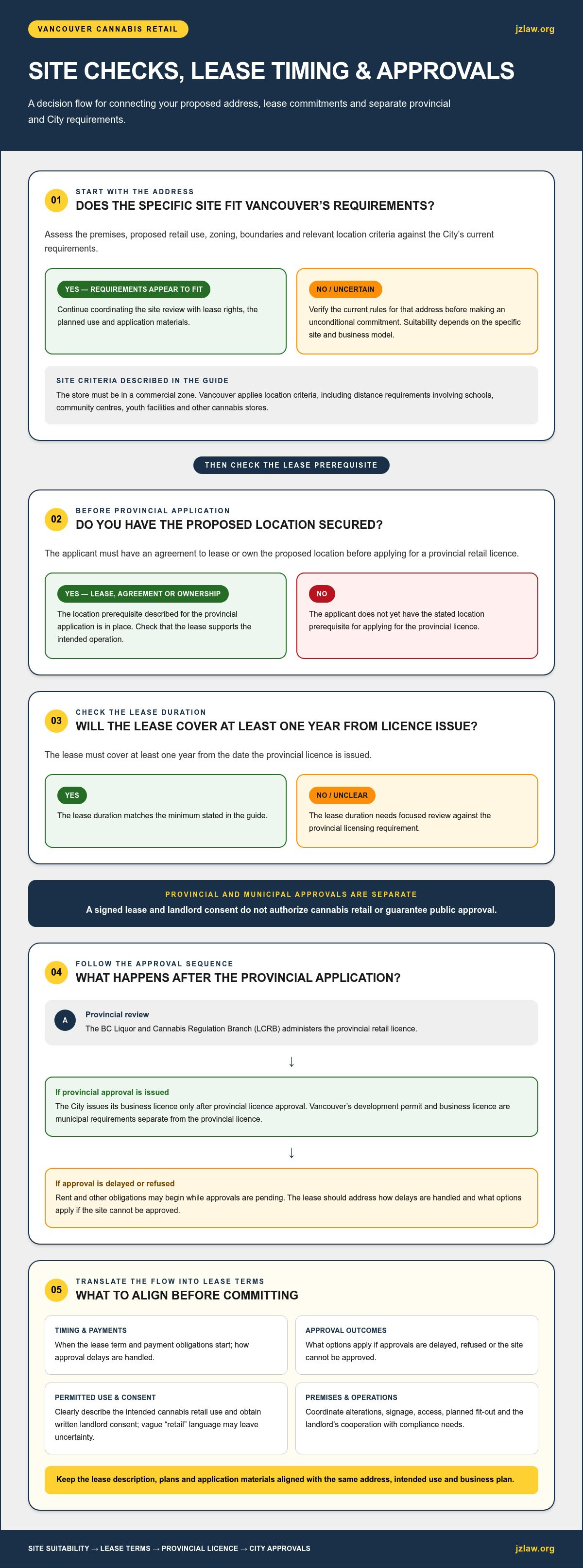
Vancouver site suitability involves municipal requirements as well as provincial licensing through the BC Liquor and Cannabis Regulation Branch (LCRB). The City requires a cannabis store to be in a commercial zone and applies location criteria, including distance requirements from specified sensitive uses and other cannabis stores. Its development permit and business licence processes are separate from the provincial retail licence. Because requirements can change and suitability depends on the address and business model, review the current rules before making an unconditional commitment. For broader context on Canada’s federal and provincial framework, see Cannabis in Canada.
The provincial process makes lease timing consequential. An applicant must have an agreement to lease or own the proposed location before applying, and the lease must cover at least one year from the date the licence is issued. The business therefore needs premises to apply, but rent and other obligations may begin before approvals are in place. Negotiate when the lease term and payment obligations start, how approval delays are handled, and what options apply if the site cannot be approved.
Why generic lease language can create cannabis-specific uncertainty
Standard prohibited-use clauses may restrict activities, products, or business categories the tenant expects to include in a lawful cannabis retail operation. Broad wording can also lead to disputes over whether product display, customer access, signage, security measures, or planned alterations are allowed. Written landlord consent should identify the intended use clearly. Don’t rely on an informal assurance or a vague reference to retail.
Coordinate that consent with the permitted-use clause and provisions governing alterations, signage, access, and compliance cooperation. For example, the tenant may need approval for a storefront layout or other improvements, while the landlord controls the timing or scope of the work. Set out the approval process and each party’s responsibilities in the agreement to reduce the risk of disputes and keep the premises aligned with the business plan.
Neither broad permission nor written landlord consent confirms that the address satisfies Vancouver requirements or that the LCRB will issue a licence. A cannabis retail lease negotiation lawyer Vancouver businesses engage can assess the lease alongside cannabis licensing and real estate considerations, identifying mismatches before they become costly commitments.
How licensing and Vancouver site checks affect lease timing
Plan the lease and site diligence together. A prospective retailer needs a lease or agreement to lease for the proposed location before applying for a provincial licence. But committing before assessing the address can expose the business to obligations for premises it may not be able to use as intended. A practical sequence is to screen the address and proposed use, negotiate lease rights that support the application and planned fit-out, then coordinate provincial and municipal processes before preparing to open.
Provincial licensing and City of Vancouver approval are separate requirements. The BC Liquor and Cannabis Regulation Branch (LCRB) administers the provincial retail licence. The City of Vancouver assesses applicable land-use and municipal requirements, including development permits and business licensing. The City’s business licence follows provincial licence approval, so meeting one set of requirements does not replace the other.
What to investigate about a Vancouver retail address before commitment
Assess the specific premises, not just the neighbourhood or listing description. Review the property’s zoning, proposed retail use, premises boundaries, and relevant location criteria against the City’s current requirements. Vancouver’s rules include location restrictions involving schools, community centres, youth facilities, and other cannabis stores. Compare the intended business model and floor plan with those requirements, and identify property-specific limits that could affect the application or planned use. Verify the rules and processes in force in 2026 for the address. Assumptions based on another site or an earlier application may not apply.
Use this review to guide lease negotiations before the tenant becomes unconditionally bound. The lease description, plans, and application materials should identify the same space and intended use. If details remain under review, record them as open issues rather than treating the landlord’s willingness to proceed as evidence that regulators will approve the location.
How lease conditions can address pending approvals
Approval conditions can allocate risk between the parties, but they need precise drafting. A clause can identify the required approvals, specify what evidence satisfies the condition, set a notice process, and establish a review period. Negotiate extension rights if regulatory review takes longer than anticipated, along with a clear termination mechanism if an approval is refused or a critical site requirement cannot be met.
Be equally specific about timing. State when possession, rent, construction access, and operating obligations begin. Don’t treat them as a single start date if they depend on different milestones. For example, the tenant may need access for permitted improvements before opening, while rent or other obligations begin under a separate trigger. Specify who must give notice, by when, and what happens if a deadline passes while an application is still under review.
These provisions don’t guarantee approval or remove every commercial risk. They clarify the parties’ responsibilities and options if timing or suitability changes. A coordinated cannabis licensing and real estate review can connect site assumptions to lease language and the approval plan before commitments become difficult to unwind.
Which cannabis retail lease clauses deserve focused negotiation?
A cannabis retail lease should turn the business plan into clear contractual permissions and responsibilities. Review the agreement as a connected set of provisions. For example, a permitted-use clause may allow retail sales while an alterations clause restricts the work needed to prepare the premises. The points below are negotiation priorities, not universal terms. The right balance depends on the site, proposed operations, and each party’s risk tolerance.
Permitted use, alterations, and landlord cooperation
Draft the permitted use to reflect the actual intended retail activity. Don’t rely on “general retail” if that wording could leave cannabis sales uncertain. The lease can also set a process for reviewing plans for security measures, ventilation, signage, and tenant improvements, including who receives the plans and how decisions are communicated. Cooperation language should identify practical assistance, such as providing property information or signing documents reasonably required for an application. It should not make the landlord responsible for the tenant’s licensing compliance or regulatory outcome.
Assignment, exclusivity, defaults, and continuing obligations
Consent provisions should address assignments and changes in ownership or control, including the information required and how a request will be assessed. Consider whether exclusivity is specific enough to be meaningful and workable alongside the property’s other operations. Review insurance, indemnity, and compliance-related default wording together. Define covered risks and obligations, and negotiate notice and cure periods where appropriate. Clear drafting reduces ambiguity, but no single clause structure suits every transaction.
A cannabis retail lease negotiation lawyer Vancouver business owners work with can review how these provisions interact with cannabis licensing and real estate considerations. That review can identify gaps between the permitted use, planned improvements, and ongoing obligations before the lease is signed.
How to prepare for a cannabis retail lease negotiation in Vancouver
Review the business plan, premises, and draft lease together. Doing so helps distinguish an approval or operational constraint from a negotiable preference, and gives each proposed change a clear business rationale.
Before reviewing the draft, organize:
Business plan: Summarize the intended retail activity, ownership structure, and target opening sequence.
Site information: Gather the address, available property details, premises boundaries, and proposed floor plan.
Build-out outline: Identify anticipated improvements, signage, security features, and other premises changes.
Lease record: Collect the current draft, schedules, landlord communications, and any written statements about permitted use or approvals.
Open questions: List unresolved licensing and municipal issues separately so assumptions aren’t mistaken for confirmed requirements.
For context on regulatory planning, review the cannabis licensing guide. A broader understanding of commercial real estate law can also help frame premises rights and commercial obligations. These resources provide general context. Address-specific requirements and lease language still need to be assessed in their own context.
Documents and decisions to organize before reviewing the draft
Bring the documents together with a short description of how the store is expected to operate. Note which space the business intends to occupy, what improvements it anticipates, who will own or control the tenant entity, and which steps must happen before opening. Include relevant landlord correspondence, but distinguish informal assurances from negotiated lease terms. A cannabis retail lease negotiation lawyer Vancouver business owners engage can compare the commercial language with the proposed use and regulatory assumptions.
A practical sequence for resolving negotiation priorities
Start with approval-critical points, including whether the permitted use and property rights support the intended application and planned fit-out. Next, address commercial protections such as approval-related timing, access for work, and responsibility for required cooperation. Then consider operational preferences that can be adjusted without undermining the business model. For each requested revision, record its rationale and a fallback position. Before signing, confirm that the final wording reflects the agreed use, timing, and allocation of responsibilities.
This sequence keeps negotiations focused without treating every preference as essential. JZ Law’s cannabis licensing and real estate experience informs a coordinated review of regulatory assumptions and lease terms. Discuss a cannabis retail lease review as part of planning your Vancouver business premises.
Work with a Vancouver cannabis retail lease negotiation lawyer
A cannabis retail lease sits at the intersection of property rights, business planning, and regulatory requirements. JZ Law’s experience in cannabis licensing and real estate law supports a coordinated review of these connected issues. The lease is assessed in light of the intended use and approval pathway, not as a standalone commercial document.
The scope of advice depends on the lease, property, proposed business plan, and requirements in force when the transaction is being considered. Legal review can identify issues and support negotiations, but it can’t guarantee that a location will be approved or that a licence will be issued.
What legal review can address before the lease is signed
Review can assess whether the permitted use, conditions, and timing align with the intended cannabis retail operations and approval sequence. It can also examine responsibility for alterations, landlord cooperation, site access, and tenant compliance obligations, including how those terms affect the business if plans or approval timing change. The review produces a clearer set of legal and commercial points to address with the landlord before execution, rather than leaving the parties to rely on informal understandings.
A cannabis retail lease negotiation lawyer Vancouver business owners consult can assess how the provisions work together. For example, a lease may permit the intended use but limit access for improvements, or require action on a timeline that doesn’t align with approval milestones. Reviewing the agreement as a whole helps identify these interactions and clarify how the parties allocate risk and responsibility.
When to seek counsel and what to bring
Seek legal review before signing, waiving a condition, or making a material non-refundable commitment. Early review leaves more room to negotiate unclear permissions, timing dependencies, or risk allocation. Bring the draft lease and schedules, landlord correspondence, site details, any available premises plans, and a concise summary of the proposed operations and business structure. These materials give counsel a practical basis for comparing the agreement with the transaction’s objectives.
For broader context on commercial leasing provisions, the commercial lease negotiation guide can help frame the issues to consider. A guide provides general background; the effect of a particular clause depends on its wording and the circumstances of the proposed tenancy.
With John Zang leading JZ Law’s boutique practice, cannabis licensing and real estate considerations can be reviewed together, with attention to the lease, proposed premises, and the business’s regulatory assumptions. If you’re considering a Vancouver cannabis retail location, discuss your lease and approval planning with JZ Law before taking on significant contractual commitments.
Set your lease priorities before the next commitment
Before your next landlord discussion, turn unresolved questions into a short decision framework. Identify which lease terms must be settled before signing, which points can remain subject to approval, and what risk the business is prepared to carry if timing changes. This ties negotiations to business priorities instead of treating every requested revision as equally urgent.
Mark the draft in three categories: terms that determine whether the premises can serve the intended business, terms that allocate costs or timing risk, and preferences that may be traded for stronger protections elsewhere. Record the reason for each requested change and an acceptable fallback. This gives legal counsel a clear basis for focused advice and helps the business make deliberate decisions as negotiations progress.
JZ Law can review a Vancouver cannabis retail lease in context and identify points to address before commitments are finalized. Bring the current lease, site information, and a summary of the intended use. JZ Law also works in Calgary, Toronto, Hamburg, Berlin, Frankfurt, New York City, and Denver. Discuss your Vancouver cannabis retail lease with JZ Law and move forward with a clearer basis for negotiation.
Frequently Asked Questions
Can I sign a Vancouver cannabis retail lease before receiving a licence?
Yes. A prospective retailer may need a lease or agreement to lease to apply for a provincial licence. Signing creates contractual obligations, however, even if the application is unsuccessful or takes longer than planned. Before committing, review the lease term, rent start date, and any conditions tied to approvals. In British Columbia, the lease must cover at least one year from the date the provincial licence is issued, according to the current licensing requirements.
Does a landlord have to allow cannabis retail in a commercial space?
No. A commercial landlord isn’t generally required to permit cannabis retail simply because the premises are in a commercial area. The lease may restrict the use, and the landlord can decide whether to consent as part of negotiating the tenancy. Before signing, make sure the written agreement expressly permits the proposed cannabis retail activity. That permission governs the landlord-tenant relationship only. It doesn’t establish that the property meets municipal rules or licensing requirements.
Can a Vancouver cannabis retail lease include a licensing condition?
Yes. The parties can negotiate a condition tied to specified licensing or municipal approvals. It should identify which approvals matter, the deadline for satisfying the condition, how the tenant must notify the landlord, and what evidence is required. The wording should also state the consequences if approval is refused or remains outstanding. A general phrase such as “subject to licensing” may leave key questions unanswered, including whether the tenant can terminate or extend the review period.
What happens if cannabis retail approval is delayed after the lease is signed?
Unless the lease provides otherwise, a delay doesn’t automatically suspend rent or other contractual obligations. Check the agreement for approval conditions, extension rights, commencement dates, and notice deadlines. If the lease has no clear delay mechanism, the tenant may need to seek a negotiated amendment, and the landlord may not be required to agree. A cannabis retail lease negotiation lawyer Vancouver businesses consult can assess the wording and explain the options before a deadline passes.
Can a cannabis retailer assign its Vancouver lease if the business is sold?
Possibly, but the answer depends on the lease’s assignment and change-of-control provisions. A sale of the business’s assets may require landlord consent to transfer the lease, while a share sale may trigger a separate clause if a change in ownership counts as a transfer. Review whether consent is required, what information must accompany a request, and whether the original tenant remains liable afterward. Plan this review before a sale, since the lease can affect transaction timing and structure.
Who is responsible for cannabis retail leasehold improvements?
Responsibility depends on the lease and any negotiated work agreement. The tenant may be responsible for its fit-out, while the landlord may retain control over approvals, building systems, or alterations affecting the property. Clarify who pays for each category of work, who obtains required permits, how contractors gain access, and what must be removed or restored at lease end. Attach or reference approved plans where appropriate so both parties share a clear understanding of the permitted scope.
Should a cannabis retail tenant personally guarantee a Vancouver commercial lease?
Not automatically. A personal guarantee can make an individual responsible for specified tenant obligations if the business entity defaults, so its scope and duration deserve careful review. Negotiation may address a cap, limited period, particular obligations, or release conditions, depending on the landlord’s position and the transaction. Before signing, understand whether the guarantee covers rent only or other liabilities as well, and how it interacts with any indemnity or security provisions in the lease.



Comments