


Commercial Lease Negotiation 2026: A Strategic Legal Guide for Global Business Hubs
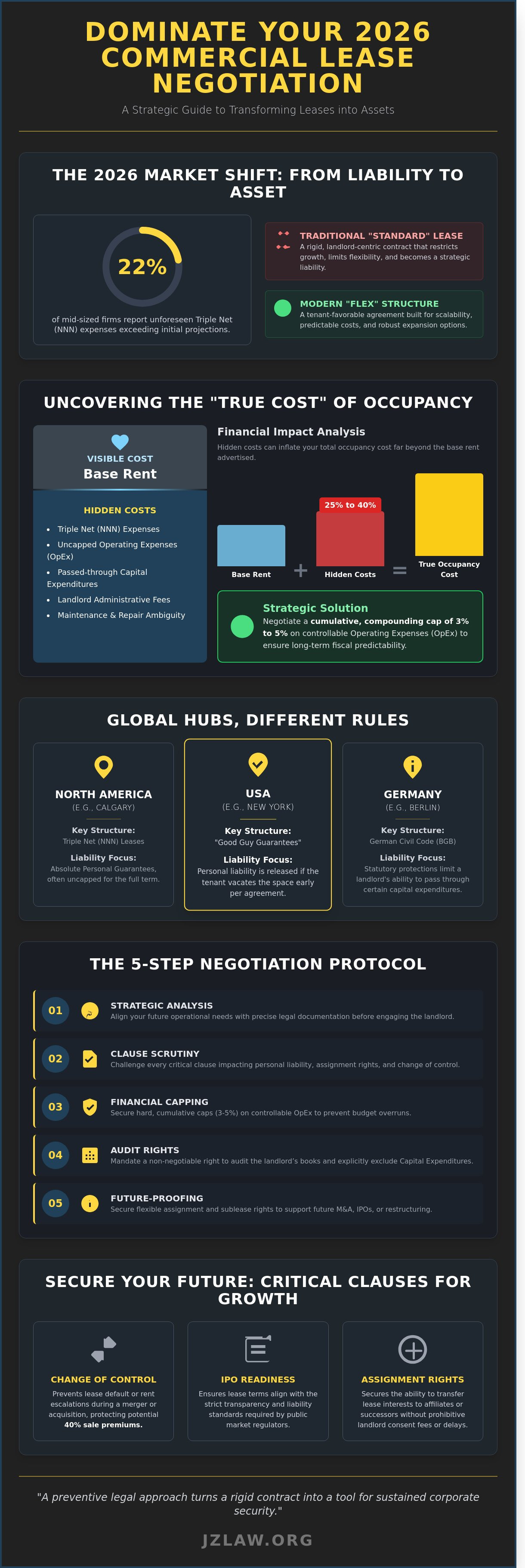
By 2026, the traditional "standard" lease has become a strategic liability, with recent industry data showing that 22% of mid-sized firms in global hubs like New York and Berlin reported that unforeseen Triple Net (NNN) expenses exceeded their initial projections within the first eighteen months. You've likely felt the pressure of balancing a prestigious address with the urgent need for operational agility. It's a common frustration to find that a lease intended to support your growth actually restricts your ability to sublease or scale as market conditions shift. We've developed a rigorous legal framework designed to help you dominate your next commercial lease negotiation. You'll learn how to transform these complex contracts into strategic assets that offer predictable long-term costs and robust expansion options. This guide outlines the specific clauses you must challenge to minimize personal liability and secure the flexibility your business demands in a volatile economic environment. We'll show you how a preventive legal approach can turn a rigid contract into a tool for sustained corporate security.
Key Takeaways
Understand the strategic shift toward tenant-favorable 'flex' structures in global hubs like New York, Calgary, and Berlin to capitalize on 2026 market volatility.
Uncover the "True Cost" of occupancy by mastering a commercial lease negotiation framework that effectively caps operating expenses and mitigates hidden financial liabilities.
Analyze the long-term fiscal trade-offs between immediate tenant inducements and the compounding risks of higher base rent structures over time.
Implement a disciplined five-step negotiation protocol designed to align your future operational needs with precise legal documentation.
Leverage a preventive legal approach to bridge international market differences and secure your business interests through meticulous contract drafting.
Table of Contents The 2026 Commercial Real Estate Landscape: Navigating Global Hubs Decoding the Financial Architecture: Rent, OpEx, and Hidden Costs Tenant Inducements vs. Long-Term Liability: A Strategic Comparison The 5-Step Negotiation Protocol for High-Growth Companies Why Boutique Legal Counsel is Your Best ROI in 2026
The 2026 Commercial Real Estate Landscape: Navigating Global Hubs
The 2026 commercial real estate market presents a fragmented reality across global business hubs. In New York City, office vacancy rates stabilized at 18.4% by the first quarter of 2026, while Berlin continues to grapple with the 2025 regulatory shifts in commercial rent protections. Calgary has seen a 12% increase in industrial demand driven by the logistics sector. These shifts have fundamentally altered the dynamics of commercial lease negotiation, moving away from rigid landlord-centric models toward "flex" structures that prioritize tenant scalability. The "standard" lease has become a legal relic in high-stakes urban centers. Every clause is now a variable subject to intense scrutiny, requiring a strategic approach to risk allocation.
Specialized legal counsel acts as a strategic architect in these cross-border deals. Managing the interplay between local property laws and global corporate objectives requires more than technical knowledge. It demands a preventive mindset that anticipates market shifts before they manifest as contractual disputes. Understanding the fundamentals of a lease remains the starting point for any executive, but the application of these principles varies wildly by jurisdiction.
Regional Nuances: From Calgary to Frankfurt
North American markets like Calgary rely heavily on Triple Net (NNN) structures where tenants cover taxes, insurance, and maintenance. In contrast, Frankfurt and Berlin operate under the German Civil Code (BGB), providing statutory protections that limit a landlord's ability to pass through certain capital expenditures. New York's "Good Guy Guarantees" offer a middle ground for personal liability, allowing a guarantor to be released from obligations if the tenant vacates the space early. This differs significantly from Canadian personal guarantees, which often remain absolute for the duration of the term unless specifically capped during the commercial lease negotiation process.
The Rise of Strategic Corporate Transactions in Leasing
Lease obligations are no longer isolated overhead costs; they are central to strategic corporate transactions that define a company's trajectory. For a startup targeting a 2027 IPO, an unfavorable lease can suppress valuation by creating long-term contingent liabilities. The following elements are critical for scaling entities:
Change of Control Clauses: These provisions can trigger default or rent escalations during a merger, potentially jeopardizing a 40% premium on a corporate sale.
IPO Readiness: Ensuring lease terms align with the transparency and liability standards required by public market regulators.
Assignment Rights: Securing the ability to transfer lease interests to affiliates or successors without prohibitive landlord consent fees.
The complexity of these arrangements necessitates a partner who understands the business environment as well as the law. Precise drafting ensures that a lease serves as an asset for growth rather than a bottleneck during future restructuring or capital raises.
Decoding the Financial Architecture: Rent, OpEx, and Hidden Costs
The financial commitment in a modern lease extends far beyond the headline figure. Sophisticated tenants distinguish between base rent and the 'additional rent' trap, which often includes fluctuating property taxes, insurance premiums, and common area maintenance. A Triple Net Lease is a structure where tenants pay taxes, insurance, and maintenance. Without a precise commercial lease negotiation strategy, these variables can inflate a tenant's total occupancy cost by 25% to 40% over the base rate. Securing 'caps' on Operating Expenses (OpEx) is vital for long-term fiscal predictability. We recommend negotiating a cumulative, compounding cap of 3% to 5% on controllable expenses to prevent budget volatility as we approach 2026.
Operating Expense Audits and Transparency
Every lease must include a non-negotiable right to audit the landlord's books. This isn't just about trust; it's about financial precision. Tenants should explicitly exclude Capital Expenditures (CapEx) from annual operating costs. If a landlord replaces a central HVAC system in 2026, that's a long-term asset improvement, not a routine maintenance expense. Managing administrative fees is equally critical. Landlords often attempt to add a 15% management markup on top of already inflated service costs. Capping these fees ensures the landlord doesn't profit from the simple act of billing. A preventive legal review of these line items can save a corporation hundreds of thousands over a ten-year term.
Sustainability Clauses and 2026 Compliance
The legal landscape for 2026 introduces aggressive ESG mandates that redefine the commercial lease negotiation process. In NYC, Local Law 97 imposes heavy fines on buildings exceeding carbon limits, while Vancouver's Zero Emissions Building Plan dictates strict building performance standards. You must clarify who pays for energy efficiency upgrades. Negotiating 'Green' build-out requirements prevents your business from absorbing regulatory fines meant for the property owner. In German commercial hubs like Frankfurt or Berlin, carbon footprint reporting is now a legal weight that affects asset valuation. Ensure your lease contains the following protections:
Detailed allocation of costs for mandatory energy retrofits.
Protection against 'double dipping' where the landlord receives tax credits for upgrades paid for by the tenant.
Specific data-sharing agreements for carbon reporting requirements.
By 2026, utility costs in buildings that fail to meet these standards are projected to rise by 12% to 18%. Establishing clear boundaries now prevents these environmental obligations from becoming an unmanaged financial liability for your global operations.
Tenant Inducements vs. Long-Term Liability: A Strategic Comparison
Strategic commercial lease negotiation requires a clinical analysis of upfront incentives against the total cost of occupancy. Landlords in 2026 frequently offer aggressive inducement packages to maintain high face rents, which preserves the building's valuation for refinancing purposes. A common tactic involves offering 10 to 12 months of rent abatement on a ten-year term. While this assists with initial cash flow, it often masks a base rate that sits 15% above the true market value. Tenants must calculate the Net Effective Rent (NER) to understand the real financial commitment. High base rates also compound annual rent escalations, meaning a tenant might pay significantly more over a decade than they would have by negotiating a lower starting rate without the "free" months.
The "clawback" provision remains a critical legal risk in these packages. If a tenant defaults or exercises an early termination right, most modern contracts require the immediate repayment of the unamortized portion of all inducements. This includes free rent, moving allowances, and legal fee subsidies. For a 2,000-square-meter office, these liabilities can exceed €500,000 depending on the fit-out intensity. We advocate for a "burn-off" schedule where clawback obligations decrease over time, protecting the firm's balance sheet against unforeseen market shifts.
The Tenant Improvement (TI) Framework
The choice between a Tenant Improvement Allowance (TIA) and a Landlord Turnkey build defines the project's risk profile. A TIA grants the tenant control over design and quality, yet it places the burden of cost overruns on the business. Conversely, turnkey builds shift construction risk to the landlord but often result in lower-grade finishes to protect the landlord's margin. Commercial lease negotiation must clearly define "Substantial Completion." This milestone should only be triggered once a permanent Certificate of Occupancy is issued and all "punch list" items are resolved. Failure to define this precisely can force a tenant to begin paying rent while the space is still a construction zone.
Flexibility and Exit Strategies
High-growth firms in 2026 prioritize agility over static stability. Data from 2025 commercial sectors indicates that 42% of corporate tenants now insist on "Contraction Rights," allowing them to return up to 20% of their space after the third year. Sublease and assignment rights are equally vital; the lease must state that landlord consent cannot be "unreasonably withheld, conditioned, or delayed."
Assignment Rights: Ensure the lease allows for transfers to affiliates or successors during a merger without triggering a landlord recapture right.
Termination for Convenience: While rare, these clauses are becoming negotiable in oversupplied markets, typically requiring a 9-month notice period and a predetermined penalty fee.
Restoration Obligations: Negotiate the removal of "make-good" clauses. Tenants shouldn't be forced to spend capital at lease end to remove standard office improvements.
Preventive legal strategy ensures that the flexibility needed for future scaling isn't traded away for temporary financial relief. Every inducement is a loan from the landlord; our role is to ensure the interest rate isn't hidden in the fine print.
The 5-Step Negotiation Protocol for High-Growth Companies
High-growth companies require a structured approach to commercial lease negotiation that anticipates rapid scaling and shifting regulatory landscapes. This protocol ensures legal safeguards are integrated before any commitment is signed. Data from 2024 indicates that approximately 40% of tech firms outgrow their initial space within 24 months, making flexibility a primary legal objective rather than a secondary luxury.
Step 1: Pre-negotiation Audit. We conduct an exhaustive review of current operational needs and 3-year growth projections. This prevents the common mistake of signing a long-term lease for a space that will be obsolete in two years.
Step 2: Drafting the Letter of Intent (LOI). This stage establishes the commercial framework with precise legal oversight. It prevents "deal creep" where landlords attempt to introduce unfavorable terms during the formal lease drafting phase.
Step 3: The Battle of the Boilerplate. Our team identifies and strikes predatory clauses. We specifically target "standard" language that allows for uncapped operating expense pass-throughs, which can unexpectedly increase annual costs by 15% or more.
Step 4: Securing the SNDA. A successful commercial lease negotiation must include a Subordination, Non-Disturbance, and Attornment agreement. This protects your occupancy rights even if the landlord faces financial insolvency or foreclosure.
Step 5: Execution and Post-Closing Compliance. We implement a monitoring system for CAM (Common Area Maintenance) reconciliations and critical renewal deadlines to ensure the landlord adheres to the negotiated terms.
The Power of the LOI (Letter of Intent)
The LOI is the most critical stage for legal intervention because it dictates the leverage for the entire transaction. While many believe the LOI is entirely non-binding, specific provisions regarding exclusivity, confidentiality, and "break-up" fees are often legally enforceable. We ensure the document sets a clear path for cannabis licensing or other specialized uses. If the regulatory framework doesn't align with your business model, we negotiate "kick-out" clauses that allow for lease termination without the burden of accelerated rent payments.
Risk Mitigation: Indemnification and Insurance
Asset protection depends on limiting the scope of mutual indemnification. Tenants shouldn't be held liable for pre-existing environmental hazards or the landlord's own negligence. In 2026, force majeure clauses must evolve beyond simple "Acts of God" like the heavy floods of 2023. They now include "Acts of Government," such as sudden regulatory shutdowns or regional health mandates that prevent business operations. We also prioritize the "Non-Disturbance" clause. This ensures that if a landlord defaults on their mortgage, the lender is legally bound to honor your lease terms. Without this protection, a bank could terminate your 10-year lease overnight during a foreclosure proceeding.
Securing a resilient lease requires more than just a signature; it demands a preventive legal strategy. Contact us for comprehensive commercial representation to protect your business interests and ensure long-term operational stability.
Why Boutique Legal Counsel is Your Best ROI in 2026
The financial impact of a poorly drafted lease often remains hidden until a dispute arises. In 2026, the "Preventative Law" approach isn't a luxury; it's a fiscal necessity. By prioritizing precise drafting during your commercial lease negotiation, we eliminate the ambiguities that lead to costly litigation. Industry data suggests that businesses adopting preventative legal strategies reduce their long-term dispute-related expenses by approximately 35% compared to those relying on standard templates. We focus on identifying "silent" triggers in clauses that could lead to defaults or unexpected rent hikes years down the line.
JZ Law serves as a vital bridge between NYC, Calgary, and European markets. We understand that a tech firm in Manhattan faces different regulatory pressures than an energy firm in Alberta or a startup in Budapest. Our expertise spans niche sectors like Crypto and Oil & Gas, where lease clauses must account for high power density requirements or specific environmental liabilities. We also ensure your physical footprint aligns with your capital market goals, specifically integrating lease strategy with the complex process of taking companies public.
Strategic Partnership Over Simple Execution
Big-box law firms often treat transactions as isolated events. They miss the nuances of boutique operations because they're optimized for volume, not strategy. We move beyond the "closing" to focus on your long-term corporate growth. John Zang's multi-jurisdictional expertise secures your footprint across borders, ensuring that a lease signed in 2026 remains an asset rather than a liability by 2031. We don't just execute documents; we protect your equity and operational flexibility.
Next Steps: Securing Your 2026 Commercial Footprint
Securing a competitive position requires early action. You should begin preparing your documentation for a professional lease review at least 10 to 12 months before your current term expires. Timing your commercial lease negotiation to coincide with market shifts in late 2025 or early 2026 maximizes your leverage against landlords. To protect your interests and optimize your global real estate portfolio, follow these steps:
Audit your current lease for hidden escalations or restrictive use clauses that hinder expansion.
Define your 5-year growth projections to ensure the space remains functional for your headcount.
Contact JZ Law for a strategic consultation to align your lease with your broader business objectives.
Effective legal counsel pays for itself through risk mitigation and strategic positioning. Don't leave your commercial future to chance. Our team is ready to provide the precision and global perspective your business demands.
Mastering Your Global Commercial Strategy for 2026
Navigating the 2026 real estate market demands more than just a signature on a standard form. Success hinges on a commercial lease negotiation that prioritizes financial transparency and operational flexibility. Companies operating in high-growth tech and regulatory sectors must look past immediate tenant inducements to analyze how 10-year liabilities affect their long-term scalability. By implementing a structured 5-step protocol, your organization can effectively mitigate the hidden costs embedded in modern OpEx structures across NYC, Calgary, and German legal jurisdictions.
JZ Law provides the specialized expertise required for these complex corporate transactions. Our team's deep understanding of international regulatory environments ensures that your lease serves as a strategic asset rather than a financial burden. We don't just review documents; we architect agreements that protect your interests in volatile global hubs. It's time to align your physical footprint with your 2026 growth objectives through precise, boutique legal representation.
Your firm's future stability starts with a well-negotiated foundation today.
Frequently Asked Questions
Is a commercial lease negotiation different in Germany compared to Canada?
Yes, the legal frameworks differ fundamentally because Germany operates under a Civil Law system while Canada follows Common Law. In Germany, Section 550 of the German Civil Code (BGB) requires any lease exceeding one year to be in written form or it reverts to an indefinite term with statutory termination rights. Canadian leases rely heavily on specific contract language and judicial precedent, often granting landlords broader "self-help" remedies for eviction that don't exist in the more tenant-protected German market.
What is a 'Good Guy Guarantee' in New York commercial real estate?
A Good Guy Guarantee is a limited personal indemnity that releases the guarantor from financial liability once the tenant vacates the premises and surrenders the keys. It's not a full-term guarantee. It ensures the landlord receives rent until the day of surrender, provided the tenant gives a notice period, typically 90 to 180 days. This mechanism protects the landlord from "holdover" tenants who stop paying rent but refuse to leave the space.
Can I negotiate a commercial lease to include a 'change of control' clause?
You can and should negotiate this clause to protect your corporate flexibility during a merger or acquisition. Most standard contracts define a 51% shift in stock ownership as an unauthorized assignment. You must secure "permitted transfer" language that allows for internal reorganizations or the sale of the entity without requiring landlord consent. This specific protection is a vital component of a successful commercial lease negotiation for any venture-backed or scaling business.
How much should I expect to pay in 'Additional Rent' for a Triple Net (NNN) lease?
Additional rent typically ranges from 15% to 40% of the base rent depending on the building's age and location. According to 2024 BOMA industry data, operating expenses for Class A office spaces in global hubs average $14.00 to $22.00 per square foot. These costs cover your proportionate share of real estate taxes, property insurance, and common area maintenance. You should always insist on a "base year" or an expense cap to prevent annual increases from exceeding 5%.
What happens to my commercial lease if I decide to take my company public?
Going public triggers the "change of control" provision because your ownership structure shifts to public shareholders. If your lease doesn't explicitly categorize an Initial Public Offering (IPO) as a "permitted transfer," the landlord might claim a lease default or demand a rent hike. You'll need to ensure your commercial lease negotiation phase includes a carve-out that exempts transfers resulting from a listing on a recognized stock exchange like the NYSE or NASDAQ.
Are ESG and sustainability clauses mandatory in 2026 commercial leases?
While not universally mandatory by law, the EU Corporate Sustainability Reporting Directive (CSRD) makes these clauses a practical necessity for large enterprises as of January 2025. Approximately 80% of institutional landlords in major business hubs now require "Green Lease" provisions. These clauses mandate energy data sharing and compliance with specific carbon reduction targets. Failing to include these terms can impact your corporate ESG rating and increase your future regulatory liability.
How do I negotiate a sublease clause that actually allows me to exit?
You must replace the landlord's absolute discretion with a "reasonableness" standard. Ensure the contract states the landlord cannot "unreasonably withhold, condition, or delay" consent for a new subtenant. It's also vital to strike any "recapture" rights that allow the landlord to terminate your lease entirely if you ask to sublease. Aim to keep at least 50% of any "excess rent" generated from the subtenant after deducting your marketing and legal costs.
What is the difference between a Tenant Improvement Allowance and a Landlord Build-out?
A Tenant Improvement (TI) Allowance is a specific cash credit, often $60 to $120 per square foot, where the tenant manages the construction. This gives you total control over the design but places the risk of cost overruns on your company. A Landlord Build-out, or "turnkey" solution, means the landlord completes the renovation based on a pre-approved plan. It's simpler for the tenant, but the landlord might use lower-quality materials to stay under their own internal budget.


Comments