


M&A Due Diligence Checklist 2026: A Strategic Guide for Calgary, Toronto, NYC, and German Markets
What if the most significant threat to your C$50 million acquisition isn't a competitor's market share, but a single overlooked clause in a 2026 German tax amendment or a Toronto-specific labor regulation? You likely recognize that cross-border transactions offer unparalleled growth, yet the sheer volume of data in a virtual data room often feels like a strategic minefield rather than a resource. It's natural to feel overwhelmed by the friction between Calgary's energy sector rules, New York's securities mandates, and Germany's rigid compliance structures. This guide provides a comprehensive m&a due diligence checklist tailored for the 2026 legal environment.
We've designed this framework to help you identify deal-breaker risks early and ensure full compliance with the latest tax and securities regulations across all three jurisdictions. We'll examine the specific document review protocols for Canadian securities, US federal mandates, and European privacy laws to ensure your transaction secures its intended value without the friction of unexpected regulatory intervention. This preventive approach transforms a standard document review into a strategic shield for your investment.
Key Takeaways
Understand the evolution of the m&a due diligence checklist for 2026, shifting from a standard audit to a preventive framework that prioritizes ESG standards and digital asset scrutiny.
Master the regulatory nuances of cross-border transactions, specifically navigating the Investment Canada Act in Toronto and Calgary alongside rigorous SEC compliance in New York.
Identify critical hazards in high-growth sectors by auditing smart contract security in cryptocurrency and verifying licensing validity within the complex cannabis regulatory landscape.
Learn to protect deal value by translating diligence findings into precise purchase price adjustments and robust Representations and Warranties (R&W) clauses.
Ensure comprehensive legal compliance across jurisdictions by verifying capitalization tables and securities regulations essential for securing global transaction integrity.
Table of Contents The Strategic Role of M&A Due Diligence in 2026 The Core Legal and Financial Checklist Navigating Local Jurisdictions: Calgary, Toronto, NYC, and Germany Specialized Sector Hazards: Cannabis, Crypto, and Energy From Diligence Findings to Closing: The JZ Law Approach
The Strategic Role of M&A Due Diligence in 2026
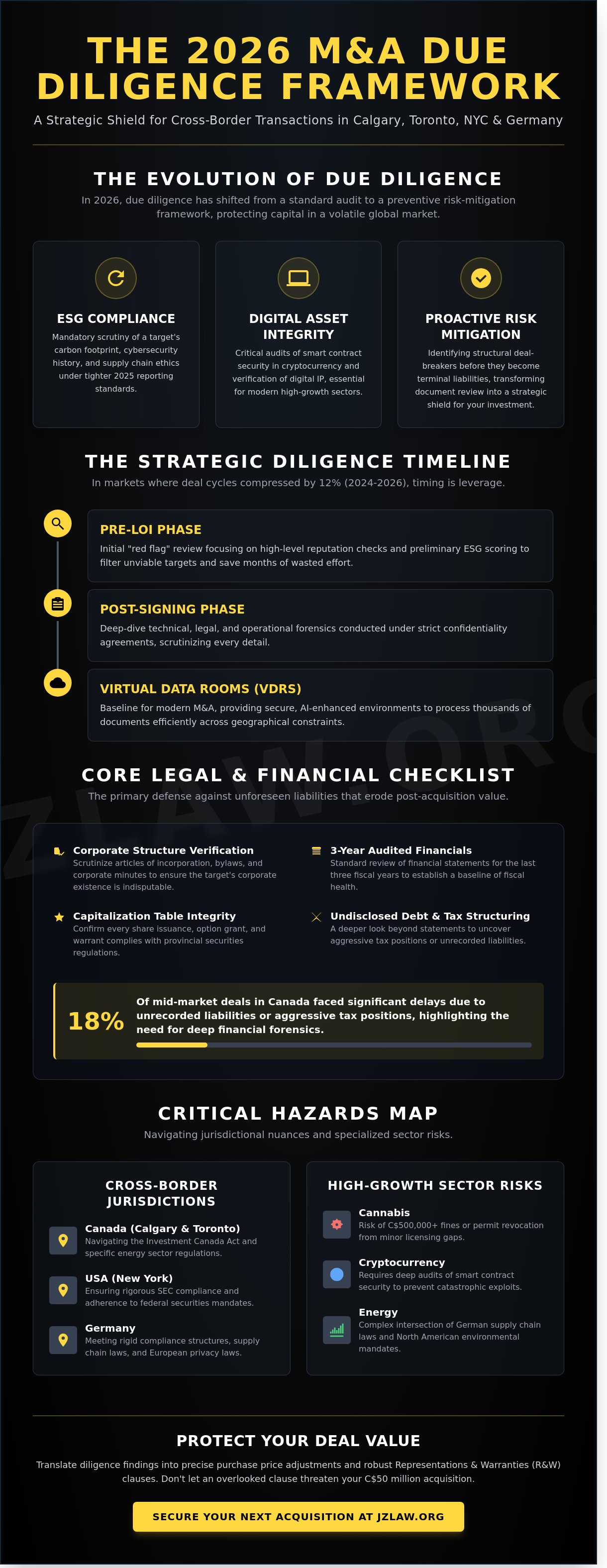
Modern corporate acquisitions in 2026 have moved beyond the era of simple financial audits. Due diligence functions as a sophisticated, preventive risk-mitigation framework designed to protect capital in an increasingly volatile global market. At JZ Law, our philosophy centers on identifying structural deal-breakers before they transform into terminal liabilities. This proactive stance is essential for transactions bridging the energy sector in Calgary, the financial heart of Toronto, and the industrial hubs of Germany. We don't just check boxes; we build a defensive perimeter around your investment.
The 2026 landscape demands a rigorous focus on ESG compliance and digital asset integrity. Regulators in late 2025 introduced tighter reporting standards that now require buyers to scrutinize a target's carbon footprint and cybersecurity history with the same intensity as its balance sheet. A comprehensive m&a due diligence checklist must now account for these intangible but high-stakes variables to ensure long-term value retention. This is especially true in cross-border deals where German supply chain laws intersect with North American environmental mandates.
Why 'Good Enough' Diligence Fails in Complex Sectors
Settling for standard verification often leads to catastrophic oversights in highly regulated Canadian industries. For instance, overlooking minor regulatory gaps in cannabis licensing or securities law can result in fines exceeding C$500,000 or the total revocation of operating permits. A strategic corporate transaction requires deep jurisdictional knowledge to navigate these local nuances. We look past the financial statements to investigate the cultural and regulatory fit. It's about ensuring the target's internal governance aligns with the buyer's global standards to avoid post-merger friction.
The 2026 Diligence Timeline: When to Start
Timing determines the leverage a buyer holds during negotiations. The most successful deals begin investigative phases in the pre-LOI (Letter of Intent) stage. This early start allows for a "red flag" review that can save months of wasted effort. In the high-velocity markets of NYC and Toronto, where deal cycles compressed by 12% between 2024 and 2026, balancing speed with thoroughness is a competitive necessity. You can't afford to be slow, but you can't afford to be blind either.
Pre-LOI Phase: Focuses on high-level reputation checks and preliminary ESG scoring to filter out unviable targets.
Post-Signing Phase: Deep-dive technical, legal, and operational forensics conducted under strict confidentiality.
Virtual Data Rooms (VDR): These platforms are now the baseline for modern professional legal services. They provide secure, AI-enhanced environments to process thousands of documents without geographical constraints.
Utilizing a structured m&a due diligence checklist ensures no stone is left unturned during these phases. It provides the clarity needed to walk away from a flawed deal or close a high-value one with absolute confidence.
The Core Legal and Financial Checklist
A comprehensive m&a due diligence checklist acts as the primary defense against unforeseen liabilities that can erode post-acquisition value. In the current 2026 market, precision is mandatory. Acquirers must scrutinize articles of incorporation, bylaws, and corporate minutes across all active jurisdictions to ensure the target's corporate existence is indisputable. This process includes verifying the capitalization table to confirm that every share issuance, option grant, and warrant complies with provincial securities regulation, particularly in sectors like the Canadian cannabis industry where compliance is under heavy scrutiny.
Financial integrity remains the most critical pillar. Reviewing audited financial statements from the last three fiscal years is a standard requirement, but 2026 mandates a deeper look into undisclosed debt and tax structuring. According to a 2024 industry report, approximately 18% of mid-market deals in Canada faced significant delays due to unrecorded liabilities or aggressive tax positions. Using a structured m&a due diligence checklist helps legal and financial teams identify these triggers early in the negotiation phase, preventing costly surprises after the C$ exchange.
Material contracts require a granular review of change-of-control clauses. A single lease in NYC or a vendor agreement in Calgary that triggers a termination upon sale can jeopardize the target's operational continuity. Simultaneously, ensuring a clean chain of title for intellectual property is vital. If proprietary tech or branding isn't properly assigned, the deal's valuation could drop by millions of C$ overnight. For a detailed review of your specific deal parameters, you may wish to consult with our strategic partners.
Verifying the Corporate Foundation
Shareholder agreements in private equity targets often contain complex voting rights and drag-along provisions that require surgical review. In Calgary and Toronto, obtaining "Good Standing" certificates from provincial registries is a non-negotiable step to confirm the target hasn't been dissolved for administrative failures. We also analyze how previous MOUs influence current deal structures, ensuring no legacy commitments or "handshake deals" haunt the new entity.
Financial and Tax Structuring Scrutiny
Cross-border acquisitions between Canada and Germany involve complex tax treaties and the risk of "tax landmines." Identifying these requires evaluating R&D tax credit compliance, which is a high-risk area in 2026 tech deals. Internal controls must be audited to ensure anti-fraud measures meet the standards of the Canadian Proceeds of Crime (Money Laundering) and Terrorist Financing Act. This preventive approach ensures that deferred tax liabilities don't become an immediate burden for the buyer.
Navigating Local Jurisdictions: Calgary, Toronto, NYC, and Germany
Navigating cross-border acquisitions in 2026 requires a granular understanding of jurisdictional friction points. In Canada, the Investment Canada Act (ICA) continues to be a primary filter for foreign capital. For 2024, the net benefit review threshold for private sector WTO investors was set at C$1.326 billion, a figure that serves as a pivotal benchmark for large-scale acquisitions. Beyond federal oversight, provincial securities laws in Ontario and Alberta dictate the pace of public company takeovers. Investors often utilize a comprehensive M&A Due Diligence Checklist to ensure every regulatory checkbox, from SEC filings in New York to the specific GmbH protocols in Germany, is addressed before closing. Bilateral tax treaties, such as the 1997 Canada-Germany Tax Convention, play a critical role in 2026 by preventing double taxation on dividends and interest, ensuring capital efficiency in transatlantic deals.
Germany's corporate landscape is dominated by the GmbH (Gesellschaft mit beschränkter Haftung) structure, which requires notarized share transfer agreements. This adds a layer of formal rigidity not found in New York or Toronto. Additionally, EU-level data privacy under GDPR remains a high-stakes area. Non-compliance can result in fines up to 4% of global annual turnover, making data audits a central pillar of the m&a due diligence checklist. It's not just about legal compliance; it's about protecting the valuation of the target entity.
Canadian Regulatory Hurdles
Reviewing oil and gas law compliance is mandatory for Alberta-based assets. The Alberta Energy Regulator (AER) Directive 067 assessments can stall transfers if financial backing is deemed insufficient. For fintech targets, FINTRAC's 2024 updated reporting standards for virtual currency dealers require deep audits of compliance programs. Labor standards also vary significantly; Ontario’s 2021 "Right to Disconnect" legislation and Alberta’s specific pension liability rules create distinct financial obligations that must be quantified early in the process.
US and German Legal Nuances
In New York City, commercial real estate leases often feature "good guy" guarantees. These clauses limit personal liability only if the tenant vacates the premises in good condition, requiring meticulous review to avoid unexpected successor liabilities. German targets involve the Betriebsrat (Works Council), where Section 613a of the German Civil Code (BGB) mandates that employees transfer with their existing contracts. This makes post-merger restructuring more complex than in North American jurisdictions. Simultaneously, US-based buyers must verify compliance with the Foreign Corrupt Practices Act (FCPA) to avoid heavy penalties from the Department of Justice for international operations. Precision in these areas prevents costly litigation after the deal closes.
Specialized Sector Hazards: Cannabis, Crypto, and Energy
Standard corporate reviews often fail to capture the granular risks inherent in highly regulated or technologically volatile industries. A sophisticated m&a due diligence checklist must evolve to address sector-specific liabilities that can jeopardize a deal's long-term viability. Whether you're acquiring a licensed producer in Calgary or a fintech startup in Toronto, the depth of your technical and regulatory investigation determines the security of your investment.
Cannabis and Regulated Substances
In the Canadian market, compliance isn't a static achievement but an ongoing operational requirement. Investigating a target's history with the Alberta Gaming, Liquor and Cannabis Commission (AGLC) or California’s Department of Cannabis Control (DCC) is the first priority. You must verify the validity of cannabis licensing and confirm that all local zoning permits remain in good standing. Recent data from 2024 suggests that nearly 12% of cannabis M&A transactions faced delays due to undisclosed municipal non-compliance.
Supply chain integrity is equally critical. We recommend auditing pesticide testing records and certificate of analysis (COA) logs for the preceding 24 months. Furthermore, if the target holds a "social equity" license, you must evaluate the specific transferability clauses. Many jurisdictions restrict the sale of these licenses to entities that don't meet strict diversity or residency benchmarks, which can lead to a total loss of the asset post-acquisition.
Digital Assets and Blockchain Law
Cryptocurrency and blockchain targets require a specialized m&a due diligence checklist that bridges the gap between code and commerce. The primary legal hurdle remains the classification of assets; you must determine if the target’s tokens are classified as securities under the Howey Test or local CSA guidelines. Beyond legal status, a rigorous audit of smart contract security is non-negotiable. A single logic error in a protocol can result in the loss of millions in capital, as evidenced by several high-profile DeFi exploits in 2025.
Custody Protocols: Review the physical and digital storage of private keys and the multi-signature requirements for asset movement.
AML/KYC Compliance: Ensure the target has maintained rigorous "Know Your Customer" records to avoid retroactive FINTRAC penalties.
DAO Governance: Assess the legal enforceability of Decentralized Autonomous Organization structures, particularly regarding director liability and fiduciary duties.
Energy and Infrastructure Liabilities
For acquisitions in the Alberta energy sector, "orphan well" obligations represent a massive balance sheet risk. Under the Alberta Energy Regulator (AER) Directive 088, the Liability Management Rating (LMR) of a company can trigger significant security deposit requirements during a license transfer. It's common for environmental reclamation costs to exceed C$550,000 per site. Buyers must conduct independent environmental liability assessments rather than relying on the seller's internal estimates.
Technology and Data Sovereignty
Technology deals frequently stumble on intellectual property "contamination." We perform open-source software audits to ensure that proprietary code hasn't been compromised by restrictive "copyleft" licenses. Additionally, data sovereignty has become a deal-breaker. If a Toronto-based target processes European or German data, they must prove compliance with both PIPEDA and GDPR. Failure to maintain proper data residency can result in regulatory fines reaching 4% of annual global turnover.
For a tailored assessment of your transaction's regulatory risks, consult our strategic legal advisors to secure your market position.
From Diligence Findings to Closing: The JZ Law Approach
The transition from investigation to execution requires a cold, analytical eye. Once the m&a due diligence checklist reveals a contingent liability, such as an unresolved environmental claim in Alberta or a tax discrepancy in Ontario, the discovery must be quantified immediately. We don't just flag risks; we translate them into purchase price adjustments. If a target company's financial records show a C$450,000 gap in pension funding, that figure should be deducted from the enterprise value or covered by a specific indemnity. We draft Representations and Warranties (R&W) that specifically target the gaps discovered during the review process. To mitigate lingering uncertainties, we often structure holdbacks where 10% to 15% of the C$ purchase price remains in escrow for 12 to 24 months. For deals involving high-growth targets, earn-outs are structured to bridge valuation gaps, ensuring the buyer only pays for proven performance.
Finalizing the closing checklist is the last line of defense. This stage ensures every condition precedent, from third-party lender consents to regulatory approvals under the Investment Canada Act, is fully satisfied before funds move. We ensure the transition from the m&a due diligence checklist to the final signature is a logical progression, not a frantic scramble.
Mitigating Risk Through Smart Drafting
Effective Disclosure Schedules are the seller's primary shield. By meticulously listing every exception to the R&W, a seller limits their liability for issues the buyer has already accepted. In the current Canadian market, we frequently structure R&W Insurance for deals exceeding C$25 million. This protects both parties by providing a clean exit for the seller and a direct insurance claim path for the buyer. Our post-closing integration plans are designed to neutralize regulatory red flags found during diligence, particularly those involving data privacy or cross-border employment transfers between Toronto and NYC.
Partnering with JZ Law for Global M&A
John Zang provides the senior-level oversight necessary for complex regulatory matters that larger firms often delegate to junior associates. Our boutique firm structure is built for rapid-response cross-border diligence, allowing us to move at the speed of the 2026 market. We act as a strategic partner, looking beyond the legal text to understand your business objectives in Calgary, Toronto, and German markets. We don't just identify obstacles; we build the legal frameworks to overcome them. Contact JZ Law for a strategic consultation on your 2026 M&A project to ensure your deal reaches a successful close.
Securing Competitive Advantage in the 2026 M&A Landscape
Success in the 2026 market demands a shift from reactive auditing to a preventive legal strategy that anticipates jurisdictional friction before it arises. A robust m&a due diligence checklist serves as the essential cornerstone for mitigating risks across Calgary, NYC, and Germany, especially when navigating the C$-intensive energy and crypto sectors. By identifying specialized hazards in the cannabis industry early, you protect your investment and ensure a seamless transition from initial discovery to the final closing. John Zang's approach focuses on logical precision and strategic representation, ensuring every regulatory nuance in Toronto or Berlin is addressed. We don't just identify obstacles; we architect the legal frameworks that allow your business to scale across borders with absolute confidence. Strategic growth requires a partner who understands the intricate interplay between international law and your specific commercial objectives. It's clear that meticulous preparation today prevents the costly litigation that often follows poorly scrutinized deals. You'll find that our expertise in cross-border transactions provides the stability your next major acquisition requires.
Frequently Asked Questions
How long does a typical M&A due diligence process take in 2026?
A typical M&A due diligence process in 2026 spans 60 to 120 days from the signing of the Letter of Intent to the final closing. This timeline reflects the increased complexity of ESG reporting and cybersecurity audits now standard in Toronto and Calgary transactions. Efficiency depends on the seller's readiness; well-prepared data rooms can reduce this period by 15%, while cross-border complexities involving NYC or German entities often push the schedule toward the 120-day mark.
What are the most common deal-breakers found during legal due diligence?
Undisclosed litigation, material breaches of contract, and intellectual property ownership disputes represent the most frequent deal-breakers in legal due diligence. In the Canadian market, failure to comply with the Investment Canada Act or significant environmental liabilities in the energy sector often halt proceedings immediately. Our experience shows that 30% of mid-market deals fail due to these hidden legal risks that surface only during a rigorous m&a due diligence checklist review.
Is a virtual data room (VDR) necessary for small-to-medium business acquisitions?
A virtual data room is necessary for small-to-medium business acquisitions because it provides a secure, auditable environment for sensitive corporate records. Modern VDRs protect against data breaches which can cost Canadian SMBs an average of C$6.7 million according to 2024 industry reports. Without a centralized digital repository, the risk of version control errors and unauthorized document access increases the likelihood of transaction failure by 22%.
How do Canadian and US M&A due diligence requirements differ?
Canadian M&A due diligence requirements differ from US standards primarily through the Investment Canada Act and provincial employment legislation like Ontario's Employment Standards Act. While US deals often focus on HSR Act antitrust filings, Canadian transactions must account for stricter privacy laws and different tax structures under the Income Tax Act. These regulatory variances require a localized m&a due diligence checklist to ensure compliance with specific Canadian securities laws and tax obligations.
Can due diligence be conducted remotely for a German target company?
Due diligence for a German target company can be conducted remotely using advanced VDR technology, though certain legal formalities require physical presence. German law necessitates a local notary for the execution of a GmbH share purchase agreement, a step that can't be bypassed digitally as of 2026. While document review is 100% digital, the finalization of the transaction remains anchored in traditional German legal protocols that demand in-person or proxy-based authentication.
What is the difference between financial and legal due diligence?
Financial due diligence verifies the economic health of a company through EBITDA analysis and cash flow audits, while legal due diligence examines the validity of the entity's obligations and rights. Financial experts look at the numbers to justify the purchase price; legal counsel reviews the preventive framework to ensure those numbers aren't undermined by future lawsuits or regulatory fines. Both streams are vital, but they serve different strategic purposes in protecting the buyer's capital.
How does the 'preventive' legal approach save money during an acquisition?
The preventive legal approach saves money by identifying and mitigating structural risks before they escalate into expensive post-closing litigation or indemnity claims. By addressing compliance gaps or contract deficiencies during the initial review, buyers can negotiate price reductions or holdback amounts that reflect the actual risk profile. This proactive strategy often results in a 10% to 15% reduction in total transaction costs by avoiding the crisis management common in poorly planned acquisitions.



Comments