


Commercial Property Purchase Agreement in Alberta: A Strategic Legal Guide for 2026
- jzanglaw
- 1 day ago
- 13 min read
Relying solely on a standard AREA form for a multi-million dollar acquisition is often the first step toward a title dispute or an unforeseen environmental remediation order. While these templates offer a necessary framework, they're rarely sufficient to address the granular complexities of Alberta's evolving regulatory landscape or the specific operational risks of your asset class. You've likely felt the pressure of ensuring every clause in your commercial property purchase agreement alberta stands up to the scrutiny of the Land Titles Office while simultaneously protecting your bottom line from hidden liabilities.
This guide provides the strategic clarity required to manage these risks effectively. It offers expert legal insights into the 2026 regulatory environment, including the recent 35% non-resident withholding tax adjustments and the updated Electronic Transactions Act. We'll examine how to move beyond basic templates by utilizing industry-specific schedules and rigorous due diligence. By the end of this analysis, you'll understand how to structure a contract that ensures a smooth transition of title and maintains full compliance with Alberta's stringent environmental and municipal standards.
Key Takeaways
Determine why the standard AREA form requires meticulous customization to accommodate the complexities of high-value corporate acquisitions.
Master the rigid timelines of Alberta real estate law, specifically the "Time is of the Essence" clause, to prevent contractual defaults.
Integrate precise protections for sector-specific risks, including environmental liabilities and municipal zoning for cannabis or industrial operations, within your commercial property purchase agreement alberta.
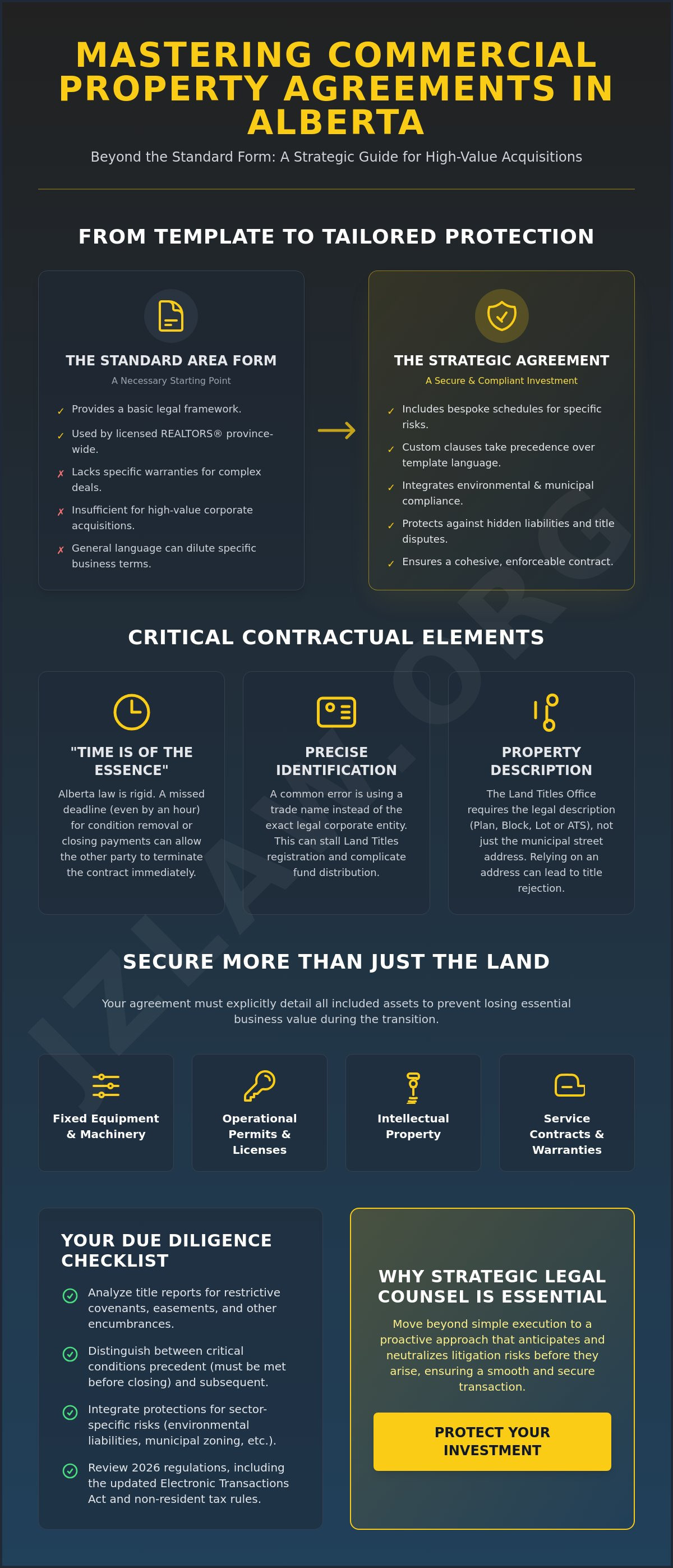
Execute thorough due diligence by analyzing title reports for restrictive covenants and distinguishing between critical conditions precedent and subsequent.
Leverage strategic legal counsel to move beyond mere execution toward a proactive approach that anticipates and neutralizes litigation risks before they arise.
Table of Contents
Understanding the AREA Commercial Purchase Contract in Alberta
The Alberta Real Estate Association (AREA) produces the standard commercial purchase contract used by licensed REALTORS throughout the province. It's a robust starting point, but sophisticated investors recognize that a generic commercial property purchase agreement alberta rarely addresses the idiosyncratic risks of a high-value acquisition. The AREA contract serves as the foundational instrument for commercial property transfer in Alberta. However, its generalized nature often lacks the specific warranties and indemnities required for complex corporate transactions, necessitating the use of bespoke schedules to bridge the gap between a standard template and a secure investment.
Successful deals rely on a clear hierarchy of documents where custom-drafted schedules take precedence over the pre-printed clauses in a Purchase and Sale Agreement (PSA). This hierarchy ensures that specific business terms, such as environmental remediation requirements or specific tenant estoppels, aren't diluted by the general language of the base form. In the 2026 regulatory environment, this precision is non-negotiable. Every added schedule must be logically integrated to ensure that the final document is a cohesive, enforceable reflection of the parties' intent.
The Role of the AREA Form in 2026 Transactions
Alberta's regulatory landscape has modernized significantly to keep pace with digital economic shifts. The March 2026 updates to the Electronic Transactions Act have clarified the use of electronic signatures, making them legally binding for most aspects of a commercial property purchase agreement alberta, though certain Land Titles Office requirements still demand traditional execution for specific interest transfers. While the Real Estate Council of Alberta (RECA) provides the consumer protection framework, your contract must go further. It's a strategic tool designed to facilitate a smooth transition, not just a procedural necessity. Balancing standardization with customization allows you to maintain the efficiency of the AREA form while layering in the protections your specific industry demands.
Parties and Property Descriptions
Precision begins with identifying the parties. A common error involves listing a trade name rather than the exact corporate entity registered with the Alberta Corporate Registry. Whether you're dealing with a numbered company or a named corporation, the contract must reflect the legal entity that holds or will hold the title. Failure to do so can stall the Land Titles Office registration process and complicate the distribution of funds.
Equally critical is the distinction between municipal addresses and legal descriptions. The Alberta Land Titles Office operates on a system of Plan, Block, and Lot, or the Alberta Township Survey (ATS) coordinates. Reliance on a street address alone can lead to significant delays or title rejection. Beyond the land itself, your agreement must explicitly detail included assets. This often includes:
Fixed equipment and specialized machinery.
Operational permits and municipal licenses.
Intellectual property related to the site's operation.
Existing service contracts and manufacturer warranties.
Without these specific details, you risk losing essential components of the business's value during the transition. A strategic advisor ensures these assets are inventoried and legally transferred as part of the closing mechanics.
Essential Clauses and Financial Terms for Alberta Buyers
The financial architecture of a commercial property purchase agreement alberta isn't merely about the final number. It's about the timing and security of capital. Alberta law is famously rigid regarding the "Time is of the Essence" clause. If a condition removal date or a closing payment is missed by even an hour, the non-defaulting party can often terminate the agreement immediately. This isn't just a formality; it's a structural risk that requires disciplined project management and clear communication between your legal team and lenders. You don't want a multi-million dollar acquisition to collapse because of a banking delay or a misinterpreted deadline.
Structuring the purchase price involves more than just a wire transfer on the closing date. Strategic buyers often utilize holdbacks and specific financing conditions to mitigate post-closing risks. For instance, if a property has unresolved repair issues or pending lease incentives, a portion of the purchase price might be held in trust until those obligations are met. This ensures the seller remains motivated to complete their responsibilities even after the title has transferred.
Deposits and Trust Provisions
Deposits serve as the primary security for a seller, signaling a buyer's commitment to the transaction. We often structure these in two tiers: an initial deposit upon execution and a more substantial additional deposit once conditions are removed. These funds are typically held in a lawyer's or brokerage's trust account to ensure they're protected. If a buyer fails to close without a legal excuse, these deposits are usually forfeited. Precise language regarding the release of these funds is essential to avoid lengthy litigation in the event of a deal collapse.
GST and Tax Structuring
Alberta's 5% Goods and Services Tax (GST) applies to most commercial transactions. However, sophisticated buyers often utilize a GST "Election" under the Excise Tax Act to avoid the immediate cash flow burden of paying the tax upfront. This allows the buyer to self-assess and offset the tax on their own return. Mismanaging this election can lead to significant interest and penalties from the CRA. Beyond federal taxes, property tax adjustments must be calculated with precision. In major hubs like Calgary and Edmonton, municipal assessments are processed annually, and the contract must clearly define how these costs are prorated between the adjustment and possession dates. Proactive Tax Structuring is vital to ensure these obligations don't erode your projected returns.
Managing these financial nuances requires a partner who understands the intersection of law and fiscal strategy. For a deeper look at how these terms impact your specific transaction, exploring John Zang Services can provide the necessary framework for a secure closing.
Industry-Specific Considerations: Cannabis, Oil, and Gas
A standard commercial property purchase agreement alberta often fails to account for the heavy regulatory burden of niche industries like cannabis or energy. These sectors operate under layers of provincial and municipal oversight that can turn a physical asset into a legal liability if not properly addressed. Success in these transactions requires more than a simple title transfer; it demands a synchronization of real estate law with specialized regulatory permits. You must ensure that every municipal license and provincial authorization is either transferred or secured as a condition of the closing, as a building without its operational permits is often of little value to a strategic investor.
Cannabis Real Estate Hurdles
Municipalities across Alberta are actively updating their Land Use Bylaws to support economic growth, yet cannabis remains a highly sensitive asset class. Distance requirements from schools, parks, and other retail sites are frequently a moving target. What was a compliant location during the letter of intent phase might become non-compliant by the time of closing due to a sudden municipal policy shift. To mitigate this, your commercial property purchase agreement alberta should include a robust "Subject to Licensing" condition. This protects the buyer's capital if the AGLC or the local municipality denies the necessary permits. For startups, we often structure these deals with lease-to-own components to provide a runway while awaiting final Cannabis Licensing approval.
Energy Sector and Environmental Due Diligence
In the energy sector, the distinction between surface rights and mineral rights is a uniquely Albertan legal hurdle that requires precise contractual language. Surface rights don't grant mineral access. If your acquisition is adjacent to energy operations, you must evaluate the Liability Management Rating (LMR) of the site to avoid inheriting decommissioning costs. The Environmental Protection and Enhancement Act (EPEA) governs contaminated sites, with remediation success measured against the Alberta Tier 1 and Tier 2 Soil and Groundwater Remediation Guidelines.
As of April 2026, the new "Co-operation Agreement on Environmental and Impact Assessment" between Alberta and the federal government aims to streamline these processes, but the burden of due diligence still rests on the buyer. We typically require both Phase I and Phase II Environmental Site Assessments (ESA) for any property with a history of industrial use. These reports identify soil contamination or "orphan wells" that could lead to millions in unforeseen remediation orders. Integrating these findings into the Oil and Gas Law framework ensures that environmental liabilities are either remediated by the seller or reflected in a significant price adjustment before the title is transferred.
The Due Diligence Process and Closing Mechanics
The period following the execution of a commercial property purchase agreement alberta is the most critical phase for risk mitigation. This window is defined by the "Condition Precedent," a legal mechanism where the contract's binding nature is contingent upon the satisfaction of specific criteria, such as securing financing or completing a satisfactory structural audit. In contrast, a "Condition Subsequent" allows a party to exit a binding agreement if a future event fails to occur. Most Alberta transactions rely heavily on the buyer's ability to satisfy sophisticated lenders, who typically demand an independent appraisal and a clean environmental report before authorizing the release of capital. If these milestones aren't met with precision, the deal risks immediate termination under Alberta's strict contractual timelines.
Title Review and Encumbrances
A meticulous analysis of the title report is essential to ensure the asset's long term viability. You aren't merely verifying ownership; you're identifying encumbrances that could severely restrict your operational freedom. Utility Rights of Way might prevent future expansions, while municipal caveats could signal outstanding development obligations that run with the land. A "Writ of Enforcement" is a particularly high risk factor. If a seller has outstanding judgments, these debts attach to the property title and must be discharged before the buyer takes possession. In the 2026 digital era, the Alberta Land Titles Office has improved registration speeds, but the complexity of these filings hasn't diminished. While Title Insurance provides a safety net against unknown defects, a current Real Property Report (RPR) remains the gold standard for identifying physical encroachments or non-compliance with municipal bylaws.
Closing Documents and Fund Transfer
The final transition of an asset is a highly choreographed exchange of documents and capital. The "Statement of Adjustments" serves as the final ledger, where the parties prorate property taxes, security deposits, and utility costs to the exact day of possession. Lawyers in Alberta typically operate under a "Closing on Trust" protocol. This system allows the buyer's counsel to hold the purchase funds until the seller's counsel delivers the executed "Transfer of Land" (TOL) and the keys. The TOL is then registered at the Land Titles Office to finalize the change in ownership. This process ensures that capital is only released once the buyer's interest is legally protected. To ensure your closing mechanics are handled with the necessary tactical precision, you can engage Real Estate Law experts to oversee the final transfer and fund distribution.
Why Strategic Legal Counsel is Essential for Alberta Commercial Deals
In high-stakes acquisitions, the distinction between a legal "closer" and a strategic advisor is the difference between simply finishing a transaction and securing a long term business advantage. A closer focuses on the mechanics of the commercial property purchase agreement alberta, ensuring the boxes are checked and the funds are wired. A strategic advisor, however, anticipates the friction points where regulatory shifts, tax liabilities, and market volatility intersect. This proactive approach is particularly vital for multi-jurisdictional transactions. When a Toronto-based investment firm or an international entity enters the Calgary or Edmonton markets, they often encounter local nuances, such as Alberta’s unique Land Titles system and the absence of provincial sales tax, which require specific contractual calibrations to optimize the deal structure.
Precise contractual language is your primary defense against litigation. Vague clauses regarding "reasonable efforts" or poorly defined condition dates often lead to disputes that can freeze assets for years. By engaging counsel that views the contract as a dynamic risk management tool, you ensure that every potential exit ramp and indemnity is clearly articulated. This level of Real Estate Law expertise transforms the agreement from a procedural hurdle into a robust shield for your capital.
Beyond the Standard Form
Standard templates cannot account for the intricate corporate tax structures that often underpin commercial deals. We move beyond the pre-printed AREA forms by drafting custom schedules that address specific holdbacks, earn-outs, and detailed "Representations and Warranties." These bespoke terms protect your interests long after the keys have changed hands, covering everything from tenant estoppel certificates to undisclosed structural defects. JZ Law specifically excels at navigating the complex regulatory intersections where emerging sectors, such as cryptocurrency operations, meet traditional industrial real estate requirements. This specialized knowledge ensures that your commercial property purchase agreement alberta is future-proofed against evolving compliance standards.
Securing Your Investment
Professional legal review prevents "deal drift," a phenomenon where incremental delays and overlooked costs slowly erode the transaction's original value. In a boutique firm environment, your acquisition receives the high-touch, time-sensitive attention it deserves. We prioritize the elimination of ambiguity, ensuring that deadlines are met and that the seller remains accountable to their pre-closing obligations. This methodical oversight is essential for maintaining the momentum of high-stakes deals while neutralizing risks before they manifest as financial losses. To ensure your next acquisition is handled with this level of tactical precision, contact JZ Law for a strategic consultation on your Alberta commercial purchase.
Securing Your Commercial Future in Alberta
Navigating a high-stakes acquisition requires more than just filling out a template; it demands a proactive legal strategy that anticipates the unique risks of the Alberta market. By prioritizing industry-specific due diligence and precise financial structuring, you transform a standard commercial property purchase agreement alberta into a robust instrument of asset protection. Whether you're managing complex environmental liabilities in the energy sector or securing municipal permits for a cannabis facility, the quality of your contractual language determines the long term stability of your investment.
John Zang provides the strategic corporate focus and boutique service necessary to handle these intricate transactions with precision. His deep expertise in specialized regulatory sectors, such as Cannabis, Crypto, and Energy, ensures that your interests are defended against both current and emerging legal challenges. To ensure your next deal is anchored by professional excellence, secure your commercial transaction with JZ Law's expert counsel. With the right partner, you can move forward with the confidence that your capital and your future operations are fully protected.
Frequently Asked Questions
Is the AREA Commercial Purchase Contract mandatory in Alberta?
Using the AREA form isn't a legal requirement, although it's the foundation for most commercial property purchase agreement alberta transactions managed by real estate agents. For complex corporate deals, legal counsel often drafts a bespoke agreement or significant custom schedules. This ensures the contract addresses the specific nuances of the asset and the buyer's corporate structure, which the standard pre-printed form might overlook.
How long is the typical due diligence period for commercial property in Calgary?
A standard due diligence window in Calgary typically spans 30 to 45 days, though complex industrial sites may require 60 days or more. This timeframe allows for structural inspections, appraisal reviews, and environmental site assessments. If your lender requires a Phase II ESA, you'll need to negotiate a longer period to accommodate laboratory testing and report finalization before the condition removal deadline.
What is a 'Schedule A' and why is it important in commercial deals?
Schedule A is a custom addendum that contains the specific terms, warranties, and conditions unique to your transaction. It's the most important part of the deal because it overrides the general clauses found in the standard AREA contract. This is where we insert protections for specific equipment, intellectual property, or environmental indemnities that are essential for the buyer's long term security.
Can I buy commercial property in Alberta through a numbered company?
Buying through a numbered company is a standard practice in Alberta for asset protection and tax efficiency. You must ensure the corporation is properly registered with the Alberta Corporate Registry before the commercial property purchase agreement alberta is executed. The contract must list the exact legal name, such as "1234567 Alberta Ltd.," to avoid registration delays or title errors at the Land Titles Office.
What happens to the deposit if I find an issue during the environmental assessment?
You'll receive a full refund of your deposit if you fail to satisfy your environmental condition before the expiry date. The contract must be drafted so that the environmental assessment is a "condition precedent" for the buyer's sole benefit. If the reports reveal soil contamination or orphan wells that exceed your risk tolerance, you can decline to remove the condition and walk away with your capital intact.
How does GST work on the purchase of a used commercial building in Alberta?
GST in Alberta is a flat 5% federal tax that applies to most commercial property sales, including used buildings. While the tax is technically payable by the buyer, registered businesses often use an election to self-assess the tax on their GST return. This avoids a large cash payment on closing. It's also important to note that as of January 1, 2026, non-resident sellers face an increased 35% withholding rate if a clearance certificate isn't obtained.
What are the specific zoning requirements for a cannabis retail location in Edmonton?
Edmonton's Land Use Bylaw imposes strict separation distances for cannabis retail, requiring stores to be a specific distance from schools and other retailers. These distances are often measured from the closest point of the property lines. You must verify the current municipal requirements during your due diligence, as these bylaws are subject to frequent updates that can impact the viability of your chosen location.
How has the Alberta Land Titles Office changed its registration process in 2026?
The Alberta Land Titles Office has modernized its intake processes following the March 2026 updates to the Electronic Transactions Act. These changes permit electronic signatures on a wider range of supporting documents, though the actual Transfer of Land often still requires traditional execution for registration. This hybrid approach has significantly accelerated the registration queue, allowing for faster title transfers while preserving the legal integrity of Alberta's land registry system.


Comments