


Environmental Site Assessment for Commercial Property: A Strategic Legal Guide (2026)
- jzanglaw
- 6 days ago
- 12 min read
Most commercial investors believe a clean title is their ultimate shield, but the most dangerous threats to your capital often lie beneath the surface, waiting to emerge as "zombie" liabilities years after the deal closes. Conducting a thorough environmental site assessment for commercial property isn't just a regulatory checkbox; it's a strategic legal instrument that defines the boundary of your future liability. You're likely aware that environmental due diligence can feel like a complex hurdle that threatens to derail a closing, especially with the shifting landscape of 2026 regulations and differing standards across jurisdictions like NYC, Toronto, and Calgary.
It's understandable to feel uneasy about the potential for deal-killing findings late in the process, but identifying these risks early is the only way to ensure long-term security. This guide provides the clarity you need to achieve 'Innocent Landowner' status and negotiate superior terms based on empirical data. We'll examine the updated ASTM E1527-21 standards, the impact of new building performance penalties like NYC's Local Law 97, and the precise steps required to maintain compliance with lenders and regulators in the current 2026 economic environment.
Key Takeaways
Understand how an environmental site assessment for commercial property identifies Recognized Environmental Conditions (RECs) to safeguard your capital from hidden liabilities.
Distinguish between the historical "paper trail" of Phase I and the physical subsurface sampling of Phase II to ensure technical data supports your legal position.
Navigate high-stakes due diligence in specialized sectors like cannabis and energy, where legacy liabilities can impact licensing and long-term asset value.
Leverage assessment findings during contract negotiations to secure price adjustments or craft robust indemnity clauses that protect your corporate interests.
Integrate environmental due diligence into your broader corporate strategy to achieve "Innocent Landowner" status and meet the stringent requirements of 2026 lenders.
Table of Contents
What is an Environmental Site Assessment (ESA) for Commercial Property?
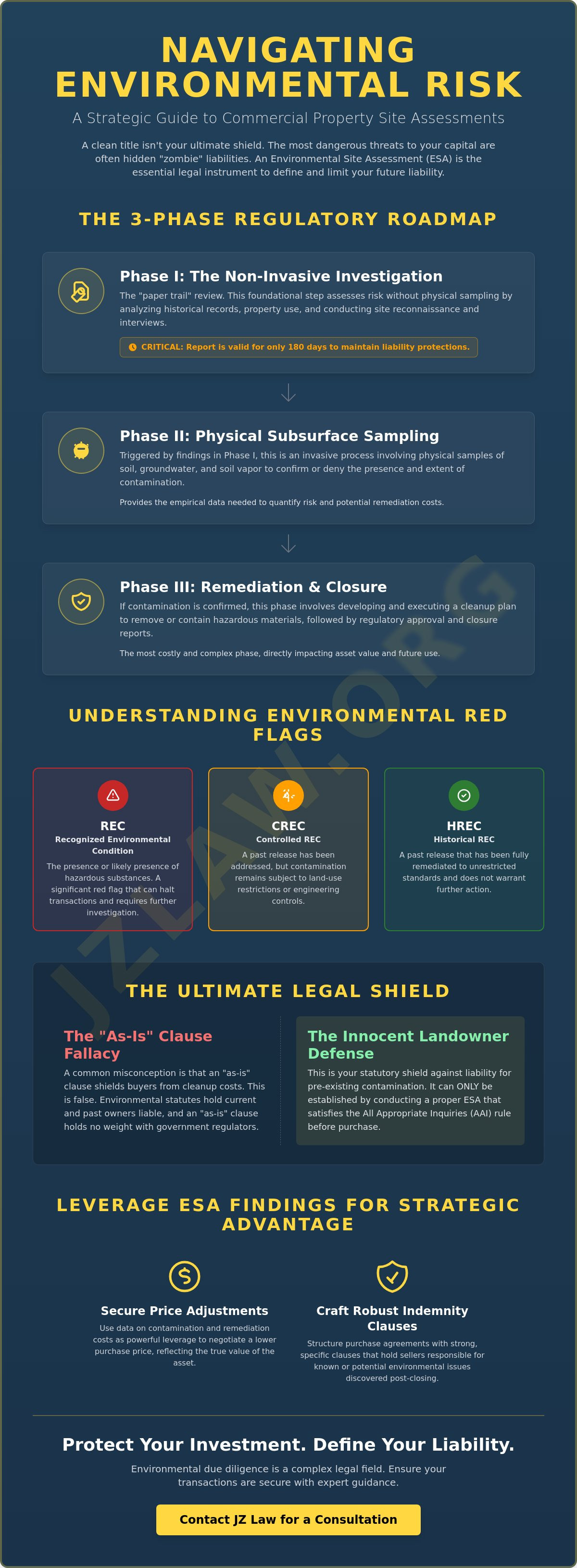
The Three Phases of Environmental Due Diligence: A Regulatory Roadmap
High-Stakes Assessments: ESAs in Cannabis, Energy, and Industrial Sectors
Beyond the Report: Leveraging ESA Findings in Contract Negotiations
Strategic Corporate Protection: How JZ Law Manages Environmental Risk
What is an Environmental Site Assessment (ESA) for Commercial Property?
An environmental site assessment for commercial property is a rigorous, multi-layered investigation designed to uncover potential contamination risks before a transaction is finalized. It isn't merely a physical inspection of the premises; it is a specialized legal due diligence report that evaluates the historical and current use of a property to determine if hazardous substances have impacted its value or safety. For investors in major hubs like NYC, Denver, and Toronto, these reports are rarely optional. Lenders in these jurisdictions mandate a Phase I Environmental Site Assessment as a non-negotiable condition for financing. This ensures that the asset securing the loan isn't compromised by hidden remediation costs that could lead to default.
The Legal Significance of the REC
Under the updated ASTM E1527-21 standards, the primary objective is to identify any "Recognized Environmental Conditions" (RECs). A REC represents the presence or likely presence of hazardous substances or petroleum products in, on, or at a property. For corporate counsel and securities regulators, a REC is a significant red flag that can halt a public offering or complicate corporate transactions. It's essential to distinguish between standard RECs and other classifications. A Historical REC (HREC) refers to a past release that has been remediated to unrestricted standards, while a Controlled REC (CREC) identifies contamination that has been addressed but remains subject to land-use restrictions. Understanding these nuances allows strategic partners to assess whether a property's environmental status fits within the firm's risk tolerance.
Why 'As-Is' Clauses Don't Protect You from Environmental Law
Many buyers mistakenly believe that an "as-is" clause in a purchase agreement shields them from future cleanup costs. This is a dangerous legal fallacy. Environmental statutes often follow the principle of joint and several liability, meaning any owner in the chain of title can be held responsible for the entire cost of remediation, regardless of who caused the initial spill. An "as-is" agreement may govern the relationship between the buyer and seller, but it carries no weight with government regulators or third-party claimants. By conducting a proactive environmental site assessment for commercial property, you establish the necessary documentation to satisfy the All Appropriate Inquiries (AAI) rule. This process is the only way to establish the 'Innocent Landowner Defense' under CERCLA, providing a vital statutory shield against liability for pre-existing contamination that was unknown at the time of purchase.
The Three Phases of Environmental Due Diligence: A Regulatory Roadmap
Environmental due diligence is rarely a linear process. It functions more like a strategic sequence of decision gates where each finding dictates the next move. For investors moving capital between major markets like NYC and Toronto, understanding the regulatory roadmap is essential. While the ASTM E1527-21 standard provides a federal framework in the United States, provincial regulations in Canada require a similar level of rigor but often involve different reporting formats. An environmental site assessment for commercial property follows three distinct phases designed to move from historical theory to physical reality.
Phase I ESA: The Non-Invasive Standard
Phase I is the investigative foundation of any transaction. It involves a meticulous review of historical records, including fire insurance maps, topographical data, and title chains to identify past high-risk tenants. This Phase I ESA overview for inspectors highlights how site reconnaissance and interviews with past property managers uncover issues that paperwork might miss. It's critical to respect the legal "shelf life" of these reports. Under EPA rules, a Phase I report is valid for only 180 days. If your closing is delayed beyond this window, you must update the assessment to maintain your statutory liability protections. Without a current report, you risk losing the 'Innocent Landowner' defense entirely.
Phase II and III: Quantifying the Risk
If Phase I identifies a Recognized Environmental Condition (REC), a Phase II assessment becomes mandatory. This stage provides the physical truth through subsurface sampling of soil, vapor, and groundwater. A Phase II is non-negotiable for properties with a history of industrial use, dry cleaning operations, or proximity to gas stations. A "positive" finding carries heavy legal implications. Certain contamination levels trigger mandatory reporting obligations to environmental authorities, which can fundamentally change the deal's trajectory. When risks are quantified, Phase III remediation strategies are often integrated as a binding closing condition in strategic corporate transactions. This phase focuses on active cleanup and obtaining regulatory closure to restore the property's value.
Strategic oversight ensures these phases don't become deal-killers. By treating each phase as a tool for risk mitigation rather than a hurdle, you protect your investment from the start. For those managing complex portfolios, consulting with experienced legal counsel can help navigate the specific provincial or state nuances that arise during this process.
High-Stakes Assessments: ESAs in Cannabis, Energy, and Industrial Sectors
Standard due diligence often fails to capture the specialized risks inherent in volatile or highly regulated industries. In these sectors, an environmental site assessment for commercial property serves as more than a safeguard; it's a foundational document for operational permits and investor confidence. The intersection of environmental risk and securities disclosure is now a critical concern for public companies. Regulators increasingly demand transparency regarding "legacy" liabilities that could impact long-term valuation. When assets move through the industrial sector, the ESA becomes the primary tool for quantifying these hidden costs before they manifest as corporate crises.
Cannabis Cultivation and Water/Soil Standards
For operators seeking cannabis licensing, the environmental history of a property can be a literal deal-breaker. Cultivators require pristine soil and water conditions. Previous industrial or agricultural use involving persistent pesticides can render a site unusable for high-grade production. Statistics from California show that cannabis product recalls increased by 800% in 2024, with many stemming from Aspergillus and soil-borne contaminants. Rigorous soil testing is essential to meet health and safety licensing standards. Operators must also navigate complex wastewater discharge compliance, as municipal jurisdictions in 2026 have tightened regulations to prevent nutrient runoff into local ecosystems.
Energy Assets and Subsurface Contamination
In the energy sector, particularly for those navigating oil and gas law in Calgary or Denver, the focus shifts to "Legacy Liability." Investors must account for orphan wells, pipeline leaks, and historical spills that may not be immediately visible on the surface. The Alberta Energy Regulator (AER) has heightened its scrutiny of environmental liability transfers, making it harder for companies to divest contaminated assets without providing significant financial security. A comprehensive environmental site assessment for commercial property is also a prerequisite for taking your energy company public. Underwriters require empirical proof that subsurface risks won't trigger catastrophic financial losses post-IPO.
Urban redevelopments in hubs like Berlin or NYC present similar challenges through 'Brownfield' sites. These properties often offer significant tax incentives but require a sophisticated understanding of historical contamination. Whether you're converting a former factory into residential units or a warehouse into a data center, the ESA provides the data necessary to quantify remediation costs before they spiral out of control. This proactive approach ensures that environmental risks are managed as strategic variables rather than unforeseen obstacles.
Beyond the Report: Leveraging ESA Findings in Contract Negotiations
An environmental site assessment for commercial property shouldn't be viewed as a final verdict, but as the beginning of a strategic negotiation. Once the technical data is in hand, the focus shifts to the Asset Purchase Agreement (APA) or Shareholder Agreement. Sophisticated investors use the ESA as a lever to reallocate risk rather than simply walking away from a deal. By quantifying the potential liability, you transform an environmental "red flag" into a clear financial variable that can be managed through precise legal drafting.
Price adjustments are the most direct application of these findings. If a Phase II reveals contamination requiring significant cleanup, that estimated cost becomes a direct deduction from the purchase price. Alternatively, buyers often utilize escrow accounts. By setting aside a portion of the purchase price specifically for Phase III remediation post-closing, you ensure funds are available without relying on the seller's future solvency. Conditional closures provide the ultimate protection. You can make the entire transaction contingent upon the seller obtaining a 'No Further Action' (NFA) letter from the relevant regulatory body, shifting the administrative and financial burden entirely onto the seller before you take title.
Drafting the Environmental Indemnity Clause
Environmental representations need extended survival periods to be effective. While standard representations might expire after 18 months, environmental indemnities often remain active for five to ten years. This reflects the reality that subsurface issues may not surface until long after the closing date. You must also define whether the indemnity covers only government-mandated cleanup or extends to third-party personal injury and property damage claims. Liability limits are often structured using a 'basket' to establish a minimum threshold for claims and a 'cap' to define the maximum total exposure the seller will assume.
Environmental Insurance as a Deal-Maker
When a seller refuses to provide a full indemnity, Pollution Legal Liability (PLL) insurance can bridge the gap between parties. These policies satisfy lender requirements by providing a dedicated source of funds for unknown pre-existing conditions. Legal counsel must review policy exclusions meticulously. Many off-the-shelf policies exclude known conditions or specific contaminants like PFAS, which can leave you exposed despite paying high premiums. Integrating these findings into a robust legal framework requires a strategic approach to risk. Consult with JZ Law to ensure your contract reflects the true environmental profile of your investment.
Strategic Corporate Protection: How JZ Law Manages Environmental Risk
At JZ Law, we don't view an environmental site assessment for commercial property as an isolated technical report. It's a cornerstone of a comprehensive corporate strategy. Our boutique structure allows for a high degree of specialization in real estate law and regulated industries, ensuring that environmental findings are integrated into your broader business objectives. We coordinate closely with environmental engineers to translate dense technical data into robust legal protections. This proactive approach ensures that potential liabilities are identified and mitigated before they can compromise your capital or corporate reputation.
Cross-Border Expertise in Global Hubs
Managing international portfolios requires a deep understanding of localized regulatory nuances. There are significant differences between NYC's Office of Environmental Remediation (OER) requirements and Toronto's Record of Site Condition (RSC) process. JZ Law provides the steady hand needed to navigate these complexities across Calgary, Vancouver, and Frankfurt. We specialize in assisting companies transitioning from private ownership to public markets. For these organizations, an environmental site assessment for commercial property is a critical component of the due diligence required for securities filings. We ensure that your environmental disclosures are accurate, defensible, and aligned with current 2026 international standards.
Consult with John Zang on Your Next Transaction
Initiating an ESA early in the acquisition process is the best way to avoid "deal fatigue" and eleventh-hour surprises. Pre-acquisition legal counseling allows us to set the parameters for the investigation, ensuring the scope covers all potential risks without unnecessary delays. We protect your interests in complex corporate and real estate transactions by anticipating regulatory shifts and lender demands before they become obstacles. Whether you're acquiring a single industrial asset or managing a diverse global portfolio, our firm provides the strategic oversight necessary for long-term security. Success in modern commercial real estate requires more than just identifying risk; it requires a partner who can manage it effectively. Secure your investment with expert legal due diligence and ensure your next transaction is built on a foundation of professional certainty.
Securing Your Commercial Future Through Strategic Oversight
Managing environmental risk in the current landscape requires a shift from reactive compliance to proactive asset protection. An environmental site assessment for commercial property serves as the empirical foundation for this shift, providing the data necessary to negotiate superior terms and establish the 'Innocent Landowner' defense. You've seen how precise legal drafting, from indemnity clauses to escrow arrangements, can transform a potential deal-killer into a manageable financial variable. Success depends on aligning technical findings with a broader corporate strategy that anticipates regulatory shifts before they impact your valuation.
JZ Law offers a principal-led boutique service that bridges the gap between technical due diligence and high-level corporate law. With expertise spanning cannabis licensing, oil and gas law, and securities regulation, we provide a multi-jurisdictional reach across Canada, the United States, and Germany. John Zang works directly with clients to ensure that every transaction is shielded from hidden liabilities. Consult with JZ Law for Strategic Real Estate Due Diligence to ensure your next acquisition is built on a foundation of professional certainty and long-term security. Your investments deserve the protection of a partner who understands the high stakes of the modern market.
Frequently Asked Questions
How long does a Phase I Environmental Site Assessment take to complete?
A standard Phase I assessment typically takes between two and four weeks to finalize. This timeline depends largely on the responsiveness of government agencies in providing historical records and the availability of the site for physical reconnaissance. If your transaction is on a compressed schedule, it's essential to initiate this process as soon as the letter of intent is signed to avoid closing delays.
Is an ESA required for commercial leases, or only for property purchases?
While an ESA isn't strictly mandated for every lease, it's a critical strategic tool for high-risk commercial tenancies. For sectors like cannabis cultivation or industrial manufacturing, conducting an environmental site assessment for commercial property before the lease begins establishes a baseline of the property's condition. This prevents the landlord from holding the tenant liable for pre-existing contamination discovered at the end of the term.
What happens if a Phase I ESA identifies a 'Recognized Environmental Condition' (REC)?
Identifying a REC serves as a strategic decision gate for the transaction rather than an automatic deal-killer. It indicates that further investigation through a Phase II assessment is required to quantify the physical risk through sampling. At this stage, your legal counsel will begin drafting specific indemnity clauses or negotiating price adjustments to account for potential remediation costs identified in the report.
Does a Phase I ESA include testing for asbestos, lead paint, or mold?
No, a standard Phase I ESA does not automatically include testing for asbestos, lead-based paint, or mold. These are considered "non-scope" items under the ASTM E1527-21 standard used for an environmental site assessment for commercial property. If you suspect these materials are present, you must specifically request a "non-scope" addition to the assessment or commission separate specialized surveys to ensure full compliance.
Who is responsible for paying for the environmental site assessment?
The buyer typically pays for the assessment as part of their standard due diligence and lender requirements. However, this is a negotiable point in the purchase agreement. In some competitive markets, a seller might commission their own report to demonstrate the property's cleanliness, though a buyer's lender will usually require a fresh report addressed specifically to the buyer to ensure legal standing.
Can I use an ESA report that was completed for the seller two years ago?
You shouldn't rely on an assessment that is two years old if you want to maintain legal protection. To qualify for the Innocent Landowner Defense, the report must be completed or updated within 180 days of the property acquisition. A two-year-old report is considered legally expired and won't satisfy the "All Appropriate Inquiries" rule required to shield you from federal environmental liability.
What is the 'Innocent Landowner Defense' and how do I qualify for it?
The Innocent Landowner Defense is a statutory provision that protects buyers from liability for pre-existing contamination they didn't cause. To qualify, you must prove you conducted "All Appropriate Inquiries" by commissioning a compliant assessment before taking title. You must also demonstrate that you had no knowledge, or reason to know, of the contamination at the time of the transaction.
How much does a Phase II ESA typically cost compared to a Phase I?
A Phase II assessment is significantly more expensive than a Phase I because it involves specialized equipment and laboratory analysis. While a Phase I focuses on historical research and site visits, a Phase II requires drilling, soil sampling, and groundwater testing. These physical investigations often cost between $5,000 and $30,000, depending on the number of samples and the complexity of the site's industrial history.


Comments