


Convertible Note vs SAFE Agreement Canada: A Strategic Guide for 2026
In the first quarter of 2026, pre-seed and seed stage investments surged to 19.8% of all capital deployed in Canada, more than doubling the historical five-year average. While this shift signals a vibrant environment for early-stage innovation, it also places founders in a high-stakes decision-making position regarding their initial capital structures. Choosing between a convertible note vs safe agreement canada is no longer just a matter of administrative convenience; it's a strategic signal of your company’s maturity and its long-term exit trajectory. You're likely balancing the need for immediate runway with the valid concern that a poorly structured deal could lead to a cluttered cap table or unexpected debt obligations.
You deserve a financing strategy that provides both security and flexibility during this period of capital concentration. This guide will help you master the legal and strategic differences between these two instruments to optimize your Canadian startup’s seed-stage financing. We'll explore how the current 4.45% prime rate affects interest expectations for notes and why the post-money SAFE has emerged as the standard for preventing dilution. By the end of this analysis, you'll understand how to choose an instrument that supports your operational goals without hindering a future IPO or M&A transaction.
Key Takeaways
Distinguish between the debt-based obligations of convertible notes and the deferred equity structure of SAFEs to protect your startup's long-term solvency.
Evaluate the strategic trade-offs of a convertible note vs safe agreement canada to effectively manage interest accrual and maturity date risks in the current 4.45% prime rate environment.
Utilize post-money SAFE agreements to enhance ownership transparency and maintain a clean cap table that remains attractive to future Series A investors.
Navigate the complex intersection of securities regulation and specialized licensing requirements for startups operating within the Canadian cannabis and cryptocurrency sectors.
Align your seed-stage financing instrument with your ultimate exit strategy, ensuring the structure supports future corporate transactions or the process of taking the company public.
Table of Contents
Seed Financing in Canada: Defining the Convertible Note and SAFE
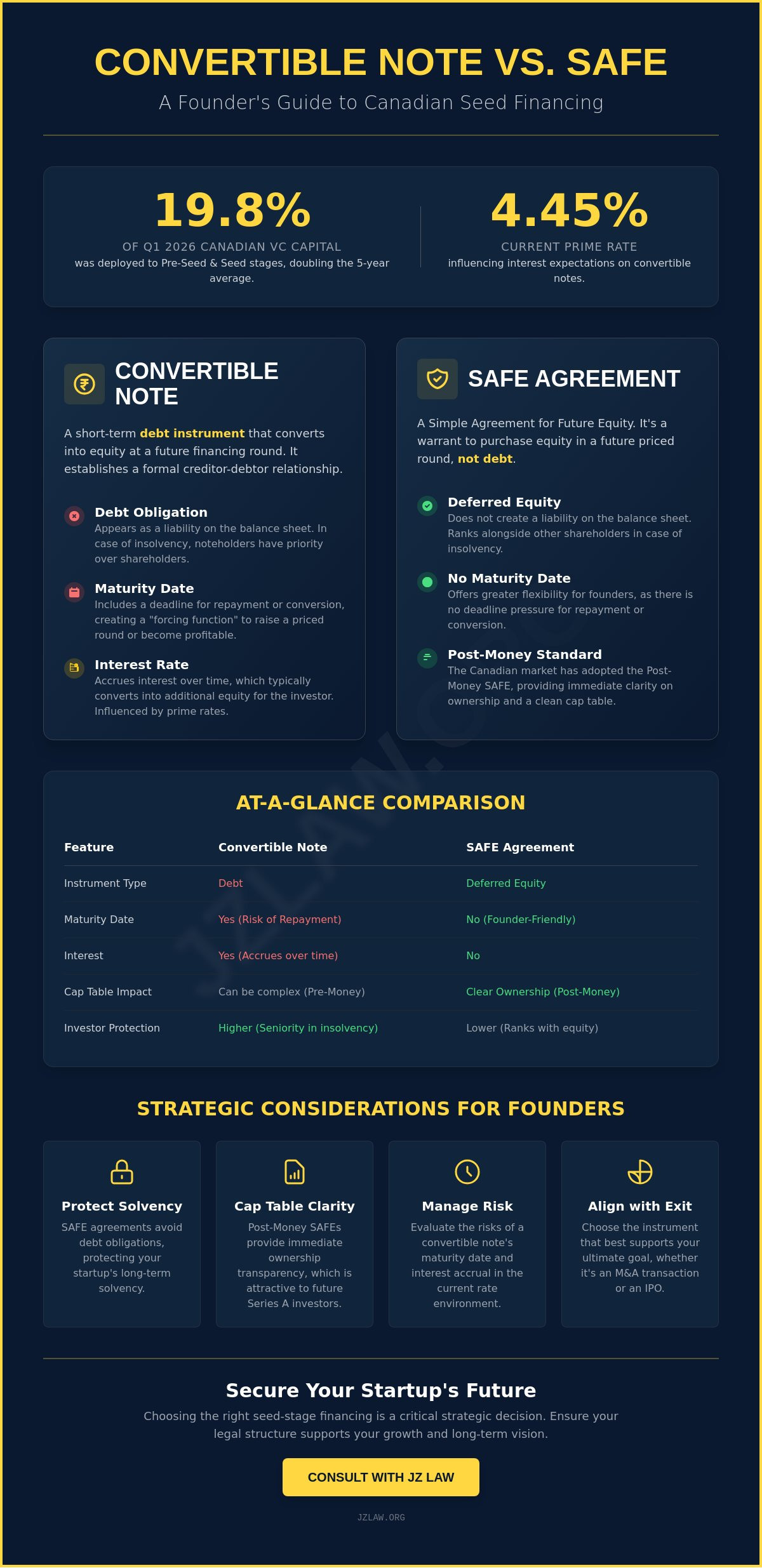
In the first quarter of 2026, Canadian venture capital investment reached $936.3 million across 104 deals, with a significant 19.8% of that capital supporting pre-seed and seed-stage companies. This surge in early-stage activity has heightened the importance of selecting the correct financing vehicle. For many founders, the decision between a convertible note vs safe agreement canada is the first major strategic hurdle in their growth journey. A Convertible Note is a short-term debt instrument that converts into equity upon a specific trigger, such as a future priced round. It typically carries an interest rate and a maturity date, creating a formal creditor-debtor relationship. In contrast, a Simple Agreement for Future Equity (SAFE) is a deferred equity purchase that lacks the debt-like features of a note, providing a more flexible path to ownership for early investors.
The primary objective for startups in 2026 is securing capital while deferring a formal valuation. In an environment where valuation caps for pre-seed rounds often range from $1 million to $3 million, establishing a fixed price too early can be counterproductive. By using convertible instruments, founders can focus on scaling operations without the immediate pressure of a priced round, which often involves more extensive legal negotiation and higher administrative costs. This strategic deferral allows the company's value to be determined when it has more robust metrics and market traction.
The Evolution of the SAFE in the Canadian Market
While the SAFE was originally popularized by Y Combinator, the Canadian ecosystem has largely adopted the "Post-Money" SAFE as the operational standard. This version provides founders and investors with immediate clarity regarding ownership percentages, which is essential for maintaining a transparent cap table. In 2026, this transparency is a prerequisite for sophisticated investors who are navigating a market characterized by capital concentration. The shift toward post-money templates reflects a more mature founder-investor dynamic in Canada, where both parties seek to eliminate the ambiguity associated with older pre-money versions. It's a move toward professional dignity and logical clarity in early-stage deals.
When Deferring Valuation is a Strategic Advantage
Deferring valuation helps startups avoid the "down round" trap, a significant concern given that 16% of Canadian financings in 2023 were down rounds. This approach allows companies to reach key milestones before setting a price per share, potentially leading to a higher valuation at the Series A stage. These agreements also facilitate rapid corporate transactions by streamlining the closing process. By reducing legal friction and the need for exhaustive due diligence at the seed stage, founders can maintain their speed to market and focus on the technical or commercial development of their products. It's about efficiency without sacrificing legal protection.
The Convertible Note: Managing Debt and Maturity in Canada
A convertible note represents a sophisticated debt instrument that establishes a formal creditor-debtor relationship between the startup and its investors. Unlike a deferred equity purchase, the note remains a liability on the company's balance sheet until it converts or is repaid. This distinction carries significant weight in the event of insolvency, as noteholders generally rank higher than shareholders in the priority of claims against company assets. This structural seniority provides a layer of protection for investors that isn't present in a standard SAFE. The strategic choice of a convertible note vs safe agreement canada often hinges on how a founder views the pressure of a maturity date, which serves as a critical "forcing function" to either raise a priced round or achieve profitability before the debt becomes due.
Conversion mechanics typically revolve around two primary triggers: Qualified Financing and Non-Qualified Financing. A Qualified Financing event is usually defined by a minimum capital raise threshold, which automatically triggers the conversion of the debt into equity at a predetermined discount or valuation cap. If the company fails to reach this threshold before the maturity date, the note may convert under Non-Qualified Financing terms or require repayment. This legal framework ensures that the investment doesn't remain in a state of perpetual debt, but it also requires founders to be exceptionally precise in their growth projections. For a deeper look at these mechanics, you can review the analysis from SkyLaw on SAFEs vs. Convertible Notes, which details the nuances of investor rights in the Canadian market.
Interest Rates and Maturity Date Negotiations
As of May 2026, the Bank of Canada policy interest rate stands at 2.25%, with the prime rate across major banks holding steady at 4.45%. These benchmarks directly influence the private market, where typical interest rates for convertible notes currently range from 2% to 8% annually. Founders must negotiate maturity dates that align with their operational milestones, with 18 to 24 months remaining the standard timeframe. It's common to include provisions for automatic conversion at maturity or options for maturity date extensions, though these often require the consent of a majority of noteholders. Proper strategic planning for corporate transactions can help ensure these deadlines don't lead to a technical default.
Regulatory and Security Considerations
Investors frequently demand a General Security Agreement (GSA) to secure the note against the startup's assets, including intellectual property. While this protects the investor, it can complicate the company's ability to secure senior debt or venture debt in the future, as those lenders typically require first-priority security. From a tax perspective, Canadian corporations must consider the deductibility of interest payments and the potential for non-resident withholding tax if the investors are located outside of Canada. These regulatory layers add complexity to the convertible note vs safe agreement canada debate, making the note a more administratively heavy but often more "investor-friendly" option for mature seed-stage companies.
The SAFE Agreement: Equity Flexibility and Cap Table Impact
The Simple Agreement for Future Equity (SAFE) represents a paradigm shift in seed financing by removing the rigid constraints of traditional debt. Unlike the instruments explored in the previous section, a SAFE doesn't carry an interest rate or a maturity date, effectively eliminating the risk of a technical default due to an arbitrary deadline. This open-ended nature allows founders to focus entirely on product-market fit and operational scaling without the looming pressure of a repayment obligation. When analyzing a convertible note vs safe agreement canada, the primary advantage of the SAFE lies in its administrative simplicity and its classification as a deferred equity purchase rather than a liability on the company balance sheet.
In the current Canadian market, the "Post-Money" SAFE has become the preferred template because it offers unparalleled ownership transparency. By calculating the investor’s ownership based on a post-money valuation cap, founders can see exactly how much of the company they're giving away before the next priced round. This clarity is often accompanied by "Pro-Rata" rights, which grant investors the option to participate in future financing rounds to maintain their ownership percentage. These rights are a common feature in Canadian SAFEs, ensuring that early supporters aren't unfairly diluted as the company attracts larger institutional capital during subsequent corporate transactions.
Valuation Caps and Conversion Discounts
A valuation cap serves as a ceiling, protecting investors from being diluted into insignificance if the company’s value skyrockets before a priced round occurs. Conversely, the conversion discount rewards early risk-takers by allowing them to purchase shares at a lower price than Series A investors. Typical 2026 market ranges for these discounts fall between 15% and 25%, reflecting the high-risk nature of seed-stage participation. Some SAFEs are structured with only a cap, while others include both a cap and a discount, with the investor receiving the benefit of whichever mechanism results in a lower share price. Balancing these terms is a critical part of maintaining founder control over the long term.
Managing the "Dilution Surprise"
The flexibility of the SAFE can lead to a "dilution surprise" if a founder stacks multiple agreements without maintaining a pro-forma cap table. Since SAFEs don't convert until a priced round, it's easy to lose track of the cumulative equity promised to various investors. This issue is compounded by the typical requirement to increase the employee option pool during a Series A, which further dilutes the founders. Our approach at JZ Law involves rigorous modeling of these conversion scenarios prior to signing. We ensure that every convertible note vs safe agreement canada decision is backed by a clear understanding of how it affects future exit proceeds and compliance with securities regulation. Maintaining a clean cap table today is the best way to ensure a smooth transition to the public markets tomorrow.
Convertible Note vs SAFE: Strategic Comparison for Canadian Founders
The choice between a convertible note vs safe agreement canada serves as a powerful signal to the market regarding a startup’s operational philosophy and its confidence in future milestones. While SAFEs offer a streamlined, low-cost path to capital, they lack the structural rigour that some institutional investors demand during periods of market volatility. In contrast, the convertible note imposes a disciplined timeline through its maturity date, signaling to the market that the leadership team is prepared to manage debt-like obligations and meet specific growth targets. This distinction is particularly relevant in 2026, as Canadian venture capital remains concentrated in a few large funds, making the "signaling effect" of your financing instrument more critical than ever.
Administrative burden also varies significantly between the two. SAFEs require minimal ongoing maintenance, whereas convertible notes necessitate precise accounting for accrued interest and monitoring of maturity dates to avoid technical defaults. For founders, the decision involves balancing this administrative weight against the need to attract specific types of capital. If your long-term strategy involves taking your cannabis company public or pursuing a high-value acquisition, the clarity of your initial financing structure will be scrutinized during the intense due diligence phases of those transactions.
Investor Perception and Fund Dynamics
Institutional venture capitalists in Canada, particularly those navigating the current "liquidity drought," often prefer convertible notes because of the downside protection they provide. As creditors, noteholders have a superior claim to assets compared to SAFE holders if a company faces insolvency. Conversely, angel investors and accelerators typically default to SAFEs to prioritize speed and reduce legal friction. When negotiating with US-based investors, Canadian founders must be cautious about adopting the "Delaware standard" without modification. Ensuring that your agreement complies with Canadian securities laws while remaining recognizable to international partners is a delicate but necessary balance for global scaling.
Exit Readiness: M&A and IPO Considerations
In an M&A scenario, both SAFEs and notes generally convert into equity or are paid out, but the presence of "phantom debt" from unconverted notes can complicate a balance sheet during IPO pricing. For companies pursuing a reverse takeover (RTO) into a public shell, the conversion mechanics must be perfectly aligned with the transaction's timing to prevent cap table distortions. Poorly structured instruments can lead to excessive dilution that frustrates new public shareholders. If you are preparing for high-level growth, our team provides expert guidance on securities regulation and corporate transactions to ensure your seed-stage decisions don't hinder your eventual exit. Choosing the right instrument today ensures you maintain the professional dignity required for a successful transition to the public markets.
Selecting the Right Instrument for Your Industry: Cannabis, Crypto, and Energy
The strategic utility of a convertible note vs safe agreement canada often depends on the specific regulatory environment of your sector. In industries where government oversight is intensive, the choice of financing instrument can impact your ability to maintain compliance or secure necessary permits. Founders in 2026 must look beyond simple dilution metrics and consider how their capital structure interacts with the specialized requirements of their field. Whether you're managing the complexities of cannabis licensing or the rapid shifts in cryptocurrency law, your legal framework must be proactive and preventative. Each instrument carries a different weight when scrutinized by regulators or institutional partners during a liquidity event.
High-Regulatory Sectors: Cannabis and Crypto
Startups in the cannabis and crypto sectors often face heightened volatility and unpredictable timelines. For these founders, the SAFE is frequently the preferred instrument because it avoids the risk of a technical debt default during a regulatory delay. In the crypto sector, 2026 has introduced significant updates, including the implementation of the Crypto-Asset Reporting Framework (CARF) and new FINTRAC obligations effective as of March 26, 2026. These regulations require virtual asset service providers to maintain rigorous tax and compliance records. Using a SAFE ensures that a sudden shift in securities regulation doesn't trigger a maturity date crisis while the company is adjusting its operational model. It's a method of preserving stability while the regulatory dust settles, allowing the leadership team to focus on compliance rather than debt servicing.
Traditional and Energy Sectors: Calgary and Denver Nuances
In asset-heavy industries like the oil and gas sector, convertible notes remain the dominant choice. Investors in Calgary and Denver often prefer the security of a debt instrument that can be backed by physical assets or proven reserves. This structure is also effective for bridging to a real estate or infrastructure development project, where the maturity date aligns with project completion milestones. Because these sectors involve high capital expenditures, the "forcing function" of a note provides investors with the professional dignity and assurance they require. Closing these deals successfully requires a specialized corporate lawyer who can draft custom terms that protect both the founder's equity and the investor's security interest. Ultimately, your choice of a convertible note vs safe agreement canada should reflect the maturity of your industry and the specific expectations of your capital partners.
Securing Your Startup's Future Through Informed Financing
Navigating the nuances of a convertible note vs safe agreement canada requires more than just a template; it demands a comprehensive understanding of how these instruments influence your company's long-term trajectory. While SAFEs offer the flexibility necessary for rapid scaling in volatile sectors like cryptocurrency, convertible notes provide the structural discipline often preferred by institutional investors in asset-heavy industries. Your decision today will ultimately dictate the ease of your transition to the public markets or your success in high-value corporate transactions. Each clause and conversion trigger represents a strategic choice that should align with your eventual exit goals.
As you prepare for your next growth phase, Principal Lawyer John Zang offers the specialized industry experience required to navigate complex securities regulation, cryptocurrency law, and cannabis licensing. Our firm provides the strategic counsel necessary to manage early-stage financing while preparing for future IPOs and public listings. We prioritize a proactive, megelőző szemléletmód (preventative approach) that eliminates risks before they manifest on your cap table. Consult with JZ Law on your next strategic corporate transaction to ensure your legal framework is as robust as your business vision. Your path to market leadership begins with a foundation built on precision and foresight.
Frequently Asked Questions
Is a SAFE agreement legally binding in Canada?
Yes, a SAFE is a legally binding contract between a startup and an investor that outlines the terms of a deferred equity purchase. While it's a valid legal instrument, it must also comply with provincial securities laws, meaning it's typically issued under a prospectus exemption. Founders must ensure the agreement is properly executed to avoid future disputes during corporate transactions or audits.
What is the standard interest rate for a convertible note in 2026?
Typical interest rates for convertible notes in the Canadian market currently range from 2% to 8% annually. This market range is influenced by the 4.45% prime rate maintained by major Canadian banks as of May 2026. When evaluating a convertible note vs safe agreement canada, founders should remember that these interest rates compound over time, potentially increasing the total number of shares issued upon conversion.
Do SAFEs appear on a Canadian company’s balance sheet as debt?
No, SAFEs are generally not classified as debt or a liability on a balance sheet because they lack a maturity date and a repayment obligation. They're typically recorded as a component of equity or a deferred equity commitment, which keeps the company's debt-to-equity ratio favorable. This distinction is a primary reason why many early-stage founders prefer SAFEs over traditional debt instruments.
Can I convert a SAFE into a Convertible Note later?
It's technically possible to convert a SAFE into a convertible note through a formal amendment, but this requires the mutual consent of the company and the investor. Such a change is rare and usually only occurs if a major institutional investor demands a debt structure for downside protection during a bridge round. Any such modification must be carefully documented to reflect the new creditor relationship and interest accrual terms.
How does the Canada Revenue Agency (CRA) view SAFE agreements?
The CRA has indicated that it doesn't consider a SAFE to be a share, bond, or debenture for the purposes of specific sections of the Income Tax Act. This perspective creates some uncertainty regarding the exact tax treatment at the moment of conversion into equity. Founders should consider how this convertible note vs safe agreement canada distinction affects their tax structuring, especially if they have non-resident investors who may be subject to withholding taxes.
What happens to a Convertible Note if the company is acquired before conversion?
Acquisitions usually trigger the "Change of Control" provision in a convertible note, which typically gives investors a choice between two outcomes. They can either receive a cash repayment of the principal plus accrued interest or convert their note into equity at a predetermined premium to participate in the sale proceeds. The specific terms of this payout are a critical part of the initial negotiation and affect the final distribution of exit capital.
Should I include a valuation cap in my first SAFE?
Yes, including a valuation cap is standard practice in 2026 to provide investors with protection against excessive dilution if the company's value grows rapidly. Without a cap, an early investor’s ownership stake could be significantly reduced during a high-valuation Series A round. For pre-seed startups in Canada, valuation caps often range from $1 million to $3 million, ensuring that early risk-takers are fairly rewarded for their participation.
How do securities laws in Ontario and Alberta affect these instruments?
Regulators like the OSC and ASC treat both convertible notes and SAFEs as securities, which requires companies to find a valid prospectus exemption for every issuance. Common exemptions include the Accredited Investor exemption or the Private Issuer exemption, which allow startups to raise capital without the expense of a full prospectus. Compliance with these provincial rules is essential for maintaining a clean legal record, especially for companies that eventually intend to go public.



Comments