


Corporate Lawyer for International Expansion in Frankfurt
A corporate lawyer for international expansion in Frankfurt can help a Canadian business plan its entry into Germany, from choosing a business structure to documenting a joint venture and considering cross-border tax structuring. These decisions should support the company’s commercial goals and clarify key issues before it commits to a structure or transaction.
Expanding into another market involves more than establishing a local presence. Ownership, governance, investment terms and the relationship between Canadian and German operations all affect how a business can grow and manage risk.
This article explains how Frankfurt corporate lawyers support business set-ups, joint ventures, corporate structuring, tax planning and international growth. It also outlines when legal advice can be especially useful and what to consider when selecting counsel, so you can approach expansion with a clearer view of the decisions ahead.
Table of Contents
Business set-ups and joint ventures
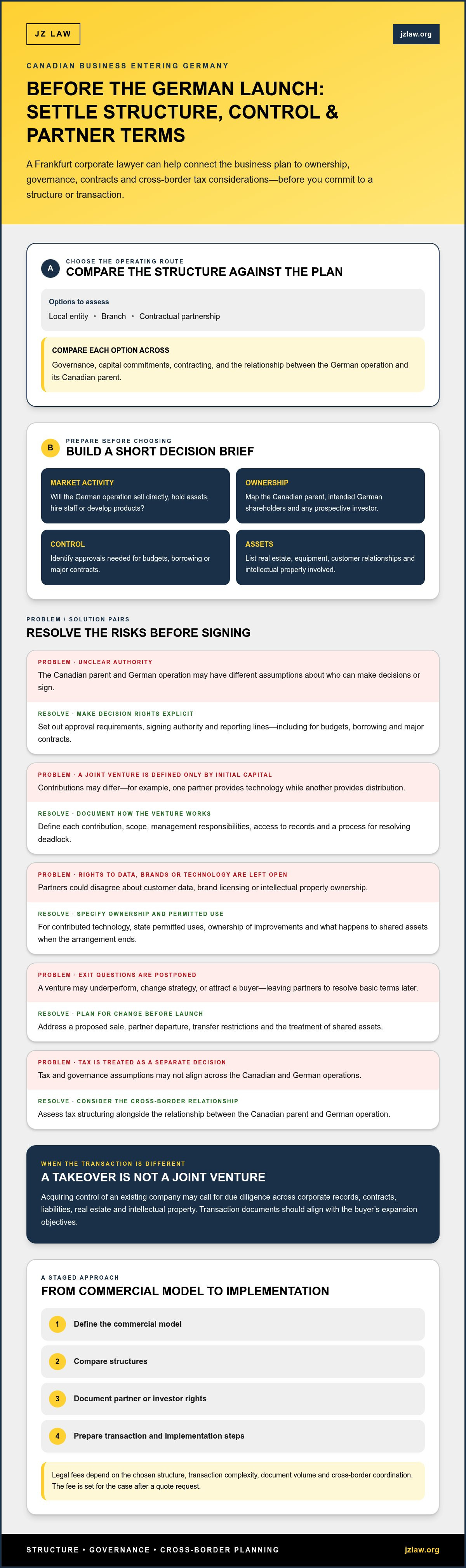
For a Canadian company entering Germany, an early decision is how to operate: through a local entity, a branch or a contractual partnership. Each option affects governance, capital commitments, contracting and the relationship between the German operation and its Canadian parent. A corporate lawyer for international expansion in Frankfurt can help compare these options against the business plan, rather than treating registration as a stand-alone task.
Legal fees for German company formation and expansion depend on the chosen structure, transaction complexity, document volume and cross-border coordination; the fee is set for the case after a quote request. Those factors also help define the work involved, from reviewing ownership arrangements to drafting joint venture terms.
Common risks in a German expansion include unclear authority, incomplete contracts, unresolved intellectual property ownership, and inconsistent tax or governance assumptions. For example, a Canadian parent and a German partner could disagree about who controls customer data or licenses a brand if their agreement leaves those rights unclear.
Frankfurt remains a key focus area for US firms expanding into Germany, and the city offers a substantial legal market. The Frankfurt Bar Association had almost 20,000 members as of 01.01.2021 and was Germany’s second largest bar association. For an incoming business, the relevant question is not simply how many lawyers are nearby, but whether counsel can address the transaction’s commercial and cross-border dimensions.
Before choosing a structure, prepare a short decision brief covering:
Market activity: Specify whether the German operation will sell directly, hold assets, hire staff or develop products.
Ownership: Map the Canadian parent, intended German shareholders and any prospective investor.
Control: Identify which decisions require approval, such as budgets, borrowing or major contracts.
Assets: List any real estate, equipment, customer relationships and intellectual property involved.
Counsel can use that brief to compare the practical implications of a subsidiary, branch or joint venture. The analysis should connect ownership with signing authority, funding, reporting lines and future plans. For example, a business expecting an outside investor may need different governance provisions from a wholly owned German operation.
A joint venture requires more than agreement on initial capital. The parties should define each contribution, the venture’s scope, management responsibilities, access to records and procedures for resolving deadlock. If one partner contributes technology and another contributes distribution, the contract should specify permitted uses, ownership of improvements and what happens when the arrangement ends.
Plan for an exit before launch. The agreement can address a proposed sale, a partner’s departure, transfer restrictions and the treatment of shared assets. These terms matter if the venture underperforms, changes strategy or attracts a buyer. Clear drafting sets out a process instead of leaving fundamental questions to a later dispute.
A public takeover differs from forming a joint venture. It involves acquiring control of an existing company, so the buyer’s review may cover corporate records, contracts, liabilities, real estate and intellectual property. A lawyer handling corporate transactions can help organise due diligence, assess transaction documents and align the proposed acquisition with the buyer’s expansion objectives.
Use a staged process: define the commercial model, compare structures, document partner or investor rights, then prepare the transaction and implementation steps. This helps a Canadian business identify unresolved ownership and control issues before signing. For a Frankfurt launch, tailored advice is most useful when it addresses both the chosen structure and the business decisions it must support.
Legal support for national and international growth
Growth brings legal decisions beyond the initial company set-up. A Frankfurt business may need to review customer contracts, investment terms, employment arrangements and intellectual property before entering another market. A Canadian company expanding into Germany also needs to align local agreements with its existing corporate structure. A clear legal work plan identifies which decisions come first and which documents depend on them.
For startups, an early review can prevent a short-form agreement from leaving core commercial terms unresolved. German startups, founders and shareholders should seek legal advice when a contract is difficult to assess by reading it alone. For example, an investor agreement may link equity, control rights, funding conditions and future share transfers. Reviewing those provisions together helps founders understand how one commitment may affect later investment rounds.
Before signing a significant contract, organise the review around its commercial purpose and practical consequences. Identify the parties, deliverables, payment arrangements, ownership of work product, termination rights and dispute process. A distribution agreement, for instance, should specify its territory and how the parties handle customer information. The precise provisions depend on the transaction, but a written issue list gives counsel a clear starting point.
Legal networks can help coordinate separate questions across Canada and Germany, particularly when a German contract depends on a Canadian parent-company decision or a transaction involves assets and counterparties in both countries. Assign a lead contact, define which jurisdiction each adviser addresses, and agree how advice and draft documents will be shared. This helps reduce inconsistent assumptions across domestic and cross-border work.
Choose the coordination model according to the transaction. A Canadian company opening a German office may need local advice on German documents and separate Canadian advice on parent-company approvals. A cross-border investment may require both teams to review the same closing timetable while keeping their legal analysis jurisdiction-specific. For each workstream, record the decision-maker, required documents and dependencies before execution begins.
Dispute planning also belongs in growth contracts. Parties can consider whether negotiation, mediation, court proceedings or arbitration best fits the relationship and type of dispute. The agreement should describe the chosen process clearly, rather than leaving the parties to interpret an incomplete clause during a conflict. For example, a software venture and its German distributor may prefer a defined escalation process before formal proceedings.
Hiring in Germany adds another workstream. Review employment documents, workplace policies and management responsibilities alongside the expansion plan, especially when adapting Canadian practices for German operations. In Germany, employees can deduct legal fees as income-related expenses when the fees relate to an employment-law matter. This concerns the employee’s tax treatment, not a company’s general legal costs.
A useful sequence is to map the expansion, list contracts and decisions, identify which jurisdiction governs each issue, then coordinate review before signing. For property-related growth, such as acquiring or leasing premises, real estate legal support can address the property dimension of the wider business plan.
Corporate structuring and tax
A Canadian company entering Germany should consider legal structure and tax planning together. The structure determines how the German operation relates to its parent, shareholders and investors. Tax advice then considers the commercial purpose and financial flows across that arrangement. As a growth plan develops, document the assumptions behind the initial structure.
For example, a Canadian parent may fund a German subsidiary directly, bring in a new investor or use a joint venture. Each option can affect ownership, decision-making and how the business records its investment. Before choosing, map the entities, shareholders, expected funding and planned activities. This gives advisers a practical basis for assessing the structure instead of starting with a preferred legal form.
Review significant changes before making commitments. In Germany, legal advice is recommended when company decisions involve shareholders or investors joining or leaving a company. This includes a proposed equity investment, a shareholder exit or a change to ownership rights. A written decision record can help clarify the commercial rationale and relevant approvals.
German startups’ legal fees are usually tax-deductible as a business expense when the advice serves the business interest. The tax treatment of shareholders’ legal fees related to an investment can depend on the circumstances, so it is worth reviewing them separately. The distinction matters: company advice and an individual shareholder’s investment advice relate to different tax positions.
A structured review can begin with four documents or workstreams:
Ownership map: Show the Canadian parent, German entity, shareholders and planned investors.
Funding plan: Describe expected capital contributions, loans or private equity investment.
Decision record: Identify the approvals needed for investment, ownership changes or restructuring.
Tax questions: Separate company-level advice from shareholders’ individual investment questions.
This process helps identify where the German entity’s business purpose, ownership and funding plan need closer analysis. For instance, a company planning to hold real estate may need a different structural review from one focused on product development. The goal is to connect the legal form to actual operations, not to choose a structure based on its label alone.
For a Canadian business with European ambitions, consider whether the German arrangement will serve one market or support wider regional growth. Record where key decisions sit, which entity enters contracts and how future investors could participate. These questions help counsel assess the proposed structure and identify assumptions to clarify before a transaction advances.
Revisit tax structuring when the business model changes. A new investor, asset purchase or company exit can alter the facts underlying earlier advice. Record material changes and their timing, then review the structure before signing related documents. This can help align corporate transactions with the company’s current commercial plans.
Finally, distinguish preventive structuring from dispute response. Clear ownership and funding records can make later disagreements easier to analyse, while litigation concerns may need a separate assessment. A corporate lawyer can review transaction documents, shareholder arrangements and business objectives together, giving decision-makers a reasoned basis for choosing the next step.
Frankfurt/Main corporate law firms
Frankfurt/Main’s legal market offers a broad range of potential counsel. A directory lists 266 law firm matches for Frankfurt/Main, Germany, so the number alone cannot identify the right fit. Narrow the search by transaction type, German market knowledge, cross-border coordination and the team’s ability to represent your commercial interests.
How should you choose a Frankfurt corporate law firm for international expansion? Compare the proposed team’s experience with your specific needs, such as market entry, mergers, investment or real estate. Ask for a clear scope, defined responsibilities and an explanation of how German advice will connect with your Canadian business decisions.
The local professional community is substantial. The Frankfurt Bar Association had almost 20,000 members as of 01.01.2021 and was Germany’s second largest bar association. That figure provides context, not a ranking of corporate expertise. For a Canadian company, the relevant counsel should understand the transaction’s commercial goals and the coordination needed across jurisdictions.
Start by describing the work in practical terms. A company preparing an acquisition can outline the target, key contracts, ownership questions and intended timetable. A business leasing premises can identify the property decision and intended commercial use. These details help a firm explain who would handle each aspect and how the work would be organised.
Compare proposals using consistent criteria:
Relevant work: Match the firm’s proposed experience to your planned transaction, such as an acquisition or joint venture.
Team structure: Identify the lead counsel and who will handle corporate, employment or property questions.
Cross-border coordination: Clarify how German advice will align with Canadian parent-company approvals and documents.
Scope and process: Request a description of deliverables, decision points and communication arrangements.
A leading firm is not automatically the right choice for every mandate. A large merger may call for coordinated specialist teams, while a focused contract review may need a narrower scope. The key is whether the proposed team can explain its approach in terms of your actual opportunities, risks and decisions.
For example, a Canadian company considering a German acquisition should understand who will review corporate records, key contracts and property interests. If employment matters also affect the transaction, establish how those questions fit into the proposed work. The firm’s plan should show how connected issues will be tracked and who is responsible for each task.
Before appointing counsel, prepare a concise briefing note with your expansion objective, proposed structure, counterparties, known deadlines and principal concerns. Compare each firm’s response against the same points. This makes differences in scope and proposed teams easier to assess, without relying on firm size or broad claims alone.
If a proposed transaction involves an acquisition, merger or ownership change, discuss corporate transaction support as part of your counsel assessment.
Practical arrangements can also matter when counsel and company representatives need to meet in person. The S-Bahn journey from Frankfurt Rhine-Main Airport to Taunusanlage is followed by an approximately 10-minute walk to Main Tower. A public parking garage is near Main Tower at Junghofstraße 16, 60311 Frankfurt am Main. These details may help when planning a visit or comparing meeting locations, but convenience should remain secondary to the team’s ability to address the mandate. Ask how the lawyers will make themselves available for decisions, document review and discussions as the work progresses, rather than relying on an office location alone.
If the mandate could involve building a team in Germany, ask about the firm’s staffing model and how responsibility is allocated. US firms hiring associates in Germany generally expect candidates to have scored 9+ in each of the two State Exams. Associates at expanding US firms in Germany are expected to take early ownership and work confidently in lean, high-performing teams. For a client, those expectations make it useful to ask who will lead the work, how senior lawyers will supervise it and which team members will be available for day-to-day coordination. Clear answers can help you assess whether the proposed staffing approach suits the matter and whether the team can maintain continuity while responding to your business priorities.
JZ Law: John Zang Services
JZ Law is a relevant next step when growth plans involve securities regulation or preparing a company to go public. These matters can shape financing options, ownership and the information a business organises for investors. JZ Law also provides Cannabis Licensing for businesses addressing this specific regulatory area.
For a Canadian company considering international growth, JZ Law is most relevant when plans involve its corporate and securities services. Its Taking Companies Public and Securities Regulation services relate to capital markets. Frankfurt-specific legal advice may be needed for German company formation, local contracts or joint ventures, so define each workstream and assign it to counsel suited to that jurisdiction.
To discuss how JZ Law’s services relate to your business plans, contact JZ Law or visit jzlaw.org.
Turn your expansion plan into a clear next step
Before committing to a German market-entry plan, identify the business decision that needs attention first. It may be financing, investor readiness or a regulated activity rather than the entity structure itself. A corporate lawyer for international expansion in Frankfurt can connect legal decisions with the commercial objective while keeping each workstream’s scope clear.
JZ Law offers John Zang Services, Cannabis Licensing and Taking Companies Public. These services are relevant when a company’s plans involve cannabis licensing or preparing for a public offering. For German incorporation, local contracts or a Frankfurt joint venture, define the legal work around those specific needs.
A concise outline of your objectives, planned transactions and key decisions can provide a productive starting point for a discussion. Contact JZ Law about expansion to discuss how its services may relate to your business plans.
With a defined objective and the right legal questions in view, you can approach your next growth decision with greater clarity.
Frequently Asked Questions
Which Frankfurt law firms handle corporate work for international expansion in Germany?
A directory lists 266 law firm matches for Frankfurt/Main, Germany, but that figure isn’t a quality ranking. A corporate lawyer for international expansion in Frankfurt should be assessed against your specific needs, such as coordinating German contracts with Canadian parent-company approvals. For example, a company planning a German acquisition can ask how the proposed counsel would organise document review, identify decision-makers and report transaction issues.
How do you establish a German subsidiary or branch in Frankfurt?
Start by deciding whether your German operation should be a subsidiary, another distinct entity or a branch connected to the Canadian parent. Prepare a plan describing ownership, management authority, business activities, funding and the documents needed from the parent company. For example, clarify who can sign contracts for the Frankfurt operation. Local legal and tax advice can help map the steps and coordinate formation with the wider expansion plan.



Comments