


Corporate Legal Support in Calgary: A Strategic Guide
Updated: Oct 12
A legal issue that shapes a major business decision can surface months before a transaction. A supplier agreement, ownership change, financing plan, or regulatory question may affect what comes next. For Calgary businesses searching for “ongoing corporate legal support Calgary,” the practical question is how to connect day-to-day decisions with longer-term business goals, rather than treating each legal issue as an isolated matter.
Seeking counsel only when a contract needs review or a major deal is underway can make it harder to spot issues early and assess decisions in context. Ongoing support is not about adding process to every decision. It is about having a consistent legal perspective as business needs evolve.
This guide explains which recurring legal needs may benefit from an ongoing relationship, how external counsel compares with one-off advice or in-house support, and what Calgary and Alberta businesses can consider as practical next steps. It also looks at how corporate and industry-specific matters, including securities, tax structuring, and regulated sectors, can intersect as a company prepares for growth.
Table of Contents
What Ongoing Corporate Legal Support Means for Calgary Businesses
Corporate legal questions rarely arrive in isolation. A proposed contract may affect financing plans; a change in ownership can raise governance and transaction considerations; and growth into a regulated area can add another layer of complexity. For a business considering ongoing corporate legal support in Calgary, the central question is whether legal advice should connect recurring decisions instead of being sought only when a specific issue becomes urgent.
Ongoing corporate counsel is continuing legal advice shaped by a business’s evolving needs and context, rather than advice limited to one transaction or occasional question. With continuity, counsel can relate a new decision to prior agreements, corporate records, financing discussions, and planned growth. This context can help leaders identify issues while they still have options, before a legal question disrupts operations or delays a business objective.
How ongoing counsel differs from hiring a lawyer for one matter
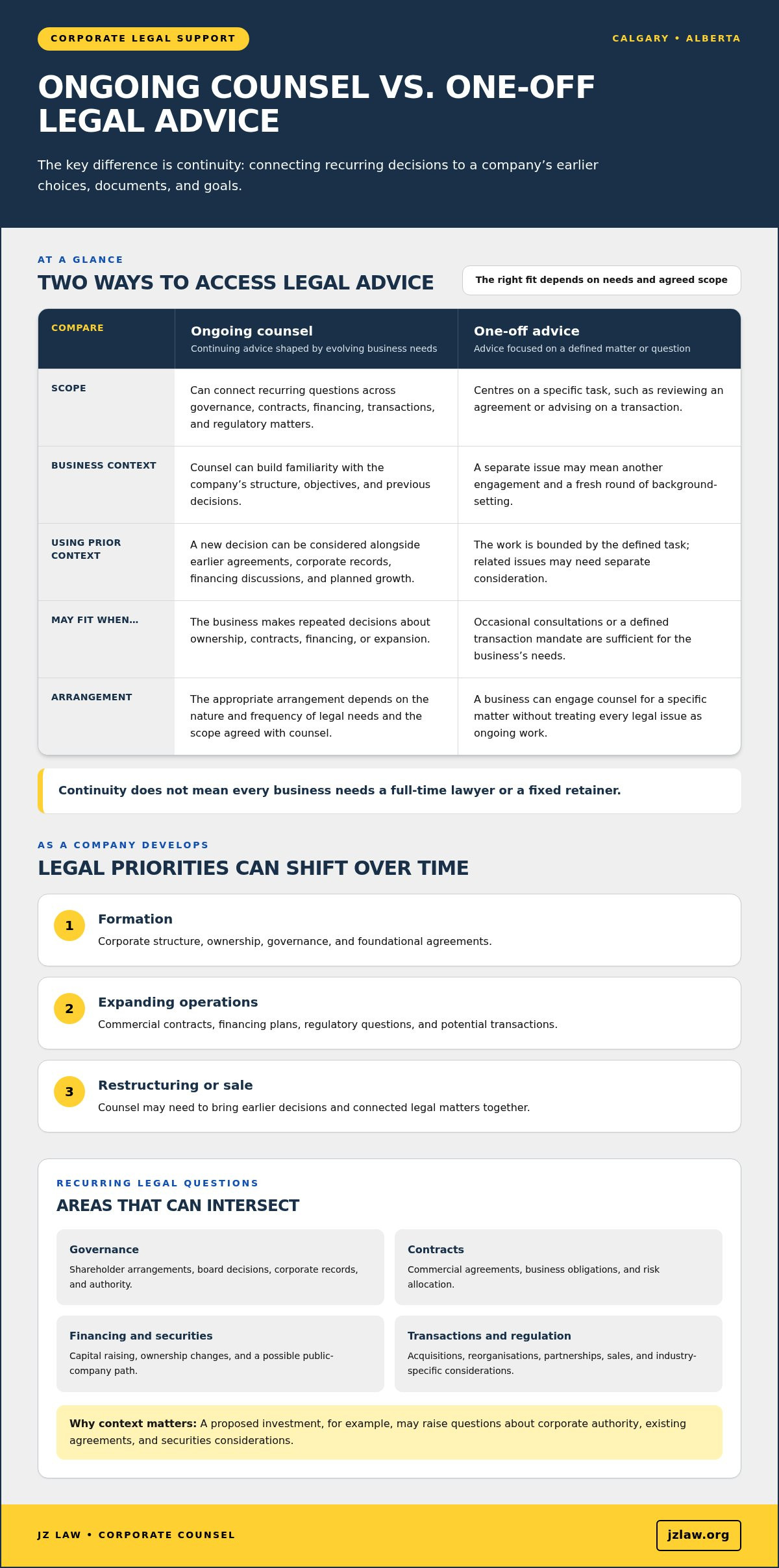
A single-matter engagement focuses on a defined task, such as reviewing an agreement or advising on a transaction. When that work ends, a separate issue may require a new engagement and another round of background-setting. In an ongoing relationship, counsel can build familiarity with the company’s structure, objectives, and previous decisions, making it easier to assess how contracts, governance, financing, and transactions may intersect.
Continuity can support more joined-up advice, but it does not mean every business needs a full-time lawyer or a fixed retainer. The right arrangement depends on the nature and frequency of legal needs and the scope agreed between the business and counsel.
Which Calgary businesses may benefit from continuing legal advice?
Growing companies making repeated decisions about ownership, contracts, financing, or expansion may benefit from advice that accounts for earlier choices. Businesses in regulated or specialised sectors may also need to consider corporate matters alongside industry-specific questions. In Alberta, the relevant considerations depend on the business’s activities and circumstances, so a developing company and an established organisation may need different kinds of support.
Continuing advice can also help leaders distinguish routine matters from questions that warrant closer legal attention. The value is not in creating a process for every decision, but in having a clear path for recurring or consequential issues.
For some Calgary businesses, occasional consultations or a defined transaction mandate may be sufficient. For others, ongoing counsel can provide a consistent point of reference as priorities change. Consider the company’s growth stage, industry, pace of decision-making, and the complexity of its legal needs when choosing an approach.
What Ongoing Corporate Counsel Can Cover in Calgary and Alberta
The scope of ongoing corporate legal support a Calgary business needs can change as the company develops. At formation, attention may centre on corporate structure, ownership, governance, and foundational agreements. As operations expand, commercial contracts, financing plans, regulatory questions, and potential transactions may take priority. Later, restructuring or a sale can require counsel to bring those strands together and help leaders understand how one decision may affect another.
Recurring advice may address several connected areas:
Governance: Shareholder arrangements, board decisions, corporate records, and how authority is exercised.
Contracts: Commercial agreements that shape business relationships, obligations, and exposure to risk.
Financing and securities: Questions that arise when raising capital, changing ownership, or considering a public-company path.
Transactions: Planning and legal review for acquisitions, reorganisations, strategic partnerships, or a sale. For more detail, see this strategic corporate transactions guide.
Regulatory matters: Industry-specific considerations that may affect operations, financing, or a proposed deal.
These areas can overlap. A proposed investment, for example, may raise questions about corporate authority, existing agreements, and securities considerations. Reviewing the decision in context can surface issues before commitments are made. A checklist can help organize questions, but legal advice should account for the company’s structure, documents, and circumstances.
Governance, contracts, and business decisions
Shareholder arrangements, board approvals, and accurate corporate records can shape how a company makes and documents important decisions. Contract review may reveal terms that affect risk allocation, future financing, or the flexibility to pursue a transaction. Early legal input helps leaders understand these connections while options are still open, rather than after an agreement or decision has narrowed them.
Regulated industries and Alberta-specific considerations
For businesses in regulated sectors, corporate planning may need to account for industry-specific rules alongside governance, funding, and transaction goals. In Alberta, the Alberta Securities Commission is relevant to securities matters, while the Alberta Energy Regulator is relevant to energy-sector regulation. Which requirements apply depends on the activity and circumstances, so assess current rules in context. Businesses working in oil and gas can explore this Calgary and energy-sector legal framework for further perspective.
The Canadian Bar Association’s Canadian Business Law Resources offer additional business-law perspectives. JZ Law provides corporate legal counsel to help businesses consider how corporate and regulatory questions relate to their objectives. Learn more about JZ Law’s corporate legal counsel.
Is Ongoing Corporate Legal Support Worth It Compared With One-Off Advice?
There is no single right model for every company. The choice depends on how often legal questions arise, how closely they connect, and whether the business has internal capacity to manage them. The value of ongoing corporate legal support for a Calgary business depends less on the label attached to an engagement than on whether the arrangement fits its actual needs.
Three approaches offer different advantages:
One-off advice can suit a clearly defined issue, such as reviewing an agreement or advising on a discrete transaction. The scope is focused, though counsel still needs enough background to assess the matter properly.
Ongoing external counsel can provide continuity across recurring questions without requiring the company to employ a full-time lawyer. Familiarity with the business can help connect separate issues and reduce repeated explanations of its structure and objectives.
In-house legal capacity may make sense when a company has a steady volume of legal work and needs close day-to-day coordination. It involves an internal staffing commitment, and specialised or complex matters may also call for external advice.
Budgeting is part of the decision, but the key is to understand scope and predictability, not simply choose the lowest-cost approach. Consider which work arises repeatedly, what should remain project-based, and how clearly proposed fees and responsibilities are defined. For teams handling complex data demands, eDiscovery, or breach response alongside corporate counsel, visit Trustpoint.One to explore specialized legal support services. The right structure should support decision-making without adding unnecessary process.
When matter-by-matter legal help may be sufficient
For a business with occasional, well-defined legal questions and limited recurring complexity, engaging counsel for each matter may be practical. A single transaction or contract review can have a clear beginning and end. The business still needs to define the issue, provide relevant records, and explain its objectives. Focused advice works best when the question and context are clear. One-off advice is not inherently inadequate.
When continuity can add practical value
Continuity may be useful when contracts need regular attention, regulatory questions recur, or financing and strategic transactions are part of the company’s plans. Counsel familiar with the business can assess how a new decision relates to existing agreements, corporate arrangements, and longer-term objectives. That context supports coordination across issues and helps leaders decide which questions need further review.
One-off advice can fit an isolated question; continuity matters most when decisions recur, overlap, or depend on the company’s history and direction. Before choosing a model, map the frequency and connectedness of legal needs, consider the workload the internal team can manage, and identify where a consistent external perspective would add value.
How Calgary Businesses Can Prepare for an Ongoing Legal Relationship
A focused preparation process turns a broad need for ongoing corporate legal support in Calgary into a practical discussion about priorities, scope, and business objectives. Before meeting with counsel, assemble a clear picture of upcoming decisions and the legal questions already affecting operations.
Build a clear picture of the company’s legal priorities
List recurring decisions, upcoming transactions, internal approval processes, and unresolved questions. Note which issues need attention now and which relate to longer-term plans. Timing matters: a financing discussion, proposed ownership change, or contract renewal may affect what should be addressed first.
Group relevant materials so counsel can consider related issues together:
Corporate records: Ownership information, governance documents, and records of key decisions.
Current contracts: Agreements that shape important commercial relationships or obligations.
Financing plans: Current or contemplated funding, investment, or restructuring objectives.
Regulatory questions: Issues connected to the company’s activities or sector.
Organizing these materials is not a substitute for legal review. It gives the discussion a useful starting point and helps separate immediate concerns from planning needs. If public-market planning is relevant to the company’s objectives, JZ Law’s guide to taking a company public offers further context.
Define scope, communication, and decision-making expectations
Before work begins, clarify what the engagement will cover and how new matters will be handled. Discuss who at the company will provide instructions, who approves significant decisions, and how relevant records or updates will be shared. Clear arrangements can prevent gaps or duplication when several people are involved.
Set a scope that reflects the business’s needs and the complexity of its matters, rather than assuming a standard model. Discuss how work will be prioritized, what falls within the agreed scope, and how billing will be addressed, including how separate or expanded matters are handled. Clear expectations make it easier to coordinate legal work with business planning.
Revisit priorities as circumstances change. A company’s legal needs may shift with growth, new financing plans, or a potential transaction, so keep the working scope aligned with its objectives. To discuss your company’s corporate and regulatory priorities, connect with JZ Law about ongoing legal support.
Ongoing Corporate Legal Support in Calgary with JZ Law
When a company’s legal questions span corporate decisions and specialised regulation, advice is most useful when it reflects both the business objective and the legal context. JZ Law, led by principal lawyer John Zang, provides strategic counsel in corporate and complex regulatory matters. Its practice includes corporate transactions, securities regulation, taking companies public, and tax structuring, alongside work in sectors such as cannabis, oil and gas, cryptocurrency, and real estate.
This breadth matters when issues intersect. A financing plan, for example, may involve corporate structuring and securities considerations, while an acquisition in a regulated sector may require attention to both transaction terms and industry-specific questions. The relevant legal work depends on the company’s activities, objectives, and stage of development. Counsel can be tailored to the priorities at hand, whether the business is assessing a particular decision or preparing for a more involved transaction.
Connecting corporate strategy with specialized legal issues
Business plans and legal questions often develop together. A company considering growth may need to assess governance and tax structure; a business exploring public-market financing may need to consider securities issues and transaction planning. In energy, cannabis, cryptocurrency, or real estate, sector-specific considerations may also affect corporate choices. JZ Law’s work across these areas helps address connected corporate and regulatory questions without assuming that every business needs the same scope of support.
Discuss your company’s ongoing legal needs with JZ Law
A concise overview can make a discussion more productive. Set out the company’s objectives, current legal matters, upcoming decisions, and known deadlines or dependencies. Identify which questions are immediate and which relate to longer-term plans, such as financing, restructuring, or expansion.
An initial discussion can help clarify priorities and the appropriate scope of counsel. The aim is to establish what legal support fits the business’s needs and the complexity of its matters, with clear expectations about the work involved. JZ Law serves businesses in Calgary and other markets, including Toronto, Vancouver, Hamburg, Berlin, Frankfurt, New York City, and Denver. Contact JZ Law to discuss your company’s legal priorities and next steps.
Make Legal Support Part of Your Growth Strategy
The right legal approach depends on how often questions arise, how they connect, and where the business is headed. For some companies, focused advice on individual matters is sufficient. For others, ongoing corporate legal support in Calgary can provide continuity across recurring decisions, helping leaders consider corporate, contractual, financing, and regulatory issues in context.
Start by mapping upcoming decisions and recurring legal needs, then organize relevant records and clarify which priorities need attention first. Shape a continuing relationship around the company’s objectives and the complexity of its matters, rather than assuming it requires a standard arrangement.
JZ Law, led by principal lawyer John Zang, provides counsel in corporate transactions, securities regulation, and specialised industries. The firm’s work can support businesses as they assess interconnected legal questions and plan for their next stage of development. A clear discussion of your goals and current matters can help define a practical scope for legal support.
Discuss your company’s corporate legal needs with JZ Law and take a considered next step toward informed business decisions and sustainable growth.
Frequently Asked Questions
What does ongoing corporate legal support include?
Ongoing corporate legal support can cover recurring corporate, contractual, financing, transaction, or regulatory questions, depending on the company’s needs. Unlike advice limited to one transaction, it provides a continuing strategic perspective as priorities develop. The specific work and scope are defined for the business rather than assumed to follow a standard package. One company may need recurring contract guidance, while another may focus on corporate transactions or securities matters.
When should a Calgary business consider ongoing corporate counsel?
A Calgary business may consider continuing counsel when legal questions recur or when planned growth, financing, transactions, or sector regulation make decisions more interconnected. There is no need to wait for a dispute or major deal to review legal priorities. The appropriate timing depends on the company’s circumstances, objectives, and legal complexity. Mapping upcoming decisions and recurring questions can help leaders decide whether ongoing corporate legal support in Calgary would provide useful continuity.
Is ongoing external counsel a substitute for an in-house lawyer?
Not automatically. External counsel and an in-house lawyer serve different organizational needs. External counsel can advise on defined matters and provide specialised input, while in-house capacity may suit a business with frequent internal legal work requiring close day-to-day coordination. Some companies use both. The appropriate structure depends on legal workload, expertise required, business priorities, and governance. Assessing how often issues arise and who needs to manage them internally can guide the decision.
How much does ongoing corporate legal support cost?
Fees depend on the agreed scope, volume and complexity of work, and engagement structure. Rather than compare a headline figure alone, clarify what work is included, how separate or expanded matters will be handled, and how billing will be communicated. Distinguish recurring needs from one-time projects. These details help a business assess whether the proposed arrangement reflects its priorities and offers appropriate clarity for planning.
Can ongoing corporate counsel help with securities and financing matters in Alberta?
JZ Law advises on securities and financing matters, including securities regulation and taking companies public. The applicable Alberta and Canadian requirements depend on the transaction, issuer, and relevant rules. Laws and regulator responsibilities can change, so assess specific requirements against current legislation and authoritative regulator information before acting. Businesses planning a financing or securities transaction should define the proposed activity and objectives for legal review.
What should a business prepare before discussing ongoing legal support?
Prepare a concise summary of business objectives, corporate structure, current contracts, upcoming decisions, and known legal questions. Identify which matters recur and which have time-sensitive milestones, such as a planned financing or transaction. Organized background information makes an initial discussion more focused and helps clarify priorities and potential scope. It gives counsel a practical starting point for understanding the company’s needs.
Can ongoing corporate counsel support a Calgary company operating in a regulated industry?
Yes. Counsel can help connect corporate decisions with industry-specific legal considerations, though the relevant framework depends on the sector, activity, and circumstances. JZ Law’s practice includes securities, cannabis, oil and gas, and cryptocurrency matters. Calgary is among the firm’s markets, alongside Toronto, Vancouver, Hamburg, Berlin, Frankfurt, New York City, and Denver. Assess the rules relevant to the company’s own operations rather than assuming every requirement applies across industries.



Comments