


DAO Legal Structure Canada: Navigating Regulatory Compliance in 2026
- jzanglaw
- Aug 5
- 12 min read
What if the decentralized autonomy you've built is actually a legal trap that exposes your personal bank account to every creditor and regulator in the country? In 2026, the idea of an "unincorporated DAO" has moved from a pioneer's dream to a founder's greatest liability. You've likely felt the growing pressure as FINTRAC increases enforcement and the CSA clarifies its stance on token classification. It's a stressful position to be in when your innovation outpaces the law, leaving you vulnerable to being classified as a General Partnership where every member is personally liable for the group's actions.
We understand that your goal isn't just to launch a project, but to build a lasting entity that can interact with the real world safely. This guide offers a comprehensive framework for establishing a professional DAO legal structure Canada that effectively shields founders from personal risk and regulatory scrutiny. You'll learn how to create a tax-compliant treasury and build a functional bridge between your smart contracts and Canadian statutory requirements. We'll examine the specific steps needed to transition your DAO from a legal uncertainty into a structured, institutional-grade organization that is ready for the next phase of Web3 evolution.
Table of Contents
The Unseen Risks: Why DAOs Need a Canadian Legal Wrapper
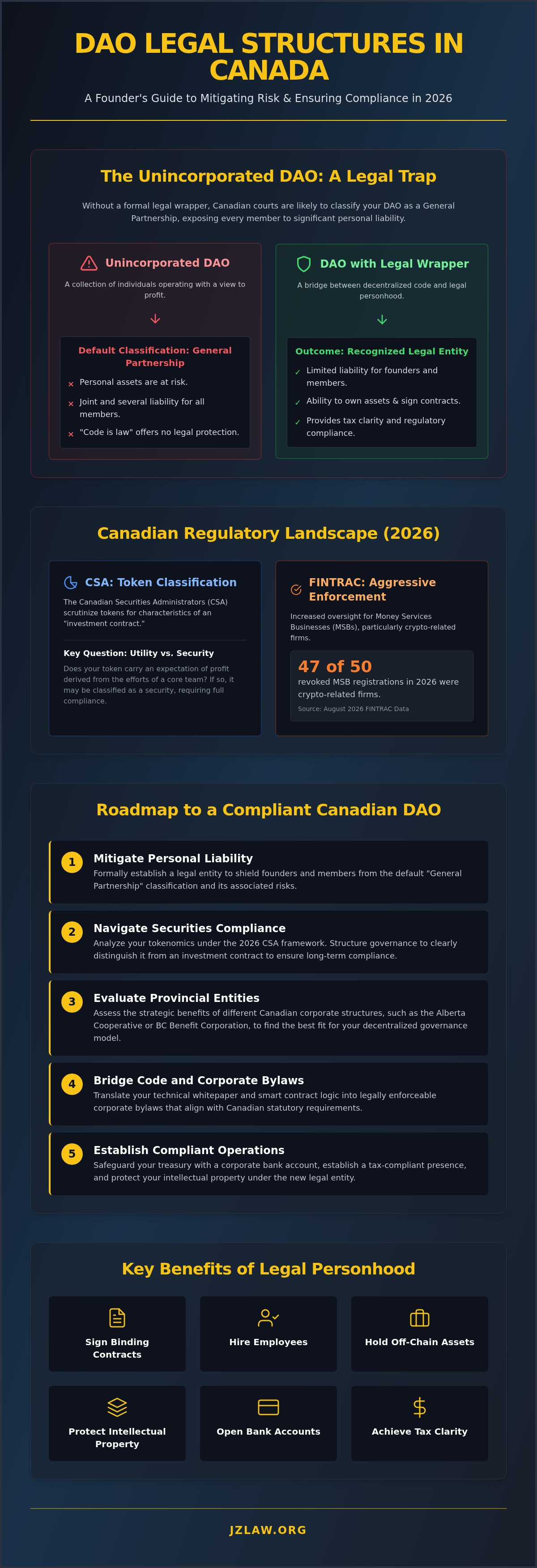
A Decentralized Autonomous Organization (DAO) operates on the principle of trustless execution, yet the Canadian legal system requires a recognizable entity to assign responsibility. A legal wrapper functions as a necessary bridge between decentralized code and legal personhood. It transforms a collection of digital wallets into a recognized entity that can exist within the Canadian regulatory framework. Without this structure, the "code is law" mantra offers no protection when a smart contract interaction leads to a real-world dispute. In 2026, the absence of a formal DAO legal structure Canada is no longer a strategic choice; it's a critical vulnerability that leaves founders exposed to the full weight of provincial and federal laws.
The core limitation of decentralized governance is its inability to interact with traditional financial and legal systems. Smart contracts cannot sign leases, defend intellectual property in court, or hold a corporate bank account. When a DAO attempts to operate in the physical world without a legal wrapper, it creates a vacuum that Canadian regulators are eager to fill with existing, and often punitive, classifications. Personal liability has become the primary threat to Canadian founders as authorities shift from observation to active enforcement.
The General Partnership Threat in Canadian Law
In provinces like Alberta and Ontario, the Partnership Act provides a default classification for groups of people carrying on business in common with a view to profit. If you haven't established a formal DAO legal structure Canada, courts will likely view your organization as a de facto partnership. This "General Partnership" trap is a significant risk because it triggers joint and several liability. This means every token holder or core contributor could be held personally responsible for the entire debt or legal obligations of the DAO. A de facto partnership in a Canadian regulatory context is an unintentional business arrangement where the law imposes full personal liability on participants regardless of their internal governance rules. This legal reality overrides any "limitations of liability" written into a DAO's Discord rules or whitepaper.
Benefits of Legal Personhood for Decentralized Orgs
Achieving legal personhood allows a decentralized organization to move beyond the limitations of the blockchain. It grants the entity the capacity to sign binding contracts, hire employees through traditional payroll systems, and hold off-chain assets such as real estate or physical equipment. It also provides essential tax clarity. Without a corporate identity, opening a Canadian bank account is nearly impossible. The Canada Revenue Agency (CRA) may struggle to attribute income correctly, which often leads to intrusive audits. Additionally, a recognized legal structure is the only reliable way to protect intellectual property (IP). It ensures that the DAO's code, brand, and innovations remain assets of the collective rather than being vulnerable to individual claims or theft.
Securities and Tax Implications for Decentralized Governance
The Canadian Securities Administrators (CSA) have intensified their oversight of decentralized protocols throughout 2026. For founders, the primary challenge lies in determining whether their token constitutes an investment contract under provincial law. This distinction is critical when designing a DAO legal structure Canada. Most governance tokens are no longer viewed as simple utility tools if they carry any expectation of profit derived from the efforts of a core development team or centralized group of contributors. Understanding these Canadian securities law considerations is essential for avoiding enforcement actions that have recently targeted several prominent decentralized finance platforms.
FINTRAC has also shifted to an aggressive enforcement stance this year. As of August 2026, the agency has revoked 50 Money Services Business (MSB) registrations, with 47 of those being crypto-related firms. Under the amendments brought by Bill C-12, the penalty ceiling for non-compliance has risen significantly. If your DAO facilitates the exchange or transfer of virtual assets, it likely falls under the definition of a Virtual Asset Service Provider (VASP). This requires rigorous Know Your Customer (KYC) and Anti-Money Laundering (AML) protocols that must be integrated directly into your operational framework. Proactive securities regulation counsel can help you implement these controls without sacrificing the decentralized nature of your project.
CSA Compliance and Token Distribution
Evaluating token launches requires a deep dive into the cryptocurrency law 2026 framework. The CSA applies the Pacific Coin test to evaluate assets, focusing on the degree of decentralization and the "expectation of profit" legal test. If a project relies on a "managerial" group to drive value, the token is a security. To mitigate this, many founders utilize private placements and prospectus exemptions, such as the accredited investor or offering memorandum exemptions. These strategies allow for compliant capital raises while the project works toward the "sufficient decentralization" threshold that might eventually change the token's classification.
Tax Structuring for Canadian-Based DAOs
Managing a DAO treasury requires a choice between corporate income tax and trust-based taxation models. A corporate wrapper provides a familiar framework for the Canada Revenue Agency (CRA), but it may introduce complexities regarding GST/HST for decentralized services. The CRA now mandates that all crypto-assets held in a DAO treasury be valued at their exact fair market value at the moment of each transaction, rather than using daily or monthly averages. This level of precision is necessary to avoid significant penalties under the new Crypto-Asset Reporting Framework (CARF). Properly structuring these assets ensures the treasury remains a viable resource for the community rather than a tax liability.
Comparing Canadian Legal Entities for DAO Structuring
Selecting an appropriate DAO legal structure Canada requires more than a cursory glance at standard corporate forms. While many founders initially consider offshore foundations in the Cayman Islands or the British Virgin Islands, the 2026 regulatory environment has made onshore Canadian wrappers increasingly attractive. These domestic structures offer superior access to the Canadian banking system and provide a clearer path for complying with CRA treasury requirements. The choice of jurisdiction often depends on whether the DAO prioritizes democratic participation, institutional credibility, or a specific social mission.
Each province offers distinct advantages that cater to different decentralized models. Founders must weigh the administrative requirements of a federal incorporation against the specialized governance features found in provincial acts. For instance, the legal needs of a Toronto-based DeFi protocol seeking venture capital will differ significantly from a Calgary-based community forest DAO. A well-chosen structure doesn't just provide a legal shield; it serves as a functional interface between the protocol's code and the physical world's requirements.
The Alberta Cooperative Model
The Alberta Cooperative model has emerged as a premier choice for decentralized organizations because its statutory requirements mirror the core values of Web3. Under the Alberta Cooperatives Act, the "one member, one vote" principle is a mandatory governance standard. This alignment ensures that a DAO legal structure Canada based in Alberta remains community-focused rather than being dominated by large capital holders. By registering a cooperative in Calgary, founders can provide their global contributors with robust limited liability protection. This structure allows the DAO to hold assets and enter into contracts while maintaining a democratic governance layer that Canadian courts and regulators already understand and respect.
BC Benefit Corporations and Federal Structures
For decentralized projects that prioritize a social or environmental mission, the British Columbia Benefit Corporation provides a sophisticated framework. This entity type requires directors to balance the interests of stakeholders and the community alongside traditional profit motives. It's an ideal fit for impact-focused DAOs that want their mission protected by law. Conversely, the Federal Canada Business Corporations Act (CBCA) remains the standard for projects aiming for high-growth and institutional scale. A federal structure is often the most efficient vehicle for strategic corporate transactions, providing the necessary credibility to engage with traditional financial partners or prepare for a future public exit. Whether you register in Vancouver's tech-forward ecosystem or the financial heart of Toronto, the federal model offers a predictable and universally recognized legal foundation.
Step-by-Step: Operationalizing Your DAO Legal Structure
Transitioning from a decentralized protocol to a recognized legal entity requires a methodical approach that respects both the autonomy of the code and the requirements of the law. Establishing a DAO legal structure Canada is a multi-phase process that begins with a rigorous jurisdictional and regulatory feasibility study. This initial step ensures that your chosen entity type aligns with the 2026 CIRO and CSA frameworks, particularly regarding digital asset custody and token classification. Once the foundation is set, the focus shifts to drafting a 'Constitution' that serves as a functional bridge between your technical whitepaper and corporate bylaws.
The third step involves formal incorporation and the appointment of directors or legal representatives who possess a deep understanding of Web3. These individuals must be prepared to act as the interface between the DAO and traditional institutions. Following incorporation, you must execute a Service Agreement that defines the relationship between the decentralized community and the legal wrapper. Finally, the organization must commit to ongoing compliance, which includes systematic auditing and tax filing under the Crypto-Asset Reporting Framework (CARF). This structured approach ensures the entity remains a viable partner for institutional investors and traditional financial systems.
Drafting Governance Documents
Translating smart contract logic into legally binding bylaws is perhaps the most technical aspect of the formation process. These documents must clearly define member rights, voting thresholds, and quorum requirements while ensuring they remain compliant with provincial corporate statutes. You should also include robust dispute resolution mechanisms, such as mandatory arbitration, to prevent internal governance disagreements from escalating into costly public litigation. This precision ensures that the "rules of the game" are enforceable in both the digital and physical worlds.
The Service Agreement Framework
The Service Agreement is the legal document that prevents the decentralized community from being viewed as a general partnership. It explicitly limits the liability of the directors and ensures they only act upon the instructions provided by the DAO's governance module. To establish a functional legal interface for code-based decisions, you must draft a service agreement that explicitly recognizes on-chain votes as binding instructions for the legal wrapper's directors. This creates a protective barrier for contributors while maintaining the operational efficiency of the protocol. If you require assistance with these complex documents, you can secure professional cryptocurrency law counsel to ensure your framework is resilient against regulatory shifts.
Operationalizing your structure also means preparing for the CRA's 2026 reporting standards. The entity must act as a diligent record-keeper, tracking every treasury movement with the same precision as a public company. By following these steps, you transform your DAO from a high-risk experiment into a professional organization capable of sustained growth within the Canadian market.
Strategic Legal Partnership: How JZ Law Protects Web3 Founders
Establishing a resilient DAO legal structure Canada requires more than just technical proficiency; it demands a deep understanding of how emerging technologies intersect with established legal principles. John Zang brings a wealth of experience in cryptocurrency law and securities regulation to the table, acting as a strategic partner for founders who need to navigate high-stakes environments. We provide the clarity needed to transform complex decentralized protocols into legally sound entities that regulators respect. Our firm's approach is grounded in precision and a commitment to protecting the personal assets of Web3 innovators from the risks of misclassification.
We specialize in creating customized tax structuring and securities compliance frameworks that address the unique needs of crypto projects. By maintaining a proactive dialogue with the Canadian Securities Administrators (CSA) and the Canada Revenue Agency (CRA), we stay ahead of shifting guidelines such as the 2026 CIRO Digital Asset Custody Framework. This preventative mindset allows us to identify and mitigate risks before they manifest as costly enforcement actions. As a boutique firm, we offer the meticulous attention to detail that large-scale organizations often lack, ensuring that your DAO's specific governance nuances are preserved within its legal wrapper.
Tailored Solutions for Calgary and Toronto Tech Hubs
Our presence in Calgary allows us to offer specialized counsel for the city's unique intersection of decentralized finance and energy-tech innovation. We understand the local economic drivers and provincial regulations that make Alberta an attractive jurisdiction for cooperative-based DAOs. Simultaneously, we navigate the complex financial landscapes of Toronto and Vancouver, where institutional standards for securities compliance are exceptionally high. JZ Law provides the high-level expertise typically associated with major national firms but delivers it through a focused, agile model that prioritizes client security and direct access to senior counsel.
Taking Your DAO to the Next Level
Preparing a decentralized project for institutional investment or the process of taking companies public requires rigorous attention to corporate governance. We provide strategic counsel on complex cross-border corporate transactions, ensuring that your DAO remains compliant as it expands into international markets. Whether you're seeking to bridge your protocol with traditional capital markets or need a comprehensive audit of your existing framework, our team is equipped to handle the most demanding legal challenges. Contact JZ Law today to schedule a thorough structural audit and ensure your organization is built on a foundation of long-term regulatory resilience.
Securing the Future of Decentralized Innovation in Canada
The transition from an experimental protocol to a sustainable organization requires a commitment to structural integrity. As the 2026 regulatory environment clarifies, the ambiguity of unincorporated associations has become an untenable risk for serious founders. By adopting a formal DAO legal structure Canada, you move beyond the dangers of personal liability and create a professional interface for institutional growth. Whether you utilize the democratic framework of an Alberta Cooperative or the scalability of a federal corporation, the goal is to ensure your innovation is protected by the same legal certainties that govern traditional commerce.
Building a resilient Web3 project involves more than just writing code; it requires a strategic vision that anticipates regulatory shifts. John Zang provides specialized expertise in Cryptocurrency Law and Strategic Corporate Transaction experience to help you navigate these complex requirements. Our firm remains focused on high-stakes regulatory compliance so you can focus on building your community. To ensure your project is built on a foundation of long-term security, Consult with John Zang on your DAO legal structure today. The path to decentralized success is clearest when you have a partner who understands both the protocol and the law.
Frequently Asked Questions
Is a DAO a legal entity in Canada?
A decentralized autonomous organization is not recognized as a distinct legal entity under Canadian law unless it's formally incorporated or registered. Without a specific DAO legal structure Canada, courts typically classify these organizations as general partnerships. This default status means that the law doesn't distinguish between the organization and its members, which results in a lack of legal personhood and the inability to own property or sign contracts in the DAO's name.
Can a Canadian DAO be sued?
Yes, a DAO can be the subject of legal action regardless of its registration status. In an unincorporated DAO, plaintiffs can sue the individual members or founders directly, often holding them jointly and severally liable for the organization's obligations. Establishing a formal legal wrapper is the only effective way to ensure that the entity, rather than its human contributors, is the target of any potential litigation.
What is the best province to incorporate a DAO in Canada?
The ideal jurisdiction depends on your project's specific governance model and commercial objectives. Alberta is frequently preferred for community-driven projects due to its robust Cooperatives Act, while British Columbia offers flexibility through Benefit Corporations for mission-aligned protocols. Toronto remains the primary hub for federal CBCA incorporations when a project requires maximum institutional credibility and access to traditional venture capital.
How does the CRA tax DAO treasury funds?
The Canada Revenue Agency treats treasury funds as either business income or capital gains depending on the nature of the activity. As of 2026, the CRA requires that all crypto-assets be valued at their exact fair market value at the moment of each transaction for tax reporting purposes. This precision is mandatory under the Crypto-Asset Reporting Framework (CARF) to ensure accurate calculations of taxable income from staking, mining, or token swaps.
Do DAO founders have personal liability for smart contract bugs?
Founders face significant personal liability if a smart contract bug leads to financial loss and no legal wrapper is in place. In an unincorporated structure, claimants can pursue the personal assets of founders under general partnership principles. A properly implemented DAO legal structure Canada creates a corporate veil that protects individuals from being personally responsible for technical failures or protocol exploits.
What is a 'legal wrapper' for a DAO?
A legal wrapper is a recognized corporate or statutory entity that acts as a legal interface for a decentralized protocol. It provides the DAO with legal personhood, allowing it to hire employees, pay taxes, and interact with the traditional banking system. This structure essentially "wraps" the decentralized code in a protective legal shell that limits the personal liability of the participants.
Can a DAO issue tokens to Canadians without a prospectus?
Tokens can only be issued without a prospectus if the DAO qualifies for specific securities law exemptions. These typically include private placements to accredited investors or the use of the offering memorandum exemption. Since the CSA's 2026 guidance, most governance tokens with an expectation of profit are classified as securities, making strict adherence to these exemptions a requirement for regulatory compliance.
How do Alberta Cooperatives work for decentralized organizations?
Alberta Cooperatives operate on a democratic "one member, one vote" basis that mirrors the governance ethos of many decentralized communities. The Alberta Cooperatives Act allows these entities to be managed by their members while providing the same limited liability protections as a standard corporation. This model is particularly effective for DAOs that want to formalize their governance without centralizing power in the hands of a few large token holders.


Comments