


Tax-Efficient Corporate Structures in Canada: A 2026 Strategic Legal Guide
Updated: Jun 30
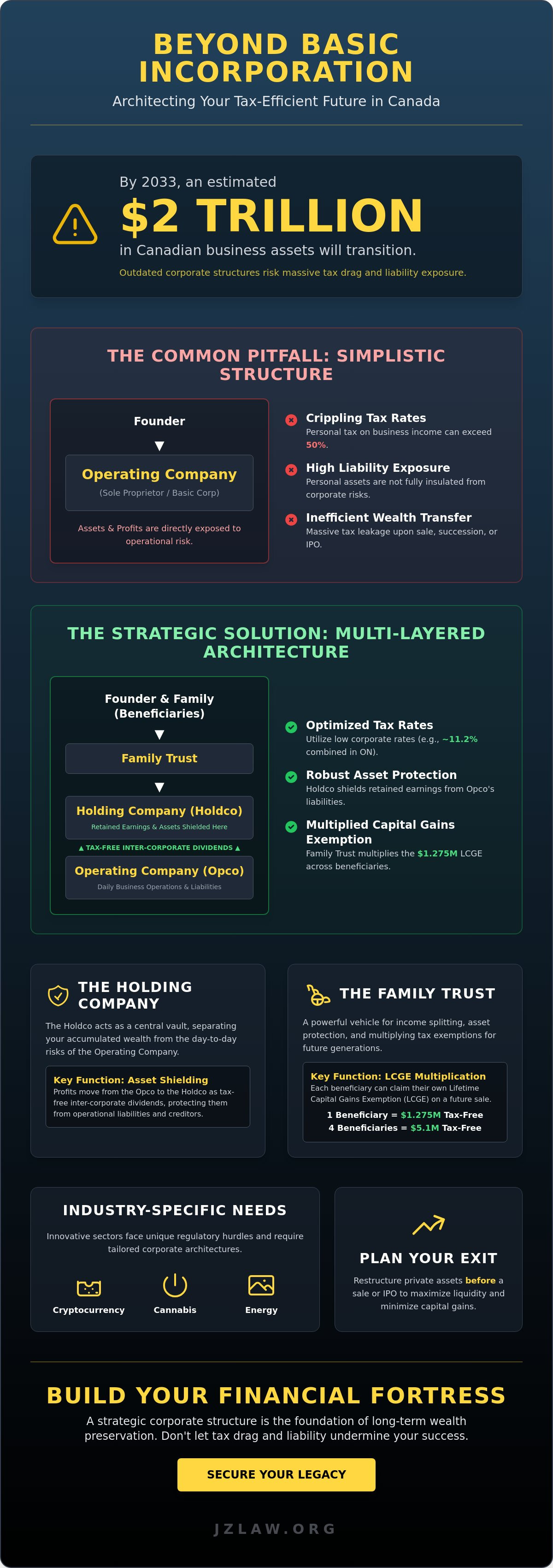
By 2033, over $2 trillion in Canadian business assets are expected to change hands, yet a staggering number of these transitions will be hampered by legacy frameworks that fail to account for modern tax complexities. Building tax-efficient corporate structures canada requires a forward-looking legal architecture that evolves alongside your enterprise, moving beyond simple incorporation to create a robust shield for your wealth. Without this strategic foundation, high-growth companies often find their momentum slowed by unnecessary tax drag and avoidable exposure to business liabilities.
You've likely felt the pressure of escalating tax rates on your business income or the unease of knowing your personal assets aren't fully insulated from corporate risks. We understand that your goal isn't just to grow, but to retain and eventually transfer what you've built with precision. This guide will empower you to master the sophisticated legal mechanisms that minimize tax liabilities and prepare your firm for a seamless sale or IPO. We'll analyze the strategic deployment of holding companies, the role of family trusts in multiplying the $1,275,000 Lifetime Capital Gains Exemption, and the specific compliance hurdles facing innovative sectors in 2026.
Table of Contents
Beyond the Basics: Why "One-Size-Fits-All" Fails in Canadian Tax Structuring
Many entrepreneurs mistakenly view incorporation as a simple administrative checkbox rather than a critical strategic inflection point. This perspective leads to a "one-size-fits-all" approach that fundamentally ignores the specific needs of high-growth enterprises. For high-revenue businesses, remaining a sole proprietor is rarely a viable path; personal tax rates on business income can exceed 50% in many provinces, causing immediate and significant wealth erosion. Even basic incorporation doesn't solve every problem. Without a tailored architecture, you're merely delaying the inevitable tax drag that comes with scale. Understanding the nuances of Corporate tax in Canada is essential for any founder who wants to move beyond surface-level compliance toward genuine asset protection.
Efficiency isn't accidental. It's engineered. By engaging in strategic corporate transactions during the early phases of growth, founders can bake tax efficiency into the very DNA of their enterprise. This proactive planning allows for the seamless integration of holding companies and trusts before the valuation of the operating company makes such moves prohibitively expensive or legally complex.
The Risk of Under-Structuring Early
Waiting to implement tax-efficient corporate structures canada often leads to massive future tax leakage. When a business grows rapidly under a simplistic structure, the cost of fixing it later can be staggering. Restructuring a mature company involves complex "butterfly" transactions or Section 85 rollovers that require extensive legal and accounting resources. Beyond the fiscal cost, under-structuring leaves personal assets exposed. In regulated sectors like cannabis or cryptocurrency, a single liability event can bypass a weak corporate veil, threatening the founder's personal estate. Setting the foundation correctly from the start is an investment in long-term stability.
Regulatory Compliance and Tax Efficiency
Balancing CRA compliance with aggressive legal optimization requires a deep understanding of the 2026 regulatory environment. The choice between federal and provincial incorporation carries distinct implications for your bottom line. For instance, as of July 1, 2026, Ontario's small business rate is set to decrease to 2.2%, which, when combined with the federal 9% rate, offers a highly competitive environment for Canadian-Controlled Private Corporations (CCPCs). However, these benefits are easily lost if the structure doesn't account for passive income thresholds or TOSI rules. Tax-efficient structuring is a proactive legal defense designed to neutralize fiscal threats before they manifest. It ensures that your enterprise remains compliant while retaining the maximum possible capital for reinvestment and growth.
The Power of the Canadian Holding Company (Holdco) Strategy
The primary mechanism driving this strategy is the inter-corporate dividend. Under the Income Tax Act, the inter-corporate dividend exemption allows for the transfer of after-tax profits from an operating company to a connected holding company without triggering additional tax at the corporate level. This means you can move liquidity from your active business to your Holdco at its full value, rather than losing a significant portion to personal income tax. This capital can then be reinvested into other ventures, real estate, or marketable securities, all within a tax-deferred environment that accelerates compound growth. If you're considering such a transition, exploring specialized tax structuring services can ensure your hierarchy is optimized for both protection and liquidity.
Opco vs. Holdco: The Two-Tiered Architecture
Success in this model depends on the precise allocation of assets. Your Opco should remain "lean," holding only the assets necessary for active production or service delivery. High-value assets, such as intellectual property, heavy equipment, or corporate real estate, are often better situated within the Holdco or a dedicated sister company. This entity then leases those assets back to the Opco. To maintain the validity of this structure, you must treat the entities as distinct legal persons, which requires separate bank accounts, rigorous inter-company agreements, and meticulous corporate minutes.
Tax Deferral vs. Tax Avoidance
Strategic structuring focuses on maximizing tax deferral, not evasion. By keeping profits within the corporate group, you defer the high personal tax rates that apply upon withdrawal. However, you must remain mindful of the 2026 passive income rules. The federal government reduces the small business limit for CCPCs with passive investment income between $50,000 and $150,000. Monitoring the official corporation tax rates and passive income thresholds is vital to ensure your Holdco doesn't inadvertently increase the tax burden on your active business income. When managed with precision, the Holdco becomes a powerful engine for long-term wealth preservation.
Advanced Tax-Efficient Vehicles: Family Trusts and Professional Corporations
While holding companies provide a vital layer of protection for retained earnings, high-growth enterprises often require more sophisticated instruments to manage intergenerational wealth and specialized professional liabilities. A discretionary family trust stands as one of the most versatile tax-efficient corporate structures canada offers for business owners looking to move beyond simple tax deferral. These vehicles allow you to separate legal control from beneficial ownership, providing a flexible framework for distributing income among family members who may be in lower tax brackets. This isn't merely about current cash flow. It's about building a multi-generational legacy that remains resilient against shifting fiscal policies.
Implementing these advanced vehicles requires a precise understanding of the 2026 regulatory environment, particularly regarding the Tax on Split Income (TOSI) rules. Success lies in the details of the trust indenture and the operational reality of the business. When these tools are integrated correctly, they transform a standard business into a sophisticated wealth management engine.
The Family Trust as a Succession Tool
The primary advantage of a family trust in a corporate context is the ability to multiply the Lifetime Capital Gains Exemption (LCGE). For 2026, the LCGE limit is approximately $1,275,000 per individual. By holding shares through a trust, a business owner can potentially allocate the capital gains from a future sale among several family members, effectively sheltering millions of dollars from taxation. However, you must remain vigilant regarding the 21-year rule. This regulation triggers a deemed disposition of the trust's assets at fair market value every 21 years, necessitating a proactive legal strategy to distribute or restructure assets before the deadline. We focus on drafting robust, audit-proof trust indentures that anticipate these milestones while maintaining the founder's ultimate control over the enterprise.
Professional Corporations: Tax Perks for Specialized Services
For doctors, lawyers, and engineers, the Professional Corporation (PC) offers a unique path to tax-efficient remuneration. Unlike a standard business corporation, a PC is subject to specific provincial regulatory body rules, yet it still provides access to the small business deduction. This allows professionals to leave surplus earnings in the corporation, taxed at the lower 9% federal rate, rather than drawing them as high-tax personal income. Strategic planning here involves managing the small business deduction limit across multiple entities and balancing salary versus dividend payments. It's a delicate equilibrium. You'll need to monitor your passive investment income closely, as exceeding the $50,000 threshold can begin to erode your access to the small business tax rate, increasing your overall tax-efficient corporate structures canada complexity.
Industry-Specific Structuring: Crypto, Cannabis, and Oil & Gas
Generic tax advice often fails when applied to sectors defined by high regulatory friction and volatile asset classes. For enterprises in emerging or resource-heavy industries, tax-efficient corporate structures canada must account for specific legislative burdens that don't apply to traditional retail or service firms. Whether you're managing a decentralized protocol or a licensed cultivation facility, your legal architecture must be as specialized as your technology. 2026 requires a proactive approach that anticipates regulatory shifts before they impact your balance sheet.
Crypto and Blockchain Tax Architecture
Canadian blockchain startups face a unique challenge because the CRA treats digital assets as commodities. This means your gains are taxed as either business income or capital gains depending on the nature of your activity. Structuring for token launches and DeFi protocols requires a multi-entity approach to isolate treasury management from operational development. Tax-efficient management of digital asset treasuries often involves specialized Canadian subsidiaries designed to manage liquidity without triggering immediate tax events on every trade. Integrating FINTRAC compliance into your tax structuring is a prerequisite for maintaining the stable banking relationships required for fiat-on-ramps. If you're launching a project, securing expert cryptocurrency ventures counsel is essential to avoid the retroactive reclassification of your assets.
The Cannabis Corporate Framework
In the cannabis sector, your licensing requirements often dictate the boundaries of your corporate form. Federal excise duties, which are projected to transfer over $800 million to provinces in the 2026/27 fiscal year, create a high-tax environment where margin preservation is a legal battle. Preparing for M&A activity requires a clean structure that separates cultivation assets from branding and distribution. Many successful firms now use asset-light models to increase valuation for potential buyers. While Canada doesn't have the exact Section 280E restriction found in the United States, cannabis firms still face significant non-deductible expenses and excise tax hurdles that require sophisticated legal accounting to navigate.
Alberta’s Oil and Gas sector continues to rely on flow-through shares as a primary engine for tax-efficient financing. This mechanism allows corporations to renounce resource-related expenses in favor of investors, which facilitates capital raises during periods of price volatility. For tech firms operating across borders, navigating international tax treaties is vital to prevent double taxation on intellectual property royalties. If your business operates in these high-stakes environments, you should seek a formal review of your Securities Regulation and Tax Structuring to ensure your growth remains unencumbered by avoidable legal friction.
Navigating the Legal Transition: From Private Structure to Public Offering
The decision to go public is the ultimate test of your enterprise's fiscal architecture. While private tax-efficient corporate structures canada often focus on aggressive tax deferral and flexible income splitting, public entities operate under a regime of transparency and rigid securities regulation. This transition represents a fundamental shift in legal status. As a private Canadian-controlled private corporation (CCPC), your firm likely benefited from the small business deduction and lower tax rates on active business income. However, becoming a public company triggers the immediate loss of CCPC status. This change necessitates a meticulous pre-IPO restructuring process to capture private-market tax advantages before they expire.
One of the most critical steps involves the "crystallization" of the Lifetime Capital Gains Exemption. With the 2026 limit indexed to approximately $1,275,000, shareholders should utilize this benefit to increase the cost base of their shares before the company’s status changes. Failing to do so results in a significant tax liability that could have been legally avoided. This is especially pertinent when taking your cannabis company public, where valuation fluctuations and excise tax burdens make early tax optimization a prerequisite for investor confidence. A "messy" cap table or unresolved inter-company debts can stall a public offering or lead to unfavorable audit results during due diligence.
The Pre-IPO Tax Audit
Success in the public markets requires resolving all potential tax liabilities well before the filing of a preliminary prospectus. We identify and resolve historical tax exposures that could trigger disclosure requirements or indemnity claims from underwriters. This includes restructuring shareholder agreements to ensure they are compatible with public market standards and exchange requirements. A clean, optimized structure doesn't just simplify compliance; it often commands a valuation premium from institutional investors who prioritize regulatory certainty. We focus on ensuring that every corporate transaction leading up to the IPO is documented with the precision required for securities commission scrutiny.
Post-IPO Continuity
The shift from private tax benefits to public accountability requires a new approach to governance. Managing the transition means adapting to the general corporate tax rate of 15% and establishing ongoing tax-efficient governance for potentially multi-national operations. You'll need to balance the interests of public shareholders with the long-term wealth preservation goals of the founding team. Our methodology ensures that your transition is seamless and that your new public entity remains as tax-optimized as its private predecessor. To ensure your enterprise is prepared for this evolution, Consult JZ Law for a strategic structure review and secure your path to public liquidity.
Securing Your Enterprise’s Fiscal Legacy
Building a resilient business in 2026 demands more than just operational excellence; it requires a legal foundation that anticipates growth and mitigates risk. By integrating holding companies and discretionary trusts, you can effectively separate your hard-earned wealth from operational liabilities while simultaneously maximizing your access to the Lifetime Capital Gains Exemption. For those in specialized sectors like cannabis or cryptocurrency, these tax-efficient corporate structures canada are not optional. They're the difference between sustainable expansion and regulatory stagnation.
John Zang and the team at JZ Law bring deep expertise in complex regulatory law and securities regulation, ensuring that the transition from a private growth stage to a public entity is handled with the meticulous precision required for modern compliance. Whether you're navigating the intricacies of Alberta's oil and gas sector or preparing for a major liquidity event, our proactive approach prioritizes your security. Secure your strategic tax-efficient structure with JZ Law and turn your corporate architecture into a powerful engine for long-term growth. Take the lead in your industry by ensuring your legal framework is as innovative as your business model.
Frequently Asked Questions
What is the most tax-efficient business structure in Canada for 2026?
The most effective framework for high-growth enterprises is typically a multi-tiered architecture consisting of an operating company owned by a holding company. This setup allows for the seamless movement of profits and provides a robust foundation for tax-efficient corporate structures canada. By separating active operations from retained earnings, you create a strategic barrier that protects capital while maintaining eligibility for the small business deduction.
How does a holding company reduce my overall tax bill?
A holding company reduces your immediate fiscal burden by facilitating tax deferral on surplus earnings. Instead of withdrawing profits as high-tax personal income, you can transfer them as tax-free inter-corporate dividends from your operating entity to the holding company. This allows you to reinvest the full value of your capital into new ventures or securities, effectively delaying the personal tax hit until you choose to draw funds.
Can a family trust still be used for income splitting under current rules?
Yes, though its primary utility has shifted toward succession planning and multiplying the Lifetime Capital Gains Exemption due to Tax on Split Income (TOSI) rules. While simple dividend sprinkling is now restricted, a trust remains a powerful tool for allocating future capital gains among family members. This ensures that when the business is eventually sold, you can leverage multiple exemptions to shelter millions from taxation legally.
Are there specific tax structures recommended for cryptocurrency businesses?
Cryptocurrency ventures require a structure that isolates digital asset treasuries from operational development to manage the commodity-based tax treatment applied by the CRA. We often recommend a multi-entity approach where a dedicated subsidiary manages token inventories and DeFi interactions. This isolation helps clarify the nature of gains as either business income or capital gains while ensuring that FINTRAC compliance doesn't disrupt your core technological operations.
What is the Lifetime Capital Gains Exemption (LCGE) and how do I qualify?
The LCGE is a significant tax break that allows individuals to shelter gains on the sale of qualified small business corporation shares, with the 2026 limit indexed to approximately $1,275,000. To qualify, your business must be a Canadian-controlled private corporation (CCPC), and you must meet specific holding period and asset usage tests. Specifically, at least 90% of the corporation's assets must be used in an active business at the time of sale.
How does provincial residency affect corporate tax efficiency in Canada?
Provincial residency determines the secondary layer of tax applied to your business income, with rates varying significantly across the country. For instance, Ontario's small business rate is set to decrease to 2.2% as of July 1, 2026, making it a highly competitive jurisdiction for tax-efficient corporate structures canada. Your corporation's permanent establishment location dictates which provincial rules apply, so strategic placement of operations can lead to substantial long-term savings.
Should I incorporate federally or provincially for the best tax outcome?
The choice between federal and provincial incorporation is primarily a matter of corporate governance and name protection rather than direct tax rates. Since corporate tax is based on where your business has a permanent establishment, both types of corporations pay the same rates in a given province. Federal incorporation is often preferred for businesses planning to operate in multiple provinces or those considering a future public offering due to its broader recognition.
What legal steps are required to transition a private structure for an IPO?
Transitioning for an IPO requires a comprehensive "clean up" of your private tax architecture, including the crystallization of the LCGE for existing shareholders. You'll need to resolve inter-company debts, update shareholder agreements to meet exchange standards, and prepare for the loss of CCPC status. This process ensures that your entity is ready for the 15% federal general corporate rate and the rigorous transparency requirements of securities regulators.



Comments