


Incorporation Cost in Alberta: Filing Fees, Legal Scope, and Cost Certainty
What if the lowest incorporation estimate leaves out costs your company still needs to address? The search for “incorporation cost alberta” often starts with a single filing figure, but that number may not include registry agent charges or legal work tailored to your business.
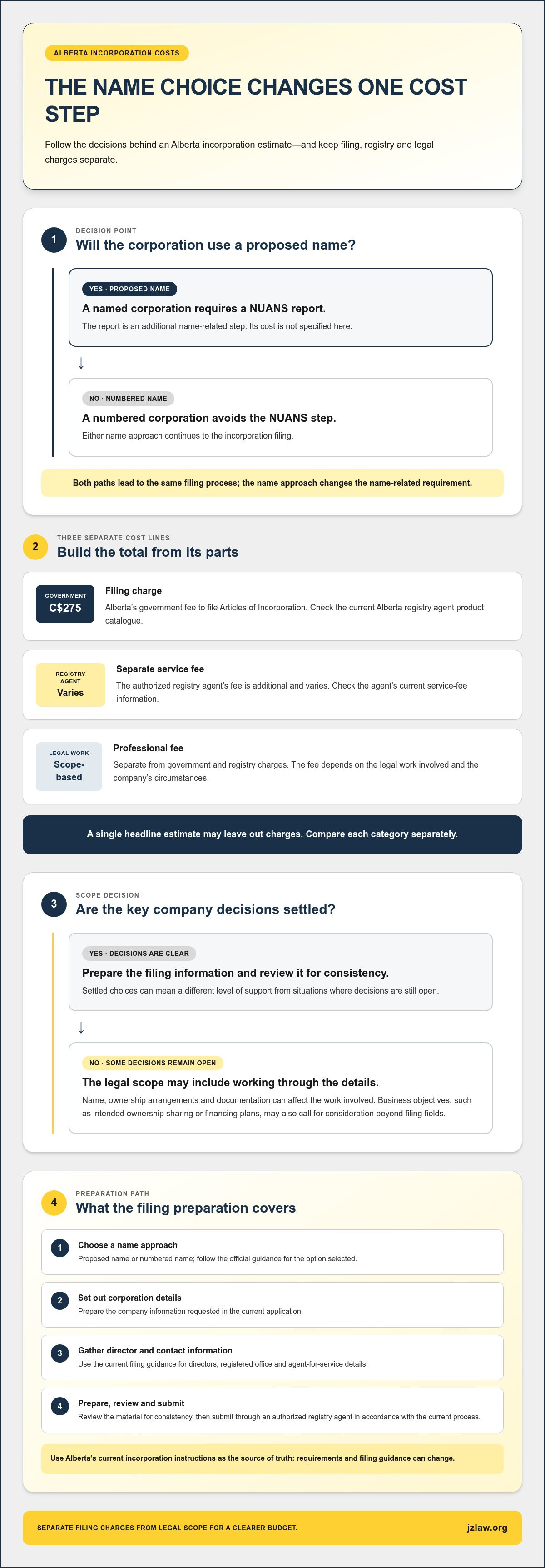
It’s reasonable to want a clear total before you commit. Alberta’s government fee to file Articles of Incorporation is C$275, and an authorized registry agent’s service fee is additional and varies. A named corporation also requires a NUANS report, while a numbered corporation avoids that step. These charges are separate from legal fees, which depend on the work involved.
This article explains how the costs fit together, how decisions about your corporation’s name, ownership and documents can affect the legal scope, and how to build a more useful budget. JZ Law provides incorporation services under Corporate Law and uses fixed-fee pricing, with its official fees listed on the Practices tab. As a small firm with lower overhead, JZ Law stands by its commitment: WE ARE HERE FOR THE LITTLE GUY, and fights the big guy on behalf of clients.
Table of Contents
What Makes Up the Incorporation Cost in Alberta?
The incorporation cost in Alberta has three distinct components: the government filing charge, the registry agent’s service fee, and any legal work you choose to have completed. Combining them into one price can make comparisons misleading. Each charge is set by a different party and covers a different part of the process.
Alberta incorporations are submitted through an authorized registry agent. The government charge relates to filing, while the agent’s separate service fee covers its role in processing the submission. A lawyer’s professional fee is separate from both. Keep these categories distinct to get a clearer view of the total than a single headline estimate provides.
Which charges are government or registry fees?
The government filing charge and registry agent service fee are related to submitting an incorporation, but they are separate charges. Registry agents set their own service fees, so the processing total can vary even when the government filing requirement is unchanged. Check Alberta’s current registry agent product catalogue rather than relying on an old article or undated estimate. Neither charge is a lawyer’s professional fee.
What does a legal fee cover?
Legal work can help define the incorporation requirements and address corporate documents appropriate to the company’s circumstances. The scope depends on the information and decisions involved. Read a quoted legal fee as covering a defined scope, not every corporate need the company might have. A corporation is a distinct legal structure; for general background, see What is a Corporation?
JZ Law provides incorporation services under Corporate Law using a fixed-fee format. This gives founders a clear legal-fee basis, separate from government and registry charges. Exact service amounts are listed on JZ Law’s Practices tab. Don’t infer a fee from an estimate for a different company or scope. As a small firm with lower overhead, JZ Law’s commitment is “WE ARE HERE FOR THE LITTLE GUY,” and to fight the big guy on behalf of clients.
This is general information, not legal advice. JZ Law can assess the work relevant to your company and explain the applicable fee scope before you proceed.
How Alberta Incorporation Steps Can Affect the Work Involved
Informational overview: Alberta’s incorporation process involves selecting a corporate name, preparing the required company and people details, and completing and submitting the filing through an authorized registry agent. Each stage involves a different decision or task, so the legal work needed can vary. This is why an incorporation cost alberta estimate may depend on more than the filing itself.
An Alberta corporation is a legal entity created through incorporation, distinct from the individuals who own or manage it. As the filing is prepared, consider the corporation’s name, registered office, directors, agent for service and intended arrangements. Use the current Alberta government incorporation instructions to confirm the information and documents required.
What information is commonly prepared for an Alberta filing?
Use the government’s current instructions as the source of truth, since application requirements and filing guidance can change. At a high level, organize the preparation into these stages:
Choose a name approach. Decide whether the corporation will use a proposed name or a numbered name. The official guidance explains any name-search or report requirements for the option you choose.
Set out corporation details. Prepare the company information requested in the application, following the government’s instructions rather than relying on an old template.
Gather director and contact information. The filing guidance identifies the director, registered office and agent-for-service information to provide. Use the definitions and fields in the current application.
Prepare and submit the filing. Review the completed material for consistency, then arrange submission through an authorized registry agent in accordance with the current process.
These are distinct preparation tasks, not a claim that every company needs identical legal assistance. A founder with settled decisions may need a different level of support from someone still working through the company’s name, ownership arrangements or documentation. Listing what is decided and what remains open helps define the work before it begins.
When might incorporation involve more than filing?
Filing creates the corporation, but a business’s objectives may call for consideration beyond completing application fields. Founders, for example, may need to think through how ownership is intended to be shared or whether the company expects to seek financing. Those objectives can affect which corporate arrangements and documents merit attention. This does not mean every incorporation requires an expansive legal project. It means the appropriate scope depends on the company’s plans.
Planning for a later transaction is distinct from submitting incorporation documents. If a company anticipates a significant corporate transaction, that work can be considered separately rather than assumed to be part of a basic filing. JZ Law provides corporate legal services to help assess the work relevant to a company’s objectives. This overview is informational and isn’t legal advice. Founders considering professional support can review JZ Law’s corporate law services as part of planning their next steps.
Base Incorporation Versus Broader Legal Work: What Changes the Scope?
A base incorporation figure doesn’t necessarily cover every legal question a company may face. Filing creates the corporation, but it doesn’t automatically resolve decisions about ownership, future financing or regulatory requirements. That distinction matters when assessing incorporation cost alberta: a basic filing and broader legal work address different needs, and neither should be assumed to include the other.
For a straightforward matter, the work may focus on preparing and submitting incorporation documents based on decisions the founders have already made. A company with unresolved ownership questions or a more involved business plan may require additional discussion or document work. Extra services aren’t automatically necessary, but the company’s objectives and circumstances can shape the appropriate scope.
What may sit outside a basic incorporation filing?
Some matters are separate from incorporating and may or may not be relevant to a particular business. Examples include shareholder arrangements, permits, professional registrations and registrations in other jurisdictions. These are potential scope distinctions, not a checklist of requirements for every new corporation. The company’s activities, plans and circumstances determine which questions warrant attention.
Consider two founders who are ready to file. If they have already agreed on their intended ownership arrangements, their immediate legal work may be narrower than that of founders who still need to discuss how ownership should be structured. Similarly, a business planning to operate beyond Alberta may need to consider registration questions that a business operating only within the province may not face. These examples show how objectives can affect scope; they don’t determine what any particular company must do.
Permits and professional registrations are also distinct from incorporation. Their relevance depends on the business and the rules that apply to its activities. Don’t treat a general incorporation estimate as confirmation that these separate matters have been addressed.
How can founders compare cost certainty and scope?
Compare proposals by separating two questions: which official or registry charges apply, and what legal work is included? A low base figure may refer only to a narrow filing scope, while a broader legal engagement may address additional work. Neither figure is meaningful without understanding what it covers.
Identify the filing scope. Clarify whether the work concerns incorporation documents alone or also addresses other identified corporate needs.
Separate outside charges. Keep government and registry agent charges distinct from a law firm’s professional fee.
Match scope to objectives. Note any ownership, financing or operating plans that could affect the work, without assuming they require a particular legal solution.
Review the fee basis. Look for a defined scope and a clear explanation of the pricing format.
JZ Law uses fixed fees, and its official fixed-fee list appears on the Practices tab. As a small firm with lower overhead, JZ Law is committed to “WE ARE HERE FOR THE LITTLE GUY” and to fighting the big guy on behalf of clients. Founders can explore JZ Law’s incorporation services as they consider the legal scope relevant to their plans.
This article provides general information, not legal advice about a particular business. JZ Law can assess the facts and explain which legal work may be relevant to a company’s circumstances.
How to Plan an Alberta Incorporation Budget Without Guessing
A reliable budget separates charges by what they cover instead of treating one advertised total as the full cost of setting up a company. A useful incorporation budget separates official filing charges from professional legal services. Identify registry processing charges separately too, so you can see which amounts relate to government filing, submission and legal work.
For an incorporation cost alberta estimate that remains useful as you plan, record the source and date of each figure. Government charges can change, and an older estimate may not reflect the current catalogue. Keep legal fees tied to their stated scope rather than assuming they include every task a company might later need.
A simple checklist for comparing incorporation estimates
Use this checklist to turn a headline number into a clearer planning document:
Identify the charges. Mark each amount as a government filing charge, registry agent service charge, legal-service fee or a combination. If a figure combines categories, note whether each component is itemized.
Check the date and source. Verify government charges against Alberta’s current registry agent product catalogue before relying on them. Record when you checked, especially if you’ll use the estimate later.
Define the legal scope. Note what the legal service is intended to address, such as incorporation preparation or other specific corporate work discussed with counsel. Don’t assume that a general description includes documents or advice beyond its stated scope.
Compare like with like. Check whether estimates cover the same tasks and charges. A lower headline total may describe less work, while a broader scope may include items another estimate treats separately.
Flag open questions. Record unresolved decisions about the corporation or its plans. They may affect the discussion of legal scope, but don’t automatically make additional work necessary.
This framework helps you compare estimate components, identify what is included and note what still needs clarification before setting a working budget.
Why current fee verification matters
Use Alberta’s official catalogue for current government charge information rather than relying on a search result, saved quote or article that may reflect earlier fees. Verify the registry service charge separately because it is not the same as the government filing charge. If your filing plans change, review the applicable information again before treating your budget as final.
JZ Law uses fixed-fee pricing for its legal services. Its exact fixed-fee amounts are listed on the Practices tab, so you can consult the firm’s published information rather than rely on an unverified figure. The legal fee remains distinct from government and registry charges, so keep those entries separate in your budget.
JZ Law is a small firm with lower overhead and a commitment to “WE ARE HERE FOR THE LITTLE GUY,” fighting the big guy on behalf of clients. To discuss incorporation legal work in light of your company’s plans, contact JZ Law about incorporation. This article is general information, not legal advice; JZ Law can provide professional counsel about your circumstances.
Alberta Incorporation with JZ Law: Fixed Fees and a Clear Next Step
Understanding the parts of an incorporation estimate is the first step. A clear legal-fee basis can make planning more predictable. JZ Law provides incorporation services under Corporate Law and uses fixed-fee pricing. The legal fee is separate from government filing charges and registry service fees, which relate to the submission process rather than the lawyer’s work.
For founders assessing incorporation cost alberta, this separation clarifies what a legal fee represents without suggesting every company needs the same support. The appropriate scope depends on the company’s circumstances and the work being discussed. A fixed fee sets the pricing format for the legal service; read the fee details together with the scope, and don’t treat them as a substitute for current government or registry charge information.
What cost certainty means at JZ Law
JZ Law is a small practice with lower overhead and a fixed-fee model. This gives founders a clear basis for understanding the firm’s legal-service fees as they plan, without confusing those fees with external filing charges. Exact JZ Law fee amounts are listed on the Practices tab. Don’t substitute an estimate or general market figure for the firm’s published information.
John Zang has been a member of the Law Society of Alberta since 1992, and JZ Law has served Calgary since 2000. The firm is based in Calgary, and Alberta-focused guidance can also help founders researching from Toronto, Vancouver, Hamburg, Berlin, Frankfurt, New York City or Denver distinguish Alberta filing charges from legal fees. The published fee list should be considered alongside the legal work relevant to the company, not as an assumption that every possible corporate task is included.
The firm’s approach is captured in its commitment, “WE ARE HERE FOR THE LITTLE GUY.” JZ Law fights the big guy on behalf of clients, with a focus on representing individuals and businesses seeking legal support. Cost certainty starts with distinguishing the service being provided from charges set by government or registry agents, then reviewing the published fee information for that legal work.
Discuss your Alberta incorporation needs
This article provides general information, not legal advice about a particular business. JZ Law can discuss your circumstances, clarify the legal scope relevant to your incorporation and help you understand how that work fits into your plans. A focused conversation about the company you intend to form and the questions you need counsel to address is a practical next step.
Contact JZ Law to discuss professional counsel for your Alberta incorporation needs.
Take the Next Step With a Clear Plan
Your incorporation budget is most useful when it reflects the company you intend to build, not just the act of filing. Before moving forward, consider which decisions are settled, which questions remain open and what you want the corporation to support as the business develops. That preparation can make a discussion with counsel more focused and help you understand how the legal scope relates to your plans.
The right approach to incorporation cost alberta is not simply finding the smallest headline figure. It’s understanding what each charge covers and seeking professional guidance on work relevant to your circumstances. JZ Law’s fixed-fee pricing supports cost certainty, with exact amounts available on the Practices tab. This article is general information, not legal advice for your business.
For professional counsel about your Alberta incorporation, discuss your incorporation needs with JZ Law. Call or text 403 680 9264, or email jzanglaw@gmail.com.
Frequently Asked Questions
How much does it cost to incorporate a company in Alberta?
There isn’t one all-in price for every Alberta corporation. As of October 2026, the provincial filing fee for Articles of Incorporation is C$275, with a registry agent’s service fee added separately. A named corporation also requires a NUANS report, while a numbered corporation avoids that name-search step. Legal fees depend on the professional work involved, so the total incorporation cost alberta founders should budget for depends on their choices and the scope of work.
What fees are involved in incorporating an Alberta corporation?
Common cost items include the provincial filing fee, a registry agent’s service fee and, for a named corporation, a NUANS report. As of October 2026, the report typically costs C$15 to C$60 and is valid for 90 days. If you engage a lawyer, that legal service is a separate cost. Review each item individually so a bundled estimate doesn’t obscure what it covers or leaves out.
Can I incorporate an Alberta company without a lawyer?
Yes, you can prepare the incorporation documents yourself without hiring a lawyer, but Alberta incorporations must be submitted through an authorized registry agent. Self-preparation doesn’t eliminate the agent’s service charge. Before proceeding, consider whether you’re comfortable making the company’s formation decisions and completing the required information. This is general information, not legal advice about whether self-preparation is suitable for your circumstances.
What does the Alberta incorporation fee include?
The provincial filing fee covers the government filing of the Articles of Incorporation. It isn’t the same as a registry agent’s charge for submitting the filing, and it doesn’t pay for a NUANS report for a named corporation or legal advice. As of October 2026, the government filing fee is C$275. Check the current catalogue before relying on that amount, since official charges can change.
Does incorporation cost more if my company needs additional legal work?
It may, because work beyond preparing the incorporation filing can expand the legal scope. Founders who need advice on ownership arrangements or planned financing, for example, may have different questions from founders whose decisions are already settled. Those circumstances don’t automatically make additional work necessary. JZ Law can explain the scope relevant to your situation and the associated fixed fee; its official fee amounts appear on the Practices tab.
Where can I find current Alberta incorporation fees?
Check Alberta’s current registry agent product catalogue for government filing charges and related fee information before setting your budget. Registry agent service fees are separate, so account for that charge independently. For JZ Law’s legal-service fees, consult the Practices tab for the firm’s official fixed-fee list. Keep the dates and sources for your figures together so you can reassess them if your filing plans change.
Is a low base incorporation estimate the full cost?
Not necessarily. A low headline estimate may refer only to a specific filing task and omit costs that apply to your case, such as the registry agent’s service fee, a required NUANS report for a named corporation or legal work. Review the itemized components and assumptions to see what the figure covers. That makes it easier to compare estimates on the same basis instead of relying on the headline alone.



Comments