


Alberta Business Succession: Strategic Legal Guide 2026
- jzanglaw
- 21 hours ago
- 12 min read
What if the multi-generational legacy you've built in Calgary or Edmonton is compromised not by market shifts, but by a shareholder agreement that lacks the legal precision required in 2026? For many owners, business succession planning alberta represents the most significant corporate transaction of their careers, yet the fear of heavy capital gains tax often leads to unnecessary hesitation. You've worked hard to scale your operations, and it's natural to worry about whether your specialized expertise can be successfully transferred or if your heirs will face an avoidable tax burden upon your exit.
We're here to provide the clarity you need to move forward with confidence. By implementing sophisticated tax structuring and proactive legal strategies, you can protect your company's value and ensure a seamless transition. This guide explores critical 2026 updates, including the $1,275,000 Lifetime Capital Gains Exemption and the 2% small business tax rate. We'll also detail how to audit your current agreements for legal validity and how to position your business as a prime target for strategic buyers, ensuring your legacy remains intact for decades to come.
Table of Contents
The Importance of Proactive Business Succession Planning in Alberta
Succession planning isn't a single event or a simple transfer of keys; it's a multi-year strategic roadmap designed to ensure the continuity of an Alberta founder's vision. Effective business succession planning alberta requires a holistic approach that balances the emotional weight of a legacy with the cold precision of financial performance. While many owners view their exit as a distant milestone, the most successful transitions are treated as active corporate projects that begin years before the actual departure date. This foresight allows for the gradual transfer of specialized knowledge and the fortification of the company's legal structure, ensuring that the brand’s dignity remains intact throughout the change in leadership.
Delaying this process introduces significant risks that can jeopardize years of hard work. Without a structured plan, companies often face a sharp decline in enterprise value when a founder's sudden exit creates a leadership vacuum. Additionally, failing to proactively structure the business can lead to unintended tax liabilities that erode decades of accumulated wealth. In Alberta, the "Alberta Advantage" provides a favorable 8% general corporate tax rate and a 2% small business rate in 2026, but capturing these benefits requires precise legal alignment. We prioritize the mitigation of these risks by positioning the transition as a calculated evolution rather than a reactive crisis.
The 5-to-10 Year Transition Horizon
Starting the process in 2026 for a planned 2031 exit provides the necessary runway to navigate the "quiet phase." This period focuses on cleaning up corporate records and ensuring the business functions independently of its founder. We work to align your personal retirement objectives with the corporation's long-term health. This proactive alignment prevents friction when a founder's personal financial needs eventually meet the capital requirements of the company's next chapter. It's about creating a self-sustaining entity that thrives beyond your daily involvement.
Protecting Value in Calgary’s Volatile Market
Calgary’s economy demands a strategy that withstands market volatility, particularly in the energy and technology sectors. A documented plan acts as a buffer by demonstrating institutional stability to potential buyers or heirs. We treat these preparations as strategic corporate transactions that enhance firm value. Sophisticated buyers from hubs like Denver or New York pay a premium for businesses where transition risks are mitigated, providing the legal certainty that modern capital markets demand for high-value acquisitions.
Identifying Strategic Succession Pathways for High-Growth Firms
Selecting the appropriate exit trajectory is a decision that dictates the entire legal architecture of business succession planning alberta. Founders must weigh the emotional continuity of a family transfer against the immediate liquidity and scale provided by a third-party sale. While family transfers preserve a legacy, they often require complex shareholder agreements to mitigate future disputes among heirs. Third-party sales, by contrast, treat the exit as a pure corporate transaction, prioritizing valuation and clean liability transfers. Management Buyouts (MBOs) offer a middle ground, providing stability by transitioning leadership to employees who already understand the company’s internal mechanics. These buyouts often involve structured financing, such as vendor-take-back arrangements, which keep the founder's interests aligned with the company's performance during the transition period. In the cannabis sector, these changes are exceptionally complex, as cannabis licensing requirements necessitate rigorous background checks and regulatory approvals for every new beneficial owner.
Taking Your Company Public as an Exit Strategy
For high-growth firms, an IPO or a reverse merger represents the pinnacle of succession. This path requires a profound shift from founder-led agility to board-governed accountability. Integrating securities regulation into your roadmap ensures that the company is "public-ready" long before the filing date. It's a strategic move that provides founders with an orderly exit while securing the capital needed for the company's next phase of expansion. Preparing for this transition involves rigorous financial auditing and the establishment of robust governance protocols to satisfy both regulators and institutional investors. Choosing between an internal buyout or an external acquisition requires a deep understanding of market trends; we recommend reviewing your options with an advisor at JZ Law to ensure your strategy is sound.
Succession in Regulated Sectors: Energy and Tech
Alberta’s economic engine relies on sectors where compliance is non-negotiable. In the energy sector, asset transfers must adhere to strict oil and gas law frameworks to ensure environmental liabilities and operating licenses are correctly assigned. Similarly, tech and crypto firms must prioritize intellectual property protection during a change of control. Our approach to cryptocurrency law focuses on ensuring that digital assets, private keys, and proprietary algorithms are legally accounted for. We ensure that all regulatory licenses remain valid through the change of control, preventing costly operational halts during the handover. This proactive stance minimizes the friction often associated with transferring highly specialized, regulated businesses.
Legal and Tax Structuring: The Foundation of Succession
The structural integrity of your exit depends on the precision of your tax strategy. In 2026, the Lifetime Capital Gains Exemption (LCGE) has reached $1,275,000, offering a significant opportunity for Alberta business owners to realize value tax-free. However, accessing this exemption isn't automatic. It requires the business to maintain its status as a Qualified Small Business Corporation (QSBC). We employ purification techniques to ensure that at least 90% of the company's assets are used in active business at the time of sale. Without this proactive cleaning of the balance sheet, you risk losing a substantial tax advantage that has been built over decades of operation.
Holding companies (HoldCos) serve as a critical layer of defense, providing both creditor protection and a mechanism for tax deferral. By moving excess cash or redundant assets into a HoldCo, you shield them from operational risks while preparing the primary entity for a clean sale. For those looking to transition within a family, an estate freeze is often the preferred instrument. This process locks in the current value of the business for the retiring generation, allowing future growth to accrue to the heirs. It provides financial certainty for the founder while minimizing the eventual tax liability for the next generation, ensuring the transition remains a source of stability rather than a fiscal burden.
Corporate Restructuring for Transition
Strategic restructuring often involves the creation of distinct share classes to separate voting rights from equity value. This allows founders to maintain operational control while gradually transferring the economic benefits of the business to a successor or a discretionary family trust. Such trusts offer unmatched flexibility, allowing for the strategic distribution of dividends and the potential multiplication of the LCGE among family members. These structures are vital in cross-border transactions involving buyers from New York or Denver, where the legal architecture must satisfy international scrutiny. We prioritize tax structuring that anticipates these complexities, ensuring that the transition of control is both legally sound and fiscally efficient.
Shareholder Agreements: The Most Critical Document
A shareholder agreement drafted a decade ago is often a liability rather than an asset. As your business evolves, the provisions governing exit must be updated to reflect current valuations and 2026 regulatory realities. We insist on robust buy-sell provisions and "shotgun" clauses that provide a clear exit path in the event of a deadlock. These agreements must explicitly address scenarios such as disability, death, and retirement with precise valuation mechanisms. Generic formulas often fail to account for the specialized nature of Alberta's energy or tech sectors. Without these legal safeguards, the business succession planning alberta founders rely on can quickly devolve into costly litigation, threatening the very continuity you've worked to establish.
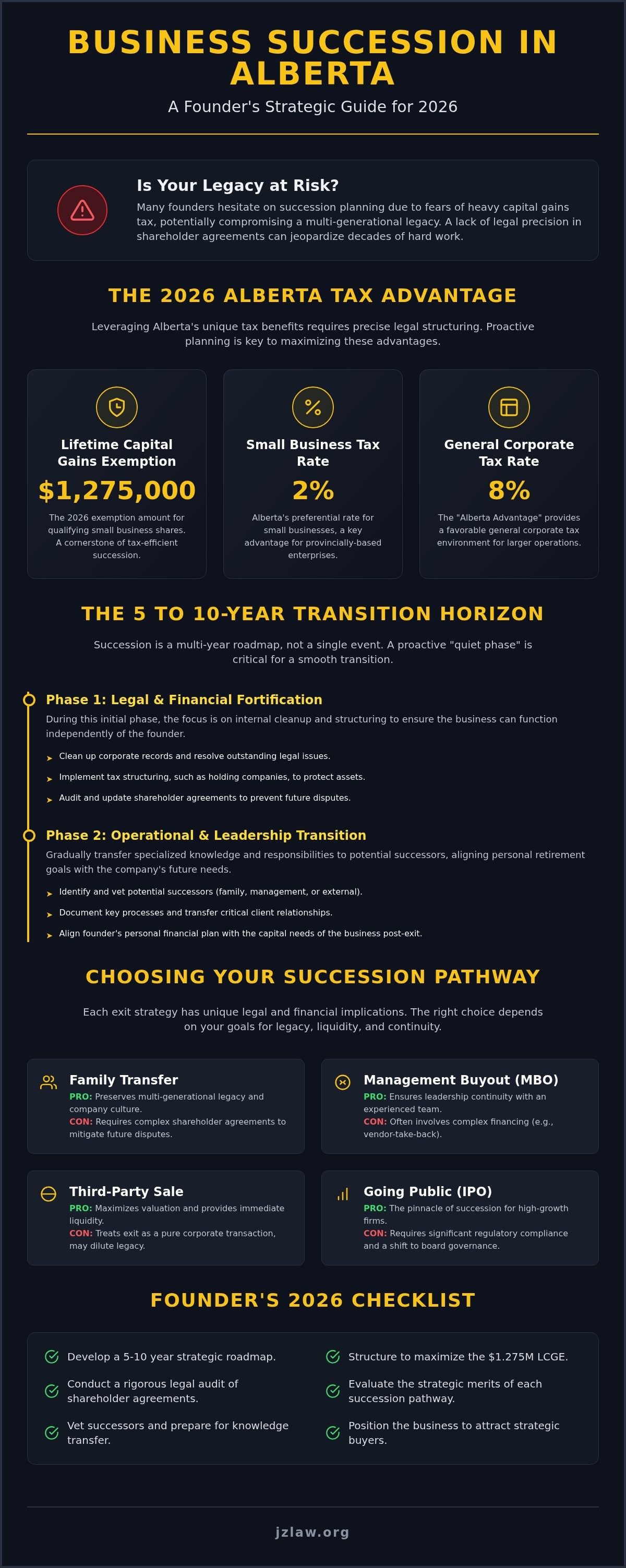
The 2026 Alberta Business Succession Checklist
Executing a successful transition requires a systematic approach that moves beyond theory into actionable legal hygiene. Business succession planning alberta is most effective when founders treat their own companies with the clinical detachment of an outside buyer. This process isn't merely about finding a replacement; it's about fortifying the entity so it survives the departure of its most influential figure. By following a structured checklist, you ensure that no regulatory or financial detail is left to chance, preserving both your wealth and your professional reputation.
Step 1: Conduct a comprehensive business valuation and legal audit to establish a baseline for all negotiations.
Step 2: Identify and vet potential internal or external successors through a rigorous performance and cultural fit analysis.
Step 3: Update corporate minute books and shareholder agreements to ensure they reflect 2026 legal standards and current ownership structures.
Step 4: Execute tax-driven restructuring, such as an estate freeze or the creation of a family trust, to lock in value.
Step 5: Develop a formal communication plan for key stakeholders to maintain market confidence during the announcement phase.
Valuation and Due Diligence
Viewing your company through the eyes of a professional auditor is the first step in identifying hidden liabilities. This involves a deep dive into your operational history, ensuring that every contract is enforceable and every asset is correctly titled. We often find that long-standing businesses have overlooked real estate law issues, such as outdated lease obligations or non-compliant environmental assessments, which can stall a sale at the eleventh hour. In 2026, enterprise value in Alberta is defined by the intersection of stable cash flows and the legal robustness of a company's regulatory compliance, regardless of fluctuations in commodity prices. Cleaning up these issues now prevents them from becoming leverage for a buyer to devalue your life's work later.
Communication and Governance Transition
The "Training Wheels" phase is a critical period where decision-making power is gradually shifted to the successor while the founder remains in an advisory capacity. This phased approach manages the emotional transition for long-term employees and clients who may feel uneasy about a change in leadership. Establishing a transition board or an advisory committee can provide the necessary oversight to ensure the company’s strategic direction remains consistent. It’s a period of testing and refinement, allowing the successor to prove their competence under the founder's mentorship. Don't rush this handover. A methodical transfer of authority protects the company’s culture and ensures that key client relationships aren't severed during the transition. To begin fortifying your company’s future today, contact JZ Law for a comprehensive corporate audit.
Navigating Complexity with JZ Law: Strategic Counsel
JZ Law understands that for Alberta’s business leaders, the transition of a company is the ultimate corporate transaction. Generalist firms often lack the granular insight required for business succession planning alberta in highly regulated environments where compliance is a moving target. Our boutique model allows for a level of precision that large-scale operations simply cannot replicate, ensuring that no detail is lost in a sea of associates. We don't just process paperwork; we act as a strategic partner, ensuring that every legal maneuver aligns with your long-term business interests and personal legacy. By focusing on the unique challenges of the Calgary market, we create a sense of security that allows founders to focus on their next chapter while we manage the technical complexities of the handover.
Integrated Corporate and Regulatory Expertise
Our firm bridges the gap between sophisticated tax structuring and industry-specific regulatory requirements. Whether you are navigating the intricacies of cannabis licensing or managing the transfer of assets under oil and gas law, we provide integrated counsel that mitigates risk at every stage of the process. We treat every succession as a high-stakes corporate transaction, applying the same level of scrutiny found in New York or Denver capital markets to ensure your business is public-ready or sale-ready. Our expertise in securities regulation and taking companies public allows us to prepare your firm for institutional-grade scrutiny, regardless of the eventual buyer's profile. This approach ensures that your exit isn't just a legal formality but a strategic victory that maximizes enterprise value and protects heirs from avoidable liabilities. We offer strategic advocacy for founders in Calgary, Toronto, and beyond, providing a vital bridge to international buyers and institutional investors.
Your Next Steps with John Zang
Initiating your exit strategy begins with a confidential, comprehensive strategic review. During this initial phase, we assess your current corporate structure and identify any immediate legal vulnerabilities in your shareholder agreements or minute books that could hinder a smooth transition. John Zang Services are specifically tailored to the unique needs of high-growth firms, providing a bespoke roadmap that outlines the timeline, tax implications, and regulatory hurdles of your unique business exit. We believe in a proactive, preventative approach, focusing on eliminating risks before they manifest during due diligence. This methodical, patient approach ensures that your business remains a source of pride and profit throughout the transition and beyond. Contact JZ Law today to schedule your professional consultation and begin the process of securing your company’s future with the dignity and precision it deserves.
Securing Your Legacy in Alberta’s Evolving Economy
The evolution of your enterprise from a founder-led operation to a self-sustaining legacy is perhaps the most significant corporate transaction you'll ever undertake. Successful business succession planning alberta requires a meticulous blend of tax structuring, regulatory compliance, and strategic foresight. Whether you're navigating the complexities of Alberta Energy Regulator (AER) compliance or preparing for sophisticated securities and IPO pathways, the legal architecture of your exit must be robust enough to withstand both market volatility and intense due diligence. By locking in value through estate freezes and maximizing the 2026 Lifetime Capital Gains Exemption, you protect the wealth you've built while ensuring a seamless transition for your successors.
Precision and proactive risk mitigation are the hallmarks of a dignified exit. We invite you to leverage our specialized expertise in tax structuring for corporate exits to ensure your company thrives long after your departure. Secure your business legacy; contact JZ Law for a strategic succession consultation today. Your commitment to excellence brought your business to this point; let's ensure its future is just as certain and secure.
Frequently Asked Questions
When is the best time to start business succession planning in Alberta?
Owners should ideally begin the process five to ten years before their anticipated departure. This timeline allows for the comprehensive "quiet phase" of corporate cleanup and successor vetting. Starting business succession planning alberta in 2026 for a 2031 exit provides the necessary runway to implement complex tax deferral strategies. It ensures the company can function independently of the founder, which significantly increases enterprise value during final negotiations.
How does the Lifetime Capital Gains Exemption (LCGE) work for Alberta business owners?
The LCGE allows Alberta business owners to exempt up to $1,275,000 of capital gains from the sale of qualified small business corporation shares in 2026. To qualify, your corporation must meet specific asset tests, including the requirement that at least 90% of its assets are used in active business at the time of sale. Proper purification techniques are essential to ensure these thresholds are met well before the transaction occurs.
What is the difference between an asset sale and a share sale in succession?
A share sale involves the transfer of the entire corporation, which typically allows the seller to utilize their LCGE for significant tax savings. Conversely, an asset sale involves the transfer of specific business components, such as equipment or intellectual property. While buyers often prefer asset sales to avoid historical liabilities and obtain a tax basis step up, sellers in Alberta generally favor share sales to maximize their after-tax proceeds.
Can I use an estate freeze if I am not planning to retire for another 10 years?
You can implement an estate freeze even if your retirement is a decade away. This strategy locks in the current value of your business for your own retirement while allowing all future appreciation to accrue to your heirs or a family trust. By freezing the value in 2026, you mitigate future tax liabilities on the company's growth, providing long-term financial certainty for both your estate and the next generation.
How do I handle cannabis retail licenses during a business sale in Alberta?
Transferring cannabis retail licenses in Alberta requires prior approval from the Alberta Gaming, Liquor and Cannabis commission. Any change of control or ownership triggers a rigorous background check and disclosure process for new beneficial owners. We treat these transitions as complex regulatory transactions, ensuring that all licensing requirements are satisfied concurrently with the corporate sale to prevent operational interruptions or the revocation of permits during the leadership handover.
What happens to my Alberta corporation if I die without a succession plan?
If you die without a plan, your shares will be managed by an estate representative under the Alberta Estate Administration Act, which often leads to a leadership vacuum. This uncertainty typically results in a sharp decline in business value and can trigger immediate tax liabilities. Without a valid shareholder agreement, your heirs may face prolonged litigation, making business succession planning alberta a critical tool for preserving your company's long-term continuity.
Does JZ Law handle family law disputes during a business transition?
JZ Law does not provide representation for family law matters or domestic disputes. Our expertise is strictly limited to complex corporate and regulatory sectors, including securities regulation and tax structuring. While we understand that personal transitions often coincide with business exits, we maintain a narrow focus on the commercial and legal robustness of the entity. We coordinate with your external family law counsel to ensure the corporate roadmap remains secure.
How can tax structuring help me pay less when selling my company?
Strategic tax structuring minimizes your overall liability by ensuring your corporation maintains its Qualified Small Business Corporation status. By utilizing holding companies and family trusts, you can defer taxes on surplus cash and potentially multiply the LCGE among family members. These methods ensure you retain a higher percentage of the sale price, transforming a standard exit into a highly efficient transaction that maximizes the low 2026 Alberta corporate tax rates.


Comments