


Legal Cost of a Series A Financing in NYC and What Affects It
The legal cost of a Series A financing in NYC depends on more than the round’s name. The transaction structure, financing amount, documents and regulatory questions all shape the legal work, so one figure cannot reliably describe every deal.
A larger or more complex financing may require broader legal support, but the type of financing matters too. New York’s commercial financing disclosure rules apply to specified commercial financing transactions, subject to exemptions and transaction-size thresholds.
This article explains which financing providers and transactions may fall under those rules, how exemptions and transaction size affect the analysis, and why Series A legal work varies with the deal’s structure and complexity. It also outlines how securities regulation and corporate transaction counsel fit into the process, helping you understand the work involved before proceeding.
Table of Contents
How do Series A legal fees vary by financing size and deal complexity?
The legal cost of a Series A financing in NYC depends on the legal work required, not simply the amount raised. A larger round may involve more investors, negotiation points and diligence materials. For example, a lead investor negotiating preferred-share rights can generate additional drafting and review beyond a straightforward financing with agreed terms. The amount raised is one factor; the transaction’s structure and documentation also matter.
Complexity often increases with the number of parties and documents. Multiple investors may seek different rights, side letters or information arrangements, requiring counsel to coordinate comments, track competing terms and ensure the final documents work together. A company with an incomplete capitalization table or unresolved corporate records may also need to address those issues before closing. Each additional issue can expand the review and negotiation.
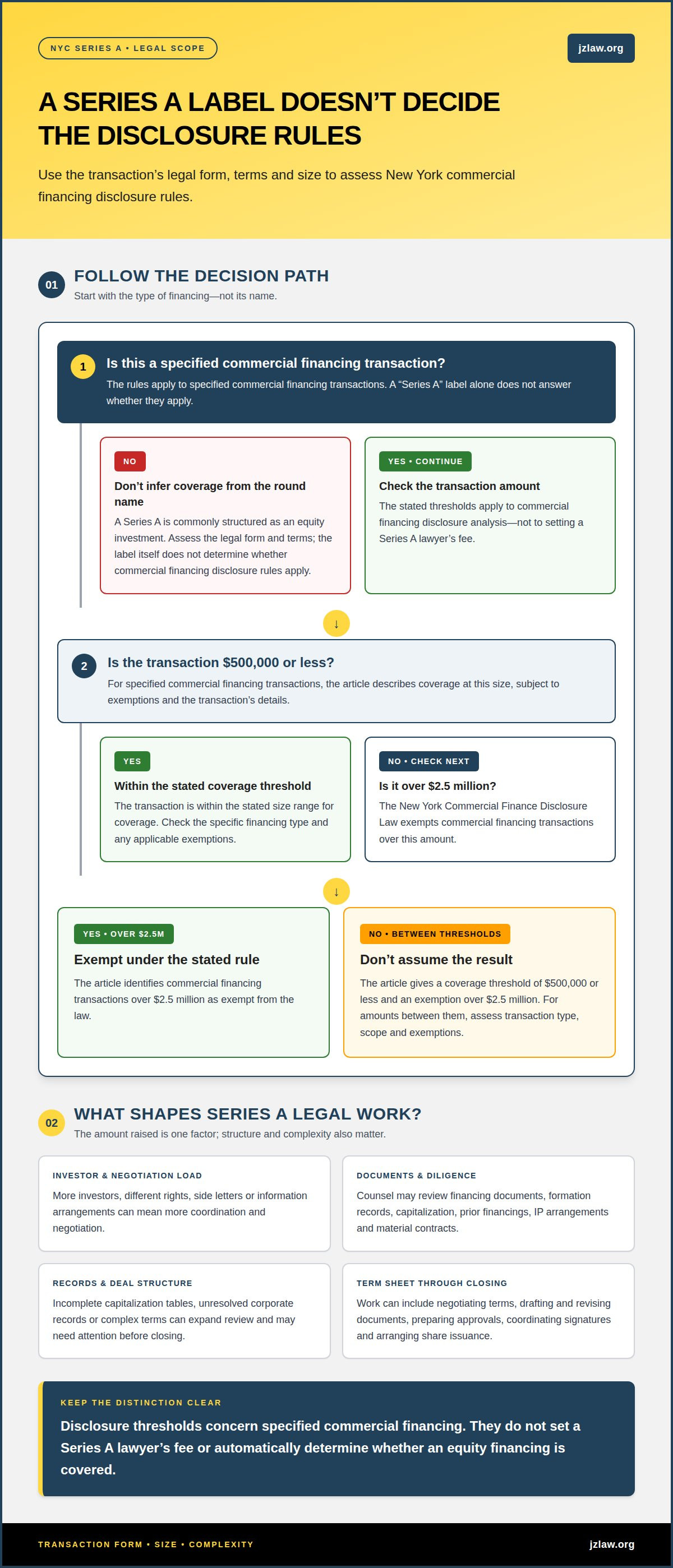
Transaction size can also matter for a separate reason: New York’s commercial financing disclosure rules turn on the type and size of a transaction. The rules cover specified commercial financing transactions of $500,000 or less, while the New York Commercial Finance Disclosure Law exempts commercial financing transactions over $2.5 million. These thresholds concern commercial financing disclosures; they do not set a Series A lawyer’s fee or automatically determine whether an equity financing is covered.
That distinction matters because a Series A is commonly structured as an equity investment, while commercial financing disclosure rules cover specified commercial financing. The transaction’s legal form and terms matter more than its “Series A” label. To scope the legal work, counsel considers the number of investors, document complexity, diligence findings, negotiation and any applicable regulatory analysis. A well-organized financing with aligned terms may involve less negotiation than one with several investors and unresolved provisions.
What legal work is included in company counsel fees for a Series A?
Company counsel typically coordinates the financing from term sheet to closing. The term sheet outlines proposed economic and governance terms, such as valuation, preferred-share rights and board representation. Counsel identifies provisions to negotiate and puts agreed terms into transaction documents. For example, a proposed board seat may affect both governance documents and the investment agreement.
Due diligence is another core workstream. Counsel reviews the company’s formation records, capitalization table, earlier financing documents, intellectual property arrangements and material contracts. If an earlier share issuance was recorded inconsistently, corporate records may need to be reconciled before new shares are issued. Findings may also lead to specific representations, disclosure schedules or closing requirements.
Depending on the deal’s structure, drafting and negotiation may involve several documents:
The stock purchase agreement sets out the investment terms, representations and closing conditions.
An amended charter may establish the new preferred-share class and its associated rights.
Investors’ rights and voting agreements can address information rights, registration matters and governance arrangements.
A right of first refusal and co-sale agreement may define how certain share transfers are handled.
Company counsel also coordinates approvals and closing steps. This may include preparing board and shareholder resolutions, confirming signature requirements, organizing final documents and arranging share issuance. A closing checklist, for example, can track outstanding signatures, corporate approvals and delivery of funds. The exact work depends on the negotiated documents and the company’s records.
The scope includes work across diligence, drafting, investor comments and closing coordination. A financing with settled terms and organized records may need fewer revisions than one with unresolved governance provisions or incomplete records. A clear engagement scope separates core financing work from additional matters, such as correcting past corporate actions. These workstreams explain the legal services involved, but do not establish a particular fee or rate.
Who usually pays investors' legal fees in a New York Series A financing?
In a New York Series A, the financing documents generally determine whether the company covers any investor counsel fees. The company pays its own counsel, while the lead investor hires separate counsel to represent its interests. As part of negotiating the deal, the company may also agree to reimburse some investor-side legal expenses. This allocation is contractual, not automatic simply because the transaction is called a Series A.
The parties can address this early in the term sheet, including whether the company will cover investor counsel’s fees and whether reimbursement is capped. For example, they might agree that the company pays documented fees up to a negotiated limit. The final financing documents should clearly reflect the arrangement, including which expenses qualify and when payment is due.
Scope matters as much as allocation. Investor counsel may review company records, negotiate investment documents and coordinate the investor’s closing requirements. If several investors share lead counsel, the parties can discuss how to allocate the resulting costs. If each investor retains separate counsel, the company’s potential reimbursement obligation may differ. The agreement should specify whose fees are covered rather than refer broadly to undefined investor expenses.
Identify the covered counsel: specify whether reimbursement applies to lead-investor counsel or other investors’ lawyers.
Define eligible expenses: distinguish transaction work from unrelated legal advice or future matters.
Set the payment terms: state any agreed cap, documentation requirements and payment timing.
Address changes: clarify how added investors or expanded negotiations affect the allocation.
Before signing, company counsel can compare the term sheet’s allocation with the final purchase and related agreements. If the final documents expand reimbursement beyond the negotiated scope, the company’s total financing expense may increase. Clear drafting helps founders understand the company’s obligation before closing while preserving investors’ ability to obtain independent representation.
What are current hourly rates for startup and venture capital lawyers in NYC
There is no single legal cost for every New York startup or venture capital financing. The amount depends on the lawyer’s seniority, the firm’s billing structure and the work involved. A complex financing negotiation and a document review may require different levels of effort. Rather than rely on a generic market figure, clarify the scope and fee arrangement for your transaction.
For a Series A, a more useful comparison focuses on the work included in each proposal. Ask how the legal team will handle drafting, investor comments, diligence and closing coordination. For example, one lawyer may lead negotiations while others prepare document revisions. The proposed staffing and scope help explain what the legal engagement covers.
Engagement terms also affect the final bill. Confirm which lawyers will work on the financing, how time is recorded, what tasks fall within the engagement, and how the firm reports progress. If the engagement uses hourly billing, request a budget or estimate tied to defined workstreams. If it offers a fixed-fee arrangement, clarify which revisions, diligence issues or added investors could fall outside its scope.
Compare like with like: review proposed team roles and included work, not only the lead lawyer’s rate.
Clarify scope: identify whether document negotiation, diligence and closing support are included.
Set reporting expectations: agree how often the firm will share time and budget updates.
Discuss changes: establish how additional investors or newly identified corporate issues affect the estimate.
These details make fee proposals easier to evaluate without treating an hourly rate as the total cost. For a financing involving complicated negotiations, the hours required may matter more than a modest difference between individual rates. Discuss securities counsel for your financing to consider the legal scope and billing approach.
JZ Law
JZ Law advises on securities regulation, a central consideration when structuring and documenting a Series A financing. The firm can help assess regulatory issues relevant to the transaction and explain how that work fits with company-side financing documents and negotiations. This is useful when founders are defining the legal scope, reviewing engagement terms or addressing questions about investor participation.
Early legal analysis can identify which securities matters belong in the financing workstream and which need separate consideration. That distinction gives founders a clearer basis for setting the scope and managing the transaction’s legal work.
For counsel on securities regulation and financing matters, contact JZ Law.
Set the Scope Before Your Financing Moves Forward
Planning for the legal cost of a Series A financing in NYC starts with defining the support your company needs. Before work begins, align the engagement scope with the transaction’s priorities, responsibilities and decision-making process. A shared understanding helps founders manage legal work alongside fundraising and keep the company’s broader objectives in view.
Consider the financing as part of the company’s long-term corporate strategy, not an isolated closing. Counsel should understand the transaction’s securities considerations and how the company’s plans shape its legal needs. If the financing structure or objectives change, revisit the scope to keep the legal work aligned with the deal.
For guidance on your financing and its legal scope, contact JZ Law about your financing. A clear conversation can help you take the next step with a more considered plan.
Frequently Asked Questions
What is the typical legal fee for a Series A financing in New York City?
There is no single typical fee for a New York City Series A; the legal cost of a Series A financing in NYC depends on the work and billing arrangement. Counsel can prepare a matter-specific estimate after assessing the company’s records, financing structure, expected negotiation and required closing support. Ask the firm to identify assumptions and exclusions, so changes to the transaction can be distinguished from the original scope.
What is the typical total cost of a Series A financing, including company and investor counsel?
There is no standard combined total because company and investor counsel have separate engagements, and the financing agreement determines whether the company reimburses investor fees. For a useful budget, separate the company’s legal work from any investor-fee reimbursement obligation. Also distinguish legal services from other transaction expenses, such as filing or administrative charges, where applicable.
How do flat-fee and hourly billing compare for Series A legal work?
The legal work can span diligence, drafting, negotiation and closing, so define those workstreams when discussing the engagement. A fixed fee can make costs more predictable; clarify which revisions, diligence issues and additional matters the agreed scope covers.



Comments