


Legal recourse for a failed M&A deal in Calgary: your options
Legal recourse for a failed M&A deal in Calgary depends on the transaction documents and whether the deal failed before or after closing. If a buyer remains obligated to close but cannot secure financing, the seller may claim damages or seek specific performance. After closing, a buyer may have a contractual claim if a representation or warranty proves false. Termination rights and any reverse breakup fee can also shape the parties’ options.
A failed deal can raise difficult questions: what did the parties promise, which conditions were met, and what losses followed? Financing difficulties alone do not determine the outcome. The purchase agreement, the parties’ conduct, and the timing of the dispute all matter.
This article explains how financing provisions and contract terms affect potential claims, what remedies may be available before closing, and how post-closing disputes can be addressed. M&A legal counsel in Calgary can review the agreement, identify relevant evidence, and help develop a strategy that reflects the business objectives at stake.
Table of Contents
Buyer exposure when acquisition financing fails
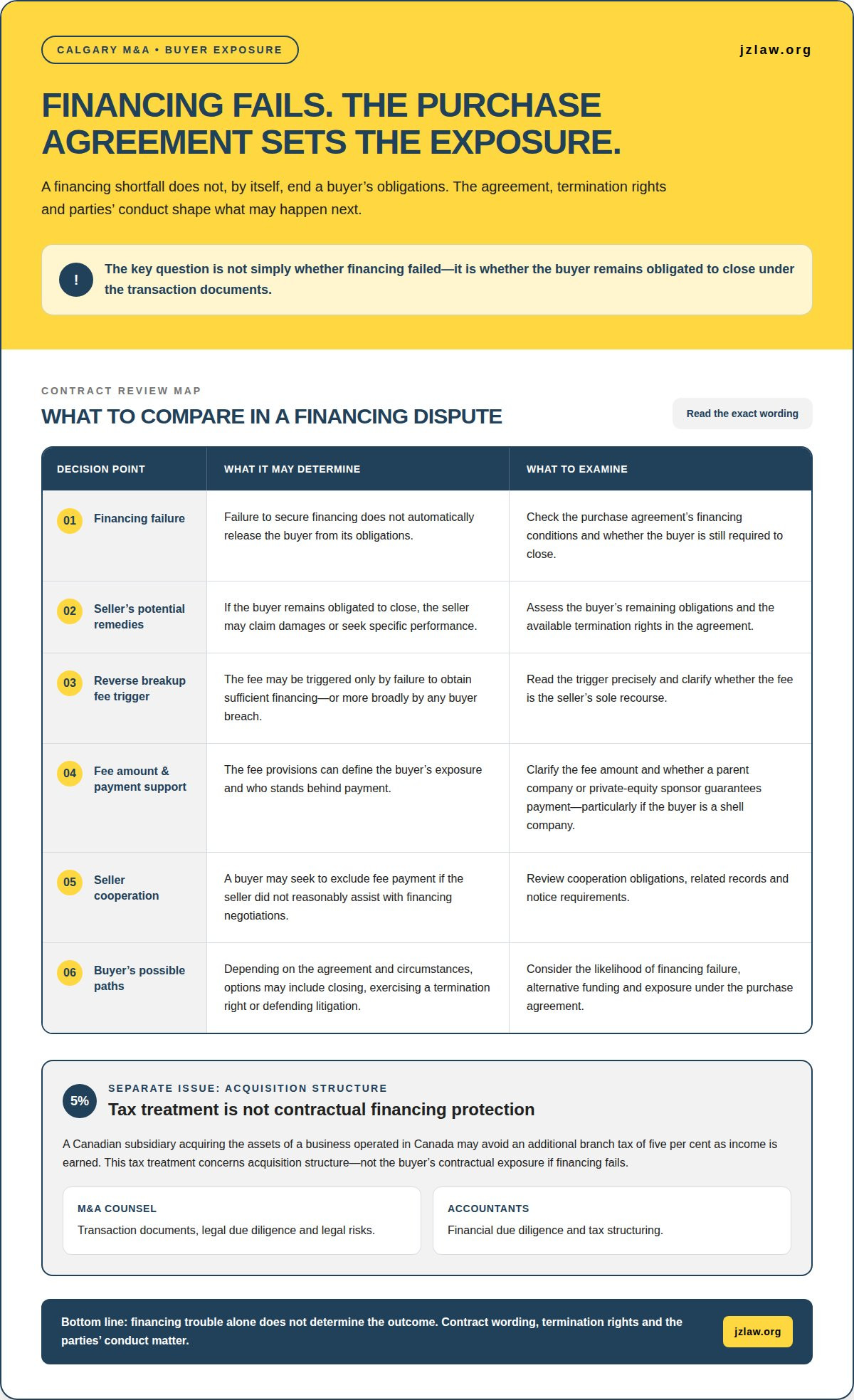
Financing failure does not, by itself, end a buyer’s obligations under an acquisition agreement. In Canada, an acquisition through a shareholder-approved arrangement does not require adequate financing arrangements as a matter of law. The purchase agreement therefore matters: if the buyer remains obligated to close after failing to secure sufficient third-party debt financing, the seller may claim damages or seek specific performance.
A reverse breakup fee can define a buyer’s exposure, but its trigger must be read precisely. It may apply only if the buyer fails to obtain sufficient financing, or more broadly after any buyer breach. The parties should clarify which termination rights apply and whether the fee is the seller’s sole recourse. They should also define the fee amount and whether a parent company or sponsor guarantees payment.
Seller cooperation can affect the negotiated fee. A buyer may seek to exclude payment if the seller did not reasonably assist with financing negotiations. Before agreeing to a fee, buyers should assess the likelihood of financing failure, the availability of alternative funding, and their exposure under the purchase agreement. If the buyer is a shell company, the parties should consider a parent-company or private-equity sponsor guarantee.
A Canadian acquisition subsidiary raises a separate structuring question. A Canadian subsidiary acquiring the assets of a business operated in Canada may avoid an additional branch tax of five per cent as income is earned. This tax treatment concerns the acquisition structure, not the buyer’s contractual exposure if financing fails. Calgary M&A counsel can assess transaction documents, legal due diligence, and legal risks; accountants handle financial due diligence and tax structuring.
Counsel can review financing conditions, notice requirements, records of cooperation, and fee provisions before recommending a response. The available options may include closing, exercising a termination right, or defending litigation. Legal recourse for a failed M&A deal in Calgary turns on the contract terms, not financing failure alone.
Post-closing dispute resolution
Disputes can arise before signing, between signing and closing, or after the transaction closes. The deal stage helps identify which documents, conduct, and remedies matter.
Disputes Across Deal Stages
A deal-stage dispute may arise during negotiations, before closing, or through post-closing performance. In Alberta, transaction documents address conditions precedent and due diligence. An M&A letter of intent is usually non-binding, though it may set out confidentiality, expenses, and a due diligence period. Its wording helps distinguish preliminary intent from binding commitments. A shareholder agreement or purchase agreement may also define what the parties must do before closing.
Remedies and Evidence for Failed Deals
Remedies are the contractual or legal responses available when an M&A transaction does not close or a party breaches its obligations. In Alberta, a seller may claim damages or seek specific performance if the buyer remains obligated to close. A Calgary M&A lawyer can organize signed agreements, meeting records, payment evidence, and communications, then assess how they support a claim. These records can help establish the parties’ decisions, commitments, and conduct.
After closing, buyers and sellers may disagree about purchase-price adjustments or an earn-out tied to future performance. The purchase agreement should explain the valuation method, calculation period, and process for resolving disputed figures. For example, a disagreement about reported revenue may turn on the accounting records and the precise earn-out formula, rather than strategic expectations discussed during negotiations.
Adjustment records should show the calculation, supporting financial information, notices exchanged, and each party’s response. An expert determiner’s decision may bind the parties contractually, but it is not enforceable in the same way as a judgment or arbitration award. If a party refuses to comply, a separate court or arbitration action is required. Mediation can also provide a way to resolve the dispute without starting court proceedings.
For Calgary businesses, organized records help clarify the claim and the response. Calgary M&A legal counsel can assess the documents and dispute-resolution terms before a claim proceeds.
Representations and warranties in M&A agreements
Representations and warranties record statements about the target company and allocate risks between buyer and seller. Their wording, supporting disclosures, and due diligence findings can shape a claim after closing.
Contract Disputes and Breaches
A contract dispute arises when a party alleges that an agreement was breached or a stated fact was inaccurate. In an acquisition, the purchase agreement may contain representations about corporate records, contracts, financial information, or liabilities. A buyer’s due diligence provides context but does not replace the negotiated language. Counsel can compare the alleged breach with the agreement, disclosure schedules, and closing documents.
Damages for Failed Acquisitions
Damages are monetary relief sought for losses connected to a contractual breach. In Alberta, a court assesses a failed-acquisition claim against the agreement and evidence of the alleged loss. The buyer’s ability to show how the breach affected the transaction matters. If a false representation is discovered after closing, the buyer may have a contractual claim, usually seeking monetary damages.
A letter of intent is usually non-binding and outlines proposed general terms. Its confidentiality provisions, allocation of expenses, and due diligence timetable may still matter if a dispute concerns conduct before the definitive agreement. The signed purchase agreement and any amendments determine the parties’ binding transaction obligations. Closing documents may also record disclosures or adjustments relevant to a claim.
Alberta limitation periods apply to M&A contract claims, but the applicable deadline depends on the claim and its circumstances. Contractual notice requirements may also affect how a claim must be raised. Counsel can assess the relevant deadlines by reviewing the claim timeline, agreement, and communications. Do not infer a limitation period from the deal’s closing date alone.
For example, if a seller’s warranty about the target’s contracts proves false, a claim may turn on the exact wording, disclosed exceptions, and resulting loss. A structured review of due diligence records and closing documents can connect the alleged breach to the evidence and remedy sought.
M&A lawyer services in Calgary
A Calgary M&A lawyer assesses legal risks, conducts legal due diligence, and prepares transaction documents. For a failed deal, counsel can compare the signed agreement with notices, closing conditions, and communications. That analysis helps identify whether a contractual right, breach, or unresolved condition affects the available response.
The transaction structure sets the scope of the review. In a share purchase, the buyer acquires the company, including its assets, liabilities, contracts, and history. In an asset purchase, the buyer can select specific assets and liabilities, leaving the corporate shell behind. A lawyer examines how the structure and purchase agreement allocate risks and obligations.
Due diligence gives counsel a factual basis for evaluating the target. Legal review may cover corporate records, contracts, employment matters, intellectual property, leases, assets, liabilities, and potential disputes. For example, an undisclosed contract restriction could affect a buyer’s decision to proceed or provide context for a later claim. The findings also inform negotiations and transaction-document drafting.
Legal and financial due diligence serve different purposes. Lawyers typically handle transaction documents, legal due diligence, and legal risk assessment. Accountants handle financial due diligence, quality-of-earnings analysis, tax structuring, and valuation support. Coordination can connect a financial finding, such as an earnings discrepancy, to a contract term or disclosure that may affect the buyer’s position.
Before recommending a response, counsel can organize the purchase agreement, amendments, disclosure schedules, and closing records. Reviewing them can clarify which conditions were satisfied, what each party communicated, and whether the agreement provides a process for resolving a specific dispute. These distinctions help keep litigation decisions tied to documented obligations and business priorities.
For transaction-specific legal analysis, request counsel for corporate transactions to assess the agreement, records, and options available after a deal breaks down.
JZ Law
JZ Law helps business owners assess their legal position when an acquisition stalls, fails to close, or leads to a post-closing dispute. Counsel can review the transaction documents and relevant communications, identify the provisions that shape available options, and help align a response with the business’s priorities. The analysis can clarify whether negotiation, a contractual dispute process, or litigation warrants consideration.
JZ Law also advises on complex corporate and regulatory matters, including securities regulation and taking companies public. This perspective can be relevant when a transaction involves corporate structure or regulatory considerations alongside contractual issues. Bring the signed agreements, amendments, notices, and key correspondence to a discussion with counsel so the matter can be assessed in context.
For legal guidance on a failed M&A transaction, contact JZ Law to discuss your circumstances.
Choose a Clear Path Forward
A clear assessment of legal recourse for a failed M&A deal in Calgary starts with the business outcome you need to protect. Consider whether preserving a potential transaction, limiting disruption, or resolving an existing claim best serves your commercial priorities. Those objectives can frame discussions with counsel and keep the next decision focused on practical consequences.
The right course depends on the agreement, available evidence, and the parties’ conduct. Before taking a formal position, organize your priorities and identify decisions that could affect ongoing operations or business relationships. A focused legal assessment can help you understand the available options and make informed choices without losing sight of the wider business context.
Contact JZ Law about your M&A dispute to discuss the circumstances and consider a constructive next step. With a clear strategy, you can move forward with greater confidence.
Frequently Asked Questions
Can a buyer or seller sue for breach of an Alberta purchase agreement after a failed M&A deal?
Yes. A buyer or seller can bring a contract claim if the other party allegedly breached a binding purchase agreement. For example, a seller may claim damages if a buyer refuses to close despite remaining obligated to do so. A buyer’s claim could concern a breached contractual promise or an inaccurate transaction statement. The agreement’s wording and the evidence of the alleged breach shape the claim.
Can a party recover a deposit or break fee after an M&A deal falls through in Calgary?
Recovery depends on the agreement’s deposit, termination, and fee provisions. A deposit may be refundable in specified circumstances, while a break fee may be payable only if its contractual trigger occurs. For example, a financing-related reverse breakup fee could apply to a defined financing failure or a broader buyer breach. The parties’ termination rights and any sole-recourse wording also matter.
When can a buyer or seller terminate an M&A agreement under Alberta law?
A party can terminate when the agreement grants a termination right and its requirements are met. These provisions may address unsatisfied closing conditions, missed deadlines, or specified breaches. A letter of intent is usually non-binding, although it may contain confidentiality or expense provisions. The signed purchase agreement, amendments, notices, and the parties’ actions determine which termination terms govern.
Can a party seek specific performance or an injunction to force an M&A deal to close in Alberta?
A party that remains obligated to close can face a claim for specific performance, asking a court to require completion rather than award damages alone. A party can also ask a court for interim relief to preserve its position while the dispute proceeds. An injunction is a distinct request, and the agreement, evidence, and relief sought shape the argument.
How do exclusivity, confidentiality, and non-solicitation clauses affect remedies after a failed deal?
These clauses can impose obligations that continue even if the purchase does not close. Confidentiality terms can govern the use or disclosure of shared information; exclusivity can restrict specified competing negotiations during its stated period. A non-solicitation clause can address contact with named employees or business relationships. A party alleging breach can rely on the clause’s wording, duration, scope, and relevant communications.
How do negotiation, mediation, arbitration, and court litigation compare for an Alberta M&A dispute?
Negotiation lets the parties seek a business resolution directly, while mediation uses a neutral facilitator who does not decide the dispute. Arbitration places the decision with an arbitrator under the parties’ agreed process; court litigation asks a judge to decide the claim. The purchase agreement may specify a process. Evidence, urgency, confidentiality needs, and the remedy sought help guide the choice.



Comments