


Navigating Cannabis Zoning Laws in Calgary: A Site-Selection Guide
What if a promising Calgary property can’t support the cannabis business you plan to operate there? When navigating cannabis zoning laws in Calgary, a suitable address is only the starting point. The land-use district, location restrictions and required municipal approvals must align with your business model before you commit to a lease or purchase.
Calgary’s land-use rules govern which activities may take place at a premises and whether development or business-licence approvals are needed. They are separate from Alberta’s AGLC licensing requirements and any applicable federal Health Canada rules. Satisfying one set of requirements doesn’t automatically satisfy the others, and the process can differ for a retail store, production facility or processing operation.
This guide provides a practical pre-commitment process for assessing a proposed site. You’ll learn which records to review and what to clarify about the property’s land-use designation, nearby uses and permit history. You’ll also see how to map municipal approvals against provincial and federal licensing. The goal is to understand site suitability and outstanding risks before taking on a property commitment. Legal review can support due diligence, but it does not replace the City’s planning decisions.
Table of Contents
What Calgary cannabis zoning determines before you choose a site
How to check whether a Calgary property fits your cannabis business
Cannabis retail, cultivation, and processing: why Calgary zoning checks differ
A Calgary cannabis site due-diligence process before signing a lease
How legal counsel helps align Calgary zoning and cannabis licensing
What Calgary cannabis zoning determines before you choose a site
A premises may look commercially suitable, yet its land-use designation can limit or prevent the cannabis activity you intend to carry out there. Zoning is the City of Calgary’s system for determining which land uses are permitted at a property; it is not a cannabis business licence or authorization to operate. That distinction is fundamental when navigating cannabis zoning laws in Calgary: land-use suitability and cannabis licensing are separate requirements, and both must align.
What does cannabis zoning mean in Calgary?
Calgary’s Land Use Bylaw 1P2007 assigns properties to land-use districts and classifies uses. This affects whether a proposed activity is allowed, may require a development permit or cannot proceed at that location. The applicable rules depend on the specific address and operation. A retail store, for example, raises different land-use questions from a production or processing facility.
The bylaw has been amended, including an update on September 15, 2026. Before relying on a zoning summary or older property record, check the current bylaw text, district rules and City application requirements against official City of Calgary resources. Describe the proposed use precisely rather than treating “cannabis business” as one land-use category.
Which authorities may be involved in a cannabis business?
The City of Calgary determines whether the proposed use fits the property’s land-use rules and which municipal approvals, such as development or business-licence approvals, apply. A municipal decision addresses the premises and local requirements. It does not grant provincial or federal cannabis authorization.
Alberta’s Gaming, Liquor and Cannabis (AGLC) administers provincial authorization for cannabis retail stores, including the cannabis store licence and requirements in its current retail policies. Health Canada oversees federal licensing for regulated cannabis activities such as cultivation and processing. These roles are distinct: Calgary land-use approval does not replace an AGLC retail licence, and neither should be confused with federal licensing requirements for regulated activities.
For provincial context, Cannabis in Alberta outlines the province’s retail model and broader legal framework. For a site decision, use official municipal, AGLC and Health Canada materials to confirm current requirements. Rules and application procedures can change, so verify them before making a lease or purchase commitment. Keeping land use, premises approvals and licensing distinct is central to assessing a site’s regulatory fit.
How to check whether a Calgary property fits your cannabis business
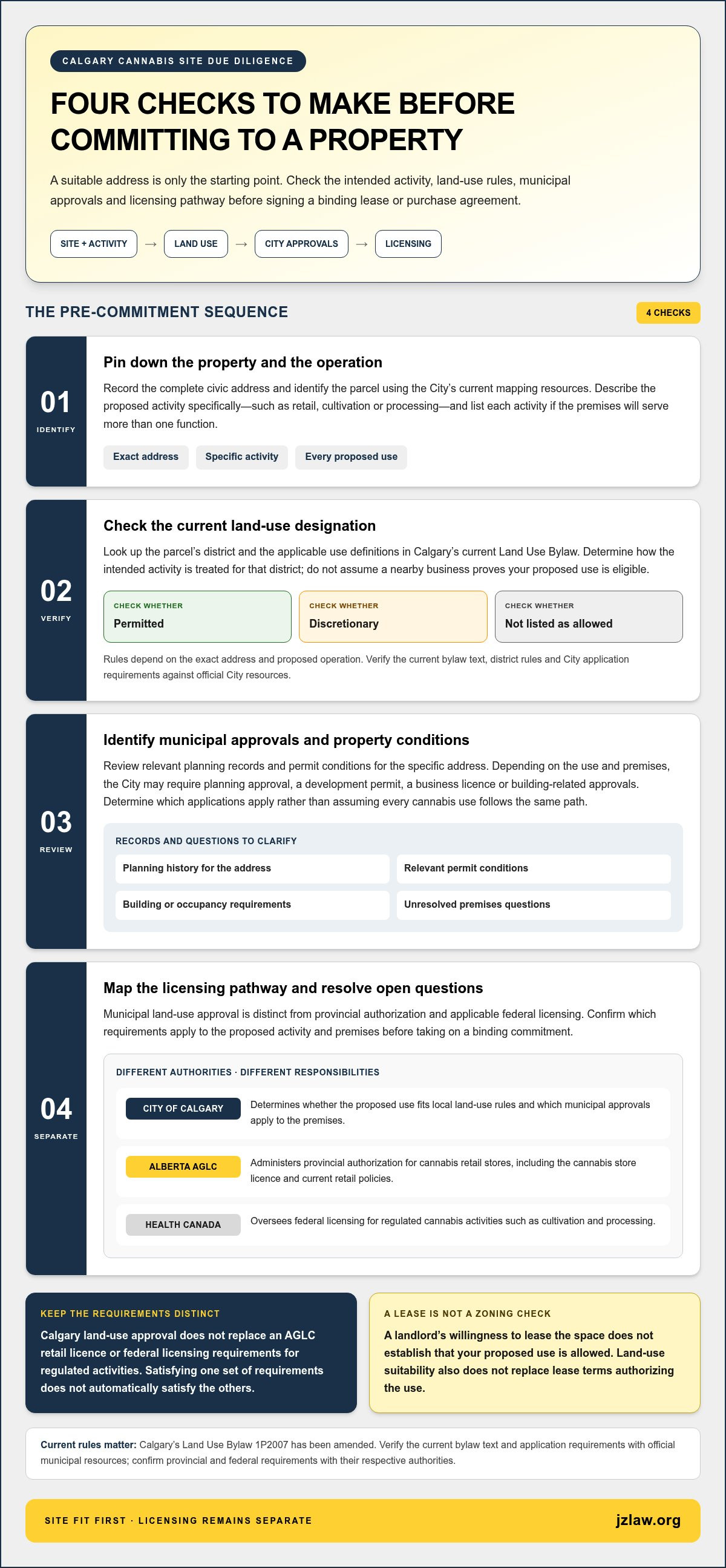
A reliable site screen starts with a precise description of both the property and the business. Use this sequence to identify land-use issues and approval questions before taking on a binding commitment.
Record the exact address and proposed activity. Note the complete civic address and identify the parcel using the City’s current mapping resources. Describe the operation specifically, such as retail, cultivation or processing. If the premises would serve more than one function, record each activity.
Find the current land-use designation. Check the parcel’s district and the applicable use definitions in Calgary’s current Land Use Bylaw. Determine whether the intended use is permitted, discretionary or not listed as an allowed use for that district. Verify any eligibility conditions against current rules rather than assuming they apply because a neighbouring business operates there.
Identify municipal approvals that may apply. Depending on the proposed use and premises, the City may require planning approval, a development permit, a business licence or building-related approvals. Review relevant planning records and conditions for the specific address. The City’s Calgary cannabis store license requirements page provides information for retail applicants. Confirm current requirements and application steps through official City resources.
Map the licensing pathway and resolve open questions. Separate municipal land-use approvals from any applicable AGLC retail authorization or federal licensing requirements. Record unanswered questions about the activity, property or required documents, and obtain qualified advice before signing a binding lease or purchase agreement.
Confirm approvals and conditions before committing
A zoning designation is only one part of site due diligence. Compare the intended operation with the property’s planning history and any relevant permit conditions. Identify whether building or occupancy requirements need to be addressed for the proposed premises. Requirements depend on the project, so determine which applications apply rather than assuming every cannabis use follows the same path.
Keep municipal approval separate from the owner’s consent. A landlord’s willingness to lease the space doesn’t establish that the proposed use is allowed. Likewise, land-use suitability doesn’t replace lease terms that authorize the intended activity. Resolve both tracks before committing.
Screening record
Confirmed: exact address, parcel, current district and documented applicable rules.
Open: unclear use classification, permit conditions, building requirements or licensing questions.
Follow-up: official City records or clarification, relevant regulator requirements, and qualified legal review.
This record gives you a practical basis for comparing candidate sites and discussing conditions in a proposed agreement. JZ Law provides cannabis licensing and regulatory counsel. Explore cannabis licensing and site due diligence.
Cannabis retail, cultivation, and processing: why Calgary zoning checks differ
The same property can raise different planning questions depending on the business activity. A customer-facing store, cultivation operation and processing facility have distinct premises needs and licensing pathways. When navigating cannabis zoning laws in Calgary, define each activity clearly before assessing whether a site and its approvals fit.
Cannabis retail premises and Calgary land use
For a store, assess the exact premises against Calgary’s current use rules and applicable municipal requirements. The City’s Calgary cannabis store licensing requirements provide an official starting point for the local process. Check current provisions and application details before relying on them. Provincial authorization is a separate step: the AGLC administers Alberta’s cannabis retail licensing framework, so municipal site suitability alone doesn’t authorize retail sales. For broader regulatory context, see the Cannabis Licensing Guide.
Cultivation and processing premises are a different analysis
Production-focused operations require a different site assessment from a storefront. Consider how Calgary’s current land-use rules classify the proposed activity, what the premises must support and which municipal permits may apply. Separately, determine whether the activity falls within federal Health Canada licensing requirements. A zoning decision doesn’t grant that licence, and federal authorization doesn’t establish that the property is suitable under Calgary’s bylaw.
For a mixed-use plan, assess each activity independently. A site intended for both processing and customer sales may raise multiple land-use and licensing questions. Record the applicable City findings alongside the relevant AGLC or federal pathway, and verify each against current official requirements before committing to the premises.
A Calgary cannabis site due-diligence process before signing a lease
A property’s apparent suitability isn’t the same as confirmed readiness to operate. Before committing, connect the proposed activity, premises, required approvals and lease obligations through a due-diligence review. This is a practical safeguard when navigating cannabis zoning laws in Calgary: an unresolved land-use question may affect whether the planned business can use the site as intended and how its opening plans are structured.
What to resolve in municipal and licensing due diligence
Build a file for the specific address. Record the current land-use designation and the City’s applicable use interpretation, then identify which municipal applications or permits may apply. Keep that review separate from the licensing pathway: AGLC retail authorization and any applicable Health Canada licensing for regulated activities are distinct from Calgary’s land-use decisions. Confirm relevant building, occupancy, development and safety requirements with the responsible authorities instead of assuming they apply uniformly to every premises.
Preserve the evidence behind your conclusions. Save official records and written responses, note application status and dates, and distinguish confirmed facts from assumptions. If guidance is preliminary or a requirement remains unclear, record the question and who is responsible for resolving it.
Protect the business decision while approvals are pending
Lease terms should account for unresolved approval dependencies. Review whether the permitted-use language describes the intended cannabis activity, what cooperation or documentation the landlord must provide, and what contractual options apply if a required approval is unavailable. The lease and municipal decision are separate matters: landlord consent doesn’t establish land-use suitability, and a suitable land-use designation doesn’t settle the parties’ contractual rights. A commercial real estate law guide can provide useful context for reviewing premises and lease issues.
Zoning: What current district and use interpretation apply to this address?
Approvals: Which municipal, building or occupancy requirements apply, and what is their status?
Licensing: Which AGLC or federal pathway applies to the planned activity?
Premises: What site or building information remains outstanding?
Lease: Are permitted use, landlord cooperation and termination provisions aligned with the approval risks?
Track open matters in a risk register that names the issue, verification source, responsible decision-maker and next step. This keeps unresolved questions visible and supports informed decisions without assuming a particular approval outcome or timeline. JZ Law provides cannabis licensing and regulatory counsel to help align licensing and premises commitments. Discuss site and lease due diligence.
How legal counsel helps align Calgary zoning and cannabis licensing
Site selection involves decisions across municipal, provincial and federal requirements. Legal counsel can connect the proposed business activity to Calgary land-use research, the relevant licensing pathway and documents describing the premises. A coordinated review can clarify dependencies and identify questions to resolve before a lease, purchase or application advances.
That advice supports the operator’s decision-making. It doesn’t determine whether the City will approve a land-use application or whether a regulator will grant a licence. For businesses navigating cannabis zoning laws in Calgary, legal review can help clarify how requirements interact, document outstanding issues and support commitments made with a clearer view of the risks.
When to bring a cannabis lawyer into the site-selection process
Consider legal review early if a proposed lease, purchase or application depends on an uncertain land-use interpretation, or if the planned activity and premises description may not align. Reviewing these together can help identify approval dependencies before major commitments are made. For broader regulatory context, consult the cannabis licensing guide.
JZ Law provides cannabis licensing and regulatory counsel tailored to the operator’s business model and proposed site. A focused review can bring available municipal records, licensing strategy and premises documentation into one decision framework, while keeping municipal and regulator decisions in their proper place.
Prepare for a focused legal review
Organize the information that defines the proposal and its current status. A concise file helps focus on the real decision points instead of treating zoning, licensing and lease terms as separate exercises.
The complete property address and the specific activities planned at the premises.
Any draft lease or purchase documents, including permitted-use language and relevant approval conditions.
City planning records, correspondence, application materials and any documented responses.
Relevant AGLC or Health Canada licensing materials and a record of outstanding questions.
Ask for an analysis of identified site and licensing risks, approval dependencies and practical next steps. The result should clarify what is established, what remains unresolved and which decision-maker or official source can address each open point. It should not be treated as a guarantee of approval.
If you have a candidate Calgary property or unresolved zoning questions, discuss Calgary cannabis zoning and licensing with JZ Law as part of your site due diligence.
Make your Calgary site decision with greater clarity
A sound cannabis site decision starts with the exact property and the activity you plan to carry out there. Confirm Calgary’s current land-use rules and applicable municipal approvals, then assess the relevant provincial or federal licensing pathway separately. Retail, cultivation and processing can raise different premises and regulatory questions. Document what is confirmed and resolve material uncertainties before committing to a lease or purchase.
Careful preparation makes navigating cannabis zoning laws in Calgary more manageable, but legal advice cannot replace decisions made by the City or regulators. It can help connect land-use research, licensing strategy and premises documents, and clarify how outstanding approvals may affect your business decision.
JZ Law is a boutique legal practice led by John Zang, providing cannabis licensing and regulatory counsel. Its local markets include Calgary, Toronto, Vancouver, Hamburg, Berlin, Frankfurt, New York City and Denver. If you’re assessing a candidate property or have unresolved site questions, discuss your Calgary cannabis site and licensing strategy with JZ Law. A methodical review can clarify the issues to address as you move forward.
Frequently Asked Questions
How do I find out if a Calgary property is zoned for a cannabis store?
Search the property’s exact address in the City of Calgary’s mapping and planning resources, then review its current land-use district and the rules for a cannabis store under the current Land Use Bylaw. Confirm whether the use is permitted, discretionary or not allowed in that district, and identify any applicable location restrictions or approval requirements. If the records leave an interpretation unclear, document the question and seek clarification before committing to the premises.
Does Calgary zoning approval guarantee an Alberta cannabis retail licence?
No. Calgary land-use or development approval addresses whether the proposed use may proceed at the premises under municipal rules. It doesn’t grant provincial retail authorization. Cannabis retailers must also meet current Alberta Gaming, Liquor and Cannabis (AGLC) licensing requirements. Treat the municipal and provincial processes as separate but related workstreams, and confirm each authority’s current requirements for the proposed store and its operators.
Can a cannabis business operate in any Calgary commercial district?
No. A commercial address alone doesn’t establish that a cannabis store is allowed. Calgary’s current land-use district, applicable use classification and site-specific rules determine whether a proposed retail use may proceed. Stores aren’t permitted in residential districts, and some eligible uses may require discretionary approval. Check current official rules for the exact property rather than relying on nearby businesses or a general description of the area.
What approvals may be needed before opening a cannabis store in Calgary?
Depending on the site and proposed work, a store may require City planning or development approval, a Calgary business licence and building-related approvals. Provincial authorization through the AGLC is a separate requirement for retail. The specific municipal steps can depend on the property, its existing use and any planned alterations. Review current City and AGLC application requirements for the address before setting opening plans or making firm commitments.
Are Calgary zoning rules different for cannabis retail and cultivation?
Yes. Calgary assesses land use according to the activity proposed at the premises, so a customer-facing store and a production facility may follow different municipal pathways. Under the current rules summarized in this guide, cannabis stores aren’t permitted in residential districts, while cannabis facilities are discretionary in certain industrial districts and must meet applicable location requirements. Cultivation or processing may also require federal Health Canada licensing, separate from municipal approvals.
Should I sign a lease before confirming cannabis zoning in Calgary?
Before signing a binding lease, verify the property’s land-use designation, the rules for your intended activity and the approvals that may apply. If important questions remain open, discuss appropriate conditions and protections with legal counsel before committing. Review permitted-use language, landlord cooperation, approval dependencies and termination provisions. A lease grants contractual rights to occupy a space, but it doesn’t establish that Calgary will approve the proposed use.
Can a cannabis zoning lawyer help assess a Calgary property before purchase?
Yes. A lawyer can review available municipal records, the proposed business activity, licensing pathway and premises documents to help identify approval dependencies and unresolved risks before purchase. Legal advice supports your decision; it can’t replace decisions made by the City, the AGLC or Health Canada. JZ Law, a boutique practice led by John Zang, advises businesses on cannabis licensing and regulation in Calgary and other markets, including Toronto and Vancouver.



Comments