


Navigating the AGLC License Appeal Process: A Strategic Legal Guide 2026
- jzanglaw
- Jul 15
- 12 min read
Updated: Jul 20
An AGLC appeal isn't a simple administrative request; it's a high-stakes legal proceeding where procedural errors by the regulator often become your most powerful leverage. If you've received a notice of license suspension or denial, the fear of losing your business is likely overwhelming. You're probably finding that the mandatory 30-day deadline for the aglc license appeal process feels impossibly tight, especially when you're forced to wrestle with complex administrative law jargon while your livelihood hangs in the balance.
We understand that you need more than just a form-filler; you require a strategic partner who views regulatory hurdles through a sophisticated business lens. This guide provides a professional framework to help you master these complexities, ensuring your interests remain protected through rigorous legal advocacy. We'll examine the critical 2026 procedural landscape, including the December 2025 updates to Form 301 and the 120-day hearing timeline. By the end of this article, you'll have a clear path toward securing a reversal of sanctions and maintaining your standing within Alberta's regulated industries.
Table of Contents
Understanding the AGLC Decision: Grounds for a Board Hearing
The receipt of a decision letter from the regulator often signals a critical juncture for any hospitality or retail enterprise. Whether it's a formal denial of a new application or a notice of administrative sanctions, these documents aren't merely suggestions; they're enforceable orders that can jeopardize your commercial viability. Understanding the specific trigger for the aglc license appeal process is the first step in constructing a viable defense. The Alberta Gaming, Liquor and Cannabis Commission (AGLC) derives its power from the Gaming, Liquor and Cannabis Act (GLCA), which sets the strict boundaries for what the regulator can and cannot do.
Many operators make the mistake of distinguishing between "minor" policy violations and "major" legislative non-compliance. In reality, the Board views any breach through the lens of public interest and safety. Even a seemingly small warning or a nominal fine should be scrutinized. These entries remain on your permanent record, serving as an aggravating factor that can lead to license cancellation if future incidents occur. Appealing these issues isn't just about the immediate penalty; it's about protecting your business’s long-term reputation and licensing eligibility.
License Denials vs. Administrative Sanctions
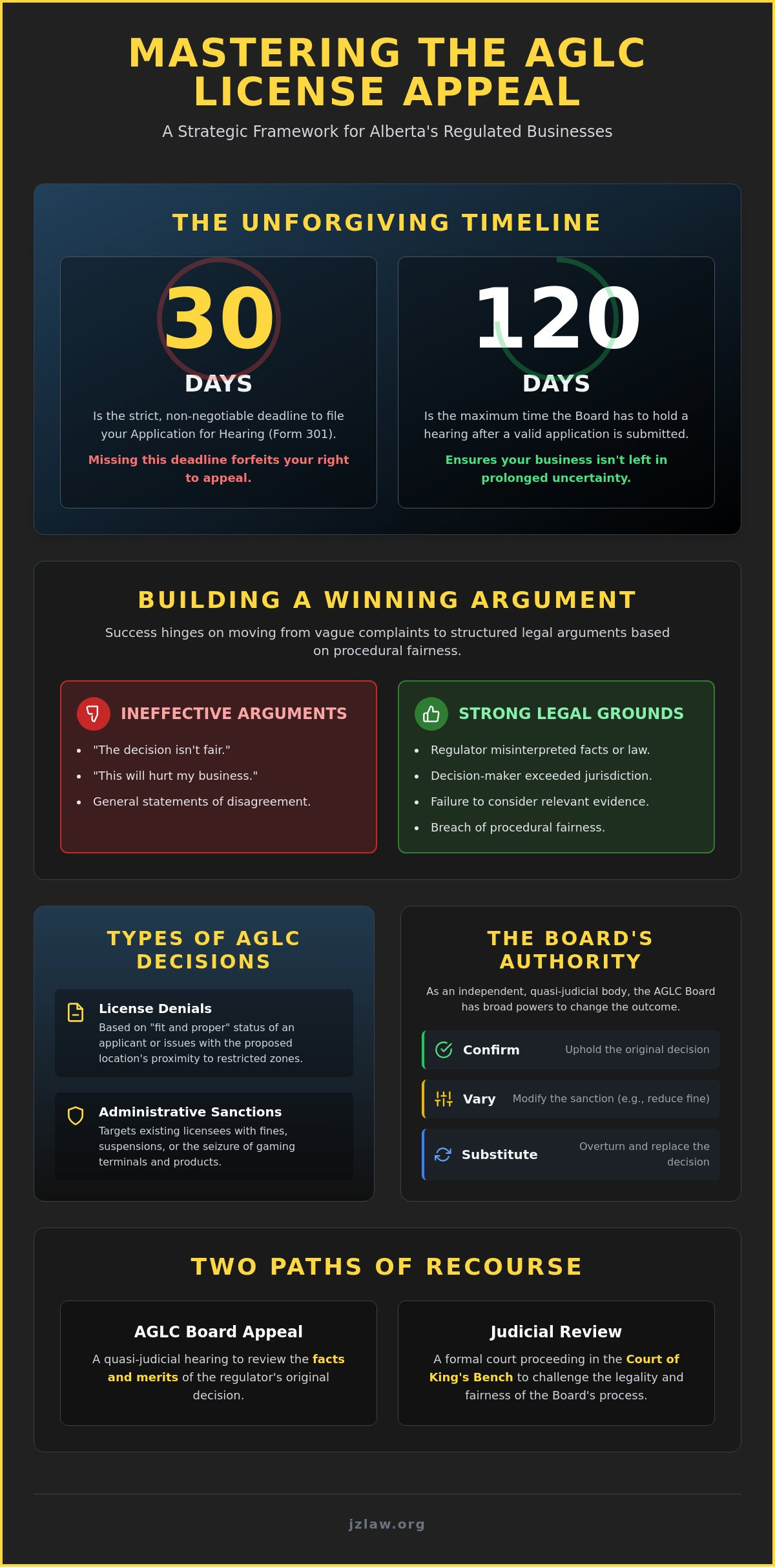
A license denial often stems from concerns regarding the "fit and proper" status of an applicant or issues with the proposed location's proximity to restricted zones. In contrast, administrative sanctions target existing licensees. These can include heavy fines, mandatory suspensions, or even the seizure of gaming terminals and products. When we analyze these decisions, we look for inconsistencies in how the Regulatory Services Division applied the GLCA. Challenging these sanctions requires a deep understanding of how your business’s prior history is being utilized to justify current penalties.
The Legal Authority of the AGLC Board
It's vital to recognize that the AGLC Board remains independent from the inspectors and investigators who initially issued the sanction. This separation is designed to provide a fair, impartial review of the facts. The Board possesses the broad authority to confirm, vary, or substitute the original decision, meaning they can potentially wipe away a fine or reduce a suspension entirely if the evidence supports it. The AGLC Board functions as a quasi-judicial body, exercising statutory authority to adjudicate disputes and ensure regulatory decisions align with the principles of administrative law. This independence ensures that the aglc license appeal process serves as a genuine check on regulatory overreach rather than a mere rubber-stamping of staff decisions.
The 30-Day Window: Initiating the AGLC License Appeal Process
Time is the most unforgiving element of the aglc license appeal process. You have exactly 30 days from the date you receive a decision to file an Application for Hearing. Missing this deadline usually ends your legal recourse immediately, as the Board rarely grants extensions for administrative oversights or delays in seeking counsel. This strict window is codified under the Gaming, Liquor and Cannabis Act, which governs all regulatory enforcement and appellate procedures within Alberta's gaming and liquor sectors.
The instrument for initiating this review is Form 301, which was most recently updated on December 18, 2025. While the form appears straightforward, the section dedicated to "Grounds for Hearing" is where most businesses fail. Vague assertions that a decision "isn't fair" or "will hurt the business" aren't legal arguments. You must provide a structured rationale that identifies specific errors in how the regulator interpreted the facts or applied the legislation. Once a valid application is submitted, the Board is statutorily required to hold a hearing within 120 days, ensuring your business isn't left in a state of permanent uncertainty.
Filing Form 301: Strategic Considerations
Success in the aglc license appeal process depends on your ability to dissect the "Notice of Matter" provided by the regulator. This document serves as the roadmap for the AGLC's case against you. We focus on identifying whether the original decision-maker exceeded their jurisdiction or failed to consider relevant evidence. At JZ Law, we provide the strategic counsel necessary to audit the decision record, ensuring every appealable error is captured before the 30-day clock expires.
Timeline Management and Acknowledgement
After you file your application, the AGLC Hearing Panel Office will typically provide a formal acknowledgement within two weeks. This period marks the beginning of the disclosure phase, where you'll receive the "Record of Decision." This bundle contains the evidence, inspector reports, and internal notes the regulator used to justify their original ruling. You'll also need to decide on a hearing format. While the AGLC offers video conferences for efficiency, in-person hearings in St. Albert or Calgary often provide a superior environment for complex advocacy. Managing these logistics requires precision to ensure all evidence is submitted according to the Panel's strict procedural timelines.
Strategic Preparation: Evidence and Procedural Fairness
Winning an appeal requires more than just showing up to tell your story. It demands a rigorous assembly of evidence that meets the specific legal standards of administrative tribunals. In the aglc license appeal process, the Board operates on the "balance of probabilities." This means you don't have to prove your case beyond a reasonable doubt; you must simply demonstrate that your version of events is more likely than not to be true. Achieving this requires a multi-layered evidentiary package. This package often includes internal business records, site-specific photography, and expert testimony to counter the regulator's assertions. By methodically building this foundation, we ensure that the aglc license appeal process remains focused on the facts rather than regulatory assumptions.
Witness preparation is equally vital. Oral testimony must align perfectly with the written record provided to the Board. Any discrepancy, however minor, can be seized upon by the regulator's counsel to undermine your credibility. We ensure that every statement is vetted and every witness understands the nuances of the hearing environment before the proceedings commence. It's about creating a cohesive narrative that leaves no room for ambiguity or misinterpretation by the panel members.
The Duty of Fairness in Alberta Regulation
Procedural fairness is the cornerstone of a successful appeal. Under Alberta law, the AGLC Board is obligated to follow the principles of natural justice, which include the right to a fair hearing and a decision-maker free from bias. This duty allows us to challenge the inclusion of unverified hearsay or biased inspector reports in the record. If the regulator failed to provide you with adequate notice or the opportunity to respond to the allegations, the entire decision may be found procedurally deficient. We scrutinize the administrative record to ensure that the Regulatory Services Division didn't skip essential steps or ignore your right to be heard during the initial investigation phase.
Leveraging Industry Expertise
Strategic advocacy involves applying specific cannabis licensing standards and liquor policies to the unique facts of your case. We don't rely on generalities. Instead, we analyze past board decisions to establish precedents that favor your position. By referencing specific AGLC policy handbooks and comparing your operations to industry benchmarks, we build a compelling narrative that moves the Board toward a favorable ruling. This proactive approach focuses on risk mitigation and the pre-emptive correction of regulatory misunderstandings. We structure our arguments to address the specific technical requirements of your license class, ensuring the Board understands the business realities behind the alleged violations.
The Hearing Day: Formats and Presentation of Case
The hearing represents the formal culmination of the aglc license appeal process. It's the final opportunity to present your case before the Board. While the AGLC offers three formats, including written submissions for exceptional cases, most strategic decisions revolve around choosing between in-person sessions and video conferencing. In-person hearings, typically held at the AGLC offices in St. Albert or Calgary, allow for a more nuanced presentation of evidence. They facilitate a direct level of engagement that is often lost through a screen. A physical presence allows counsel to better gauge the Panel’s reactions and adjust the flow of advocacy in real time.
The structure of the day is strictly organized. It begins with opening statements, where each side outlines their position. This is followed by the presentation of evidence and witness testimony. This stage includes cross-examination, which is often the most high-pressure portion of the day. AGLC counsel and the Panel members will ask probing questions to test the validity of your claims. Success here depends on remaining composed and providing precise, factual answers without volunteering extraneous information. If you're facing a complex hearing, you should engage expert legal representation to manage these interactions and protect your business interests.
In-Person vs. Video Conference Dynamics
Video conference hearings require specific technical preparation and adherence to digital etiquette. You must ensure a stable connection and a professional environment to avoid procedural delays. However, the dynamics of a digital room can sometimes obscure the subtle cues essential for persuasive advocacy. Whether you're appearing in person at the St. Albert headquarters or via a secure video link, the role of legal counsel is to act as a buffer. We manage the introduction of exhibits and ensure that the regulator's counsel adheres to the rules of procedural fairness throughout the proceedings.
Closing Arguments and the Written Decision
The hearing concludes with closing arguments, a vital phase in the aglc license appeal process where the legal arguments are crystallized. This is the moment where we summarize the legal failures of the original decision and reiterate why the proposed sanction or denial lacks merit under the legislation. Once the parties leave the room, the Panel enters a period of deliberation. You won't receive a decision immediately. A written decision, containing the Board’s full reasons and final order, is typically provided to all participants approximately four weeks after the hearing. Interpreting these reasons is critical, as they dictate your next steps, whether that involves immediate compliance or exploring further legal remedies.
Beyond the Board: Judicial Review and Compliance Strategy
If the written decision from the Panel doesn't yield the desired reversal, your legal journey hasn't necessarily reached its end. While the internal aglc license appeal process concludes with the Board's final order, Alberta's administrative law framework allows for a "Plan B" through an application to the Court of King's Bench for judicial review. It's crucial to distinguish this from the initial appeal. While the Board hearing focused on the merits and facts of your specific case, a judicial review examines the legality of the process itself. The court doesn't ask if they would've made the same decision; they ask if the Board acted within its authority and followed the rules of natural justice.
Transitioning from a regulatory hearing to a courtroom environment requires a shift in strategy. The focus moves toward identifying jurisdictional errors or breaches of procedural fairness that occurred during the aglc license appeal process. Success at this level can result in the court quashing the Board's decision and ordering a new hearing. However, because judicial reviews are complex and involve significant legal costs, the most efficient path to business security remains a proactive, preventative compliance strategy that keeps your operations out of the regulator's crosshairs entirely.
Judicial Review in Alberta Courts
The Court of King's Bench oversees administrative bodies to ensure they don't exercise their power in an arbitrary or illegal manner. During a review, the court applies a "standard of review," typically assessing whether the Board's decision was "unreasonable" or "incorrect." A decision is considered unreasonable if it lacks a transparent and intelligible line of logic or falls outside the range of acceptable outcomes. You should be prepared for a more formal and lengthy process than the Board hearing. Timelines for judicial review can extend several months, and the costs are generally higher due to the rigorous brief-writing and oral advocacy required in superior court.
Strategic Regulatory Compliance for 2026
The most effective way to protect your livelihood is to ensure your business remains invisible to the AGLC enforcement division. We recommend developing internal audits that strictly mirror the checklists used by AGLC inspectors. This allows you to identify and correct potential violations before an inspector ever walks through your door. Comprehensive employee training is equally vital to mitigate vicarious liability. In Alberta, a licensee is often held responsible for the actions of their staff, meaning a single untrained employee can jeopardize your multi-million dollar investment.
By utilizing John Zang Services, you gain a strategic partner who understands the intersection of regulatory law and business operations. We provide the high-level counsel needed for complex corporate transactions and long-term licensing stability. We don't just react to crises; we help you build a resilient corporate structure that prioritizes compliance as a competitive advantage, ensuring your business thrives in Alberta's strictly regulated landscape.
Securing Your Regulatory Future in 2026
Success in the aglc license appeal process requires a transition from reactive defense to proactive strategic planning. You've seen that the 30-day filing window is absolute and that your right to procedural fairness remains your most potent tool when challenging regulatory overreach. It's not just about addressing a single sanction; it's about protecting the commercial assets you've worked tirelessly to build. By moving beyond administrative basics and embracing a rigorous legal framework, you position your business to overcome even the most complex regulatory hurdles.
John Zang brings focused industry experience and strategic counsel to complex regulatory sectors, ensuring your business interests are represented with professional dignity and modern business acumen. Don't let an adverse decision jeopardize your operations or licensing standing. Consult with JZ Law for Expert AGLC Appeal Representation to secure the high-level advocacy your case deserves. With the right partner managing your regulatory challenges, you can return your focus to what matters most: the long-term growth and stability of your enterprise.
Frequently Asked Questions
What are the most common reasons for an AGLC license denial?
Denials typically occur when an applicant fails the "fit and proper" assessment or when the proposed location violates municipal or provincial distance requirements. Issues regarding the public interest or the safety of the community are also primary drivers for rejection. The Board examines whether the applicant’s history or the site’s physical layout aligns with the strict standards set by the Gaming, Liquor and Cannabis Act.
Can I continue to operate my business while the AGLC appeal is pending?
You must generally cease the regulated activity if your license has been suspended or cancelled. The filing of an application for a hearing does not automatically stay the regulator's decision. Operating without a valid license during the aglc license appeal process can lead to severe penalties or permanent disqualification. You should consult with counsel to determine if a stay of the decision is a viable legal option for your specific circumstances.
How much does it cost to file an Application for Hearing with the AGLC?
There's no fee for submitting an Application for Hearing or navigating the appeal process itself. According to the AGLC Fee Schedule effective June 1, 2026, the regulator doesn't charge applicants for the right to be heard by the Board. This ensures that the aglc license appeal process remains accessible to all business owners, though you'll still be responsible for your own legal representation costs and evidentiary expenses.
Do I need a lawyer for an AGLC board hearing, or can I represent myself?
You're permitted to represent yourself, but engaging a lawyer is highly recommended for managing the procedural complexities of administrative law. A legal professional ensures that your evidence is presented logically and that the principles of procedural fairness are upheld throughout the hearing. Given that the Board functions as a quasi-judicial body, having an advocate who understands cross-examination and statutory interpretation provides a distinct advantage over self-representation.
What is the success rate of AGLC license appeals in Alberta?
Success rates vary significantly based on the specific facts of each case and the quality of the evidence presented. While the AGLC doesn't publish standardized success percentages for the aglc license appeal process, some industry professionals report that cases focused on procedural errors or misinterpretations of policy often have a stronger chance of reversal. Each decision is made on a case-by-case basis, making the strategic preparation of your evidentiary package the most critical factor in your outcome.
What happens if I miss the 30-day deadline to appeal an AGLC decision?
Missing the 30-day deadline typically results in the immediate loss of your right to a Board hearing. The AGLC Hearing Panel Office rarely grants extensions for late filings, as the timeline is a strict statutory requirement. Once this window closes for the aglc license appeal process, the original decision becomes final and enforceable, leaving you with very few legal options beyond an expensive application for judicial review in the Court of King's Bench.
Can public objections stop my liquor or cannabis license from being approved?
How long does the entire AGLC appeal process take from start to finish?
The entire process generally takes between five and six months from the initial decision to the final written order. You have 30 days to file your application, and the Board must then hold a hearing within 120 days of receipt. Following the hearing, the panel typically delivers its written decision in approximately four weeks. This timeline ensures a structured approach but requires business owners to plan for a period of regulatory uncertainty while the matter is adjudicated.


Comments