


NYSE Listing Legal Requirements: A 2026 Guide for Companies
What if meeting the NYSE’s financial and shareholder thresholds still isn’t enough to make a listing viable? For Canadian companies, understanding the NYSE listing legal requirements means looking beyond exchange eligibility to the securities-law, disclosure, and governance work that comes with entering U.S. public markets.
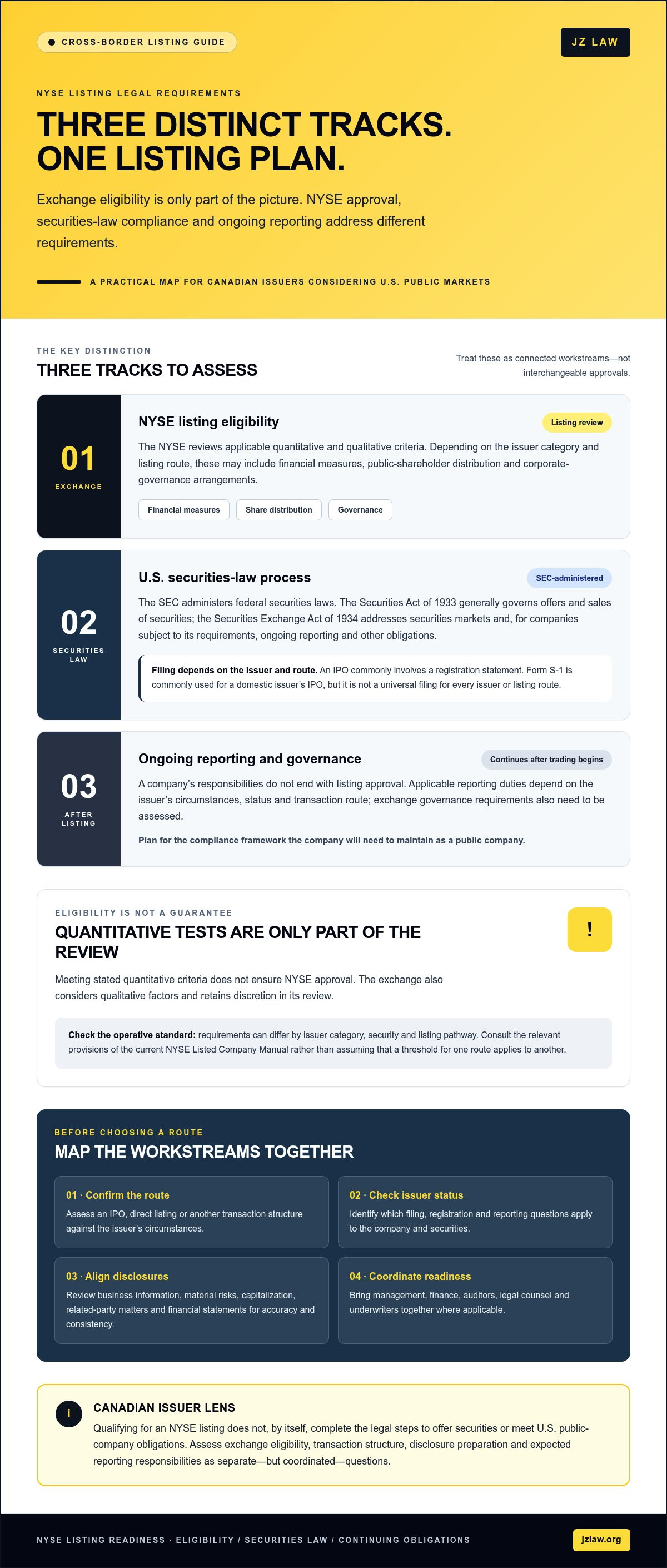
That distinction matters from the outset. NYSE initial listing standards determine whether a company may qualify for a particular listing route, while U.S. securities laws and exchange rules shape its obligations as a public company. The NYSE also considers qualitative factors, so meeting quantitative criteria doesn’t guarantee approval.
This 2026 guide distinguishes initial listing criteria from ongoing reporting and governance obligations, and outlines the legal workstreams to assess before choosing a route. It covers financial and distribution standards, board and committee requirements, disclosure planning, and considerations for foreign private issuers. You’ll also find practical questions to address when assessing readiness, structuring a transaction, and planning for responsibilities that continue after listing. These issues can arise for companies based in Calgary, Toronto, Vancouver, Hamburg, Berlin, Frankfurt, New York City, and Denver.
Table of Contents
NYSE listing legal requirements: what a company must qualify for
NYSE listing legal requirements combine the exchange’s eligibility and governance standards with separate U.S. securities-law obligations. NYSE approval, SEC registration, and ongoing reporting are distinct parts of the process. For a Canadian issuer, qualifying for an exchange listing does not, by itself, complete the legal steps needed to offer securities or meet U.S. public-company obligations.
There is no single checklist for every company. Applicable standards depend on factors such as the issuer’s category, security, financial profile, shareholder distribution, and proposed route to market. A company considering an IPO, direct listing, or another transaction structure should assess both its initial eligibility and the compliance framework it would need to maintain once trading begins.
NYSE eligibility standards and issuer categories
The NYSE assesses quantitative and qualitative criteria. Depending on the applicable listing standard, its review may consider financial measures, the distribution of shares among public investors, and corporate-governance arrangements. Tests and supporting evidence can differ by issuer category and listing pathway, so don’t assume that a threshold for one route applies to another.
Identify the standard that appears to fit the company, then test the underlying information before committing to a transaction plan. Coordinate financial data and capitalization details with an assessment of board structure, shareholder distribution, and other exchange criteria. The NYSE retains discretion in its review, so meeting stated quantitative tests does not ensure approval.
For operative requirements, consult the relevant provisions of the current NYSE Listed Company Manual rather than relying on a general summary. An overview of the NYSE Listed Company Manual can orient readers to topics such as governance and disclosure, but it is not a substitute for the current manual or advice tailored to the issuer.
Exchange listing approval versus securities-law compliance
Exchange review and federal securities regulation address related but different questions. The NYSE decides whether a security meets its listing standards and whether the issuer is suitable for listing. The U.S. Securities and Exchange Commission (SEC) administers federal securities laws. Exchange approval does not fulfil an issuer’s separate filing or reporting duties.
The Securities Act of 1933 generally governs offers and sales of securities, including registration requirements and related disclosures. The Securities Exchange Act of 1934 addresses securities markets and, for companies subject to its requirements, ongoing reporting and other obligations. Applicable filings depend on the issuer’s circumstances and transaction route. An IPO commonly involves a registration statement, while another route may involve different filings or requirements.
Before selecting a path, map exchange eligibility against the proposed securities-law process. Securities counsel can help identify questions to resolve early, including the issuer’s status, transaction structure, disclosure preparation, and expected reporting responsibilities. Treat these as connected workstreams, not interchangeable approvals, for a more reliable readiness assessment.
NYSE listing requirements across securities filings, disclosures, and governance
Listing preparation is coordinated work, not just a form submission. Issuers need to align transaction structure, financial information, investor disclosures, exchange review, and governance arrangements so each component presents a consistent account of the business. A Canadian company should also assess how U.S. transaction and reporting obligations apply to its particular circumstances.
Exchange eligibility and SEC compliance are distinct review tracks. Satisfying NYSE listing standards does not, by itself, satisfy federal securities-law filing or reporting obligations. The NYSE’s regulatory and listing information is a starting point for understanding exchange oversight. Issuers should also assess SEC rules relevant to their status and transaction.
Registration statements, financial information, and investor disclosures
A registration statement provides required information about an offering and the issuer so investors can evaluate the securities being offered. Form S-1 is commonly used for an IPO by a domestic issuer, but it isn’t a universal filing for every listing route or issuer. The applicable form, registration obligation, possible exemption, and later reporting duties depend on factors such as issuer status, offering structure, and the securities involved. Review these questions against current SEC rules before settling on a transaction plan.
Disclosure preparation should involve the people who understand the company’s operations and records. Review business descriptions, material risks, capitalization, related-party matters, and financial statements for accuracy and consistency. For example, a proposed change in share structure may affect capitalization disclosures, while an identified operational risk may need to be reflected consistently in offering materials and management’s supporting information.
Audited financial information is another essential workstream, although applicable requirements and presentation depend on the issuer and filing. Management, finance personnel, auditors, and counsel should establish responsibilities early, confirm relevant SEC requirements, and allow time to resolve gaps in records or explanations. Late discoveries can affect the filing timetable and the reliability of the disclosure process.
Corporate governance and public-company controls
Governance preparation involves more than adopting policies on paper. NYSE rules address matters such as board independence and independent committees, with requirements that can depend on issuer circumstances and applicable exceptions. Federal securities law may impose additional obligations. Map each requirement to a responsible decision-maker, committee, or control process, then document how it will work in practice.
The Sarbanes-Oxley Act introduced requirements concerning public-company reporting, accountability, and internal controls. Which provisions apply, and when, can depend on issuer status and relevant exemptions or transition provisions. Assess financial reporting processes, control documentation, and the company’s capacity to support required certifications and disclosures rather than assuming every provision applies identically to every issuer.
For Canadian issuers, securities counsel can coordinate the U.S. filing analysis with existing governance and reporting arrangements. Securities and going-public counsel can help identify gaps, clarify responsibilities, and organize the legal workstreams. Preparation does not guarantee exchange approval.
IPO, direct listing, and other routes: how the NYSE path changes
The route to an NYSE listing affects how shares reach the market, whether the company raises new capital, and which transaction documents and filings may be required. The NYSE listing legal requirements should therefore be assessed against the chosen structure, not treated as one uniform process. A route that fits a company’s funding objectives may involve different execution and disclosure demands from one designed mainly to provide liquidity for existing shareholders.
Route selection is part of broader transaction planning. A company weighing a public offering against other corporate-finance alternatives should assess how each structure affects ownership, proceeds, timing, and investor communications. These considerations connect to strategic corporate transactions, but the legal analysis must remain specific to the proposed securities and issuer.
What changes between an IPO and a direct listing?
In a conventional IPO, a company commonly offers newly issued shares to investors through a registered offering, often with underwriters involved in distribution and pricing. The company may receive proceeds from the sale of its shares. Existing shareholders may also sell shares if the offering is structured to include them.
A direct listing can instead facilitate trading in existing shareholders’ shares without following the same conventional underwritten IPO structure. Some direct-listing structures may also include a primary offering by the issuer. The distinction matters: a company seeking capital, shareholders seeking liquidity, or both should assess which structure serves those aims and what registration and disclosure requirements apply.
The NYSE has described potential direct-listing advantages in terms of price discovery and access to trading. Those are the exchange’s stated benefits, not guaranteed results for a particular issuer. A direct listing isn’t automatically simpler: the company still needs a defensible disclosure record, market readiness, and a route-specific analysis of current NYSE and SEC rules. Verify applicable requirements for the proposed structure before proceeding.
How issuer circumstances shape the route analysis
Start with the commercial objective. If the company needs new funds for growth, a structure that raises primary capital may be central. If existing investors chiefly seek liquidity, their ownership and sale plans may carry greater weight. Some issuers need to address both objectives. The answer affects capitalization planning and how the transaction is described to prospective investors.
Next, assess whether the company can support the route’s demands. Review ownership structure and share restrictions, the readiness of financial records and reporting processes, and the information investors will need to understand the business and its risks. For a Canadian issuer, coordinate U.S. listing and securities-law work with existing corporate and reporting arrangements.
Route selection is a legal and strategic decision, not a shortcut around review. Securities counsel can compare structures against the issuer’s financing goals, shareholder position, readiness, and disclosure risks, then coordinate the transaction analysis. The result is a reasoned path forward, not a promise of NYSE approval.
A practical NYSE listing legal-readiness checklist for issuers
A structured readiness review helps a company identify gaps before they affect its transaction plan. Assess NYSE listing legal requirements against the issuer’s chosen route, category, and current financial and governance position. Use the sequence below to organize the work. It’s a planning tool, not a fixed timetable or assurance of exchange approval.
Early assessment and corporate-record review
Start by establishing the issuer’s objectives and likely listing pathway. Then review records that support its legal, ownership, and financial position. Assign clear owners: management supplies business information and makes decisions, finance coordinates financial records, auditors address audit work, and counsel assesses legal issues and filing implications.
Assess the issuer and potential route. Define whether the company is pursuing a public offering, direct listing, or another structure, and identify the listing standard that may apply. Verify current eligibility thresholds and review procedures against NYSE primary materials, and confirm securities-law requirements against current SEC sources.
Review corporate records and ownership. Assemble organizational documents, capitalization records, shareholder and other ownership information, material contracts, and information relevant to potential litigation disclosures. Reconcile discrepancies, such as inconsistent share counts across records, before they enter transaction documents.
Identify corporate and governance work. Determine whether approvals, organizational-document amendments, board changes, or committee arrangements may be needed. Counsel can identify legal questions and coordinate required corporate actions; management and the board remain responsible for decisions and implementation.
Assess financial reporting readiness. Finance personnel should organize financial information and supporting records with auditors and appropriate accounting professionals. Identify gaps in historical information, reporting processes, or documentation that could affect the required financial presentation or disclosure work.
Diligence, exchange review, and post-listing planning
As preparation advances, connect diligence findings to disclosure decisions and formal submissions. Maintain an issue log recording each question, its responsible owner, supporting evidence, and resolution. This helps coordinate the issuer’s account of the business across legal, financial, operational, and governance materials.
Conduct and resolve diligence. Counsel coordinates legal diligence and helps assess disclosure issues; management confirms business facts; finance and auditors support financial review. Address identified legal, operational, or governance gaps, and handle material risks and statements consistently in draft disclosures.
Coordinate filings and exchange materials. Prepare the NYSE application and related materials alongside the securities filings applicable to the issuer and route. Counsel manages legal analysis and filing coordination, while management and finance validate company information. Where an underwriter is involved, coordinate its transaction role without treating it as a substitute for the issuer’s responsibilities.
Plan for life as a public company. Before trading begins, assign continuing reporting duties, internal controls, insider policies, governance processes, and continued-listing obligations to accountable people and systems. Readiness includes maintaining compliance, not just completing the initial review.
For a tailored assessment of listing readiness, disclosures, and transaction workstreams, discuss your U.S. listing plans with securities counsel.
How securities counsel supports an NYSE listing decision
A sound listing decision weighs legal eligibility, transaction objectives, and operational readiness together. Securities counsel can help a Canadian issuer evaluate potential routes, identify legal and disclosure issues, and prioritize work before a formal process begins. Counsel supports planning, but cannot assure NYSE approval.
New York City is a central setting for U.S. capital markets, but a company’s listing analysis turns on its own circumstances and the rules that apply to its transaction. Counsel can translate NYSE listing legal requirements and relevant SEC obligations into a practical assessment using current primary sources, rather than assuming a general checklist resolves every issue.
What legal counsel can assess before a listing process begins
Early legal diligence can reveal issues that may affect route selection, disclosure preparation, or transaction structure. Depending on the issuer, counsel may review:
Capitalization and ownership: whether share records, ownership rights, and proposed securities are documented consistently.
Corporate authority: whether organizational documents, board approvals, and other corporate actions support the contemplated transaction.
Disclosure risks: whether material contracts, litigation matters, business operations, and identified risks have been assessed for accurate disclosure.
Governance readiness: whether board and committee arrangements, policies, and decision-making processes need attention before listing.
Counsel can coordinate a requirements analysis against current NYSE and SEC primary sources, while finance teams and auditors retain distinct responsibilities for financial information and audit matters. The resulting issue list helps management distinguish matters that could affect eligibility or disclosure from those requiring further planning. It also supports decisions about route, timing, and remediation without imposing a fixed timetable.
Planning next steps with JZ Law
An initial discussion is most useful when grounded in the company’s objectives and current position. Prepare a concise overview of why the issuer is considering public markets, its ownership and capitalization, its financial reporting readiness, and any preferred route, such as an IPO or direct listing. Include known corporate, disclosure, or governance questions to focus the discussion on the decisions that matter most.
JZ Law’s securities-regulation and going-public counsel can connect these issues to the company’s broader corporate-transaction strategy, assess legal readiness, and organize the relevant workstreams. The objective is a better-informed decision about pursuing a U.S. listing, not a promise of exchange approval or a particular outcome.
Set a clear course for your company’s next move
A potential NYSE listing is a strategic decision, not simply a transaction milestone. Use readiness findings to determine what needs attention, which route best fits the company’s objectives, and what management should decide before committing resources to a process. Assessing NYSE listing legal requirements against the issuer’s circumstances can turn open questions into a more considered plan.
JZ Law provides securities-regulation counsel to companies pursuing public-market transactions. Legal guidance aligned with the issuer’s circumstances can help leadership evaluate options, prioritize open issues, and plan the next stage. Exchange approval cannot be guaranteed, but sound preparation supports better-informed decisions.
Discuss your company’s public-market plans with JZ Law to plan the next step for your business.
Frequently Asked Questions
What are the minimum requirements to list on the NYSE?
There isn’t one minimum checklist for every issuer. NYSE listing legal requirements depend on the company’s listing category, security, and route, and can include financial, shareholder-distribution, and governance tests. The exchange also considers qualitative factors, so meeting numerical standards alone may not be enough. Identify the specific standard the company intends to use and consult the current NYSE Listed Company Manual before relying on any threshold.
Does a company need to be profitable to list on the NYSE?
No, profitability isn’t a universal prerequisite. Some NYSE listing standards include an earnings test, while others may assess financial measures that don’t require that particular test. A pre-revenue or loss-making company shouldn’t assume it qualifies: its financial profile, public distribution, issuer category, and chosen listing route all matter. Review the applicable standard against current exchange rules and the company’s financial statements.
Can a foreign company list its shares on the NYSE?
Yes. A company organized outside the United States, including a Canadian issuer, may pursue an NYSE listing if it satisfies relevant requirements and applicable U.S. securities-law obligations. Certain foreign private issuers may follow different disclosure or governance provisions, depending on their status and the rules involved. Companies based in Toronto, Calgary, Vancouver, Hamburg, Berlin, Frankfurt, Denver, or New York City should not assume location alone determines their regulatory classification.
Is an NYSE listing the same thing as an IPO?
No. An NYSE listing is the admission of a security to trading on the exchange; an IPO is a transaction in which a company offers shares to the public for the first time. An IPO can be the route to an NYSE listing, but companies may pursue other routes, subject to applicable requirements. The distinction affects transaction planning: an issuer’s goal of raising capital differs from existing shareholders’ goal of selling shares.
Can a company list on the NYSE through a direct listing?
Yes, a direct listing may be available if the company and proposed transaction satisfy the NYSE’s applicable standards and securities-law requirements. The structure may involve existing shareholders’ shares, newly issued shares, or both, depending on the transaction. It isn’t automatically simpler than an IPO. Its suitability depends on the issuer’s objectives, ownership, disclosures, and market readiness. Confirm current NYSE and SEC requirements for the specific structure before choosing this route.
How long does the NYSE listing process usually take?
There’s no reliable standard timeline for every issuer. Preparation can be affected by the condition of corporate records, transaction complexity, financial-statement readiness, disclosure diligence, and questions raised during exchange or SEC review. For example, unresolved ownership records may need attention before materials are ready. Build a project plan around the issuer’s actual workstreams rather than assuming a set number of weeks or months.
What happens after a company is approved for an NYSE listing?
Approval marks the transition to public-market responsibilities, not the end of the compliance process. The issuer coordinates the listing’s commencement and must meet the reporting and governance duties that apply to it. Listed companies also have NYSE corporate-governance obligations, including an annual written affirmation from the CEO concerning compliance with applicable governance rules. Management should keep reporting controls, board oversight, and internal processes active as the company begins trading.



Comments