


NYSE Listing Requirements for Canadian Firms: 2026 Guide
Updated: Aug 20
What if the perceived barrier to entry for the world's most prestigious exchange is actually a bridge you've already started building? Many Canadian executives view the listing on NYSE requirements for Canadian companies as an insurmountable wall of SEC oversight and prohibitive capital outlays. It's understandable to feel a sense of trepidation regarding the complexity of dual-listing compliance or the C$438,750 initial listing fee. You're right to prioritize the security of your firm's reputation while seeking the liquidity of the New York markets.
This 2026 guide offers a comprehensive breakdown of the financial, governance, and regulatory hurdles your firm must clear to cross-list successfully. We'll demonstrate how the Multi-Jurisdictional Disclosure System (MJDS) serves as a strategic extension of your current Canadian filings rather than a total regulatory overhaul. By examining the latest financial standards, including the C$16.2 million three-year pre-tax income benchmark and the recent 2026 SEC reporting exemptions, you'll gain the clarity needed to determine your eligibility. We'll preview the exact roadmap for transitioning from a domestic issuer to a global contender without compromising your operational focus.
Table of Contents
Understanding the MJDS: The Canadian Advantage for NYSE Listing
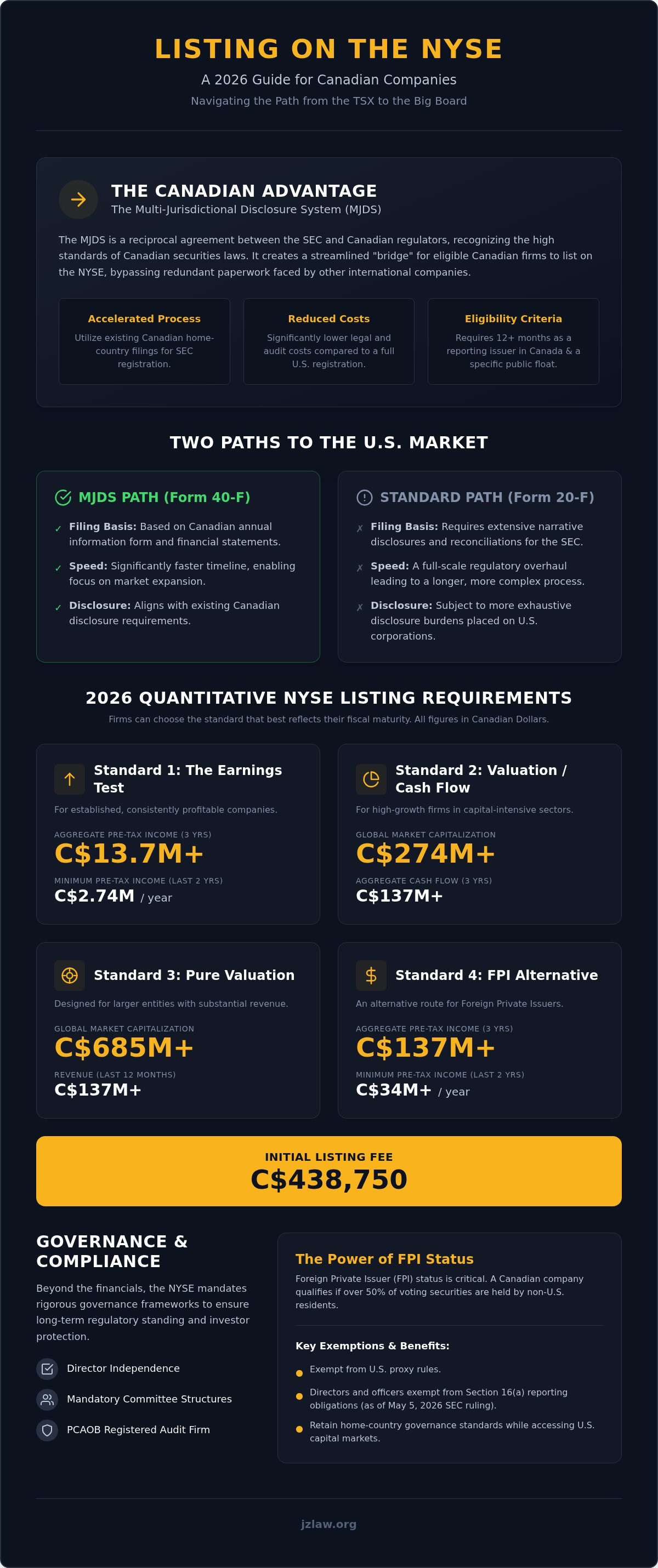
The Multi-Jurisdictional Disclosure System (MJDS) isn't just a regulatory shortcut; it's a strategic recognition of the high standards maintained by Canadian securities regulators. This reciprocal agreement between the SEC and provincial authorities allows eligible Canadian firms to cross-list by essentially utilizing their existing home-country filings. When evaluating the listing on NYSE requirements for Canadian companies, the MJDS stands out as the most efficient path to the New York Stock Exchange (NYSE). By bypassing the redundant paperwork that other international firms face, Canadian executives can significantly reduce the legal and audit costs typically associated with a U.S. debut.
Eligibility for this framework requires a disciplined history of compliance. To qualify, a firm must have been a reporting issuer in Canada for at least 12 months and maintain a specific public float threshold. These standards ensure that only companies with established market depth and a proven track record of transparency make the leap to the Big Board. In 2026, the NYSE remains the premier destination for Canadian issuers because it offers unparalleled liquidity and prestige that domestic markets alone cannot provide.
The Role of Foreign Private Issuer (FPI) Status
Maintaining FPI status is a cornerstone of a successful cross-border strategy. To qualify, a Canadian company must ensure that more than 50% of its voting securities are held by non-U.S. residents, or that its business is primarily administered outside the United States. The benefits are substantial. FPIs are exempt from U.S. proxy rules and, as of the May 5, 2026 SEC ruling, directors and officers from qualifying Canadian jurisdictions enjoy significant exemptions from Section 16(a) reporting obligations. A Foreign Private Issuer is a non-U.S. entity that retains its home-country governance standards while accessing American capital markets, primarily to avoid the exhaustive disclosure burdens placed on domestic U.S. corporations.
MJDS vs. Standard SEC Registration
The distinction between Form 40-F and Form 20-F represents the difference between a streamlined transition and a full-scale regulatory overhaul. Form 40-F allows you to use your Canadian annual information form and audited financial statements as the backbone of your U.S. filing. In contrast, Form 20-F often requires more extensive narrative disclosures and reconciliations. While you'll still need an audit firm registered with the Public Company Accounting Oversight Board (PCAOB), the MJDS timeline is significantly faster. This speed is vital when coordinating strategic corporate transactions 2026, as it allows your leadership to focus on market expansion rather than administrative delays.
Quantitative NYSE Listing Requirements for 2026
Meeting the listing on NYSE requirements for Canadian companies requires more than just a strong balance sheet; it demands a precise alignment with specific financial benchmarks. The Exchange provides four distinct pathways for the Main Board, allowing firms to choose the standard that best reflects their fiscal maturity. For established, profitable companies, Standard 1 (The Earnings Test) is the most common route. It requires an aggregate pre-tax income of at least C$13.7 million over the last three fiscal years, with a minimum of C$2.74 million in each of the two most recent years. This ensures that only companies with sustained profitability gain access to the Big Board.
High-growth firms or those in capital-intensive sectors like tech or mining often look toward Standard 2 (Valuation/Cash Flow) or Standard 3 (Pure Valuation). Standard 2 requires a global market capitalization of C$274 million and C$137 million in aggregate cash flow over three years. Standard 3 is designed for larger entities, mandating a market capitalization of C$685 million and revenues of at least C$137 million in the last 12 months. Finally, Standard 4 provides an alternative for Foreign Private Issuers, requiring an aggregate pre-tax income of C$137 million over three years. Selecting the right path is a strategic decision that impacts how investors perceive your firm's stability; our team specializes in taking companies public by identifying the most advantageous entry point.
Minimum Thresholds: Share Price and Public Float
As of 2026, the NYSE has harmonized its entry requirements to ensure higher quality across its tiers. Both the Main Board and the NYSE American now require a minimum closing share price of US$4.00 (approximately C$5.48) for initial listing. While the Main Board remains the target for mid- to large-cap firms, the NYSE American is an attractive option for smaller issuers. However, you must account for the new "unrestricted" public float rules. For an IPO on the NYSE American, you'll need a minimum of US$15 million (C$20.5 million) in unrestricted public float, which excludes shares held by insiders or those subject to lock-up agreements.
Financial Reporting and Auditing Standards
Transparency is the bedrock of U.S. capital markets. Your financial statements must be audited by a firm registered with the Public Company Accounting Oversight Board (PCAOB). While the MJDS allows Canadian firms to use IFRS without a full reconciliation to U.S. GAAP in many cases, you must still maintain robust internal controls over financial reporting (ICFR). Preparing for these audits often reveals gaps in corporate structure that require correction months before the application. Strategic tax structuring and early-stage audit preparation are essential to prevent delays that could cost your firm its market window.
Governance and SEC Compliance: Beyond the Numbers
While financial benchmarks provide the foundation, the qualitative listing on NYSE requirements for Canadian companies often present the most significant operational challenge. Success requires a shift in corporate culture toward U.S. standards of transparency and oversight. The Exchange mandates a board composed of a majority of independent directors. This independence is defined by the lack of material relationships with the company, whether directly or as a partner, shareholder, or officer of an affiliated organization. You'll need to establish three core committees: Audit, Compensation, and Nominating; Corporate Governance. The Audit committee is particularly scrutinized; it must consist of at least three independent members who are financially literate, with at least one member possessing accounting or related financial management expertise.
Compliance with Sarbanes-Oxley (SOX) Section 404 is essential, requiring an annual assessment of internal controls over financial reporting. As of 2026, the SEC has introduced mandatory climate-related risk disclosures and rigorous cybersecurity incident reporting timelines. These mandates require firms to disclose material cyber breaches within four business days, a standard that demands a proactive, risk-focused mindset. Aligning these internal processes early ensures that your governance framework supports, rather than hinders, your market aspirations.
Board Diversity and Modern Governance
2026 NYSE rules now emphasize diversity disclosures, requiring boards to report on their composition and progress toward inclusion. A formal Code of Business Conduct and Ethics must be adopted and made publicly available, covering everything from conflicts of interest to compliance with laws. Strategic alignment with these modern governance standards provides a distinct advantage. It signals to institutional investors that your firm is built for long-term stability and is prepared for the scrutiny of the global stage.
Continuous Disclosure Obligations
Transitioning to the NYSE means moving to a continuous disclosure cycle that mirrors the intensity of your Canadian filings but with added SEC layers. Form 6-K is the primary vehicle for reporting material changes that occur between annual reports, including earnings releases or significant corporate developments. For those taking your cannabis company public or scaling in other high-growth sectors, maintaining the 120-day annual report deadline for MJDS issuers is critical to remaining in good standing. This reporting rhythm ensures that the market remains fully informed, protecting your valuation and investor trust.
Phased Timeline: The Path from TSX to NYSE
Transitioning from a domestic listing on the TSX or TSX-V to a global stage requires a disciplined, multi-phase approach. This isn't merely a paperwork exercise; it's a strategic evolution of your corporate structure. The journey typically spans four to six months, depending on your firm's existing governance maturity and audit readiness. Understanding the listing on NYSE requirements for Canadian companies through a chronological lens allows your board to manage resources effectively and maintain market confidence during the transition.
Phase 1: Pre-listing Audit and Governance Gap Analysis. Before any public filings, you must conduct a rigorous internal review. This involves identifying "material weaknesses" in internal controls and ensuring your financial statements meet PCAOB standards. Phase 2: Preparation of the MJDS Registration Statement. Here, your team prepares Form 40-F or F-10, leveraging your Canadian disclosures. This phase focuses on wrapping your domestic filings in the specific narrative required by the SEC. Phase 3: Formal Application and NYSE Staff Review. Once submitted, NYSE examiners will review your application for both quantitative and qualitative compliance. Expect a series of comment letters requiring precise, technical responses. Phase 4: Pricing, Marketing, and the "First Trade" Ceremony. The final stage involves the underwriter's roadshow, final pricing of the offering, and the symbolic bell-ringing at 11 Wall Street.
The Role of the Underwriter and Legal Counsel
Success depends on a synchronized effort between your Canadian and U.S. advisors. Selecting a U.S. underwriter with specific cross-border experience is vital, as they understand the nuances of Canadian share structures and MJDS eligibility. Your legal counsel acts as the primary liaison with the SEC and NYSE staff, managing the due diligence process to prevent avoidable delays. This coordination ensures that your strategic tax structuring remains intact while meeting the heightened transparency demands of U.S. investors.
Common Delays and How to Avoid Them
The most frequent bottlenecks occur during financial statement reconciliation and the identification of internal control deficiencies under SOX 404. If your PCAOB-registered auditor identifies significant gaps late in the process, it can push your listing date back by months. Proactive communication with NYSE listing examiners can mitigate these risks. By addressing potential hurdles during the pre-consultation phase, you demonstrate a level of professional readiness that examiners appreciate. For expert guidance through these technical hurdles, consider the specialized securities regulation services offered by our firm.
Strategic Legal Guidance for Canadian NYSE Aspirants
The technical complexity of the listing on NYSE requirements for Canadian companies necessitates a level of specialized attention that generalist firms often struggle to provide. Cross-listing is a multifaceted endeavor where securities law, strategic tax structuring, and industry-specific regulations intersect. A boutique firm offers the precision required to navigate these overlapping frameworks without the impersonal nature of massive global practices. For Canadian founders, the primary concern is often the preservation of tax efficiency while accessing U.S. liquidity. Strategic tax structuring is essential to mitigate the impact of U.S. tax designations that can inadvertently penalize Canadian shareholders if they aren't addressed well before the listing application. For firms also managing the relocation of key personnel to the U.S. as part of their expansion, you can learn more about MJ Law for specialized immigration support.
JZ Law acts as a dedicated bridge, managing the regulatory burden so leadership can remain focused on operational growth. We provide a proactive, preventative mindset that identifies potential SEC friction points months in advance. Our firm serves as a strategic partner in managing complex corporate transitions and high-stakes strategic corporate transactions. By handling the heavy lifting of SEC registration and NYSE liaison work, we allow you to maintain the momentum that made your firm a candidate for the Big Board in the first place.
Tailored Securities Regulation Support
High-growth and heavily regulated sectors face unique hurdles that standard checklists don't cover. For those in the cryptocurrency and cannabis spaces, compliance frameworks must be exceptionally robust to satisfy both provincial regulators and the SEC's evolving standards. Similarly, resource companies must balance Alberta Energy Regulator (AER) reporting with the SEC's technical disclosure requirements for oil and gas reserves. Our expertise ensures that these diverse regulatory demands are harmonized into a single, cohesive compliance strategy that protects your firm's standing on both sides of the border.
Conclusion and Contact
The 2026 outlook for Canadian firms remains optimistic, provided they approach the New York markets with a structured, long-term plan. The advantages of the MJDS framework, combined with the prestige of a New York listing, offer a powerful catalyst for expansion and valuation growth. However, the margin for error in these cross-border transactions is slim. A professional legal assessment is the first step toward securing your firm's future in the global capital markets and ensuring you meet every benchmark with confidence.
Schedule a consultation with JZ Law for your NYSE listing strategy to begin your transition with the clarity and authority your business deserves.
Securing Your Competitive Edge in the Global Capital Markets
Expanding your firm's reach to the New York market is a transformative milestone that demands more than just financial strength. It requires a meticulous alignment with the MJDS framework and a proactive approach to the 2026 governance standards we've discussed. By mastering the listing on NYSE requirements for Canadian companies, you position your organization to capture unprecedented liquidity while maintaining the integrity of your Canadian operations. This transition is not merely a regulatory hurdle but a strategic opportunity to redefine your firm's global presence through disciplined compliance and expert foresight.
JZ Law provides the steady guidance necessary to navigate this complexity. With deep expertise in securities regulation and MJDS filings, we serve as a strategic bridge for firms engaging in complex corporate transactions across North America. From our offices in Calgary, Toronto, Vancouver, and NYC, we offer the localized insight and international perspective required for a seamless cross-listing. Consult with JZ Law on your NYSE listing and securities regulation needs to ensure your firm is prepared for the 2026 listing window. Your path to the world's premier exchange is within reach, and we're here to ensure you walk it with confidence.
Frequently Asked Questions
Can a Canadian company list on the NYSE without a U.S. IPO?
Yes, Canadian firms can list on the Exchange without a concurrent U.S. public offering through a process known as a cross-listing. Many established issuers on the TSX utilize the MJDS framework to register their existing shares with the SEC. This allows your company to tap into the deep liquidity of the New York markets and broaden your investor base without the immediate necessity of a capital raise.
How much public float is required for a Canadian company to use MJDS?
To utilize the MJDS for a substantial offering or listing, an issuer generally needs a public float of at least US$75 million, which is approximately C$102.7 million. You must also have been a reporting issuer in a Canadian jurisdiction for at least 12 months. These benchmarks ensure that only firms with sufficient market depth and a history of transparency can access the streamlined registration process provided by the SEC.
What are the NYSE listing fees for Canadian companies in 2026?
In 2026, the NYSE application fee is C$34,250, while the initial listing fee for common stock is C$445,250. You must also account for annual fees, which start at a minimum of C$115,080 and increase based on the number of shares listed. These figures represent the direct costs of the Exchange and don't include the legal and audit expenses required to meet the listing on NYSE requirements for Canadian companies.
Does a Canadian company need to report in U.S. GAAP for the NYSE?
No, eligible Canadian firms using the MJDS are permitted to provide financial statements prepared under IFRS as issued by the IASB. The SEC accepts these filings without a full reconciliation to U.S. GAAP, provided the company maintains its Foreign Private Issuer status. This reciprocity is a primary advantage for Canadian boards, as it significantly reduces the administrative burden and costs of maintaining a dual listing.
Is Sarbanes-Oxley compliance required for all Canadian NYSE listings?
Yes, all companies listed on a U.S. exchange must adhere to Sarbanes-Oxley (SOX) requirements, particularly Section 404 regarding internal controls over financial reporting. While the MJDS offers relief for certain disclosure items, it doesn't exempt you from the rigorous internal audit standards designed to ensure investor protection. Emerging growth companies may qualify for a temporary phase-in period, but long-term compliance is a mandatory aspect of U.S. market participation.
Can a TSX Venture-listed company move directly to the NYSE?
It's technically possible but mathematically challenging because most TSX-V firms don't yet meet the Main Board's quantitative standards. Many smaller Canadian firms target the NYSE American first, which requires a minimum unrestricted public float of C$20.5 million for an IPO. Moving directly to the Main Board usually requires the company to first transition to a senior exchange or demonstrate exceptional market capitalization and revenue growth that meets the 2026 benchmarks.
What is the minimum share price for a Canadian company to remain listed on the NYSE?
The NYSE requires a minimum continued listing price of US$1.00, roughly C$1.37, over a consecutive 30-trading-day period. For your initial listing in 2026, the listing on NYSE requirements for Canadian companies mandate a closing price of at least C$5.48. If your stock falls below the C$1.37 threshold for an extended period, the Exchange will issue a deficiency notice, which could eventually lead to a delisting if not corrected.
How does the SEC define a Foreign Private Issuer in 2026?
A Foreign Private Issuer (FPI) is an entity incorporated outside the U.S. where 50% or less of its outstanding voting securities are held by U.S. residents. If U.S. ownership exceeds this threshold, the company can still maintain FPI status if most of its officers and directors are non-U.S. citizens and its business is administered primarily outside the United States. This status is vital for accessing the disclosure exemptions provided by the MJDS framework.


Comments