


Oil and Gas Joint Operating Agreements in Alberta: A 2026 Strategic Legal Guide
- jzanglaw
- Jul 12
- 13 min read
Updated: Jul 20
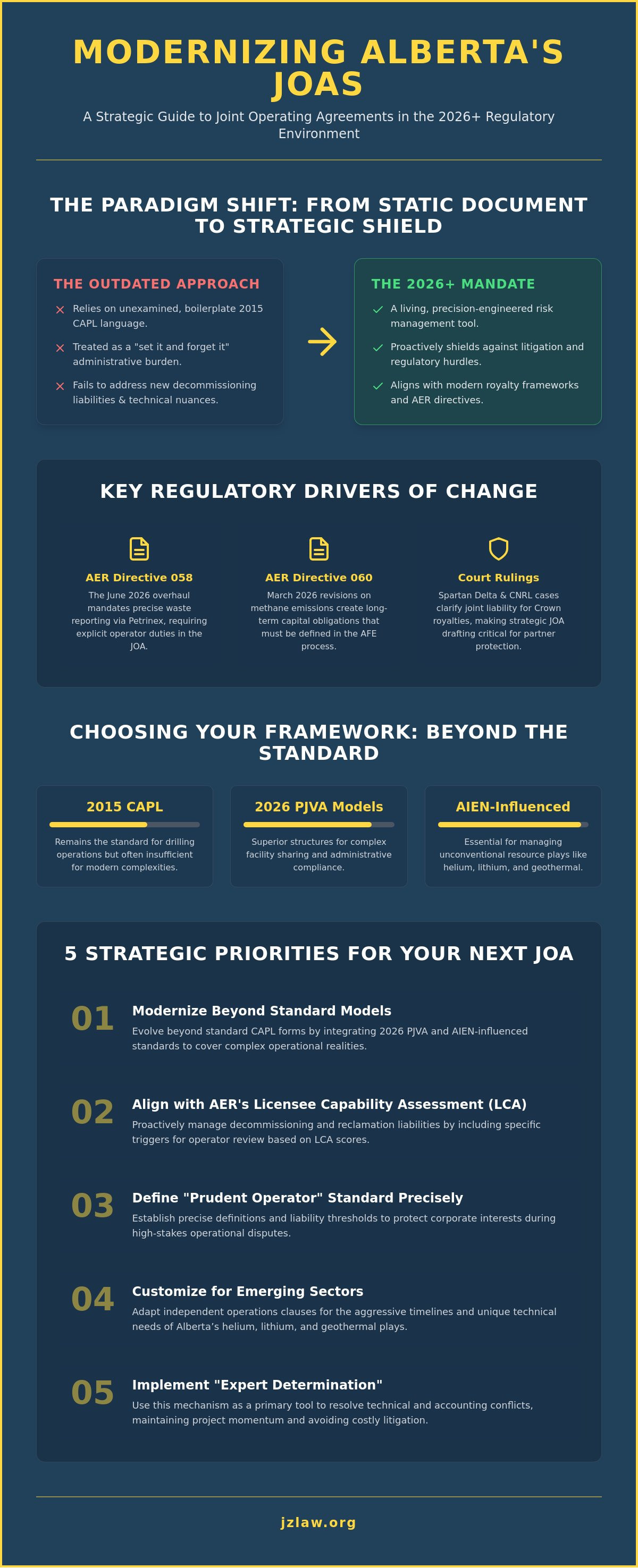
The 2015 CAPL Operating Procedure is no longer a "set it and forget it" document; it's a living risk management tool that requires extreme precision to survive the 2026 regulatory environment. Many Alberta energy firms still rely on boilerplate language that fails to account for the unique technical pressures of unconventional plays or the June 2026 overhaul of AER Directive 058. When drafting and negotiating oil and gas joint operating agreements alberta, assuming that standard forms provide sufficient protection against decommissioning liabilities or new waste management codes is a gamble your balance sheet shouldn't take.
You've likely felt the friction of inefficient negotiation cycles or the uncertainty following the 2026 Court of Appeal rulings in Spartan Delta and CNRL regarding joint liability for Crown royalties. It's frustrating to watch a project stall because of regulatory hurdles that you could've mitigated during the initial drafting phase. This guide provides the strategic clarity needed to align your agreements with the latest AER bulletins and the 2026 transition to the Modernized Royalty Framework. We'll examine how to streamline AFE processes, ensure independent operation clauses remain robust, and transform your JOAs from administrative burdens into proactive shields against litigation.
Table of Contents
The Landscape of Alberta Oil and Gas Joint Operating Agreements in 2026
The Joint Operating Agreement (JOA) serves as the constitutional framework for energy partnerships in the Western Canadian Sedimentary Basin. It's the primary instrument that dictates how capital is deployed, how operations are conducted, and how risks are shared among working interest partners. As we move through 2026, the standard for these contracts has shifted significantly. Modern oil and gas joint operating agreements alberta must now account for a regulatory landscape that is more rigorous than it was even two years ago. The Alberta Energy Regulator (AER) no longer views joint venture participants as passive investors. Instead, it increasingly looks to the JOA to define who bears the ultimate burden of environmental stewardship and financial liability.
The traditional reliance on unexamined boilerplate is a strategy of the past. In the current market, the JOA must be a precision-engineered document that balances the operator's need for autonomy with the non-operators' requirement for transparency and cost control. This balance is particularly critical as companies look to maximize recovery from mature assets while simultaneously exploring new resource plays. A well-drafted JOA doesn't just manage the joint account; it provides a roadmap for conflict resolution and long-term project viability.
The 2026 Regulatory Environment and AER Oversight
AER oversight has reached a new level of granularity that directly impacts how partners interact. The June 4, 2026, update to Directive 058 mandates precise waste reporting through Petrinex. This requirement must be explicitly reflected in the administrative duties of the operator within the agreement to avoid reporting gaps. Additionally, the March 2026 revisions to Directive 060 regarding methane emissions and continuous ignition systems create long-term capital expenditure obligations. These can trigger significant disputes if the Authorization for Expenditure (AFE) process in the JOA is poorly defined. To maintain "Good Standing" in Alberta, partners must ensure their operator has the financial and technical capacity to meet these standards. The JOA should include specific triggers for operator review if Licensee Capability Assessment (LCA) scores fall below AER thresholds. Recent 2026 Court of Appeal rulings, such as the Spartan Delta and CNRL decisions, emphasize that while liability for Crown royalties may be joint rather than joint and several, the strategic drafting of the JOA remains the only way to insulate your firm from a partner's insolvency.
Key Model Forms: CAPL vs. PJVA in Modern Operations
Choosing between the 2015 CAPL Operating Procedure and the 2025/2026 PJVA models depends on the technical nature of the play. CAPL remains the standard for drilling operations. However, the PJVA models offer superior structures for complex facility sharing and modern administrative compliance. Many operators are also integrating AIEN-influenced clauses to manage unconventional resource plays, such as helium or lithium co-production. These projects often originate from Farmout Agreements, which define the earning phase before the JOA governs the joint account. It's a fundamental principle of energy law that the JOA is subordinate to the Head Lease. The JOA cannot grant rights or impose obligations that exceed the authority granted by the underlying Crown or freehold lease. Ensuring this hierarchy is respected is essential for maintaining the legal integrity of the partnership.
Critical Provisions: Operator Duties, Standard of Care, and Financial Controls
The operator functions as the administrative and technical heart of any energy partnership. However, the legal relationship between the operator and non-operators is frequently a source of friction. In the context of oil and gas joint operating agreements alberta, the "Prudent Operator" standard serves as the benchmark for performance. This standard requires the operator to conduct activities in a good and workmanlike manner, consistent with industry practices. While this sounds straightforward, the operational reality in 2026 involves navigating tighter margins and stricter environmental mandates, making the definition of "prudent" more complex than ever.
Most model forms, including those developed by the Petroleum Joint Venture Association, limit an operator's liability to instances of gross negligence or willful misconduct. This high threshold protects operators from being second-guessed on every technical decision, but it can leave non-operators vulnerable if an operator’s performance is merely mediocre. For high-value assets, sophisticated parties often negotiate custom standards of care that bridge the gap between simple negligence and gross misconduct. This ensures that the operator remains accountable for systemic failures that don't quite reach the level of "willful" harm but still cause significant financial loss.
The Operator’s Standard of Care in Alberta Law
Recent Alberta judicial trends through 2025 have reinforced that while an operator isn't always a fiduciary in the traditional sense, they do owe a duty of transparency regarding the management of the joint account. Non-operators should ensure their agreements include robust removal provisions. These clauses must trigger not only for gross negligence but also for insolvency or a failure to maintain a specific Licensee Capability Assessment (LCA) score. Proactively tailoring these operator duty clauses is essential for protecting your working interest in a volatile market.
Financial Governance and the AFE Process
The Authorization for Expenditure (AFE) is your most potent risk management tool. It's not just a budget; it's a legal limit on the operator's authority to spend your capital. Standard JOAs typically allow for a 10% over-expenditure before a supplemental AFE is required. In 2026, with the AER imposing a 20% late payment penalty on administrative fees, financial discipline is paramount. Agreements must clearly define the consequences of unauthorized spending. If an operator exceeds the AFE without approval, they may be forced to carry those costs alone. Similarly, non-participation penalties for independent operations must be set high enough, often 300% to 500%, to account for the risk taken by the participating parties.
Beyond the Model Form: Strategic Customization for Alberta Niche Plays
Standard templates often provide a false sense of security. While PJVA model operating agreements offer an essential foundation for traditional petroleum activities, they weren't designed to govern the hybrid energy projects that define the 2026 Alberta market. Relying on "one size fits all" boilerplate for assets involving helium, lithium, or geothermal co-production is a strategic error. These niche plays involve unique technical risks and revenue streams that traditional forms simply don't contemplate. A customized approach ensures that your oil and gas joint operating agreements alberta reflect the actual operational intent of the partnership rather than a generic industry average.
Data sharing and intellectual property rights also require specific attention in modern ventures. In shared seismic programs, the right to use, license, or sell data can be worth as much as the physical assets themselves; ensuring the spatial precision of these technical assets through GNSS services like wiznetbc.com is a critical operational consideration. Without explicit language, partners may find themselves in a stalemate over who controls the proprietary insights gained during the exploration phase. Similarly, independent operations clauses need to be aggressively tailored. If you're operating in a high-growth play with tight drilling windows, the standard notice periods in model forms might be too slow. Shortening these windows or adjusting the penalty structures can maintain project momentum while protecting the interests of the non-participating parties.
Customizing for Unconventional and Emerging Resources
The 2026 surge in Alberta lithium and carbon capture projects has exposed gaps in traditional cost-allocation models. When you're dealing with multi-zone production, the legal framework must clearly distinguish between petroleum costs and those associated with mineral extraction or sequestration. Drafting specific clauses for ESG reporting is no longer optional; it's a requirement for institutional capital. Your JOA should explicitly define carbon credit ownership and the methodology for calculating emissions reductions. This level of precision prevents disputes before they arise and ensures that all participants can meet their corporate sustainability targets without administrative friction.
When managing the complex chemical requirements of these extraction processes, referencing industry-leading resources like JAS Global Industries can provide the technical depth needed to refine cost estimates and operational protocols.
Area of Mutual Interest (AMI) and Non-Compete Strategy
Defining the geographic and stratigraphic scope of an Area of Mutual Interest (AMI) requires a deep understanding of both the geology and the competitive landscape. A poorly defined AMI can lead to partner poaching or accidental breaches during future acquisitions. In Calgary corporate litigation, courts look for reasonableness in the scope of non-compete provisions. Ensuring your AMI clauses are logically structured and legally robust is vital. These provisions must be harmonized with your broader strategic corporate transactions. This alignment ensures that as your company expands, your existing joint venture obligations don't become an anchor that prevents you from pursuing new, high-value opportunities in the same basin.
Managing Liability and Environmental Obligations in Joint Operations
Environmental stewardship has evolved from a secondary compliance concern into the primary financial risk factor for 2026 Alberta energy partnerships. The Alberta Energy Regulator (AER) now employs a holistic Licensee Capability Assessment (LCA) system that scrutinizes the financial health of every working interest participant, not just the operator. In this climate, oil and gas joint operating agreements alberta must serve as proactive risk-mitigation tools that account for the full life cycle of an asset. Failing to address decommissioning liabilities with precision can lead to catastrophic financial exposure if a partner faces insolvency, leaving the remaining parties to shoulder the burden of orphan well levies and remediation costs.
Security for costs has become a non-negotiable component of modern JOA negotiations. While historical agreements often relied on the goodwill of partners, the 2026 economic environment demands more tangible protections. Sophisticated operators now frequently require letters of credit or parent company guarantees from non-operators, especially when participating in high-stakes unconventional plays. These instruments ensure that the joint account remains funded even during periods of commodity price volatility or corporate restructuring, preventing the project from stalling due to a single partner's liquidity crisis.
Decommissioning and Abandonment (A&R) Obligations
The "last man standing" problem is a recurring nightmare for Alberta producers. Under current oil and gas law, the AER can look to any working interest participant to fulfill abandonment and reclamation orders if the operator fails. Recent June 2024 and 2025 judicial trends, punctuated by the 2026 Spartan Delta and CNRL decisions, clarify that while liability for Crown royalties may be joint, the environmental obligations often default to the solvent parties. To mitigate this, modern JOAs should include segregated "Abandonment Funds" where partners contribute a portion of production revenue into a trust. This ensures that the capital required for end-of-life obligations is preserved and protected from general creditors.
AER Compliance and Transfer of Assets
Managing the "Right of First Refusal" (ROFR) during asset divestitures requires a dual focus on contractual rights and regulatory reality. You can't simply assign a JOA interest to the highest bidder without ensuring they meet the AER’s financial fitness requirements. If a proposed partner has a poor LCA score, the AER may block the license transfer, effectively voiding the transaction. Environmental due diligence must be integrated into the JOA’s assignment provisions to ensure any incoming partner has the technical and financial capacity to maintain the site’s regulatory standing. If you're navigating a complex asset transfer or need to restructure your environmental liability clauses, you can consult with our Alberta energy law team to ensure your agreements remain compliant with the latest AER directives.
Dispute Resolution and Strategic Partnership with JZ Law
Conflict is often an inherent byproduct of long-term energy partnerships. When negotiating oil and gas joint operating agreements alberta, the selection of a dispute resolution forum is a strategic decision that dictates how quickly and cost-effectively a deadlock can be broken. While arbitration is frequently touted as the default choice due to its confidentiality, litigation in the Alberta Court of King’s Bench may be preferable when a party requires the enforcement of a clear legal precedent or the ability to join third parties. The decision shouldn't be made based on habit; it requires a calculated assessment of the specific asset and the partner profile.
For technical or accounting conflicts, "Expert Determination" offers a more streamlined alternative to formal legal proceedings. This mechanism allows an independent engineer or auditor to issue a binding decision on focused issues, such as the validity of a supplemental AFE or the allocation of production costs. Integrating sophisticated tax structuring into JOA exit provisions and buy-out clauses is equally vital. It ensures that the transfer of a working interest doesn't trigger unintended tax liabilities, protecting the net value of the divestiture for all participants.
Modern Dispute Resolution Mechanisms
Valuation deadlocks can paralyze a project, especially during a buy-sell trigger. Drafting "Final Offer Selection" clauses, often called baseball arbitration, forces both parties to submit a reasonable number, as the arbitrator must choose one of the two figures without modification. This approach incentivizes realistic valuations and discourages aggressive posturing. Confidentiality remains a cornerstone of these processes, ensuring that sensitive operational data or internal financial metrics don't become public record during mediation. When managing defaulting partners, the agreement must provide the operator with clear authority to continue activities while placing the defaulting party’s interest into a suspended state, thereby preventing a single firm’s financial distress from jeopardizing the entire venture.
Strategic Counsel for Calgary Energy Leaders
JZ Law offers a distinct strategic advantage by moving beyond the "big firm" boilerplate mentality. John Zang’s boutique approach prioritizes the creation of bespoke agreements that reflect the unique stratigraphic and economic realities of your play. We leverage deep expertise in real estate law to manage the complex overlap between subsurface operating rights and surface land access. This holistic view ensures that your joint venture is protected from both regulatory interference and contractual ambiguity. If you're preparing for a new project or restructuring an existing partnership, Consult with JZ Law for your next Alberta Joint Operating Agreement to secure a framework that prioritizes your long-term commercial interests.
Future-proofing Your Alberta Energy Partnerships
The 2026 regulatory environment in the Western Canadian Sedimentary Basin leaves no room for contractual ambiguity. As we've explored, successful oil and gas joint operating agreements alberta must now integrate complex AER compliance standards with precise financial controls. Protecting your working interest requires moving beyond standard model forms to address the specific technical demands of unconventional plays and emerging resource sectors like lithium and carbon sequestration. By establishing robust abandonment funds and refining operator standards of care, you transform a standard administrative document into a strategic shield against litigation and environmental liability.
Navigating these complexities demands a partner who understands the intersection of corporate law, tax structuring, and energy regulation. John Zang provides principal-led, boutique counsel that prioritizes your firm's security and operational agility in Calgary's competitive market. Whether you're restructuring a legacy joint venture or launching a high-stakes exploration program, our integrated approach ensures your agreements remain resilient against shifting market conditions. Secure your energy assets with JZ Law’s strategic counsel to ensure your partnerships are built on a foundation of legal precision and commercial foresight. We look forward to helping you lead the next chapter of Alberta's energy evolution.
Frequently Asked Questions
What are the main differences between CAPL and PJVA model agreements?
CAPL model forms primarily govern the drilling, exploration, and land-focused aspects of a partnership; whereas PJVA models are designed for the operation of facilities and midstream infrastructure. While CAPL is the industry standard for well-site operations, PJVA agreements provide more robust frameworks for complex cost-sharing and administrative management of joint ventures. Choosing the correct form depends on whether the project's primary risk lies in the subsurface exploration or the surface processing and transportation.
How does the AER Licensee Capability Assessment affect existing JOAs?
The Licensee Capability Assessment (LCA) allows the regulator to monitor the financial health of all participants, which can trigger mandatory security deposits for decommissioning. If a partner's LCA score falls below established thresholds, it may prevent the transfer of well licenses or require the partnership to provide additional financial guarantees to the AER. Modern oil and gas joint operating agreements alberta must include clauses that allow for the review of a partner's standing to prevent one firm's financial instability from jeopardizing the entire project's regulatory compliance.
Can an operator be removed in Alberta if they are not in default but are underperforming?
Removal of an operator without a specific default is possible if the agreement includes a "removal without cause" provision or specific performance benchmarks. Most standard forms require a vote of the non-operators, typically representing a supermajority of the working interest, to effect a change in leadership. Without these specific triggers, non-operators may find it difficult to replace an operator who is technically compliant but operationally inefficient or unresponsive to partnership goals.
What happens if a partner refuses to pay their share of an AFE in Alberta?
A partner’s refusal to fund an approved Authorization for Expenditure (AFE) constitutes a contractual default under the operating procedure. The operator typically has the right to charge interest on the unpaid balance, place the defaulting party’s production in trust, or require the non-defaulting partners to cover the shortfall. Persistent failure to pay can lead to the forfeiture of the defaulting partner's interest in the specific operation or the entire joint account, depending on the severity of the breach.
Are "Area of Mutual Interest" clauses enforceable in Calgary courts?
Area of Mutual Interest (AMI) clauses are generally enforceable in Alberta provided they are reasonable in geographic and stratigraphic scope. Calgary courts interpret these provisions as restrictive covenants that prevent partners from competing for the same land or resources contemplatated by the venture. To ensure enforceability, the AMI must be clearly defined and limited to a specific duration; otherwise, it may be challenged as an unreasonable restraint on trade during corporate litigation.
How should decommissioning liabilities be handled in a 2026 JOA?
Decommissioning liabilities should be managed through segregated trust accounts or abandonment funds established early in the asset’s life cycle. The 2026 regulatory environment demands that oil and gas joint operating agreements alberta move beyond mere proportionate liability to include tangible security, such as letters of credit. This proactive approach ensures that the capital required for reclamation is available even if a partner becomes insolvent, protecting the solvent participants from the "last man standing" liability problem.
What is the role of a Right of First Refusal (ROFR) in Alberta oil and gas deals?
The ROFR gives existing partners the opportunity to match any third-party offer for a participant's working interest before a divestiture can proceed. While this protects the partnership’s composition, it can significantly delay transaction timelines and complicate the AER license transfer process. Parties must ensure the ROFR notice periods are strictly followed to avoid litigation that could cloud the title of the assets being sold.
Is arbitration always mandatory for Alberta joint venture disputes?
Arbitration is not mandatory unless it is explicitly required by the dispute resolution clause within the JOA. While many firms prefer arbitration for its confidentiality and speed, some parties opt for the jurisdiction of the Alberta Court of King’s Bench to ensure access to formal discovery and appellate rights. It's essential to tailor the forum to the nature of the conflict, using expert determination for technical accounting errors while reserving litigation for fundamental breaches of contract.


Comments