


Preventing and Resolving Shareholder Disputes in Alberta: A 2026 Legal Guide
- jzanglaw
- Jul 31
- 13 min read
In the high-stakes environment of Alberta's 2026 corporate sector, a single misaligned clause in your articles of incorporation can be the difference between a thriving enterprise and a total business collapse. You've likely recognized the mounting pressure of maintaining control when directors mismanage funds or minority interests feel frozen out of key decisions. The prospect of protracted, costly litigation often creates a paralyzing stalemate for stakeholders. However, preventing shareholder disputes in Alberta starts with a proactive, strategic approach that treats legal frameworks as a tool for growth rather than just a defensive measure.
We understand that your goal is a resolution that preserves value, whether through a fair buyout, the removal of rogue directors, or the restoration of your fundamental rights. This guide explores the complexities of corporate conflict by leveraging the latest Alberta Business Corporations Act amendments and sophisticated commercial litigation strategies. We will examine how to use the 2026 regulatory landscape to your advantage, ensuring your business remains resilient while protecting your professional legacy and commercial interests.
Table of Contents
The Landscape of Shareholder Disputes in Alberta (2026)
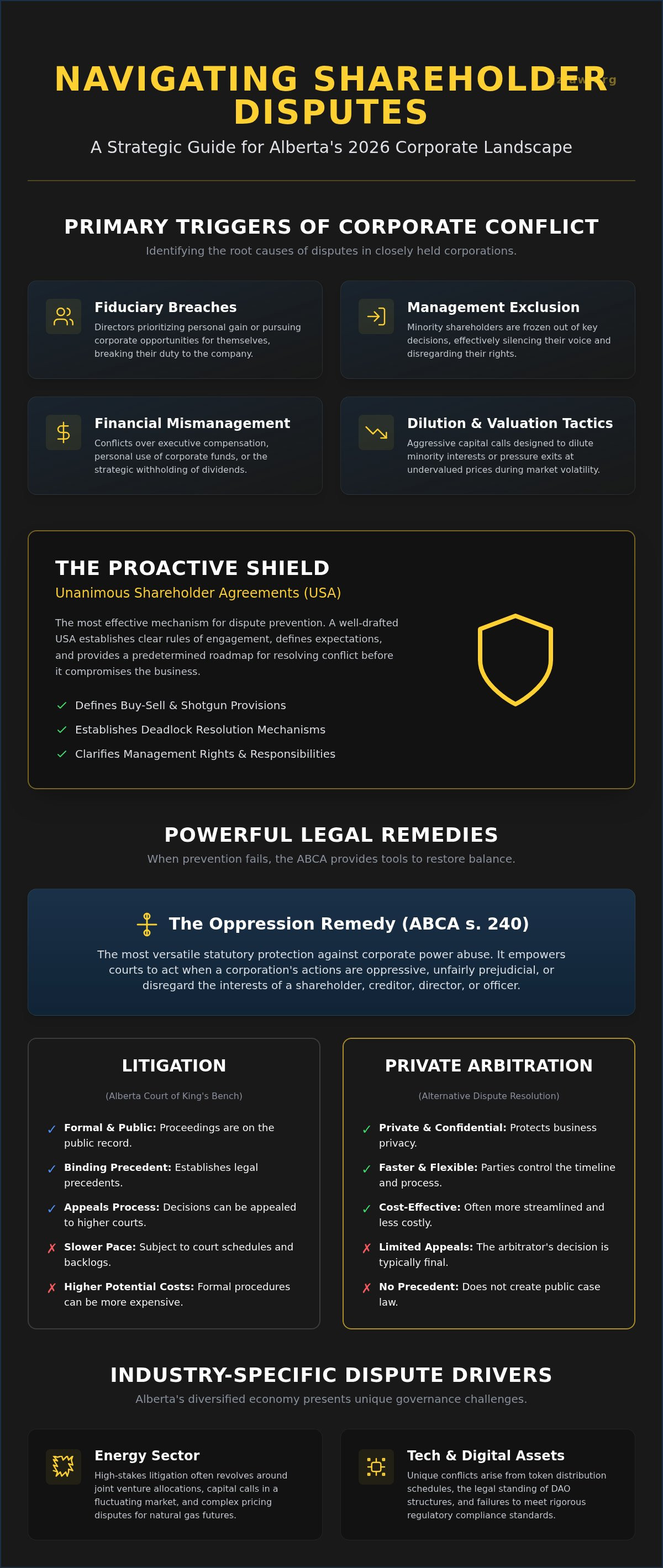
The Alberta corporate climate in 2026 reflects a sophisticated shift from traditional resource extraction to a diversified, tech-heavy economy. While the Alberta Business Corporations Act (ABCA) provides the statutory foundation for governance, the nature of conflict has evolved significantly. We're seeing a transition where disputes over natural gas royalties are now matched in complexity by governance battles in decentralized finance and software-as-a-service ventures. This evolution requires a legal perspective that understands both the bedrock of oil and gas law and the nuances of digital asset regulation.
Market volatility throughout Calgary and Edmonton has intensified valuation-based conflicts. When capital is expensive, the stakes for every corporate decision rise. Minorities often find themselves excluded from management or face the strategic withholding of dividends, tactics sometimes used to pressure exits at undervalued prices. For private entities, the ABCA's flexibility can be a double-edged sword; it offers freedom of contract but leaves gaps that only a robust legal strategy can fill. Preventing shareholder disputes alberta requires recognizing these patterns early, as the distinction between a private "quasi-partnership" and a reporting issuer dictates the available legal remedies and the court's level of intervention.
Common Causes of Conflict in Closely Held Corporations
In private, closely held firms, the line between professional governance and personal interest often blurs. Multi-generational family businesses are particularly susceptible when the historical expectations of the founding generation clash with the modern objectives of their successors. These breakdowns in trust frequently manifest as:
Capital Calls: Aggressive requests for funding designed to dilute minority interests who lack the liquidity to contribute.
Executive Compensation: Conflicts regarding salary levels or the personal use of corporate funds that appear to prioritize directors over the share class.
Fiduciary Breaches: Directors pursuing individual business opportunities that should have been presented to the corporation first.
Proactive planning is essential. Establishing comprehensive Unanimous Shareholder Agreements remains the most effective way to define expectations before the relationship sours and the business asset is compromised.
Industry-Specific Dispute Drivers: Energy and Tech
The energy sector remains a primary theater for litigation, but the focus has shifted toward joint venture allocations and the pricing of natural gas futures. These aren't simple contract disagreements. They're high-stakes battles over capital allocation in a fluctuating market where every decimal point impacts the bottom line.
Simultaneously, Alberta's tech sector, particularly in cryptocurrency and blockchain, faces unique governance hurdles. Conflicts often arise regarding token distribution schedules and the legal standing of DAO structures. When these ventures fail to meet rigorous regulatory compliance standards, it creates a legal basis for shareholder derivative actions. Directors who overlook these complexities risk not only the company's solvency but also their personal liability under the ABCA. Strategic partners like JZ Law specialize in these niche intersections where generalist firms often struggle to provide the necessary depth of counsel.
Legal Remedies Under the Alberta Business Corporations Act (ABCA)
The Alberta Business Corporations Act (ABCA) provides a robust statutory framework designed to maintain corporate integrity and protect stakeholder interests. While the priority for any business owner should be preventing shareholder disputes alberta, the Act ensures that specific, powerful remedies are available when governance structures fail. These legal tools allow shareholders to challenge actions that jeopardize their investment or exclude them from the corporation's success.
The Oppression Remedy: Protecting Minority Interests
The Oppression Remedy is the statutory protection against the abuse of corporate power. Contained within Section 240 of the ABCA, this remedy is widely considered the most versatile tool in Canadian corporate law. It allows a "complainant" to apply to the court for relief if the corporation's affairs are being conducted in a manner that is oppressive, unfairly prejudicial, or that unfairly disregards their interests. Unlike a simple breach of contract, oppression focuses on fairness and the equitable treatment of shareholders.
To determine if intervention is necessary, Alberta courts apply the "Reasonable Expectations" test. This is a fact-specific inquiry that goes beyond the literal text of corporate bylaws. The court examines the historical relationship between the parties, the nature of the business, and any representations made at the time of investment. If a majority shareholder's conduct violates these established expectations, the court has broad discretion to fashion a remedy. This can include ordering a mandatory buyout at fair value, setting aside a transaction, or even restructuring the board of directors. When these disputes arise, aligning your case with strategic legal objectives is essential for achieving a resolution that preserves your capital.
Derivative Actions vs. Personal Actions
It's critical to distinguish between a personal action and a derivative action. A personal action is brought when a shareholder's individual rights have been violated, such as being denied the right to vote. Conversely, a derivative action is brought by a shareholder on behalf of the corporation itself. This typically occurs when a director or officer has breached their fiduciary duty, such as by misappropriating corporate assets or failing to act in the company's best interest.
Under the ABCA, a shareholder must obtain "leave" (permission) from the court before proceeding with a derivative claim. The court will only grant leave if it's satisfied that the directors won't bring the action themselves, the shareholder is acting in good faith, and the claim appears to be in the best interests of the corporation. While more procedurally complex, derivative actions are strategically advantageous in multi-party structures because any recovery or damages awarded are returned to the corporate treasury, stabilizing the underlying asset for all stakeholders.
In extreme cases of deadlocked boards or total governance failure, the court may resort to the "nuclear option": court-ordered liquidation and dissolution. While Alberta courts are generally reluctant to dismantle a functional business, they will do so if the corporate purpose has been frustrated or if the relationship between shareholders has become so toxic that the entity can no longer operate. Understanding these statutory pathways is the first step toward resolving conflict before it reaches this point of no return.
Litigation vs. ADR: Strategic Choices for Calgary Businesses
When internal negotiations reach an impasse, the decision between the public courtroom and private Alternative Dispute Resolution (ADR) becomes a pivotal business maneuver. This choice isn't merely about legal preference; it's about strategic alignment with your long-term commercial goals. While mediation offers a collaborative environment for preserving partnerships, high-stakes litigation through the Alberta Court of King's Bench remains a powerful tool for forcing a settlement or a favorable buyout. Choosing the right path is a fundamental component of preventing shareholder disputes alberta from escalating into a total business collapse.
Litigation in the Alberta Court of King's Bench provides a transparent, structured environment where judicial authority can compel disclosure and enforce compliance. However, this process is inherently public and subject to the court's schedule, which can be a significant drawback for businesses in sensitive sectors like cannabis or oil and gas. Conversely, mediation allows for a confidential, cost-effective dialogue that often uncovers creative solutions, such as restructured share classes or revised dividend policies, that a judge might not have the authority to grant. Understanding the nuances of legal remedies under the ABCA is essential when weighing these options, as the threat of a formal court application often serves as the necessary catalyst for a successful mediation.
Arbitration Clauses in Alberta Shareholder Agreements
In the 2026 legal environment, mandatory arbitration clauses have become a standard feature in sophisticated corporate documents. These provisions offer a level of confidentiality and speed that the public court system can't always match. For ventures involving digital assets or complex energy futures, the ability to select an arbitrator with specific industry expertise is invaluable. An arbitrator who understands the technicalities of cryptocurrency law or joint venture accounting will deliver a more precise ruling than a generalist. It's important to remember that arbitration awards are generally final with limited grounds for appeal, providing a level of certainty that allows the business to move forward without the shadow of multi-year litigation.
The Role of Forensic Accounting and Valuation
Resolving a dispute often hinges on a single question: what is the business actually worth? In the context of a court-ordered buyout, expert witnesses and forensic accountants play a decisive role in determining "fair value." This process involves more than just looking at a balance sheet; it requires a deep dive into corporate transactions to uncover hidden assets or investigate potential fraud. Data from strategic corporate transactions often informs these valuations, providing a benchmark for what similar entities are fetching in the current Alberta market. By employing rigorous financial analysis, you ensure that your exit or buyout reflects the true economic reality of the enterprise rather than a distressed figure born of conflict.
Preventing Conflict: The Role of Unanimous Shareholder Agreements (USA)
While the statutory remedies discussed previously provide a safety net, the most effective method for preventing shareholder disputes alberta is the implementation of a comprehensive Unanimous Shareholder Agreement (USA). In Alberta's private corporate sphere, a USA functions as a bespoke constitution that overrides the default provisions of the ABCA. It allows stakeholders to define the rules of engagement before commercial pressures or personal disagreements cloud professional judgment. Without this document, shareholders are often left at the mercy of broad judicial interpretations of "fairness," which can lead to unpredictable and costly outcomes in the Alberta Court of King's Bench.
One of the most potent, albeit aggressive, tools within a USA is the "shotgun clause." This buy-sell provision allows one shareholder to offer to purchase the shares of another at a specific price; the recipient must then either accept the offer or buy out the initiating shareholder at that same price. It acts as a nuclear deterrent against persistent deadlock, as the party triggering the clause must be prepared to either exit or double their investment at a fair valuation. For high-growth regulatory sectors, integrating clear exit strategies for founders ensures that the transition of power doesn't destabilize the company's standing with provincial regulators or its capital structure.
Key Clauses to Mitigate Litigation Risk
Precision in drafting specific restrictive covenants and transfer rights can eliminate the ambiguity that typically fuels litigation. A well-structured agreement should include:
Right of First Refusal (ROFR): Ensures that existing shareholders have the opportunity to purchase shares before they are sold to an outside party, maintaining the integrity of the original partnership.
Drag-Along and Piggy-Back Rights: Protects majority interests by allowing them to compel minority participation in a sale, while simultaneously ensuring minority shareholders aren't left behind during a lucrative acquisition.
Dispute Resolution Ladders: Establishes a mandatory sequence for conflict, requiring formal negotiation and mediation before any party can initiate arbitration or court proceedings.
Non-Compete Covenants: Safeguards the corporation's intellectual property and client base when a key stakeholder exits the firm.
Updating Agreements for 2026 Realities
A USA drafted a decade ago is often insufficient for the modern Alberta business environment. By 2026, corporate governance must account for digital voting protocols and remote board meetings to ensure that decisions remain legally binding in a decentralized work landscape. For firms operating in the energy sector, these agreements must also include specific provisions for oil and gas law joint ventures, particularly regarding capital allocation and environmental liability. Ensuring your governance documents comply with the latest Alberta securities regulations is not just a matter of administration; it's a strategic necessity for long-term survival. If your current agreement hasn't been reviewed to reflect these shifts, you should consult with a strategic partner to fortify your corporate framework.
JZ Law: Expert Commercial Litigation for Complex Shareholder Disputes
John Zang’s approach to commercial litigation is defined by a refusal to treat legal conflict as an isolated event. In the 2026 Alberta market, a shareholder dispute is rarely just a disagreement over governance; it's a high-stakes financial event that can dictate the future of a corporation's capital structure. By combining legal precision with a deep understanding of corporate finance, JZ Law ensures that every tactical move in the courtroom aligns with your broader business objectives. This strategic synergy is essential for preventing shareholder disputes alberta from eroding the enterprise value you've worked to build.
Our firm specializes in the high-growth, regulatory-heavy sectors that generalist firms often find overwhelming. Whether you're navigating the complexities of cannabis licensing, managing governance in a cryptocurrency venture, or overseeing a joint venture in the traditional oil and gas sector, our counsel is rooted in industry-specific reality. We understand how a Statement of Claim affects your ability to secure secondary financing or complete a corporate transaction. This perspective allows us to manage the intersection of litigation and corporate finance with the composure and technical accuracy required for complex, multi-party disputes.
Strategic Advocacy for Shareholders and Corporations
JZ Law provides sophisticated representation for both minority interests and corporate entities. For minority shareholders, we offer aggressive advocacy in oppression claims, ensuring that "reasonable expectations" are met and that fair value is extracted when a relationship becomes untenable. Conversely, we defend corporations and their boards against strategic derivative actions that are often designed to extract settlements rather than address genuine fiduciary breaches. Our experience extends to the most delicate of corporate maneuvers, such as taking a company public while a shareholder dispute remains active, requiring a masterful grasp of securities regulation and disclosure requirements.
Contact JZ Law for a Strategic Consultation
Effective dispute resolution begins with a clear-eyed assessment of your current legal position. A consultation with JZ Law involves more than a cursory review of your articles of incorporation; we identify immediate risks to your corporate control and develop a multi-phase strategy tailored to the 2026 regulatory environment. Our goal is to provide a path forward that restores your rights or facilitates a clean exit without compromising the business's operational integrity. To ensure your corporate governance remains resilient and compliant with the latest Alberta standards, we invite you to engage our firm as your strategic partner in commercial litigation.
Risk Identification: We analyze your current agreements to pinpoint vulnerabilities before they are exploited.
Customized Resolution: From private mediation to high-stakes litigation in the Alberta Court of King's Bench, we select the forum that best serves your financial interest.
Regulatory Alignment: We ensure your internal protocols meet the rigorous demands of Alberta's evolving securities and industry-specific laws.
Securing Your Corporate Future in the 2026 Alberta Market
The evolution of Alberta's commercial landscape requires a departure from reactive legal measures in favor of a proactive, strategic partnership. We've explored how the modern application of the Alberta Business Corporations Act, particularly the oppression remedy, serves as a vital safeguard when governance fails. However, the most robust defense remains a meticulously drafted Unanimous Shareholder Agreement that anticipates the unique pressures of the energy, cannabis, and cryptocurrency sectors. By aligning your corporate documents with current regulatory standards, you're not just complying with the law; you're actively preventing shareholder disputes alberta from compromising your commercial legacy.
JZ Law provides the specialized Calgary-based counsel required to navigate these high-stakes environments. Our expertise in securities regulation and complex corporate transactions ensures that your interests are protected with the precision of a global firm. Whether you're facing a board deadlock or seeking to fortify your governance structure, our team is prepared to develop a multi-phase resolution strategy that prioritizes your financial objectives. Book a Strategic Consultation with JZ Law for your Shareholder Dispute to secure your position and identify immediate risks before they escalate. Your business's resilience depends on the clarity of your legal framework.
Frequently Asked Questions
What is the oppression remedy under the Alberta Business Corporations Act?
The oppression remedy is a statutory protection under Section 240 of the ABCA for stakeholders whose interests are unfairly disregarded or prejudiced. It allows the court to intervene in corporate affairs to rectify conduct that is oppressive or unfairly prejudicial. This remedy is a cornerstone for preventing shareholder disputes alberta from escalating, as it provides a clear pathway for minority interests to challenge the abuse of corporate power based on their reasonable expectations.
How long does a shareholder dispute lawsuit typically take in Alberta?
Commercial litigation in the Alberta Court of King's Bench generally takes between 18 and 36 months to reach a full trial. However, urgent applications for injunctions or interim relief can often be heard within weeks. Given the 2026 daily trial fee of C$250 for trials exceeding five days and the C$600 fee to set a matter for trial, many businesses opt for mediation or arbitration to reach a faster, more cost-effective resolution.
Can a minority shareholder be forced out of a company in Alberta?
Minority shareholders can be forced out through "shotgun" clauses in a shareholder agreement or via court-ordered buyouts in oppression cases. While majority shareholders can't simply evict a partner without cause, they may use legal mechanisms to trigger a sale. If the process is used to unfairly freeze out a minority interest, the court will intervene to ensure the departing party receives fair value for their investment under Alberta law.
What is a derivative action and when is it necessary?
A derivative action is a legal proceeding where a shareholder sues on behalf of the corporation to rectify a wrong done to the entity itself. This is necessary when directors or officers breach their fiduciary duties, such as misappropriating corporate assets or failing to act in the company's best interest. You must obtain leave from the court to proceed, demonstrating that the action is brought in good faith and serves the corporation's interests.
How is 'fair value' determined in an Alberta court-ordered buyout?
Alberta courts determine fair value by evaluating the corporation as a going concern, typically excluding discounts for minority status or lack of marketability. Forensic accountants and valuation experts provide testimony based on earnings, assets, and market trends to establish a price that is just and equitable. The objective is to ensure the shareholder receives their proportionate share of the business's value as if the conflict or oppression hadn't occurred.
Do I need a written shareholder agreement to sue for unfair treatment?
You don't require a written contract to pursue legal action for unfair treatment. The ABCA provides statutory rights that protect all shareholders from oppression regardless of an existing agreement. However, a written document is the most effective mechanism for preventing shareholder disputes alberta because it clearly defines the roles and expectations of all parties. Proving reasonable expectations is significantly more complex when relying solely on verbal agreements or historical conduct.
What happens if a shareholder dispute leads to a corporate deadlock?
Corporate deadlock occurs when a board or shareholder group is split 50/50 on essential decisions, often paralyzing the business. If a Unanimous Shareholder Agreement doesn't contain a tie-breaking mechanism, the court may appoint a third-party manager or order the corporation's dissolution. Because these outcomes can destroy business value, courts often encourage parties to engage in a mandatory buyout or structured mediation to resolve the impasse before liquidating assets.
Can I recover my legal fees in a successful shareholder litigation case?
Successful litigants in Alberta can usually recover a portion of their legal expenses through a court order for costs. While it's rare to recover 100% of your fees, the court typically awards party-and-party costs to the winning side, which covers a percentage of the litigation expenses. In specific cases where a minority shareholder lacks the funds to challenge a wealthy majority, the court may even order the corporation to provide an advance on legal costs.


Comments