


Requirements to be Listed on NYSE: A Strategic Legal Guide for 2026
- jzanglaw
- Jul 14
- 12 min read
Updated: Jul 20
Achieving a $200 million market capitalization is merely the entry fee for a conversation with the New York Stock Exchange, not a guarantee of admission. For many leadership teams, the specific requirements to be listed on NYSE represent a daunting barrier of regulatory complexity and rigorous financial scrutiny. You likely recognize that a failed application isn't just a missed regulatory milestone; it's a public setback that can impact investor confidence for years. We understand that the pressure to transition from a private entity to a global market leader requires more than just meeting a checklist; it demands a fundamental shift in your corporate architecture.
This guide provides the clarity you need to master the financial, quantitative, and governance standards required to join the world’s premier stock exchange in 2026. We'll examine the critical pre-tax income thresholds, such as the $10 million aggregate requirement over three years, while demystifying the board independence rules that often cause the most uncertainty. You'll gain a clear checklist of financial benchmarks, an understanding of the necessary corporate governance shifts, and a systematic roadmap for the application process. By treating this transition as a strategic legal evolution rather than a simple administrative task, you'll position your organization for a seamless and successful debut on the Big Board.
Table of Contents
The NYSE Standard: Why Listing Requirements Matter in 2026
The New York Stock Exchange stands as the ultimate benchmark for corporate excellence. It isn't merely a platform for transactions; it's a global seal of approval that signals a company has reached institutional maturity. For leadership teams, understanding the requirements to be listed on NYSE is the first step in a long-term strategy to secure deep liquidity and global visibility. In 2026, this move carries even more weight as investors seek stability amidst the volatility of emerging sectors like cannabis and decentralized finance. Listing here tells the world that your organization possesses the financial health and governance discipline to survive under the brightest lights of Wall Street.
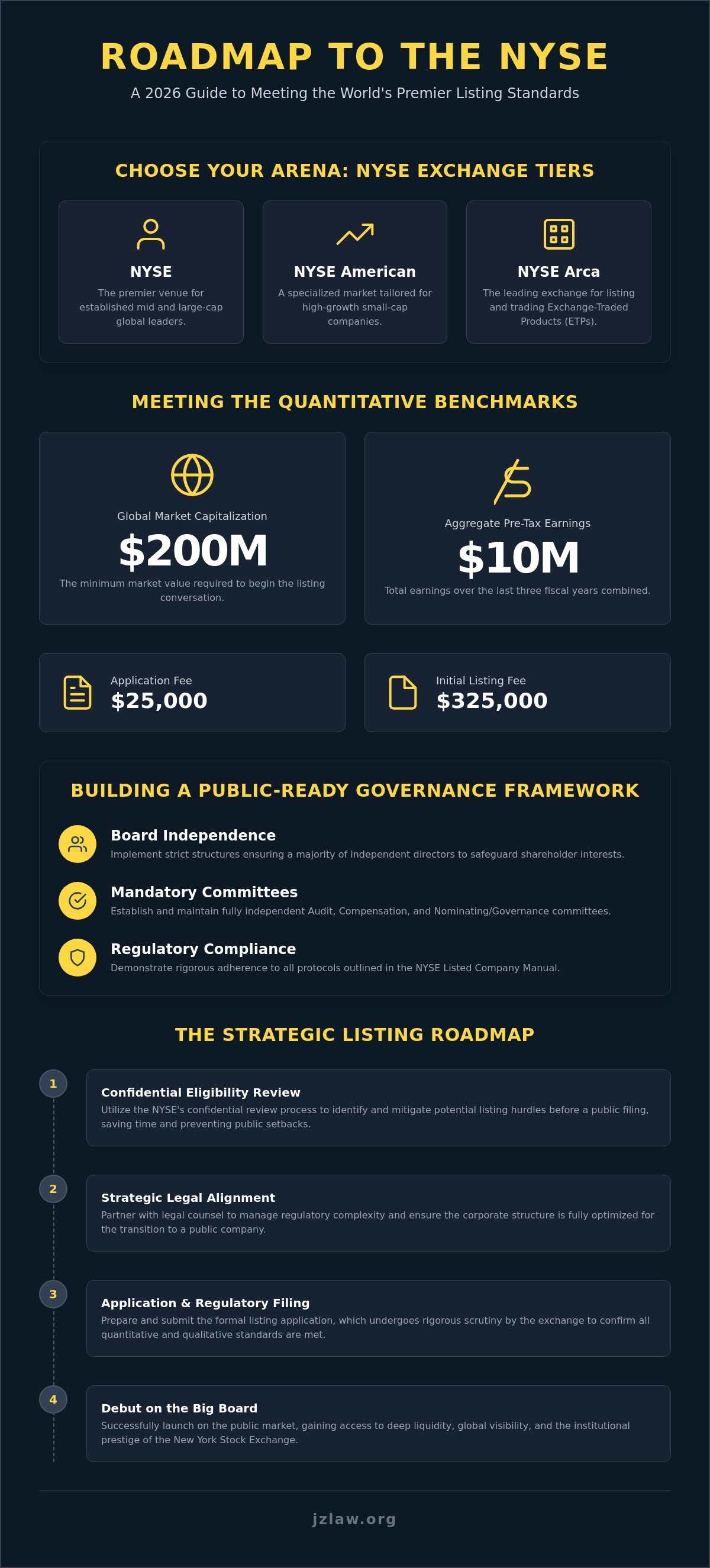
The exchange operates through distinct tiers tailored to specific corporate profiles. While the main NYSE board is reserved for mid- and large-cap leaders, the NYSE American provides a specialized environment for small-cap growth companies. Meanwhile, NYSE Arca serves as the primary venue for exchange-traded products. Selecting the correct venue is a strategic decision that dictates your regulatory path and investor audience. Each tier requires a different level of commitment, but all are governed by the same philosophy of protecting the integrity of the market.
All these standards are codified within the NYSE Listed Company Manual. This foundational document outlines the rigorous disclosure and governance protocols every issuer must follow. It's the rulebook that transforms a private entity into a transparent, public institution. For companies in emerging tech or the cannabis sector, 2026 represents a pivotal year. Regulators are demanding higher levels of transparency, and meeting these exchange standards is often the most effective way to prove a company's long-term viability to skeptical institutional players.
Prestige vs. Compliance: The Dual Nature of the Exchange
A listing on the Big Board acts as a powerful branding tool. It often results in a lower cost of capital because institutional investors view the exchange's oversight as a risk-mitigation layer. However, this prestige isn't free. Once listed, you'll face intense ongoing reporting obligations that require a permanent shift in how your legal and financial teams operate. The strategic benefits, such as access to massive pools of institutional capital and enhanced valuation multiples, are significant. You're no longer just running a business; you're managing a public trust that requires meticulous attention to detail.
NYSE vs. NASDAQ: A Strategic Legal Comparison
Choosing between the NYSE and NASDAQ often comes down to market structure and corporate identity. The NYSE utilizes a designated market maker model to provide a human element in the auction process, which can reduce price volatility during high-stress periods. NASDAQ, conversely, relies on a decentralized dealer market. While NASDAQ often attracts high-growth tech firms, the requirements to be listed on NYSE often appeal to companies prioritizing the traditional prestige of the auction model. Fee structures also diverge; for example, the NYSE application fee is currently $25,000, while the initial listing fee for common stock is $325,000. These costs reflect the premium nature of the venue and the extensive regulatory support provided to listed issuers.
Quantitative Entry Requirements: Financial and Distribution Standards
The transition to a public market requires a meticulous audit of your balance sheet against the exchange's rigid benchmarks. Meeting the requirements to be listed on NYSE involves clearing several high-stakes quantitative hurdles designed to ensure only the most stable entities reach the trading floor. In 2026, these standards prioritize genuine liquidity and sustainable profitability over speculative growth. The exchange utilizes these metrics to filter for companies that possess the financial stamina to withstand market volatility while protecting the interests of retail and institutional investors alike.
Financial Tests: Earnings vs. Market Capitalization
Most domestic issuers qualify through the Standard Earnings Test, which demands an aggregate pre-tax income of $10 million over the prior three fiscal years. Specifically, your organization must demonstrate a minimum of $2 million in pre-tax income for each of the two most recent years, and all three years in the period must be profitable. An alternative path exists for larger entities, requiring a $12 million aggregate over three years, with $5 million in the most recent year. For companies that haven't yet reached these profit levels, the Global Market Capitalization Test serves as a secondary gateway. This requires a minimum global market capitalization of $200 million. Emerging Growth Companies can leverage specific JOBS Act provisions to streamline certain reporting, yet the fundamental valuation and income floors remain a strict barrier to entry.
Shareholder Distribution and Liquidity Rules
Liquidity is the lifeblood of the exchange, and the distribution rules are crafted to prevent price manipulation and ensure active trading. To qualify, a company must have at least 400 round-lot holders, defined as investors who own 100 shares or more. The public float must consist of at least 1.1 million publicly held shares with a minimum market value of $40 million for initial public offerings. If you're transferring from another exchange, this market value requirement rises to $100 million. Furthermore, a minimum share price of $4.00 is required at the time of listing to align with modern anti-manipulation standards. You can review the official NYSE listing standards to confirm how these specific liquidity definitions apply to your current share structure.
In 2026, companies operating in the cryptocurrency and cannabis sectors face heightened scrutiny regarding their "unrestricted public float." Regulators now look beyond the raw numbers to ensure that shares are not trapped in complex legal structures or subject to subtle resale restrictions that could stifle market depth. This level of detail requires a proactive, pre-emptive approach to corporate structuring. Engaging a specialist in securities regulation can help you identify these hidden bottlenecks in your capitalization table long before you submit your formal application, ensuring your path to the Big Board remains clear and predictable.
Qualitative Listing Standards: Corporate Governance and Regulatory Compliance
While meeting financial thresholds is a prerequisite, the requirements to be listed on NYSE extend far into the structural DNA of your organization. The exchange views corporate governance not as a secondary administrative hurdle, but as a foundational legal transformation. Transitioning from a private entity to a public one requires a complete overhaul of how your leadership functions, ensuring that decision making is transparent, accountable, and insulated from undue influence. These qualitative standards are designed to protect the integrity of the market by mandating a sophisticated system of checks and balances.
The exchange maintains a rigid set of expectations regarding board composition and committee oversight. Every listed issuer must adopt and disclose a comprehensive Code of Business Conduct and Ethics that applies to all directors, officers, and employees. This framework must address conflicts of interest, corporate opportunities, and compliance with laws and regulations. You can review the full scope of these expectations in the Official NYSE Listing Standards, which serve as the definitive guide for maintaining your status on the Big Board. Failure to implement these policies with precision can lead to a failed application, regardless of how impressive your balance sheet may appear.
Restructuring the Board for Public Life
A central pillar of NYSE compliance is the requirement for a majority of independent directors. Under Section 303A of the manual, independence means the board must affirmatively determine that the director has no material relationship with the company, either directly or as a partner, shareholder, or officer of an affiliated organization. This isn't a mere formality; it's a rigorous legal standard that requires deep vetting. Additionally, the Audit Committee must be composed entirely of independent directors, at least one of whom must qualify as an "Audit Committee Financial Expert" under SEC rules. JZ Law provides the strategic legal architecture needed to vet candidates and structure boards that meet these high-stakes regulatory demands.
The Compliance Framework: Beyond the Financials
Beyond the boardroom, you must establish the legal infrastructure for ongoing transparency. This includes an internal audit function to provide management and the audit committee with ongoing assessments of the company's risk management processes and system of internal control. For companies in high-scrutiny sectors such as cryptocurrency and cannabis, establishing robust Internal Controls over Financial Reporting (ICFR) is critical. These industries face unique regulatory pressures that make a comprehensive whistleblower policy and clear reporting channels a legal necessity. We focus on creating a proactive, preventative mindset that identifies and eliminates governance risks before they can jeopardize your listing or invite regulatory intervention.
The NYSE Listing Process: A Strategic Legal Roadmap
Securing a place on the trading floor is a multi-phased operation that begins long before the first bell rings. While the quantitative benchmarks are fixed, the procedural path requires a nuanced understanding of how the exchange evaluates potential issuers. Transitioning from a private entity to a public one involves a series of high-stakes filings and strategic decisions that define your market presence. In 2026, the requirements to be listed on NYSE demand a proactive approach to these procedural milestones to ensure a friction-free debut. It's not just about compliance; it's about market integration.
Phase 1: Pre-Filing and Eligibility
The journey starts with a Confidential Eligibility Review. This is a critical "dry run" where the exchange's staff examines your financial statements and governance structure without the pressure of a public filing. This phase typically takes one to two weeks and allows you to identify potential hurdles in your capitalization table or board composition early. During this time, you'll also reserve your ticker symbol. On the NYSE, symbols are generally one to four characters. Securing your desired identity on the tape is a vital branding step that should happen as soon as the confidential review confirms your eligibility. Simultaneously, your legal team will draft the necessary registration statements, such as Form S-1 for domestic issuers or Form F-1 for foreign private issuers, to satisfy SEC mandates.
Phase 2: Application and Market Integration
Once the preliminary hurdles are cleared, you'll submit the formal listing application. The NYSE typically operates on a 14 business day review timeline once a complete application is received. This period involves intense coordination between your counsel and the exchange's regulatory team. A unique aspect of the NYSE is the selection of a Designated Market Maker (DMM). Unlike the purely electronic dealer models found elsewhere, the DMM is a high-touch liquidity partner responsible for maintaining fair and orderly markets for your stock. You'll participate in DMM interviews to select the firm that best aligns with your corporate goals and expected trading volume.
The process culminates in the "Big Day," which involves strict legal protocols for the first day of trading. This includes final certification of the listing and the execution of the first trade. Every step in this roadmap is designed to build institutional trust. If you're ready to begin this transition, our team specializes in the legal heavy lifting required for taking companies public through every phase of the regulatory cycle. We ensure that your application isn't just a submission, but a strategic success that positions your company for long-term growth.
Navigating the NYSE Transition with JZ Law
The journey to the New York Stock Exchange is a fundamental evolution of your corporate identity. It requires a partner who understands that the requirements to be listed on NYSE are a baseline, not a ceiling. JZ Law serves as this strategic partner, providing the sophisticated oversight necessary to manage complex securities regulation and corporate transactions. We don't just facilitate a listing; we build the legal infrastructure that allows your organization to thrive as a public entity. Our approach is rooted in precision, ensuring that every financial disclosure and governance policy is beyond reproach before it ever reaches the exchange's regulatory staff.
We specialize in taking companies public by designing customized legal architectures that withstand the intense scrutiny of both the NYSE and the SEC. For firms operating across Calgary, Toronto, and New York, we bridge the gap between regional operations and international capital markets. This cross-border expertise is particularly vital for companies in emerging sectors. Our deep understanding of cryptocurrency law and cannabis licensing allows us to navigate the unique regulatory friction that often delays listings in these high-growth industries. We anticipate the specific questions regulators will ask, allowing us to resolve potential bottlenecks before they impact your timeline.
Why a Boutique Approach Matters for Complex Listings
High-stakes transactions demand more than just a large legal team; they require the focused attention of experienced strategists. At JZ Law, John Zang provides personalized oversight on every listing, ensuring that the nuances of your specific business model are reflected in your regulatory filings. We focus on your long-term regulatory health, looking past the initial listing day to prepare your team for the rigors of quarterly reporting and annual compliance. This involves seamless coordination with your auditors, underwriters, and the exchange itself. We act as the central hub of your transition, managing the legal heavy lifting so your leadership can focus on market strategy and investor relations, which can be enhanced through professional media platforms like Podcast Zurich.
Next Steps: Initiating Your Eligibility Review
The most successful listings begin with a period of quiet, meticulous preparation. We recommend initiating a confidential assessment of your listing readiness at least twelve months before your target date. This lead time allows for essential corporate cleanup, early-stage tax structuring, and the vetting of independent board members. By addressing the requirements to be listed on NYSE through a proactive, preventative mindset, you eliminate the risk of a public failed application. Contact JZ Law today to schedule a strategic consultation. We'll conduct a preliminary review of your financial and governance standing, providing you with a clear, actionable roadmap for your transition to the world's premier stock exchange.
Securing Your Position on the Global Stage
The transition to the New York Stock Exchange is far more than a financial milestone; it's a fundamental legal evolution that demands a sophisticated corporate architecture. Success depends on balancing rigid quantitative thresholds with a robust commitment to qualitative governance standards. Mastering the requirements to be listed on NYSE involves meticulous board restructuring and the implementation of transparent internal controls that protect both the issuer and the investor. By treating the listing process as a strategic roadmap rather than a simple administrative hurdle, you ensure your organization is prepared for the high-stakes transparency of the public markets in 2026.
JZ Law provides the specialized expertise in securities regulation and corporate finance needed to manage this complex transition. With local expertise in New York City, Calgary, and Toronto, we offer strategic counsel tailored to firms in high-scrutiny sectors like cannabis and cryptocurrency. We invite you to consult with JZ Law on your NYSE listing strategy to begin your confidential eligibility review. Your path to the Big Board requires precision and a proactive mindset, and we're here to ensure your debut is a resounding success.
Frequently Asked Questions
What is the minimum share price to list on the NYSE?
A minimum share price of $4.00 is required at the time of initial listing to comply with modern anti-manipulation standards. This threshold ensures the security possesses sufficient value to attract institutional interest and maintain market stability. Maintaining this price level is a critical component of the quantitative requirements to be listed on NYSE, as it reflects the exchange's commitment to high-quality issuers.
How many shareholders does a company need to list on the NYSE?
To satisfy the distribution standards, a company must have at least 400 round lot holders, which are investors owning 100 shares or more. This metric is paired with a requirement for 1.1 million publicly held shares. These rules are designed to ensure there's adequate liquidity and a broad enough shareholder base to support active, fair trading on the exchange floor.
Can a cannabis company list on the New York Stock Exchange?
Cannabis companies can list on the NYSE provided their operations strictly comply with U.S. federal law. Typically, this applies to Canadian-licensed producers that don't have plant-touching operations within the United States or ancillary businesses that provide secondary services. Any organization in this sector faces heightened regulatory scrutiny regarding their "unrestricted public float" and legal structure during the application process.
What is the difference between NYSE and NYSE American requirements?
The primary difference lies in the financial and capitalization thresholds, as the NYSE targets mid- to large-cap entities while the NYSE American serves small-cap growth companies. While the main exchange requires a $200 million global market capitalization, NYSE American provides a specialized environment with lower entry barriers. However, both exchanges now require a $4.00 minimum share price to ensure market integrity.
How long does the NYSE listing process typically take?
The formal NYSE review process typically takes 14 business days once a complete application is submitted to the regulatory staff. However, the comprehensive preparation phase, including confidential eligibility reviews and SEC registration, often spans several months. This lead time is essential for conducting the necessary corporate cleanup and board restructuring required for a successful public debut.
Do I need a majority independent board before applying to the NYSE?
Yes, the exchange mandates that a majority of the board of directors must be independent as defined by Section 303A of the Listed Company Manual. This requirement is a cornerstone of the qualitative standards intended to protect shareholders through unbiased corporate oversight. Establishing this board structure, along with independent audit and compensation committees, is a non-negotiable step in the application journey.
What are the ongoing maintenance requirements after listing?
Post-listing, companies must maintain a minimum share price, usually $1.00, and meet specific market capitalization floors to avoid delisting proceedings. Issuers are also responsible for annual listing fees, which start at a minimum of $84,000 as of 2026. Continuous compliance with disclosure obligations and corporate governance standards is required to maintain a seat on the Big Board.
Can a foreign company list on the NYSE without a US headquarters?
Foreign companies can list on the NYSE without a U.S. headquarters by qualifying as a Foreign Private Issuer (FPI). These entities must still meet the same rigorous financial and distribution requirements to be listed on NYSE as domestic firms. While they may follow certain home-country governance practices, they're still subject to the exchange's oversight and must provide transparent financial reporting to U.S. investors.


Comments