


Securities Investigation Defense in New York City
An SEC investigation can end in a settlement, civil litigation, an administrative proceeding, a referral for criminal prosecution, or closure without enforcement action. Defending against a securities investigation in NYC calls for a strategic response as the matter develops, because the SEC’s findings may influence what happens next.
An agency inquiry or Wells Notice can feel like a sign that enforcement is inevitable, but neither makes that outcome automatic. This article explains how informal inquiries differ from formal investigations, how SEC matters may be resolved, and how to respond carefully to an inquiry or Wells Notice. Early legal guidance can help assess the issues, prepare communications and submissions, and manage risks across parallel proceedings.
Table of Contents
How Can a Securities Investigation Defense Lawyer Help If You Think You Might Be Under SEC Investigation?
An SEC inquiry can involve civil enforcement and a separate criminal investigation. A lawyer can assess the issues, coordinate responses, and help manage records and communications. For someone defending against a securities investigation in NYC, early coordination helps ensure that decisions in one proceeding account for possible consequences in another.
Choosing a New York Defense Lawyer
Look for a lawyer experienced in SEC investigations, securities regulation, and matters that may involve criminal exposure. Ask how the attorney assesses evidence, communicates with investigators, and coordinates with criminal defence counsel if federal prosecutors become involved. Fees depend on complexity, investigation stage, document volume, and work required across parallel proceedings. The fee is provided after a quote request.
Preserving Investigation Records
Counsel can identify relevant documents, emails, texts, and trading records, then organize their preservation. This may involve identifying record custodians, instructing staff to retain materials, and gathering brokerage statements, trade confirmations, and communications. A complete record helps counsel assess transactions, including potential insider trading issues, and prepare consistent responses. This careful process supports a coordinated strategy for defending against a securities investigation in NYC.
Risks of Speaking, Destroying Records, or Notifying Clients
Unplanned conversations with investigators can lead to incomplete or inconsistent statements that complicate later responses. Destroying or altering emails, texts, or trading records can create serious legal exposure and undermine an explanation of transactions. Notifying clients may affect an investigation if the message reveals sensitive information or prompts others to discuss evidence. Counsel can assess who should communicate, what must be preserved, and when contact is appropriate.
Managing Parallel Criminal and Securities Proceedings
An SEC civil investigation may proceed alongside a separate federal criminal investigation. SEC information may be shared with the Department of Justice as prosecutors build a securities fraud case. Coordinated counsel can assess how testimony or document production in one matter could affect the other. Criminal proceedings and civil regulatory cases can involve different standards of proof; an SEC civil case may seek an injunction, monetary penalties, or disgorgement. The SEC may also seek an industry bar.
What Is the Difference Between an Informal SEC Inquiry and a Formal Investigation?
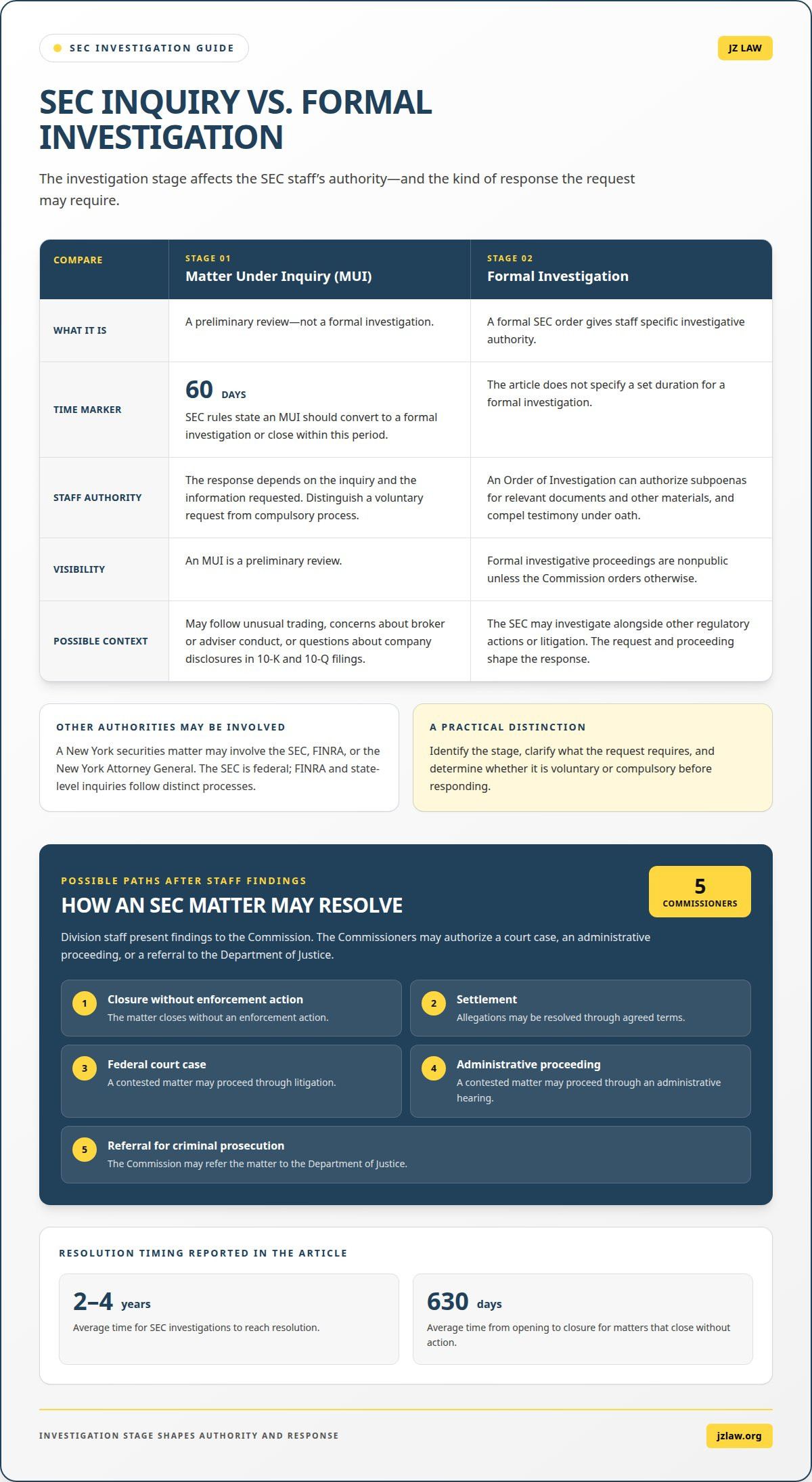
An SEC Matter Under Inquiry (MUI) is a preliminary review, not a formal investigation. SEC rules state that an MUI should convert to a formal investigation or close within 60 days. An inquiry may begin after unusual trading activity, concerns about broker or financial adviser conduct, or questions about company disclosures in 10-K and 10-Q filings.
The response depends on the request and the agency involved. A lawyer can review the inquiry, identify its scope, organize relevant records, and prepare a measured response to the SEC or another regulator. This helps ensure that explanations and documents address the actual issues, including potential securities fraud, rather than creating confusion with incomplete or inconsistent information.
A New York securities investigation may involve the SEC, FINRA, or the New York Attorney General, depending on the conduct and the authority involved. The SEC is a federal agency, while FINRA and state-level inquiries follow distinct processes. The notice, requested action, and proceeding determine the appropriate response.
A formal investigation carries different powers. A formal SEC Order of Investigation can authorize staff to issue subpoenas for relevant documents and other materials, and to compel testimony under oath. Formal investigative proceedings are nonpublic unless the Commission orders otherwise. Before responding, distinguish a voluntary request from compulsory process.
SEC inquiries can also develop alongside other regulatory actions or litigation. Counsel can assess the inquiry’s stage, clarify what the request requires, and coordinate responses when multiple agencies seek information. The distinction between an MUI and a formal order affects the agency’s authority and the decisions required from the recipient. For guidance on the regulatory issues involved, consider speaking with securities regulation counsel.
How are SEC Investigations Resolved?
After an SEC investigation, Division staff present their findings to the Commission. Its five Commissioners may authorize a federal court case, an administrative proceeding, or a referral to the Department of Justice for criminal prosecution. Other outcomes include settlement or closure without enforcement action. A settlement may resolve allegations through agreed terms, while a contested case proceeds through litigation or an administrative hearing.
SEC investigations take an average of two to four years to reach resolution. Matters that close without action average 630 days from opening to closure. In New York, the Martin Act, enacted in 1921, is a state securities law. A misdemeanor violation can carry up to one year in jail; a class E felony violation can carry up to four years in prison. Federal securities cases commonly proceed in federal court.
For brokers and financial advisers, an investigation may examine trading, disclosures, client recommendations, or sales practices. Assessing unsuitable investments or churning requires considering several factors, including the customer relationship and transaction pattern. Counsel can represent an adviser or broker-dealer by analysing the conduct under review, organizing evidence, and preparing responses to the SEC or other regulators. Parallel proceedings make coordination especially important.
Registration is another issue: securities brokers must be registered in every state where their clients reside. Broker-dealer compliance and defence may therefore involve reviewing registration, supervision, policies, and specific transactions. If insider trading or other alleged misconduct is raised, counsel can assess the records and regulatory issues before preparing a response. The appropriate resolution depends on the evidence, the alleged violation, and whether the Commission authorizes enforcement. Each year, the SEC brings hundreds of civil and administrative enforcement actions for alleged federal securities-law violations.
Wells Notices and Wells Submissions
A Wells Notice indicates that SEC staff has completed its investigation and intends to recommend enforcement action to the Commission.
Reviewing a Wells Notice
Start by identifying each alleged violation, its factual basis, and the evidence cited by SEC staff. Counsel can compare those points with internal records, communications, and transaction timelines. The notice may concern a current or former broker, an executive, or a company. This analysis defines the response’s scope without treating allegations as established facts.
Preparing a Wells Submission or Response with Counsel
A Wells Submission gives the recipient an opportunity to persuade the SEC not to proceed with enforcement action. Counsel can organize relevant evidence, address the staff’s stated concerns, and prepare a clear response. The submission should account for the recipient’s role, the transactions under review, and related communications involving the client or other parties.
A recipient is generally given about 30 days to respond. That period makes prompt review important: counsel needs to assess the notice, gather relevant materials, and develop the submission within the available time. A carefully structured response can present factual context and legal arguments before the Commission considers whether to authorize charges.
The SEC does not always offer an opportunity to submit a Wells statement. It may withhold that opportunity if a submission could risk concealment of assets or destruction of evidence. Counsel can assess whether a response is available and how it may affect the matter, including any parallel proceedings.
For guidance on reviewing a Wells Notice and preparing a response, contact securities investigation counsel.
JZ Law: Securities Regulation
JZ Law provides securities law services for businesses and individuals facing complex regulatory matters. If you receive an SEC inquiry, formal investigative request, or Wells Notice, securities counsel can assess the issues, review available records, and help develop a considered response. Early advice can also clarify how the investigation may affect business decisions and regulatory obligations.
Turn to JZ Law when you need guidance on securities regulation, including a response to an investigation or notice. The firm also offers Taking Companies Public and Cannabis Licensing, which address distinct business and regulatory needs. Contact JZ Law to discuss your securities regulation matter.
Set the Next Step with Care
The next step is to turn uncertainty into a defined plan. For defending against a securities investigation in NYC, that means assessing immediate decisions, the business interests at stake, and how legal strategy should support them. A focused discussion can clarify what needs attention first and what information will guide the assessment.
Consider seeking counsel when an agency contacts you, a Wells Notice arrives, or a securities matter begins affecting important business decisions. The discussion can focus on your role, the documents or communications involved, and the questions requiring timely attention. Clear priorities help you approach the process deliberately rather than reacting to each development in isolation.
JZ Law provides securities regulation services for complex matters. To discuss your circumstances and possible next steps, contact JZ Law about your investigation. A measured, informed conversation can help you move forward with greater clarity.
Frequently Asked Questions
What Triggers SEC Investigations?
SEC investigations may follow unusual investment activity, concerns about a broker or financial adviser, or questions about public-company disclosures. For example, a pattern of trades before a company announcement may prompt scrutiny of trading activity and the information available to participants. Tips and complaints can also bring possible violations to the agency’s attention. The origin of an inquiry does not, by itself, establish misconduct.
What is a Wells Notice?
A Wells Notice tells its recipient that SEC staff has completed an investigation and intends to recommend an enforcement action to the Commission. It is not itself a final Commission decision or a court judgment. A recipient is generally given about 30 days to respond with a Wells Submission, which can present factual and legal arguments against proceeding. Counsel can assess the allegations and potential consequences before a response is prepared.
Can Individuals and Companies Face Both Civil and Criminal Securities Law Enforcement Action?
Yes. An individual or company may face an SEC civil matter while federal prosecutors pursue a related criminal case. For example, alleged misleading disclosures might be examined in both proceedings, although each has a distinct purpose and process. Prosecutors must prove guilt beyond a reasonable doubt in a criminal case. An SEC action may seek civil remedies, so the response strategy should account for how statements and evidence could affect both matters.
Do Targets of SEC Investigations have the Right to Counsel?
A witness appearing at a formal SEC investigative proceeding may be accompanied, represented, and advised by legal counsel. Counsel can help prepare the witness, assess the scope of questions, and provide advice during the proceeding. The process depends on the person’s role and the type of request received. Before providing testimony or documents, a target or witness should understand whether the SEC’s request is voluntary or compulsory and what it covers.
What Are the Early Warning Signs of an SEC Investigation?
Possible indicators include direct contact from SEC staff, requests for records or interviews, or a subpoena seeking documents or testimony. A company may also face questions about its public filings, while a broker or adviser may receive inquiries about trading patterns or client accounts. These developments can arise at different stages, and an initial request may not reveal the agency’s full concerns. Preserve relevant materials and seek advice on how to respond.
What Information Will the SEC Seek to Collect During Its Investigation?
The SEC may seek company filings, transaction records, communications, and information about people involved in relevant decisions. For a trading inquiry, records may help establish when transactions occurred and what information was available at the time. In a broker or adviser matter, investigators may examine client-account activity and the basis for recommendations. The documents and testimony sought depend on the conduct under review and the investigation’s scope.



Comments