


Selling a Commercial Building in Calgary: The 2026 Legal and Strategic Guide
- jzanglaw
- 4 days ago
- 13 min read
With the federal capital gains inclusion rate for corporations reaching 66.67 percent as of 2026, the traditional approach to selling a commercial building in Calgary is no longer sufficient to protect your bottom line. A successful exit in the current market isn't just about finding the right buyer; it's about proactively managing the legal and fiscal friction that can erode your proceeds long after the transaction concludes. Relying on outdated strategies in a year defined by significant regulatory shifts can lead to unexpected tax exposure and avoidable litigation risks.
You've likely spent years building equity in your property and deserve a transition that honors that investment without the stress of hidden liabilities or complex land title disputes. This guide provides a strategic roadmap to achieve a clean, legally sound sale while optimizing your tax position under the latest Alberta regulations. We'll examine the 2026 Property Tax Bylaw implications, the impact of the recent Condominium Property Act amendments, and the specific due diligence milestones required to ensure your interests remain protected well beyond the closing date.
Key Takeaways
Assess how 2026 Calgary zoning bylaws and shifting vacancy rates in the industrial and office sectors directly influence your property’s market valuation.
Execute a proactive pre-sale audit of lease agreements and tenant estoppels to eliminate hidden liabilities before the due diligence phase begins.
Evaluate the strategic advantages of a share sale versus an asset sale to maximize tax optimization and leverage the Lifetime Capital Gains Exemption.
Navigate the complexities of selling a commercial building in Calgary by mastering the transition from a Letter of Intent to the satisfaction of conditions precedent.
Partner with a strategic legal advisor to coordinate a holistic divestment plan that aligns corporate transactions with long-term fiscal protection.
Table of Contents
Navigating the Calgary Commercial Real Estate Landscape in 2026
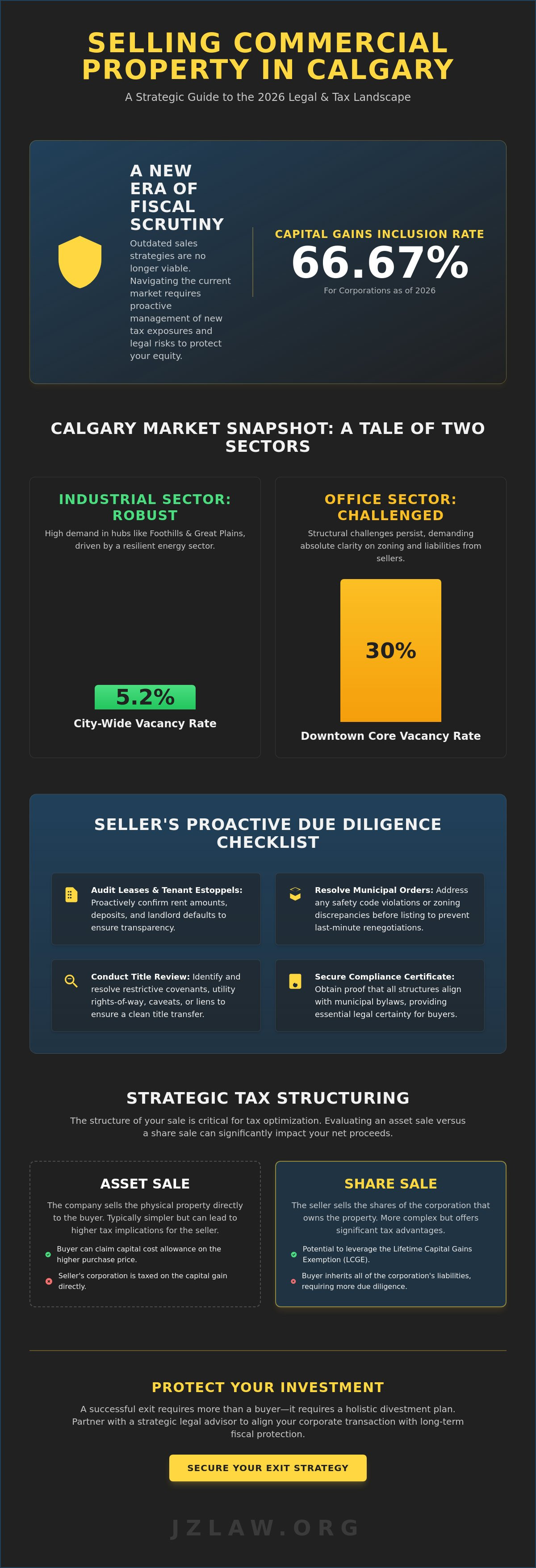
The operational environment for selling a commercial building in calgary has undergone a fundamental shift as we move through 2026. Success in this market is no longer a matter of simple listing; it's a strategic exercise in navigating localized demand and a tightening regulatory framework. While the industrial sector remains robust with a city wide vacancy rate of 5.2 percent, the office market continues to face structural challenges, particularly in the downtown core where vacancy rates persist near 30 percent. This disparity means that buyers are more selective than ever, demanding absolute clarity on zoning, tax liabilities, and title integrity before committing to a purchase.
Navigating the Calgary Commercial Real Estate Landscape requires an appreciation for how provincial modernization efforts are changing the transactional pace. The Alberta Land Titles Office is currently transitioning toward a more digitized service delivery model. While this shift promises long term efficiency, the current phase of implementation requires sellers to be exceptionally precise with their initial filings. Any discrepancy in property descriptions or encumbrance reporting can lead to significant delays at the provincial level, potentially jeopardizing closing dates in a volatile interest rate environment.
Calgary Zoning and Land Use Bylaw Updates
The City of Calgary’s Land Use Bylaw 1P2007 serves as the primary benchmark for property valuation and redevelopment potential. For many sellers, the complexity arises when dealing with "Direct Control" (DC) districts. These areas don't follow standard zoning rules; instead, they're governed by specific Council resolutions that dictate unique land use permissions. If your property falls under a DC designation, you must verify exactly what's permitted to avoid misrepresenting the site's potential to a buyer. It's also vital to secure a current Compliance Certificate early. This document confirms that all existing structures align with municipal setbacks and bylaws, providing the legal certainty necessary to move a transaction forward without friction.
Economic Drivers Affecting Calgary Divestments
Demand for industrial assets in hubs like Foothills and Great Plains remains high, driven by a resilient energy sector and a warehouse vacancy rate of only 3.0 percent. However, the cost of holding these assets has increased. The 2026 non-residential property tax rate is set at 0.0221488, a figure that savvy buyers factor into their capitalization rate calculations. When selling a commercial building in calgary today, you must also account for how interest rate shifts have extended due diligence windows. Buyers are taking more time to verify environmental reports and infrastructure alignments. Properties located near new transit developments or major logistics corridors continue to command a premium, provided the seller can demonstrate a clean title and a proactive approach to risk management.
Pre-Sale Legal Due Diligence: A Seller’s Checklist
Preparation defines the outcome of any high-stakes transaction. When selling a commercial building in calgary, your legal standing is often more significant than the physical condition of the assets. You must conduct a rigorous internal audit of all existing leases to ensure every tenant estoppel is ready for signature. These documents should clearly confirm rent amounts, security deposits, and the absence of any landlord defaults. Proactively organizing these records into a secure digital Data Room signals professionalism to high-value buyers and helps accelerate the due diligence window by providing immediate transparency.
Resolving outstanding municipal work orders or non-compliance issues before the property hits the market is equally critical. If the City of Calgary has flagged your building for safety code violations or zoning discrepancies, these will inevitably surface during the buyer’s investigation. Addressing these friction points early prevents price renegotiations or deal collapses at the eleventh hour. A clean bill of health from municipal authorities is a powerful tool for maintaining your asking price.
Title Review and Encumbrance Management
Buyers often withdraw when they discover unexpected registrations on the Certificate of Title. You need to identify restrictive covenants or utility rights-of-way that might limit future redevelopment flexibility. If there are active caveats or liens, you should resolve them immediately to ensure a clean title transfer. Furthermore, you'll need a current Real Property Report (RPR) with a municipal compliance stamp. This document verifies that all structures are correctly located within property boundaries, protecting you from potential post-sale litigation regarding encroachments.
Environmental and Regulatory Compliance
Calgary's industrial history means soil contamination is a constant concern for buyers in areas like Manchester or Foothills. Addressing Phase I and Phase II Environmental Site Assessments (ESA) early allows you to manage the narrative rather than reacting to a buyer's findings. If issues exist, navigating Alberta Environment and Protected Areas (AEPA) requirements is essential to define the scope of any necessary remediation. Transparent disclosure, backed by professional assessments, often preserves more asset value than a buyer discovering a hidden plume during their own inspection period.
Properly managing these legal milestones is part of a broader Tax Structuring and Capital Gains Mitigation strategy. Ensuring your property is compliant and your records are pristine allows for a more efficient transaction flow. If you're unsure how your current corporate structure interacts with these liabilities, consulting a strategic legal partner can help you identify risks before they become deal-breakers.
Tax Structuring and Capital Gains Mitigation
The fiscal reality of selling a commercial building in calgary in 2026 is defined by the federal capital gains inclusion rate increase to 66.67 percent for corporations. This shift makes tax optimization a primary pillar of the transaction rather than an afterthought. You can't simply rely on market appreciation; you must actively structure the deal to preserve capital. This often involves evaluating whether to defer taxes through replacement property rules or utilizing capital gains reserves if the sale involves vendor financing. Strategic timing is also essential, as the 2026 Alberta corporate income tax rate remains at 8 percent, but your overall tax exposure depends heavily on how you extract the proceeds from your corporate entity.
Asset Sale vs. Share Sale: Legal Pros and Cons
Choosing between an asset sale and a share sale is a fundamental decision that often pits the buyer's interests against yours. Buyers typically demand an asset sale because it allows them to "step up" the cost base of the property for future depreciation while leaving behind any of your corporation's historical liabilities. Conversely, you likely prefer a share sale to potentially access the Lifetime Capital Gains Exemption, provided your corporation qualifies as a Canadian-controlled private corporation. While share transactions can simplify the transfer of certain permits and licenses, they require much more intensive due diligence from the buyer's legal team. Implementing Strategic Corporate Transactions early in the process can help bridge this gap by cleaning up the corporate record and preparing the entity for a smooth ownership transfer.
GST Implications for Calgary Commercial Sellers
GST is one of the most misunderstood aspects of Alberta real estate. Most commercial property sales are taxable, but you might qualify for the "Election for Nil Consideration" if you're selling a "going concern" business where the buyer is also a registrant. The specific classification of the property within Calgary's commercial land use districts can influence how the Canada Revenue Agency (CRA) views the nature of the transaction and the applicability of certain exemptions. You're generally responsible for collecting the tax unless the buyer meets specific criteria for self-assessment. Failing to correctly document GST exemptions or neglecting to remit the required funds can trigger substantial penalties and interest charges from the Canada Revenue Agency.
The Transactional Process: From LOI to Closing
The journey of selling a commercial building in calgary begins in earnest once a Letter of Intent (LOI) arrives on your desk. While many view the LOI as a mere formality, it establishes the skeleton of the entire deal. You must distinguish between binding provisions, such as exclusivity and confidentiality, and non-binding commercial terms. A well-structured LOI prevents the buyer from "fishing" for information without a serious commitment, ensuring that the subsequent "Conditions Precedent" phase has clear boundaries and realistic timelines for due diligence. If these early negotiations are handled with precision, you'll avoid the common pitfall of having your property tied up by a buyer who lacks the capacity to close.
Managing the buyer’s due diligence window is a delicate balancing act. You're granting access to sensitive data and physical inspections while keeping the transaction on track. If the buyer fails to waive conditions by the specified date, the deal may collapse. You need a mechanism to ensure the buyer acts in good faith. This stage is where the "Data Room" mentioned earlier proves its value, as it allows you to monitor buyer engagement and respond to inquiries with documented precision, leaving no room for late-stage surprises that could devalue the asset.
Negotiating the Purchase and Sale Agreement (PSA)
The PSA is the definitive legal instrument that governs your exit. For a Calgary seller, the "as-is, where-is" clause is a non-negotiable shield. It stipulates that the buyer is relying on their own investigations rather than your representations. You must also include a strict limitation of liability, capping any potential claims post-closing to a specific dollar amount and duration. In a market where interest rates and economic conditions can shift rapidly, clear default and termination clauses are essential. These provisions define exactly what happens to the deposit if the buyer fails to close, providing you with financial recourse for lost time and opportunity.
Managing the Closing and Statement of Adjustments
On closing day, the legal transfer occurs through a system of trust conditions. These conditions ensure that you don't lose title to your property until the buyer's lawyer has confirmed the funds are available and ready for disbursement. The Statement of Adjustments accounts for the granular financial details. For instance, the 2026 non-residential property tax rate of 0.0221488 is used to calculate the exact per-diem split between you and the buyer. Utilities, security deposits, and prepaid rents are similarly prorated to ensure neither party is unfairly burdened. For a deeper look at how these local mechanics fit into a broader context, explore Real Estate Law 2026.
Securing your proceeds requires more than just a signed contract; it demands a strategic partner who understands the nuances of Alberta land titles. If you're preparing for a divestment, you can consult with our corporate transactions team to ensure your PSA is built for maximum protection.
Why Strategic Legal Counsel is Vital for Calgary Divestments
The process of selling a commercial building in calgary often reveals a significant gap between a standard administrative closing and a comprehensive strategic divestment. While a typical closing lawyer focuses on the mechanics of the transfer, a strategic legal partner like John Zang operates as an architect of the entire transaction. This distinction is vital in 2026, where the interplay between tax structuring, municipal zoning, and corporate liability requires a holistic viewpoint. We coordinate closely with your accountants and tax advisors to ensure that the legal structure of the deal doesn't just satisfy the contract, but actively protects the net proceeds you receive at the end of the day. This proactive approach prevents the common error of treating a commercial sale as a standalone event rather than a pivotal corporate transaction.
Efficiency in project management is the primary antidote to "deal fatigue," a common phenomenon in complex commercial transactions where momentum stalls during the due diligence window. In a market where interest rates and economic conditions can shift rapidly, delays are not just inconvenient; they're expensive. By maintaining a rigorous pace and providing clear, structured communication, we ensure that every milestone is met without sacrificing the precision required for high-value assets. We anticipate potential roadblocks in the Alberta land titles system before they manifest, allowing you to focus on your broader business objectives while we manage the legal friction.
Expertise in Complex Regulatory Sectors
Our firm brings specialized depth to transactions involving highly regulated Alberta industries. We provide the specific counsel needed for Cannabis Licensing transfers, where real estate and provincial regulations are inextricably linked. Similarly, our background in Oil and Gas Law allows us to navigate the environmental and subsurface complexities unique to energy hubs like Calgary. This expertise bridges the gap between traditional real estate law and corporate finance, offering a more robust level of protection for your interests. We understand that in these sectors, you aren't just selling a building; you're often transferring a complex bundle of rights and obligations that require meticulous handling.
Protecting Your Legacy and Future Liquidity
Every divestment represents the culmination of years of investment and management. Protecting that legacy requires ensuring that the liquidity generated from the sale is structured for your future, whether that involves a new venture or a transition into retirement. We combine the professional dignity of a traditional practice with the modern efficiency expected in a global business hub. If you're currently selling a commercial building in calgary, the protection of your equity should be your highest priority. You can reach out to JZ Law for a confidential consultation to discuss how our strategic approach can secure your transaction and your future liquidity.
Securing Your Equity in Calgary's Evolving Market
The complexity of the 2026 regulatory environment means that a successful exit requires more than just a willing buyer. It demands a meticulous alignment of pre-sale due diligence, precise tax structuring, and a robust Purchase and Sale Agreement. By addressing potential environmental liabilities and title encumbrances early, you eliminate the friction that often devalues high-stakes assets during the closing phase. Whether you're navigating the nuances of a share sale to optimize capital gains or managing the proration of non-residential property taxes, the goal remains a clean transaction that preserves your hard-earned equity.
When you're selling a commercial building in calgary, the difference between a standard administrative closing and a strategic divestment lies in the depth of legal foresight applied to the deal. Our firm serves as a strategic partner, offering specialized knowledge of Alberta real estate and tax law to ensure your corporate interests are protected at every milestone. We provide the sophisticated representation necessary for complex corporate transactions, allowing you to move forward with confidence and financial security.
Consult with John Zang on your Calgary commercial sale today to ensure your legacy is protected by a partner dedicated to your long term success.
Frequently Asked Questions
Do I need a lawyer to sell a commercial building in Calgary?
Legal representation is essential for managing the transfer of title through the Alberta Land Titles Office and for overseeing the secure disbursement of funds. A lawyer establishes the trust conditions required to ensure you don't lose ownership of the property until the buyer's payment is fully secured and verified. Beyond the closing mechanics, a strategic legal partner protects your interests by drafting robust Purchase and Sale Agreements that limit your post-closing liability.
What is the difference between a residential and commercial sale in Alberta?
Commercial transactions lack the standardized consumer protections found in residential real estate, placing a much higher burden of due diligence on both parties. These sales involve complex GST considerations, environmental assessments, and sophisticated "as-is, where-is" clauses that are rarely seen in home sales. When selling a commercial building in calgary, the process is governed by corporate law and commercial contracts rather than the simplified Alberta Real Estate Association forms used for housing.
How long does the commercial closing process typically take in Calgary?
A typical commercial transaction takes between 60 and 90 days from the signing of the Letter of Intent to the final transfer of title. This timeline accounts for a 30 to 45-day due diligence period where the buyer investigates zoning, environmental status, and tenant estoppels. The remaining time is used to satisfy financing conditions and process the registration at the provincial Land Titles Office, which can experience fluctuations in processing speeds during modernization phases.
What environmental reports are required when selling industrial land?
Phase I and Phase II Environmental Site Assessments (ESA) are the standard requirements for industrial assets in Calgary. A Phase I report reviews the historical use of the land to identify potential contamination risks, while a Phase II involves actual soil and groundwater testing if risks are identified. Providing these reports early in the process helps maintain your asking price by removing the uncertainty that often leads to aggressive buyer "re-trading" or price reductions.
How is GST handled in a Calgary commercial real estate transaction?
GST is generally applicable to commercial sales at the rate of 5 percent, but the responsibility for payment often depends on the buyer’s registration status. If both the seller and buyer are GST registrants and the property is part of an ongoing business, you may be able to use the "Election for Nil Consideration" to avoid the immediate cash flow burden. It's vital to document this election correctly in the closing documents to avoid future audits and penalties from the Canada Revenue Agency.
What are the typical seller warranties in a commercial Purchase and Sale Agreement?
Seller warranties in commercial deals are intentionally limited to protect the seller from future litigation. You'll typically warrant that you're not a non-resident of Canada for tax purposes and that you have the legal authority to sell the property. Most other physical and environmental aspects are sold under "as-is" provisions, meaning the buyer accepts the property's condition based entirely on their own professional investigations and inspections.
Can I sell my commercial building as a share sale to save on taxes?
You can structure the transaction as a share sale if the property is held within a corporation, which may allow you to access the Lifetime Capital Gains Exemption. This approach is highly effective for tax optimization but requires the buyer to take on the corporation's historical liabilities. Because of this added risk, buyers may demand a lower purchase price or more extensive indemnities, making early corporate tax structuring essential for a successful outcome.
What happens if a buyer finds a defect during the due diligence period?
If a buyer discovers a material defect, they generally have the right to terminate the contract and receive their deposit back without penalty. Alternatively, the parties may enter a new round of negotiations to adjust the purchase price or agree on specific repairs before the conditions are waived. Proactively identifying these issues through your own pre-sale audit allows you to address them on your own terms rather than under the pressure of a looming closing date.


Comments